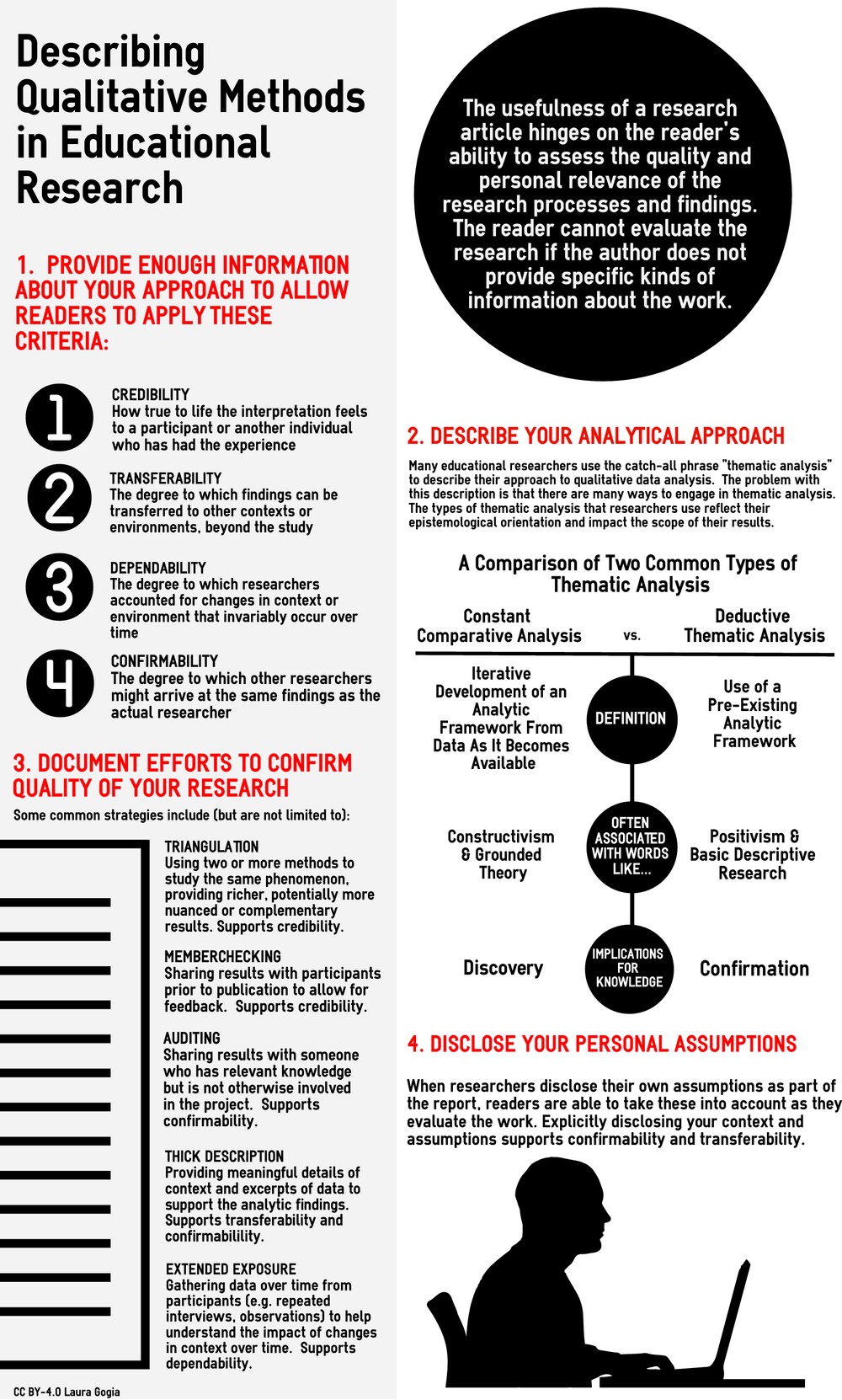
As I described in my last post, Understanding Educational Research and Design, I have spent a significant amount of the last year reading and evaluating the educational research literature for its structure, themes, and methods. I found problems; too many articles lacked epistemological framing, glossed over faulty sampling and data collection, provided minimal information on analytical processes, and failed to advance the literature in any meaningful way. As this concerns me in terms of the future of educational research, I have started to develop a collection of downloadable, CC-licensed visual articles that address some of the issues I found in the literature.
One of the qualities I enjoy about educational research is its strong tradition of using qualitative, quantitative, and mixed study designs. However, too often I found articles that described qualitative data collection without information about participants or the collection process, qualitative findings without information on the analytic processes, or qualitative collection processes without information on analysis or findings. It was difficult to tell if the problems lie in the study design and implementation or whether these were shortcuts made in writing and reporting.
When researchers take short cuts in reporting research processes – qualitative or quantitative – they inevitably and irreparably devalue the work. The usefulness of a research article hinges on the reader’s ability to assess the quality and personal relevance of the research. The reader cannot evaluate the research if the author does not provide specific kinds of information about the work.
The following visual article reviews some of the critical methodological pieces that must make it into a research article (regardless of prescribed word counts), if a reader is to be able to make meaning of the work. While I have presented my argument through a lens of qualitative methodologies, at least one Twitter follower suggested that it was relevant to all research, regardless of methodological tradition. I tend to agree with him, but will be creating one specific to a quantitative lens soon. Also, a shout-out to all the Twitter followers who reviewed this visual article before I published it here. Special thanks go to Margy MacMillan and Chelsea O’Brien for their detailed feedback. Also, thanks to my friend and SCHEV colleague Tod Massa for looking at this about a dozen times over the last week and finally telling me today that it might be okay.

- For more information on criteria for quality in quantitative research:
Lincoln, Y. S. (1995). Emerging criteria for quality in qualitative and interpretive research. Qualitative Inquiry, 1(3), 275-289.
Mays, N., & Pope, C. (2000). Assessing quality in qualitative research. British Medical Journal, 320 (7226), 50.
Trochim, W. (2006). Qualitative Validity. Research Methods Knowledge Base
2. For more information on thematic analysis:
Charmaz, K. (2003). Grounded theory. Qualitative psychology: A practical guide to research methods, 81-110.
Fereday, J., & Muir-Cochrane, E. (2006). Demonstrating rigor using thematic analysis: A hybrid approach of inductive and deductive coding and theme development. International journal of qualitative methods, 5(1), 80-92.
Strauss, A., & Corbin, J. (1994). Grounded theory methodology. Handbook of Qualitative Research, 17, 273-285.
Vaismoradi, M., Turunen, H., & Bondas, T. (2013). Content analysis and thematic analysis: Implications for conducting a qualitative descriptive study. Nursing & health sciences, 15(3), 398-405.
3. For more information on qualitative research methods and strategies (general):
Bogdan, R., & Biklen, S. K. (1997). Qualitative research for education. Boston: Allyn & Bacon.
Lincoln, Y. S., & Guba, E. G. (1985). Naturalistic inquiry (Vol. 75). Sage.
Strauss, A., & Corbin, J. (1998). Basics of qualitative research: Techniques and procedures for developing grounded theory . Sage Publications, Inc.

