Category Archives: Miscellaneous

Week Eight: Open Pedagogy

A Week of Open Pedagogy

Your directors this week are Amy Nelson (Virginia Tech) and Shelli Fowler (VCU).

A quick review (as we’re nearly halfway done!): We’ve talked about “fifty shades of open” and considered some of the building blocks of open education: Foundational texts on the ways digital spaces could liberate and amplify knowledge and support enhanced collaboration, the characteristics and significance of digital literacy,the transformative potential of connected learning, the role of Open Access in keeping knowledge public. This week we will pull from all of these areas to think through the powerful implications of open pedagogies.

Some of our familiar activities will remain: We will be reading, annotating on Hypothes.is and staying in touch on Twitter throughout the week. But the focus will shift a bit, as the “make” for this week is to create and / or share a piece of Open Pedagogy. So, learning by doing, modeling a mode of engagement, working together and independently, playing around with ideas and tools, and then sharing it out in the OPEN — these integrated, recursive practices should help us explore and articulate our praxis in open pedagogy.

Non-Disposable Assignment: A critically engaged, innovative, disruptive (or already proven effective) example of Open Pedagogy. Could be an exercise, or an artifact, or a guided, collaborative reading of a text, image, film, song, etc.

Monday

Read / Listen to Hybrid Pedagogy Podcast #12 : Access (Robin DeRosa and Chris Friend)
http://www.digitalpedagogylab.com/hybridped/access/

And / or:

Extreme Makeover: Pedagogy Edition
http://robinderosa.net/higher-ed/extreme-makeover-pedagogy-edition/

Tweet: “What is Open Pedagogy?”

@actualham: “I think it’s a connected learning piece. It’s a critical digital pedagogy piece. It’s an access piece. You roll those together and you get open pedagogy.”

And check out slide 18 here:
https://www.slideshare.net/orbitdog1/oer-and-beyond-reducing-costs-transforming-teaching

Tuesday: Open and Critical

Reading:
Contemporary Pedagogy at Virginia Tech: A Conversation with Shelli Fowler
https://siriusreflections.org/gedivt/contemporary-pedagogy-at-vt-a-conversation-with-shelli-fowler/

(more) Hypothes.is Annotation of
Audrey Watters: Ed-Tech in the Time of Trump
http://hackeducation.com/2017/02/02/ed-tech-and-trump

Additional Material from Hybrid Pedagogy:

CFP: Politicizing Critical Digital Pedagogy (Feb. 2017)
http://www.digitalpedagogylab.com/hybridped/politicizing-critical-digital-pedagogy/

Open Digital Pedagogy=Critical Pedagogy
http://www.digitalpedagogylab.com/hybridped/open-digital-pedagogy-critical-pedagogy/

If Freire Made A MOOC: Open Education as Resistance
http://www.digitalpedagogylab.com/hybridped/freire-made-mooc-open-education-resistance/

Wednesday: Networked and Integrated

Gardner Campbell
Networked Learning as Experiential Learning
http://er.educause.edu/articles/2016/1/networked-learning-as-experiential-learning

Amy Nelson
Connected Learning and Integrative Thinking: Teaching History at Virginia Tech
https://www.youtube.com/watch?v=0xhrAtzqiFg

Or

Networked Learning Communities in Hybrid Courses
https://siriusreflections.org/uncategorized/networked-learning-communities-in-hybrid-courses/

The Student-Centered Lecture
https://siriusreflections.org/uncategorized/the-student-centered-lecture/

Twitter Chat With Shelli Fowler on “Developing Open Pedagogues” 3:00-4:00 pm EDST 

Thursday: Talk to an OpenLearning.net friend about your Open Pedagogy Praxis

via Tweets, DM’s, email, any other form of subspace communication.
Gold Stars for reporting / reflecting on that exchange on your blog!

Friday: Post your Open Pedagogy

Twitter Chat:  Share and Care / Weekly Wrap up 3:00-4:00 pm EDST

Additional Readings / Resources

A small sampling of things that have resonated with our work on Open Pedagogy authored by people not taking part in the cMOOC.

Laura Gibbs and Stacy Zemke, “Ten qualities of Open Pedagogy”
https://nextthought.com/thoughts/2015/02/ten-qualities-of-open-pedagogy

Catherine Cronin: Openness and Praxis
https://catherinecronin.wordpress.com/2016/11/28/openness-and-praxis/

Mariana Fuenes: Openness in Education:
https://mdvfunes.com/category/openness-in-education/

Tressie McMillan Cottom https://tressiemc.com/

Sava: Fallacy of Open
https://savasavasava.wordpress.com/2015/06/27/the-fallacy-of-open/

Martin Weller, The Battle For Open
http://www.ubiquitypress.com/site/books/10.5334/bam/

Open Pedagogy linked to OER:

David Wiley:
https://opencontent.org/blog/archives/2975 (2013)
https://opencontent.org/blog/archives/4921 (2017)

Clint Lalonde, “Does Open Pedagogy Require OER?” (Feb. 2017)
http://clintlalonde.net/2017/02/04/does-open-pedagogy-require-oer/

Bronwyn Hagarty, “Attributes of Open Pedagogy: A Model for Using OER” (2015)
https://upload.wikimedia.org/wikipedia/commons/c/ca/Ed_Tech_Hegarty_2015_article_attributes_of_open_pedagogy.pdf

Mentioned in Previous Weeks:
Mike Caulfield’s Web Literacy for Student Fact Checkers
https://webliteracy.pressbooks.com/


Post content by week eight director Amy Nelson
Edited for Open Learning ’17 by hub director Gardner Campbell
Perspectives on #OpenAccess During #OpenLearning17 hangout

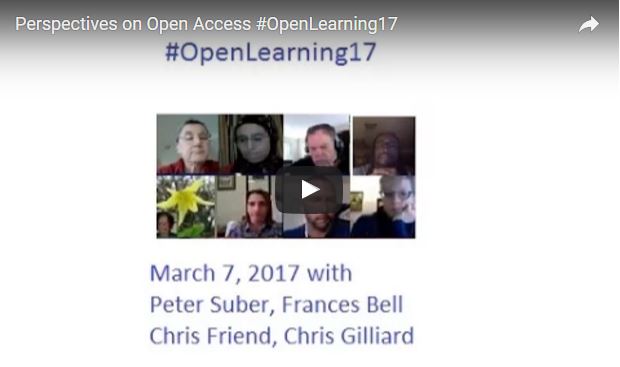
We just ended the first of two #OpenLearning17 hangouts, with Frances Bell, Chris Gilliard, Chris Friend and surprise guest, Peter Suber, whose book on Open Access we’ve been reading this week. The hangout was co-facilitated by Sue Erickson and myself, and I also invited folks from the community to participate, so Amy Nelson and Jim Luke joined us and enriched the discussion further. When putting together the guest list for this, I thought of reaching out to people with diverse approaches to openness, and I think while we all have a similar orientation towards openness and social justice, we definitely took different approaches to it in the hangout. From Chris Friend talking about openness in the Hybrid Pedagogy review process, to Frances Bell providing her perspective on open access over time, and offering critical questions (what Frances has to offer is so multi-faceted it’s difficult to summarize, honestly), and Chris Gilliard talking about digital redlining – and Peter Suber answering questions on different topics, but particularly giving his views on Gold Open Access that involves Article Processing Charges. There were some great questions from Twitter and within the hangout and some useful resources/links shared to the #OpenLearning17 hashtag on Twitter (Storify here). To watch the hangout [click on the image below]:

Click to view and hear hangout

The second hangout is planned for Thursday March 9th at 1pm South Africa time (6am EST) and will be a Virtually Connecting session from #OEGlobal (in Cape Town) with Laura Czerniewicz, Catherine Cronin, Rajiv Jhangiani and Caroline Kuhn. That session will be livestreamed and recorded also, and the link to watch is below:

See you around!


Post by Maha Bali
Formatted for Open Learning ’17 by hub director Gardner Campbell

Week Seven: Open Access

Logo from cover of Peter Suber, <i>Open Access</i>. Artist not credited. CC-BY-NC
Logo from cover of Peter Suber, Open Access. Artist not credited. CC-BY-NC

Cross-continental greetings from Week Seven directors Maha and Sue! Our plan for this week is to have participants explore issues around Open Access (OA) and share their motivations for participating in OA.  With a variety of activities and platforms, we hope to facilitate learning from each other’s experiences and practices with open access and open scholarship.  

Sunday, March 5

Daily provocation (via Twitter): what motivates you to go open access? Tweet throughout the day on your timezone with hashtag #OpenLearning17

Our main reading for the week will be Peter Suber’s book Open Access, focusing mainly on chapter 1: What is Open Access? We will be collectively annotating this chapter in Hypothes.is,  but feel free to annotate other chapters that interest you throughout the week, and to blog your reflections.

The book can be found at: https://mitpress.mit.edu/books/open-access

Instructions for annotating PDFs offline via Hypothes.is: https://hypothes.is/blog/synchronizing-annotations-between-local-and-remote-pdfs/

NOTE: for updates and supplements to Open Access, please see Peter Suber’s home page for the book: http://bit.ly/oa-book

Monday, March 6

Daily provocation: what are the biggest obstacles/barriers/challenges of open access, in your view? Tweet throughout the day on your timezone with hashtag #OpenLearning17

Explore and share your learning: Sherpa-Romeo and Sparca Open

A useful resource for those who care about open access is http://sparcopen.org/ – and a useful resource within it for evaluation “how open is it?” https://sparcopen.org/our-work/howopenisit/

What are the main differences between green OA and gold OA? [Suber has a concise description of each here:  http://legacy.earlham.edu/~peters/fos/overview.htm] Sherpa Romeo is a great resource for learning about open access policies of subscription journals: http://www.sherpa.ac.uk/romeo/index.php

Tuesday, March 7, 3pm EST, 10pm Cairo time

Join us for a Google hangout with at 3pm EST with Frances Bell (@francesbell), Chris Gilliard (@hypervisible) and Chris Friend (@Chris_friend). Each of these educators has a special perspective on open access to offer us. We’ll be asking them what open access means to them, why it matters, and how they apply it in practice.

Wednesday, March 8

Daily provocation: Is there still a role for OA Green? Tweet throughout the day on your timezone with hashtag #OpenLearning17

Choose your own Open Access adventure:

Read the following blog post and post your reactions on your own blog with the #OpeningLearning17 tag: http://poynder.blogspot.com/2017/01/the-nih-public-access-policy-triumph-of.html
Is there still a role for OA Green?
Is the definition in the Budapest Open Access Initiative still valid, or is it need of updating in light of developments in the last decade?

Or

On your blog, respond to the following questions:
What is the value of the DOAJ https://doaj.org/? What are the implications of corporate sponsorship of the DOAJ?

Gold stars for anyone who does both!

Thursday, March 9, 6am EST/1pm South Africa time

We’ll be teaming up with Virtually Connecting at the #OEGlobal conference in Cape Town to have a discussion with an international group of educators on open access: Laura Czerniewicz (@czernie), Catherine Cronin (@catherinecronin), Rajiv Jhangiani (@thatpsychprof), and Caroline Kuhn (@carolak). We will also hear from them how the conference is going! If you can’t make it to the session, you can watch it live or recorded here.

Additional resources

Friday, March 10

Daily provocation: how will you approach open access (own practice or advocacy) going forward?

A little Friday fun!  Create a meme about your feelings about open access (or how people around you respond when you mention open access) and post it to Twitter or your blog. There are many meme makers for different operating systems, or you can use a simple program like Paint or Google slides.

Additional resources:
Check out other memes here https://clmoocmb.educatorinnovator.org/home/assignments/make-a-meme/  

Week Seven Directors: Sue Erickson (Virginia Wesleyan College) and Maha Bali (The American University in Cairo)

Information above by Sue Erickson and Maha Bali
Page compiled/edited by hub director Gardner Campbell
Week Three: Augmenting Human Intellect (in the open)

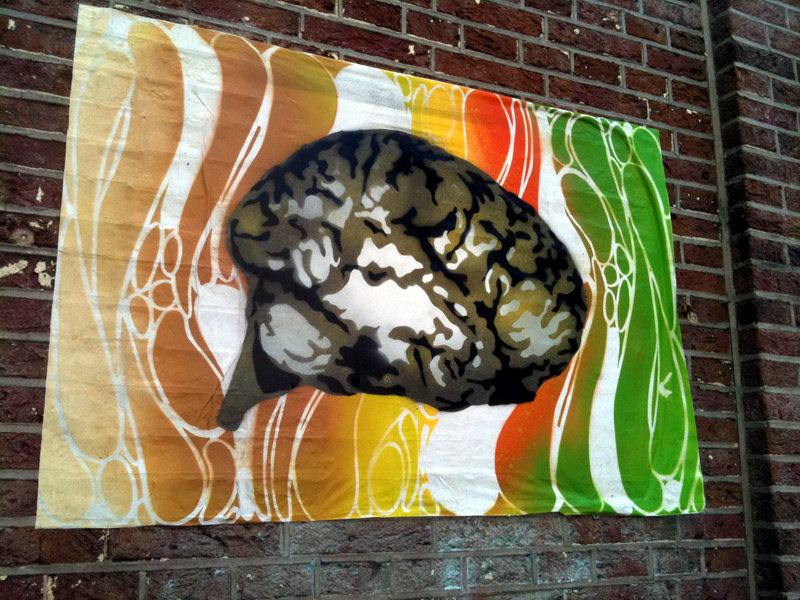
Brain, mural, brick wall: photo by Anders Sandberg.
Photo by Anders Sandberg.

Open Learning ’17 continues this week with another key reading: Douglas Engelbart’s Augmenting Human Intellect: A Conceptual Framework. This 1962 essay led directly to much of the computing environment we take for granted today: mouse, keyboard, display; word processing; concept mapping; computer-enhanced videoconferencing. Even wikis can trace part of their intellectual lineage to Engelbart’s conceptual framework and the innovations that followed.

As impressive as these computing innovations are–and they are mighty impressive–Engelbart always regarded his “framework” as his most important contribution to the computer age. That’s the reason we’re reading this strange and strangely compelling essay this week. Lots of things happen in our global, light-speed telecommunications network, but the conceptual frameworks are often weak or missing. These gaps lead to unintended consequences, to be sure, but they also lead to under-realized potential–the more serious failure, I think.

The essay is long, so I’ve prepared a set of excerpts that I believe represent the ideas that are most directly relevant to our course.

Our guiding question this week will be how Engelbart’s framework might help us think more clearly, complexly, and effectively about open learning. As director for the week, my hope is that Engelbart’s framework advances our conversation, particularly in terms of how mind-liberating education might be understood and crafted in our digital age.

EDIT: the post above is by Open Learning ’17’s hub director, Gardner Campbell.

EDIT: As was the case with “As We May Think,” Engelbart’s use of “he” and “him” and “man” and “men” is jarring and regrettable, and reflects the prevailing sexist attitudes of the era in which he wrote.