
As part of our ongoing exploration of the potential of Massive Open Online Courses, Online Learning Strategies in conjunction with the Centre for Teaching Support & Innovation recently held a community event, MOOCapalooza: Purposes and Potential of Massive Open Online Courses … Continue reading

All I Have to Show for the #VCUBRB Presentation at Open Ed Are the Tacos it Was Planned Over
My how I have fallen down on my presentation archiving. I joined Tom Woodward and Amy Rector Verrelli on the last day of Open Education 2015 to present The Great VCU Bike Race Book: Connected Learning meets the UCI Road World Championships.
Imagine your university was going to close for a week in the 1st month of the semester because the UCI Road World Championships was overtaking your city. Residential students could stay in their residence halls, but classrooms were to be closed and traveling to campus would be extremely difficult for non-residential students. Next, imagine you are charged with considering how you might turn that situation into one or more learning experience. The open Web to the rescue, #amiright?
The Great VCU Bike Race Book (#vcubrb) was borne of this opportunity. The Great #vcubrb is a unique Connected Learning experience at Virginia Commonwealth University that will take place during the Fall 2015 semester. There are three purposes for the #vcubrb. 1) To provide a purposeful, enjoyable learning experience during the Bike Race week, especially for residential students who would otherwise not have any academic work to occupy them. 2) To give students an opportunity to participate in an innovative online course that aligns with the VCU Quality Enhancement Plan’s goals of integrative learning by means of digital fluency. 3) To provide a unique faculty development experience that will advance VCU faculty’s involvement in distinctive online learning.
My hunch is the “#amiright” in the abstract meant Jon Becker wrote the proposal, and we missed Jon and of course Gardner Campbell who were unable to attend the conference- leaving Tom to represent the ALTLab, Amy as one of the faculty who taught a course, and me who remotely worked on the web site.
After two days of sessions and some conference grumbling about “too much open textbook” stuff, Amy and Tom were keen to go with something different… and literally we came up with the idea on Thursday over some street tacos from a truck behind the Vancouver Art Gallery.
We each had our different roles in the project, but felt a 3 way slide deck walk through was not tasty. How could we do it more conversational? If you overly generalize presentations, the person in front comes in with a pre-planned stack of stuff; the audience listens or tweets, and maybe there are some questions at the end, or just polite clapping.
With us being three Americans recently crossing the border for the conference, the customs desk experience made think of a different modality.
So there is this set of official paperwork, the conference session presentation, maybe itself a paradox of content? (leave that for another day)
What if we said to the audience, rather than us coming in with our set of presentation content, what if we asked for a volunteer to come u0 and ask us a series of questions as if they were the customs/presentation agent? Just to make sure this did not flopped, I pre-enlisted a willing (Canadian) volunteer…
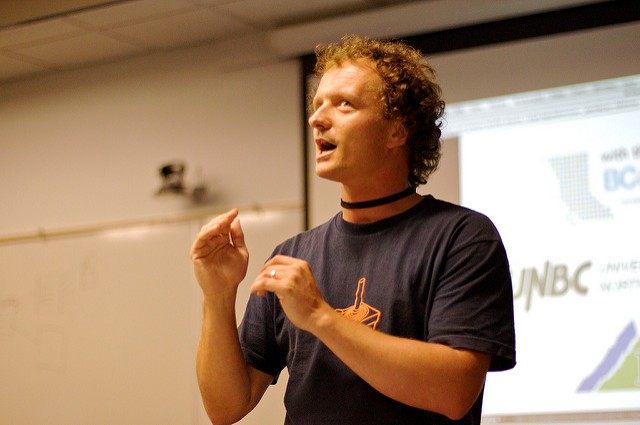
Grant Potter will always play along. I sent some suggested questions.
- Who are you people?
- What is this Bike race thing? What is “UCI”? (Tom can answer)
- How did you get involved?
- Why is a university even doing this?
- What kinds of courses were created? What was it like for faculty (Amy’s response key)
- What do you have to show for this?
- What was the experience like?
- What happened for the students?
- What is this book thing? Why are we talking about books?
We might have done 2, but it was enough to set the discussion in motion. No slides. No script. Just Tom, Amy, and I conversing about this project we were part of, as we had the day before outside eating tacos.
Just for reference, as I have really said nothing about the project…
- UCI Road World Championships – official race site. If you get near the screen you can smell bike oil.
- The Great VCU Bike Race Book – this is a holder now for a few bits of project parts, but ultimately will be “the book” (open, but not a textbook!)
- UNIV 291 Courses – a piece I worked on as gateway for information about the courses. Great graphic art work on the jerseys by VCU’s Emma Gauthier (blogged here)
- Anthropology of the Crowd — this is Amy’s course site, a tremendous body of work by her students. Her summary there on the front is the kind of project recap we dream off- it’s reflective, full of examples of student work, and lots of media.
- FAQ this is Tom’s work, and much of his sarcastic wit got toned down, but still left with great lines like:

- Bike Fortunes another Woodward gem, take a spin.
- Creative Commons and Copyright– a reference for student bloggers.
- Interviewing Tips – a great video with Scholar-in-Residence (and peer of Jonathan Worth) Brian Palmer– Brian’s photography and blogging for the project were total highlights.
- Covering the Coverage the site I worked on. It was a daily “newspaper” that curated and published content syndicated in from student blogs (~1500 posts in a week) via Feed WordPress. (previously blogged… the making of this site)
There you go; a pile of web links- no slides, no audio recording, not even a photo of us yacking on stage.
It was as great as the tacos.
Stay tuned, as we move early next year into producing the “book” (again, not a textbook 😉
Top / Featured Image Credit: You should envy those street truck tacos! flickr photo by cogdogblog http://flickr.com/photos/cogdog/22863843910 shared under a Creative Commons (BY) license
The post “All I Have to Show for the #VCUBRB Presentation at Open Ed Are the Tacos it Was Planned Over” was originally yanked out of the teeth of a rabid chicken at CogDogBlog (http://cogdogblog.com/2015/11/vcubrb-presentation-at-open-ed/) on November 25, 2015.

SPLOT on Open Ed 2015
The second of three sessions my name was listed on at Open Ed 2015 was Splots and Darkweb Plots. It might not take a lot of guessing to know that this was co-presented with Brian Lamb.
Furthermore, in the spirit of remix, the platform of the presentation was the same platform as just described in the last post, a stock WordPress theme tricked out with a few other added spices and oils.
Brian assembled 90% of it; 100% of the GIFs are his genius, like this 5MB one worth the left:
and we riffed some from the last talk we did in March in Victoria for Open Education Week. And for a metalevel sense of goodness, the NS Cloner tool we talked about was used to set up this new version of the talk.
For fun, we played of course with the acronym, asking people to email us an image that came to mind for the word “SPLOT” – and of course later showin them that by emailing a message that had unknowingly authored a WordPress post in our SPLOT Collector tool

My bit was an overview of the way I had implemented these in WordPress and showing the two more useful tools, the Writing tool and the Image collecting ones.
It is affirming a year later to have a good handful of SPLOTs in the wild, meaning people other than us using them. The prep for this talk got me, way overdue, moving the later changes to the github repos (TRU Writer) and (TRU Collector) and finally adding some documentation.
I was happy to meet David Wright there who had managed to set up a version of the writing SPLOT before it had an installation instructions
Been playing with @cogdog & @brlamb TRUWriter all morning. Great tool. Easy to install. Up and running.
— David N. Wright (@davidnwright) November 13, 2015
And we are seeing a lot of potential for this to be even easier to use within the Open Ed Tech collaborative that has the creative fingerprints of Grant Potter all over it. I am looking forward to helping maybe set up some Sandstorm grains that are SPLOT ready.
This has me pumped to return to the SPLOT home base and maybe pick up some of the half ideas that never got built out last year (example).
Stay tuned to the Smoothest Portable Learning Open Technologies or Simplest Possible Lucid Online Tools or Simplest Possible Lexical Outstanding Timesavers or Super Perceptive Learning Online Touchstones…. at splot.ca
Top / Featured Image Credit: Screen capture of our presentation at http://splotplots.trubox.ca/
The post “SPLOT on Open Ed 2015” was originally pulled charred and crispy from a smoky charred oven at CogDogBlog (http://cogdogblog.com/2015/11/splot-on-open-ed-2015/) on November 22, 2015.
The Graduation Thesis: Insufficient and Outmoded
This the title of a recent article I wrote for my university research journal (Gakuen). In it, I advocate for subsuming the Graduation Thesis, common here in Japan among undergraduates, among a collection of other possible ways for demonstrating ability to work in a field. Notice how I don’t use the word “mastery”, as that is not really possible in a foreign language at the undergraduate level (I work in the English Department).
This collection of what I call Graduation Projects (sometimes called Capstone Projects) could entail a variety of different ways to demonstrate that one can use tools (not understand a field), as tools and skills are what will be needed in this world with the entire sum of human knowledge is constantly at our fingertips (OK, I exaggerate, but not by much). Knowing stuff is no longer as important as being able to learn new stuff by yourself.
Read more about it in the article which I have attached here. Another thing I argue for is that all students should learn programming, or at least enough to be able to understand the thinking behind programming. Authoring is no longer just about writing words, and the people who program are creating a world that the rest of humanity has to live in (or will have to live in, soon). So if you want to control your creative production, you have to learn how to program.
Since the article came out, a number of new events have reinforced the points I made. The most popular major among women at Stanford is Computer Science, along with the most popular course at Harvard, Computer Science. A recent article is going viral about how virtual classes can be better than real ones. Another thing I advocate is for Open Source Publishing, or Open Education Resources, and now the entire staff from a linguistics journal has quit Elsevier in protest over the policies that make huge profits selling things produced at universities back to the faculties.
Lots more issues, but no time here. Let me attach my article, maybe we can get a discussion going.
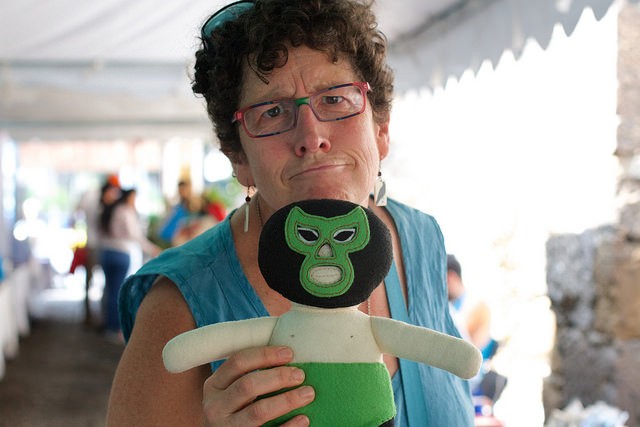
Hace doce horas en un pasillo del hotel oscuro – Openness with Brian Lamb
Much as he may disavow my assertion (ask him about the one in Flagstaff a few years ago), Brian Lamb and I getting together for presenting is always a peak experience, usually peaking soon before it happens.
For the UdG Agora face to face sessions last month in Guadalajara, Tannis Morgan asked us to do “something” as a main session on Openness, as this was one of the pillars of the project. We knew the one we did in Victoria in March for BC Campus was not quite the right thing (especially w/o our twitter performance which went a bit off the rails).
We’ve done much individually and together on the topic or a while, so I was not worried that we had nary a plan before we went to Mexico.
There was also no plan by Thursday of the first week, and we were slated to do it the next day. We had talked/speculate at we might not want to start with the assumptions on attitudes and awareness of open sharing, re-use that we know from our usual North American audiences.
It was on the ride back from the CUAAD campus in a car with Nancy White, that her typical magical force happened:
Of course what she said seems to have faded, but it really gelled the idea- that rather we try to explain the ideas of openness, that it becomes more of a questioning our our own assumptions; and that we look to use small examples if things that the participants had done that week that demonstrate its spirit in action (I may have actually been dozing on the ride home, but Brian got the spark).
He banged out an outline that night as we sat on the veranda at Villa Ganz.
And that was the setting for a bit of drama inn our session;; we literal play acted for the audience “twelve hours ago in a dark hotel lobby”. We acted like we were trying to organize the very presentation we were doing. I would do a bit of overview of my usual stuff (True Stories of Open Sharing) and Brian talks some about one of his favorite examples, the Jon Beasley Murray Murder Mayhem Madness Wikipedia writing story.
We in fact talk about these as if we were conversing. Then we stop and say to each other “I don’t think this will work for this audience”.
Brian hams it up fine with his quizzical look!
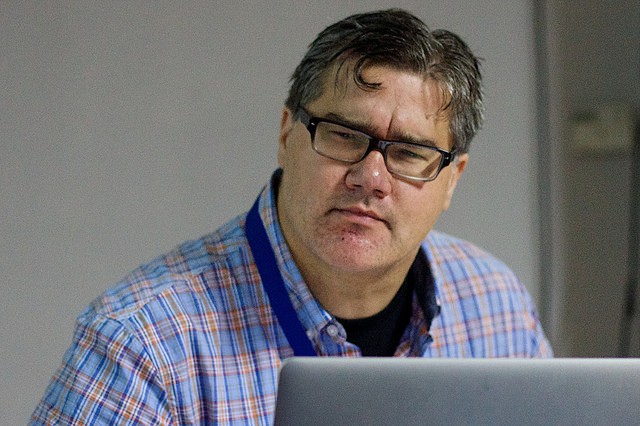
And then we break into a series of vignettes of examples we saw that weak, things openly created and shared by participants, informal connectivity, how the open internet participated in the activities that week. Plus some serious addressing of the concerns people described for us, unclear local support, how to integrate technology not readily available, and the looming issue of being evaluated.
Then we flash back to our own stories of how we first connected in 2003, of finding support from remote colleagues, even flashing the old photo of us with D’Arcy Norman in Vancouver at 2004 (oh they loved the old photo!)
Also @franbicentenari got great photo of me and @brlamb (+ @dlnornan in 2004) from #UdgAgora talk on Stories of Open pic.twitter.com/4fDmkxPuVm
— Alan Levine (@cogdog) July 19, 2015
And we return to images of what we saw that week, how every time we looked at our participants, the way the were nearly always working collaboratively, laughing, showing their work. The question we want them to leave with is how can we sustain or develop this same sense of being together we had face to face when we move to the online sessions.
I don’t want to gloat much, but the energy in the room was strong when we moved to a conversational mode, even with us doing this in English. Does the spirit of openness come across even when not all the words do? I’d like to think so.
It was a joy to put this together- Brian and I both co-assembled the images as a Google Docs presentation thing, and in the morning, I downloaded it as Powerpoint (in case of internet hiccups) to project. Both of them are embedded below (we used media and stories from each week of the activities, to showcase people who were in the room).
I have an audio recording of the second version:
I have admitted and demonstrated my ignorance many times on the internet. @brlamb @cogdog #udgagora Yes! pic.twitter.com/RBU1GCRxAT
— Ken Bauer (@ken_bauer) July 24, 2015
It’s hard to top working with Brian, it’s sheer excitement every time we plot something off kilter. My favorite mode of presenting has a bit of theatrics to it, and Brian is always willing to play (or provide the foil hats)

Our audience provided their own photos as well
Closing up #UdGagora at #CUAAD @vdaniel @adrianalic @VictorGenaro8 @gerardo_jh @irengs9 @brlamb @cogdog pic.twitter.com/CY0IEA8EJo
— Ja Zo (@javierzepeda) July 24, 2015
@cogdog and @brlamb recapitulando la semana de el curso de Aprendizaje Móvil con humor y agradecimiento. #UdGAgora pic.twitter.com/HjKtLlJIbL
— Luis Alejandro (@magnolexandro) July 24, 2015
@brlamb and @cogdog start "amazing stories of openness" #UdGAgora pic.twitter.com/JXqzRHijbx
— Nancy White (@NancyWhite) July 24, 2015
A lot of interesting things in the last day #udgagora with @cogdog and @brlamb pic.twitter.com/qsaPcC1wSd
— Hector Shimizu (@hecshimizu) July 17, 2015
#UdGAgora ,@AgoraUdG gracias a los dos @cogdog @brlamb pic.twitter.com/fFL8zRaagh
— omar martinez torres (@Omato1Omar) July 24, 2015
@cogdog @brlamb muy buenos asesores #udgagora pic.twitter.com/Owabe9ODQz
— Rafael Tavarez Duran (@Rafatavarez08) July 24, 2015
Compartiendo experiencias #udgagora @cogdog @brlamb @Patrici52370438 @danielromanroja @Alkimista pic.twitter.com/51Sp7M6P8a
— José Antonio Rubio (@Alkimista) July 17, 2015
Also, Brian storified a bunch of twitter responses to his question about the Value of Openness
Top / featured image credit: Twitter photo by @javierzepeda
The post “Hace doce horas en un pasillo del hotel oscuro – Openness with Brian Lamb” was originally emerged from the primordial ooze and first walked on land at CogDogBlog (http://cogdogblog.com/2015/08/hace-doce-horas/) on August 2, 2015.
Quads as Symbols of Liberal Learning
We recently ended Springboard, a series of thirteen days in June and July that are designed to welcome freshmen to campus and provide a key part of their orientation programming. Organized by our Orientation Office in conjunction with Admissions, the advising centers, the academic colleges, and my unit, University Programs, it affords my colleagues and me an opportunity to talk directly to students and their parents about academic expectations here and the value of a liberal education. I only get ten minutes, so I try to make it count by focusing on a few “mental images” as takeaways.
Here’s what I said:
“Welcome, class of 2019! I’m honored to be here representing the faculty. To give you a sense of scale: there are more than 960 FT instructional faculty here and more than 400 part-time instructors. It’s a big place! And a rich, vibrant academic community. My goal this morning is for you to understand what an academic community is. If you’ll humor me for just a minute, I’d like you picture our beautiful Quad. Go ahead, close your eyes. See the broad expanse of lawn. The bluestone buildings on all four sides (cuz it’s a quadrangle). They house dormitories, classrooms, computer labs, and offices. Once upon a time, the only dining hall was there, the library, too. Now picture other quads you know. Maybe UVa’s Grounds, designed by Thomas Jefferson. My own alma mater, the University of Delaware, has two quadrangles. Think: Harvard yard, Oxford, Hogwarts. Quads are everywhere in the landscape of American higher education because they are deeply symbolic spaces. Tracing back to the medieval period, they are echoes of the great European cloisters and universities, living and learning communities where groups of scholars came together in the spirit of contemplation, study, and research.”

Architect’s conjectural drawing of the quad in 1908. Then, the fourth side was left open following UVAs example in order to signify a welcoming community appropriate for a democracy. Of course it wasn’t really open: only white women could attend then. But that’s another blog post.
“You’re here today because you’ve chosen to join our academic community. Chosen is the operative word. You are not actually required to be here! There are no laws requiring Americans to attend college. No truant officers will show up at your parent’s door if you skip classes for a few weeks. There are no state mandated SOL tests and no single set of subjects that everyone must take. For the first time in your lives, YOU are the sole person responsible for your education.”
“Because you have voluntarily chosen to enroll here, the faculty have high expectations for you. It’s not like high school, even if you have dual enrollment or AP credit, trust me. For one thing, you were ALL tops in your high school classes. We received about 26,000 applications to produce a freshman cohort of about 4300. So congratulations. But now you’ll have to step up your game. For another thing, this is a university. That word has meaning, too–it’s not a synonym for college. By definition a university is a place that grants graduate degrees—we create new knowledge here. That’s why we call ourselves professors–the faculty profess expertise in their research fields; we are scholars as well as dedicated teachers. And we expect you to join us in doing research. Ok, maybe not freshman year, but certainly when you’re in those 300- and 400-level seminars. Our undergraduates are studying everything from nanotechnology to genocide in Bosnia. A university also offers study abroad experiences, internships, and service-learning projects. To succeed, you’ll want be active not passive learners.”

The Quad today.
“In choosing to join this academic community, you have chosen to acquire a liberal education, not job training or a piece of paper. I’m talking now about the stuff that prepares you to be an educated and enlightened citizen, like it says in JMU’s mission statement. Like the Quad, this kind of self-reflective, analytical education has been a hallmark of American colleges and universities since the colonial era. It prepares you to be an effective participant in a free society–and that’s why you can’t get this education in many parts of the world today. Now, here’s another thought exercise for you: it’s 1769; picture a short, skinny, knobby-kneed seventeen-year old boy leaving his home in rural Virginia and traveling by carriage all the way to far off, exotic New Jersey. Talk about culture shock! The boy was James Madison and like some of you he didn’t know exactly what he wanted to be when he grew up. At that time, the College of New Jersey (now Princeton) was known for producing Presbyterian ministers. (Apparently, William and Mary was a party school then.) Fortunately for us, he didn’t follow that path. But he did acquire a liberal education, one that enabled him to become one of the most original political thinkers in the world. JMU provides the same kind of liberal arts and sciences curriculum Madison knew, though can rest easy knowing we’ve updated it for the needs of the 21st century. We call it General Education: The Human Community, and it’s a vital part of your degree, a whopping one-third of it, in fact. It’s that important.”
“Despite what you hear in the media, public opinion research tells us a liberal education is also the best preparation for long-term career success you can get. Here’s a shocking statistic: by age 39, the average American with a BA or BS degree will have held between 10-14 different jobs. You can’t know what those jobs will be. None of us knows what jobs lie ahead, not even employers. In a January 2015, researchers interviewed more than 400 employers across all sectors. Do you know what they said they look for in hiring new employees? A little more than 60% said they valued ‘broad, comparative knowledge’ and ‘cross-cutting skills’ like writing and critical thinking over narrow technical competence, which they intend to teach you themselves. So think about the value of your entire degree. As we like to say here, your major will help you get your first job, but a liberal education equips you for a lifetime of employment.”

Students studying and relaxing on the Quad in front of Wilson Hall.
“But I know you aren’t thinking about the workplace today! You’re ready to meet your Orientation Peer Advisors and get your JAC cards. Just do this one thing for me: when you leave Wilson Hall today, take a good look at that Quad again and remember what it symbolizes–Your academic community!”
MOOC Design Day 2015
On June 24th, Online Learning Strategies hosted our third annual MOOC Design Day, which was attended by several teams that have been awarded project funding or are considering proposal development in the coming year. New initiatives are taking shape across several divisions and departments, including … Continue reading
Access to Course Materials – Keeping Costs in Check
Whether on-campus or online, the cost of university courses keeps going up. One of the hidden expenses for students is the cost of course materials, which can run up to $200 dollars per class. Some students have noticed even higher … Continue reading