Next week, the 13th annual Open Education Conference will be hosted in my hometown. This is an exciting time for me; in academic circles we talk about how certain conferences bring out all of “our people.” For me, #opened16 is that conference. You are my people and I hope you consider me one of your’s.
Although the conference is firmly within my geographic community (and as such I have already been made responsible for bringing “my people” to the community’s beer and tacos), I am participating in this conference from a distinct position of in-betweeness. My presentations make my point for me.
On Thursday I will be joining the inestimable Kate Bowles, Kristen Eshleman, Bonnie Stewart, Dave Cormier, and Amy Collier and potentially others for a panel discussion on the place of narrative inquiry in the context of open education. This is a story of my now and future: I am working with Kristen on a project that combines data visualization and narrative inquiry to capture the complexity of experience and drive systems-level change. More and more my work involves data visualization in some way…not always in the sense of business intelligence or institutional reporting, but always in the sense of capturing a story and displaying it in a way that is intentional, interpretable, and useful towards a greater purpose.
On Friday, I will be joining the equally inestimable Jon Becker, Bonnie Stewart (again!), Alec Couros, and potentially others for a panel – workshop on the open dissertation. This presentation represents my past: I completed a version of the open dissertation in February, 2016 with the support of Jon (my chair) and Alec (a committee member) and the entire open education community.
I want to take a minute to discuss the open dissertation and the origins of this panel discussion. In reality, it is all Bonnie Stewart’s fault.
The discussion started in February or March of this year. I had just successfully defended my dissertation – the research for which was situated in data visualization and open pedagogy – but when people call my dissertation “open,” they are really talking about how I executed the process and published the product.
Over the year of active reading, writing, and researching, I lived online. I blogged and tweeted openly throughout my dissertation process – a simple search will provide you with iterations of proposals, theories, models, and slides. There was the horrible writers block – After months, I cleared it in one day of pounding out four or five blog posts – one point after another in the most epic display of literature synthesis I think I will ever be capable of achieving. Jon live tweeted his readings of my drafts. I invited Lee Skallerup and Valerie Holton into my defense hearing specifically to live tweet. Between them, Alec, Jon, and the entire opened community, my defense turned out to be an international goodwill party I will remember for the rest of my life. Then I published my dissertation under a CC license and created a website for it, complete with open educational resources for teachers and students.
Mine was an open dissertation.
A week after my defense, Maha Bali wrote a ProfHacker post about the open dissertation, arguing that it represented a spectrum of activity – not a specific thing. She began to explicate the spectrum, offering Bonnie (Stewart)’s livestreamed dissertation and my live tweeted defense as examples. Bonnie and I both commented on the post, pointing out some of the granularities of the process that lends it to personalization…open can be open in about a million different ways. Bonnie suggested the panel.
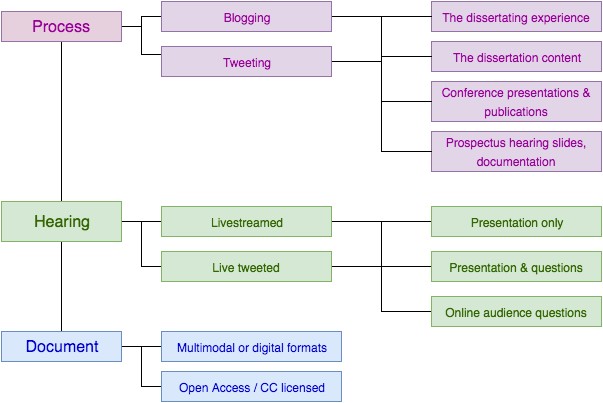
The panel discussion at #opened16 is meant to discuss some of those granularities and to examine some of the benefits, pitfalls, and institutional barriers that exist in exercising your right (and I do believe it’s a right) to an open dissertation. I was trying to map out the “spectrum” – after all, that’s my part in the panel presentation – but I’m not sure it’s a spectrum at all. In reality, it’s more like a flowchart with decisions to be made all along the way.
Here’s a first pass* at understanding the granularities of the open dissertation.
Now here are the “open” choices I made – in yellow.
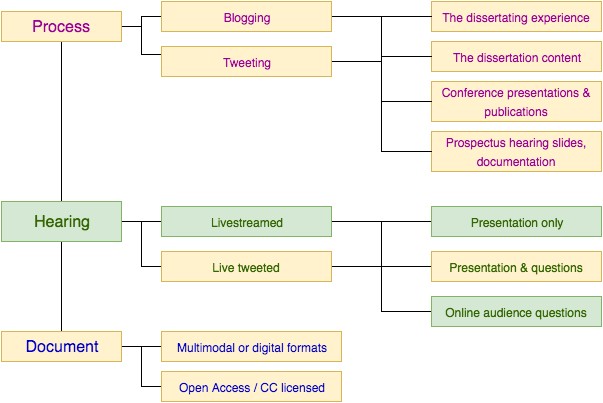
See how that works? I have a lot of yellow boxes on my organizational chart – but how would that translate to a spectrum in comparison to someone else’s yellow boxes? Are all yellow boxes considered “equal”? What’s open and more open? Quite frankly, I don’t care. People should do what’s right for them. However, I do like the idea of a chart. I am, after all, the data visualization person. I want to be able to pick my boxes and talk to you about your’s.
However, this next part is important, too. If I go back into my diagram and identify the institutional structures that needed to be in place for me to do what I did…
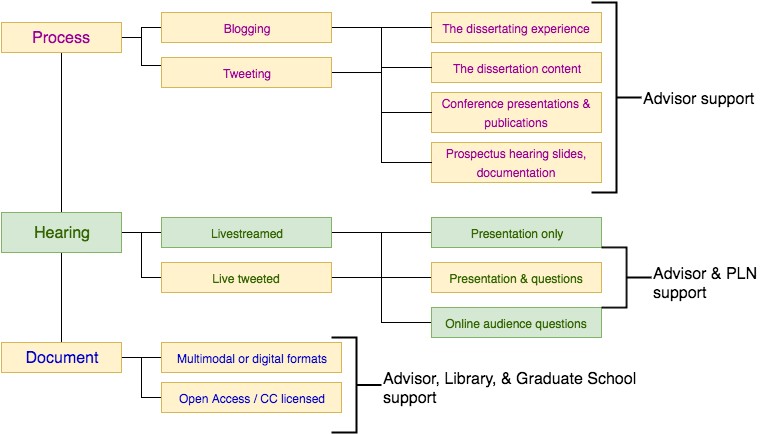
Then you’ll see how much of this depended on Jon’s support. Consider that.
And come to the session – help add to the org chart.* Even as I get ready to publish this post, I see some glaring absences. So come, help fill it out because that’s a very open education type thing to do . It should be fun.


