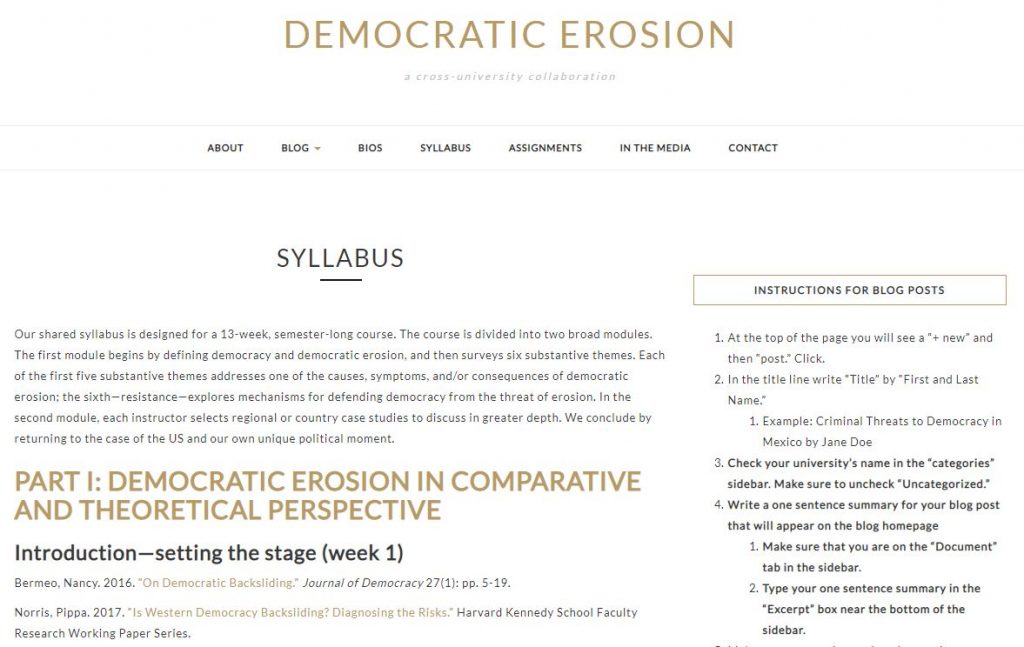
Probably the most remarkable content this week was an interview (45 min) with Rob Blair on his (and many others’) course on Democratic Erosion (syllabus). This was all part of the online course I am taking for #openlearning19 at the Open Learning Hub.
This is team teaching on a whole new level. It is team learning. It is collaboration between students, professors, and institutions. It works because faculty, starting at Brown University, then expanding last year to more than a dozen universities, were all able to work together on a common syllabus, then sharing comments and produced work. This year there are over 25 universities involved.
Do watch the interview. Gardner Campbell covers the issues, starting with the technical, then moves on to design and administration. They get into the nuts and bolts of how the program was set up. It was enlightening. It is revolutionary. It breaks down the classroom walls and tasks students with creating relevant materials for distribution to a real audience. The content is now being collected by graduate researchers who will use it to synthesize into a body of work useful to the outside work. This is a truly relevant audience.
I floated the idea of working together within our department, and it went nowhere. I am now considering how to adapt this framework to my language classes here in Tokyo. There is a lot of potential.
First, the interview with Pomerantz led me to read “50 Shades of Open” and I am utterly perplexed – not about the content just as to what I thought ‘open’ was as of last week. I find my understanding has deepened but also changed … yet again (yay, learning!). Pomerantz and Peek depict many aspects of what it means to be ‘open’ and I find that ‘openness’ is defined by the context of use – as in what, how, where, what purpose, which makes the term ‘open’ much more fluid and even more difficult to pin down. It actually reminds me of my own area of study currently. Instructional Design and Technology has struggled to define itself and still does today – are we educational technology, technological instruction, educational design, instructional technology? (and so on…) Academics find that the terminology shifts and changes depending on the context much like ‘open.’ This confusion is not a bad thing, it just gets you thinking more and more and around in circles about specificity or the impacts of this ambiguity (both positive and negative).
Second, I thoroughly enjoyed the interview with Dr. Rob Blair. His Democracy Erosion course was a great example of open-style collaborative learning. I am a huge fan of constructivist learning approaches and I can see great potential in the collaborative techniques used in this course design – recommended it to my husband for use! More so, I was intrigued by the design aspect of this course as an instructional designer. I would love to look deeper into the design choices, philosophical underpinnings of design, and design strategies that are used to develop cMOOCs. Instructional designers argue that the design mechanisms and not the delivery system itself is the key to optimal achievement of learning outcomes … would be interesting to see how this stands in these new connectivist scenarios.
Last, open pedagogy is interesting from an instructional designer’s (ID) perspective as it is, from what I gathered, experiential learning. Much literature argues that experiential learning/discovery learning is the key to contextualizing real-world problem solving. Learners develop a better sense of their ability to solve real-world problems or learn new information when it is contextualized and the learning is directly experienced – we can better understand and connect to prior knowledge that we have when our learning is situated. So why not situate it within a crowd of various-minded learners who directly construct and experience the learning together – a crowd whereby the ‘professor’ is the facilitator or does not exist in the traditional sense. Instead, learner guidance is provided by our peers. It also brings people together to discuss and collaboratively work on real issues (education with more purpose!) There are just so many interesting angles to look at as an ID.
After viewing the interview between Dr. Rob Blair and Gardner Campbell, I was struck by the appropriateness of using a networked course to teach a class on “democratic erosion.” Involvement of students and educators with different income sources, lifestyles, and political leanings (in terms of regional differences) can only diversify and enrich intellectual discourse.
I was interested to discover what concepts were discussed and in what ways students engaged with them, so I visited the course online. It was just as simple as I had imagined from the interview. While individual instructors design assignments specific to their classes, all students are expected to participate in (if only to attend/observe) political events locally and to blog about their experiences.
The overarching idea that we are all here together, learning and sharing with each other, no matter our differences is central to a democratic system and is key to making open learning work. I loved when Dr. Blair described how he introduced this idea to others. He sent out a few emails to some “friends,” and that turned into emailing larger groups, and those people talked to each other and spread the word, until the Washington Post got wind and published on the project.
If an idea is good, it isn’t likely to stay small. It can become something large and complex and help lots of people. I see open pedagogy as something that is taking shape and becoming a force strong enough to break down old barriers to access to information and education.
Last week I had the opportunity to attend the Digital Pedagogy Lab in Toronto. There were five intensive tracks. I chose to go for the Digital Storytelling track led by Chris Friend. I worried maybe I was taking the safe route by choosing a topic I’ve done some work in before. I think I kind of just wanted the chance to jump back on that horse.
When you see other track leads like Martha Burtis, Dave Cormier, Jesse Stommel, Sean Michael Morris and Amy Collier there’s some serious FOMO, even while you’re there. Chris was the most unknown entity of the bunch to me. I’m glad he is unknown no more.
Digital Pedagogy Lab puts us, the participants, very much in the centre of the “what are we going to do while we are together” question. The leads, therefore, cannot know precisely what we’ll be doing. I imagine it takes a lot of courage to hop on a plane to another country to deliver a three day intensive session and not know exactly what bits of their expertise they will need.
So what did we do? We discussed our story ideas, worked them, focused together on things here and there that seemed to be shared needs or interests, spun our wheels, worked our ideas some more, shared our ongoing progress. In true open pedagogy fashion, Chris began and we built up a shared doc. (I’d share it here, but I am not convinced everyone in the group would okay that. I will update with the link if I can.)
We took some time to chat about what we might want to get out of the stories, what emotion we wanted people to feel, what purpose it would serve. Much of the time Chris spent one-on-one helping guide these stories out. Many digital routes were pursued.
Mine went nowhere.
It was not for lack of effort or anything but my cavalier attitude towards closing my laptop. I came in to the experience completely fascinated by one of the suggested readings, unphased that many of my fellow track members seemed to despise it with a passion. I wanted to do something kind of out there. Something that threw you in to the middle of the story not knowing much about what’s going on. I wanted people to feel “wonder”. My pursuit of wonder was even discussed live online in one of three wonderful Virtually Connecting chats during the event.
My secondment at eCampusOntario ends soon so I wanted my story to be about my experience, for the folks back at Fleming College. I am well aware that there is not enough there for “wonder” to be experienced. I mean, some folks may wonder where I’ve been but “wonder: the emotion” is not really on the table here yet. My shot at that comes from the incredibly enabling opportunities that open education offers. My story was meant to offer rabbit holes to the things/people/experiences that I’ve been lucky enough to work on or near for the last 2 years. Things which I believe have the potential for wonder.
So… it looks I like laid a very simple task out for myself: Provide a bunch of rabbit holes to wonder! I’d been a little bit enthralled lately by the idea of text based adventure games that Sidney Shapiro had been working on with his students, but learning Python was not in the cards just now… So I thought I’d go with a Choose Your Own Adventure format (since I’d recently done okay with the idea in a presentation format.)
Track mate Kendall suggested I try out Twine – an open source tool for telling interactive, non-linear stories? Sounds perfect. And it certainly was, except for their weird to me way of “saving” lol.
I concocted a story that involved a condition known as “Post-Secondment Frazzle” in which one has no recollection of ever being away. As I wander through Fleming College, I run into people I know who had had the same experience who would help me to find out what I’d been up to at eCampusOntario. This would ultimately lead readers to different rabbit holes (hopefully) of open education awesomeness as we worked together to cure my frazzle.
It was coming along, but still very much a work in progress. Not sure if any sense of wonder was imminent or anything. But then at the end of day 2 I closed my laptop without doing whatever Twine needs you to do to save but not call it save.
40+ passages were nuked. So I got nowhere. Back to the drawing board.
But, #DigPed, you definitely took me somewhere. You took me somewhere when Sean Michael Morris’s opening remarks dropped the mic and the gauntlet right from the get-go. You took me somewhere when Rajiv went extra personal, experimental (and fun) with his opening keynote. You took me somewhere when you left us to sit in our work for a while during workshop time. And you pushed me somewhere when Jess Mitchell didn’t let us go easily with the closing keynote.
Put together, it sent me on a path somewhere. And like Jess said, “completion is good for bridges. It’s not good for community.” I’ll be headed that somewhere for a while and I’m glad some of this somewhere is with you and everyone involved in all of this.
photo “ONTARIO-00368 – Colour my World” flickr photo by archer10 (Dennis) 198M Views https://flickr.com/photos/archer10/14656590048 shared under a Creative Commons (BY-SA) license
The topic this week was open access and open educational resources. The first thing that struck me was Peter Suber’s response during his interview when he said that open access cannot solve all our problems because it is not universal access. The other problems that still remain are: filtering and censorship, language limitations, disability limitations and the fact that only 50% of human beings have internet access. Knowing about all these issues only makes open access options more logical to me. We all should start small by controlling the things that we can control. My small library is making a big effort to help inform faculty about open access and open educational resources. If they see the valuable options that exist out there, or that are needed, perhaps they will be more likely to use them and contribute their work to the public as open access publications.
The second thing that struck me was from the Suber reading on page 19 when he quotes the Budapest Open Access Initiative stating that technology, through the internet, has allowed for the public good of open access publishing. One of the most positive things about the internet is that information can get to people at their point of need. The story of Gardner Campbell meeting Claudia Ceraso because he asked a question into the Twittersphere reminds me of this as well. The internet has allowed us not only to phone a friend but to ask the world audience a question and they can respond instantly! Open learning and open access reflect this new way of thinking and working. It invites others to please come in, contribute and help build something better, together. Therefore, in today’s technology environment, it only makes sense to do what we can to encourage open access in order to enable wide spread collaboration which I believe will produce better research and better work products.
Toward the end of Open Learning ’18, I spotted an article in the Washington Post about a “nationwide college course” about the way democracies decay or erode over time. The Brown University professor who started the course, Rob Blair, began his efforts in the fall of 2017, with three schools in the network. As of this writing, in the spring of 2019, the main course website, democratic-erosion.com, lists thirty-seven schools in the network, three of them outside the United States, as well as one that’s not an institution of higher education, the DC Jail. There’s also an “uncategorized” category, bringing the total categories of participation to thirty-eight. While not all of these participants have contributed to the cross-university blog yet, their presence on the site, and the shared learning resources in the course itself, emphasize the fact that networked learning is at the heart of this ongoing project.
Although the term “open pedagogy” doesn’t appear on the democratic-erosion.com site, I think Dr. Blair’s course and the network built on that foundation certainly deserve to be considered in that light–which is why I immediately contacted him to arrange for an interview.
The interview took place in April, 2018, too late for Open Learning ’18. Nevertheless, while the course network has grown considerably since that time, the course design and the course site are still what they were when I spoke with Rob, so the interview remains relevant (at least in my view). So here, for Open Learning ’19, is our conversation about what I remain convinced is a remarkable example of the value and essential qualities of open pedagogy.
Suber acknowledges that academic research can be hard to access and hard to understand (Open Access, 2013). OA lowers the barriers to financial access, as far as making meaning from access to ideas and information, understanding comes with time in the discipline. The author questions why is it that academics are reluctant to go OA? My experience is that we will have to wait until tenure boards and the academic community start accepting OA publications as equal to established journals that have yet to go OA. Some OA publications are perceived as not having rigor whereas the established journals are familiar.
The levels of open access aren’t easy to explain to the skeptical academic: Gold OA for journals, Green OA for repositories. There is also Gratis OA for no cost, and Libre OA for limited to full permissions. Heads spin, eyes roll at this explanation. According to Suber, publishing in an OA format has one advantage academics will appreciate, “OA articles are cited more than non-OA articles (p. 15).”
So this week’s open learning activities ran parallel to my personal start into investigation of a potential topic for my PhD (Needless to say, I am overwhelmed but academically so it is a good thing). My ideas are running rampant and so is my anxiety haha but they tend to fuel one another so I cannot really complain.
As for this week’s topic, I am frustrated. I have much to learn and that is more than apparent. However, my frustration is … why does higher education cling to the remnants (and they are remnants – the way we do things are changing whether we like it or not) of past traditionalist research views and publishing methods. This whole “forward-thinking” side of me has only just developed on this end! I liked my old ways and I still do but they are becoming irrelevant and one thing I hate even more than change is being left behind and consequently irrelevant – so here I am! I’m extremely uncomfortable but I am more excited despite my discomfort. Now that I have educated myself on the way the digital age works and I better understand it, I feel like the guy in the Matrix when he took the pill – oh, the possibilities! The power of crowd and connectivity is incomprehensible! So, how do we get other people on board (without forcing or bribing them LOL)?
I leave you with this, we ran out of time with Peter Suber earlier this week but I am interested in what people have to say… I wanted to ask, “How do we encourage a move of higher education from conventional methods of publishing to OA? (not to mention a complete rework of the education framework of incentives, etc.) My question comes from reading Robert A. Reiser’s (2001) A History of Instructional Design and Technology (Part I & II). https://link.springer.com/article/10.1007/BF02504506. He tells of the unfortunate inability of education to adopt and allow technologies to reach their full potential. Academia never seems to use them to their full potential and they eventually fall by the wayside. How can we circumvent this?
The concept of publishing for impact rather than for pay was highlighted in this week’s chapter read on Open Access. Impact is seen as not only beneficial to the larger scholarly world, but to to the author as well, in that they “score career points” (p. 2) and have a better chance of receiving promotions, grants, and the like. So the impact (once measured) is as generous as it might be self-serving.
By chance, I happened to read another article this week, “Widening the Threshold: Using Scholarship as Conversation to Welcome Students to Science,” in which another side to career benefits and publishing was mentioned. In this article, undergraduate students observed that
“lab techs who do much of this kind of work but are rarely credited as authors or invited to participate in larger conversations. This was an opportunity for students to reflect on how people might choose research collaborators, and indeed who counts as a collaborator. It sparked their beginning to think about how authorship credit is impacted by social expectations and biases. This, in turn, can help students see that citation and collaboration are not markers solely of virtue but of social forces.”
This says to me that even articles published as open access are not always beneficial to all creators of the information, or even fair. Previous to this revelation, I had pictured open access material as something morally good. But maybe I should take a different perspective. Maybe morals have little to do with it.
This same article discusses barriers to access and to perceptions of authority based on social structures like gender and race, etc., which further tied in to the discussion on Tuesday among the conference participants in Toronto.
One more related idea that presented itself to me haphazardly to me was during my viewing of a webinar from ACRL titled “Beyond Citation Counting: Metrics and Altmetrics for Demonstrating Scholarly Impact.” The very simple idea was that “the absence of metrics [does not equal] the absence of impact.” I think of this more in terms of OER, where materials can be so remixed that they are almost unrecognizable. Their core purpose may still have a big impact on a large audience, but it can’t necessarily be accurately assessed.
I’m still trying to wrap my head around the interconnectedness of scholarly communication in its many forms. I feel like this blog is all over the place, but that I could map these ideas onto a piece of paper and show myself the big picture. So many factors play into the dissemination of scholarly works, the measurement of impact of those works, and the driving force behind it all: just we humans, engaged in sharing information we find important.
Thoughts on annotating Barbara Fister’s “Adulting for the Web: At thirty, it’s time to stop with the wild oats, already, and take some responsibility.” Inside Higher Ed, 13 March 2019. I left notes on items that relate to my experience as an academic librarian and as a graduate of an information science program. I left two annotations: one about internet security and one about Vannevar Bush’s Memex machine. I find poetry in the notion that Bush was thinking about a collective memory machine.