Toward the end of Open Learning ’18, I spotted an article in the Washington Post about a “nationwide college course” about the way democracies decay or erode over time. The Brown University professor who started the course, Rob Blair, began his efforts in the fall of 2017, with three schools in the network. As of this writing, in the spring of 2019, the main course website, democratic-erosion.com, lists thirty-seven schools in the network, three of them outside the United States, as well as one that’s not an institution of higher education, the DC Jail. There’s also an “uncategorized” category, bringing the total categories of participation to thirty-eight. While not all of these participants have contributed to the cross-university blog yet, their presence on the site, and the shared learning resources in the course itself, emphasize the fact that networked learning is at the heart of this ongoing project.
Although the term “open pedagogy” doesn’t appear on the democratic-erosion.com site, I think Dr. Blair’s course and the network built on that foundation certainly deserve to be considered in that light–which is why I immediately contacted him to arrange for an interview.
The interview took place in April, 2018, too late for Open Learning ’18. Nevertheless, while the course network has grown considerably since that time, the course design and the course site are still what they were when I spoke with Rob, so the interview remains relevant (at least in my view). So here, for Open Learning ’19, is our conversation about what I remain convinced is a remarkable example of the value and essential qualities of open pedagogy.
The third iteration of Open Learning begins next week (March 17) with a focus on Open Access and Open Educational Resources. Week Two (March 24-30) emphasizes Open Pedagogy. Week Three launches Open Learning ’19 into the future with a discussion of Open Professional Development, including the idea of openly networked faculty development that was the initial emphasis for Virginia’s participation in the AAC&U’s Faculty Collaborative project, phase II, led and inspired by Dr. Susan Albertine.
This week, then, is the warm-up week, the orientation week, the week in which new folks have a chance to get themselves sorted and situated: sorted as in “what sorts of things should I be ready to do?” and situated as in situated cognition.
First, getting sorted. Here are the primary ways in which you can co-create (i.e., learn from) this experience.
Blogging. Yes, it can be the hardest, for all sorts of reasons. But I put it first because it’s the sort of participation that can yield the greatest benefits. When you blog, you’re present to your fellow learners (and yourself!) with a depth and breadth that can’t really be achieved with shorter and less essayistic forms of participation. Remember that the word “essay” originally means “an attempt.” An essay is not a term paper. Again, with feeling: an essay is not a term paper. It’s an attempt. And yes, I forget that too, all the time.
Tweeting. Yes, Twitter is fraught in all sorts of ways. But for now, at least, it’s also a place where you can share, link, and connect quickly and effectively. Gather ’round our hashtag the way you’d gather around a warm and welcoming campfire: #openlearning19. Be hospitable. Expect hospitality in return. If you’re new to Twitter, you’ll likely be surprised by how quickly your network grows and becomes an indispensable part of your personal and professional development. I’ve been on Twitter since 2007, and while I’m repulsed and overwhelmed and bewildered by much of what lives in the fetid parts of our global lightspeed telecommunications network, in the last few weeks I’ve also been very strongly reminded that extraordinary things are not only possible in that network but more likely than they would be otherwise.
Hypothesis. Here’s where we gather around a text and read it together, making our annotations and weaving them into conversations. So, set up an hypothes.is account, look at the quick-start guide, and maybe practice a little. Shared online annotation, in an atmosphere of hospitality and a commitment to good faith, can reveal more glorious layers of both commonality and diversity within community.
Open Learning ’19, like the two iterations preceding it, generates resources worth consulting long after the event is over. There are interviews and panel discussions archived on YouTube. There are Twitter chats, annotated documents, blog posts, lush forests of learning full of associative trails. But the resources exist because of the networks from which they emerged, and for Open Learning, the network is the deliverable. That’s the situated part, as in situated cognition. For Open Learning to be meaningful, you must situate yourself within the network. That’s the easiest part and the hardest part, too.
Welcome! We look forward to learning with you, and from you.
Open Learning ’19, a cMOOC about open learning now in its third iteration will begin on March 17th and run for three weeks. Week 1 will be preceded by a “pre-cMOOC” week for anyone who is new to connected learning, new to MOOCs (and espeically to cMOOCs) or new to open learning concepts. Starting on March 10th, all are welcome to join in for the pre-cMOOC week led by Gardner Campbell, Open Learning’s original hub director.
The schedule for Open Learning ’19:
3/17-3/23 Week 1: Open Educational Resources and Open Access
3/24-3/30 Week 2: Open Pedagogy
3/31-4/6 Week 3: Open Faculty Development
These are topics that we’ve explored in previous iterations of Open Learning, and you will find a wealth of resources already on the Hub site: http://openlearninghub.net/.
To begin, start tuning in to the hashtag on Twitter: #OpenLearning19 and syndicate your blog to the Hub (don’t have a blog, this is a great chance to start one!) and use #OpenLearning19 for relevant posts. See instructions in the “Join Up!” link.
I’ve just returned from ELI2018, where a few of us presented on the OpenLearning ’17 experience and took the opportunity to promote OpenLearning ’18. My colleague Gardner Campbell, Hub Director extraordinaire and leader of our motley crew gave me the opportunity to talk about my “Novice to Node” experience in OpenLearnimg ’17. I started that journey with no blog, no Twitter presence and no experience in a networked learning environment. In some ways, I had no business being a facilitator for OpenLearning ’17, but it some ways, I was best guide for fellow newbies and my newness to it all gives me a unique perspective among my colleagues on the steering committee. And besides, not knowing how to do something is not a valid hurdle for me. I figured out how to do it by doing it. I learned through trying to teach others.
There were some tweets from audience members in the session that called out my pithy personal learning outcomes from the OpenLearning ’17 experience. I had my 5 seconds of fame as they were liked and retweeted, but I think they may have been misinterpreted as lessons learned from one specific week. I want to be clear about this– these are takeaways from my entire experience over the duration of the course. These ideas evolved over a 15 week period (don’t worry, OpenLearning ’18 is just 8 weeks!) when I was focused on learning about teaching and learning in the open.
So now that I’ve cleared that up, I’d like to explain a little more about what I meant in the session at ELI2018.
Vulnerability is Essential
If you can be vulnerable and in the moment, you can make connections between ideas and you can make connections with other learners in this networked environment. The network is the classroom and the more time you spend in the network, the more experiences you will have and the more you will learn. Vulnerability and authenticity are important traits for leaders, and I would argue for teachers as well. They are certainly important traits for learners, but it can be hard to admit what you don’t know, especially if you are used to being an expert in your field.
Having just returned from a conference, I find the conference scene a useful metaphor. If you go to sessions, but talk to no one there or in between sessions, you are going to have a more shallow experience than if you strike up conversations in the hallways and over meals. It requires putting yourself out there, but the reward is significant. If you engage on Twitter with others at the conference, you might have an even richer experience.
The Network is the Classroom
The same is true for connected learning–to get the most out of the experience, you need to connect, not just with the readings, but with the other learners in the network. And ideally, you get the opportunity to connect with people who are another step further out from the course you are engaged in. You begin to build your network thought the connections you make in the course, and then you make connections with their connections (it’s like those shampoo commercials from the 70s and 80s–and they tell two friends, and they tell two friends, and that’s the power of the network).
But back to vulnerability. Think about times when you have really made a connection with someone, not over something superficial (like shampoo…), but over something meaningful. How did that connection happen? One or both of you probably shared something personal, something that was important to you, something you’ve been thinking about for some time. That’s what can happen in the network if you open yourself up to connecting in that deeper way, but you do have to put a piece of your deeper self out there. The network IS the classroom. It’s where the learning happens. To be part of the learning experience, you need to be in the network, connecting with others.
Agency is Everything
Agency is about having a choice, and in the connected learning environment the choice is for the learner. The learner decides whether to do all, some, or none of the readings in a cMOOC. The learner decides whether to participate in the synchronous activities offered and at what level (are you lurking in the Hangout, or are you engaging in the chat?). Each learner’s experience will be different based on the choices they have made. Agency is empowering. It also lets us make decisions about our privacy. Perhaps you don’t want to join Twitter because you are concerned about how your information will be used. You can choose not to participate in that way. Your experience will be limited by that choice, but the choice is yours to make. Open pedagogy takes further steps to give students agency. Students might have a voice in how the syllabus is shaped or in the tools they use to complete an assignment. Perhaps they even have a choice in which assignments they will complete. Again, each learner’s experience is unique based on their decisions and what learning opportunities they choose to experience.
And a little about time management for cMOOCs
For me, I choose it all. My only limit is time and I have been amazed at how much time I can create when I adjust my priorities and my habits. So when I’m in the cMOOC, I will take a break from social media that is not connected to the experience (sorry, Pinterest and Facebook), and I will engage on Twitter over my morning coffee, but I will filter for #OpenLearning18 and focus my experience. I might write a blog post over several mornings or evenings (this one was begun in an airport and finished in my office). I will find ways to fit this experience into my days and nights because it is important to me. I know I will gain valuable insights from connecting with others in the network. It’s worth the small sacrifices and adjustments to my routines. For 8 weeks, I can change my lifestyle and it will change my life for the better.
When I started out on this journey with the Faculty Collaboratives Steering Committee and the OpenLearning17 cMOOC, I found out that in order to fully participate, we needed to have a blog and a Twitter account. We would have weekly Twitter chats (whatever those were…) and our blogs would be linked to the main site for all to see. I definitely felt like a novice. I had played with eBlogger sometime back in the noughties and I had created a Twitter account a couple of years ago, but hadn’t ever tweeted or retweeted and I rarely logged in. I was using other social media pretty actively in my downtime (I’m a Pinterest junkie with nearly 2,000 followers; librarians love to curate!), but I hadn’t yet wrapped my mind around how I could use Twitter in my professional life. I had talked with colleagues who use it to keep up in their field or with the news, but it just seemed like noise to me.
I dutifully started a blog and found the hashtag #OpenLearning17 on Twitter. A couple of people from the cMOOC started following me and I followed them back, pretty sure that was the polite thing to do. Then came the “share your space” OpenLearning17 Twitter chat that our Connected Learning Coach, Laura Gogia facilitated. It was into the fire pan chaos! It was like my first tango lesson, lots of missed steps, a few sweeping moves where I almost thought I was getting the hang of it and then it was over before I even knew what had hit me. By the time it ended, I was already working on my strategy for next time (Refresh, refresh, refresh! Shorter tweets! Don’t forget the hashtag!).
By the time the Open Access week rolled around in week 7, I had already won an award (in the form of a Minion meme–thanks for the encouragement, Amy Nelson!) for “most improved” and my Twitter activity was working its way towards the top of the charts in the cMOOC. When Gardner Campbell pulled up the network map showing the participants and their activity, I was stunned to see that my name wasn’t a spec as I had expected it to be. It was actually legible, a real deal. Even though I didn’t feel like I was participating enough, I was a player, just by making an effort and building a strategy.
Then came Open Access week. I am so grateful for the opportunity to have co-facilitated the week with Maha Bali, who is one of the most networked people I know . “I’m pretty good at getting people to agree to Hangout,” she assured me as we started our planning together. Great, and I’m pretty good at finding good sources on topics (I am a librarian, after all). So off we went on our tasks. I found the Peter Suber text and knew it was just right for the week’s reading. We’d use Hypothes.is to annotate the text. “Oh yeah, Suber is great. I’ve met him,” she said. And the next thing I knew she had talked him into joining our Google Hangout.
Dang, she is good at this! We agreed that I would handle the chat while she asked Suber the questions. He’s really delightful in that down-to-earth, brilliant sort of way. So I hammered away in the chat, adding links and catching questions from the participants. I was working the chat like a champ.
Then we had an amazing VirtuallyConnecting session (cut to me Googling VirutallyConnecting–oh, what a cool idea!). Uber-networked Maha set this up with folks from around the globe who were attending OEGlobal in Cape Town, South Africa. I was going to let Maha take this one solo and watch the video later, but then I decided I wanted to be there in the moment, even if it meant getting up at o-dark thirty (have I mentioned that I am NOT a morning person?). I was only on my first cup of Joe and I was hitting the chat hard and they were liking what I had to say. That was the moment when I decided to join the revolution.
I found them all on Twitter and followed them; they followed me back! So now I’m connected to those amazing educators who are pushing the Open movement forward all around the globe. I retweet them, they retweet me. It’s getting to know you on the Net.
The cMOOC wrapped up with an empassioned Google hangout with Gardner, Amy, Steve Greenlaw and Susan Albertine (even watching the recording is moving). I didn’t want the cMOOC to end!
The opportunity to have a panel about the cMOOC came along, thanks to ODU’s Faculty Summer Institute on OER and Stephanie Blackmon’s initiative in writing a proposal. Over lunch during the conference, I met some of the other Faculty Collaboratives Steering Committee members for the first time. In talking about my journey in the course, Gardner Campbell told me I was now a node and had the responsibility to keep it up. What? Me, a node?! I felt like I’d become a Jedi knight (use the Force, Sue) after being an apprentice for months. Node you are, connect you will.
I started the cMOOC with no followers on Twitter. I remember Maha noting that she was my first. I’m up to 30 followers and 239 tweets and counting. 15 weeks from zero to thirty, novice to node. It’s that easy, folks, but you do have to make an effort. You have to be present and active. You have to want to be part of the conversation. You might have to leave your comfort zone behind. And you might have to get up in the dark to chat with passionate people doing amazing things, all for the good of students and the power of learning together.
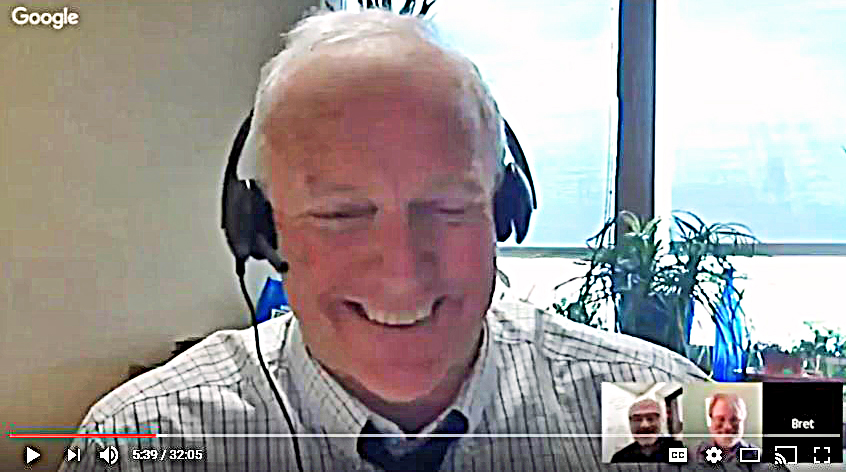
Here’s the second live Hangout conversation with Randy Bass and Bret Eynon, authors of Open and Integrative: Designing Liberal Education for the New Digital Ecosystem. This week we dive even further into the core elements and purposes of a liberal education, as well as the questions of vendors, platforms, and ready-made ecosystems that might be obstacles to the “rebundling” Bass and Eynon advocate in their book.
To view this conversation, click on the image below.
What does liberal education look like at Georgetown University vs. LaGuardia Community College? What unites liberal learning advocates and digital ecosystem aficionados, and what separates them? How do the digital ecosystems our students bring to school connect with the digital ecosystems built for schools? What do the authors mean by “open and integrative”? These and other questions emerged from the conversation with Randy Bass and Bret Eynon in support of Open Learning ’17 and our first week considering their book Open and Integrative: Designing Liberal Learning for the New Digital Ecosystem. The conversation also sparked some lively discussion on Twitter, and was informed by annotations of their ebook by means of Hypothes.is.
Rather than summarize the conversation further, I invite you to watch it for yourself. It’s a half-hour well spent. Click on the image below to view the video.
For our second week with Open and Integrative, we’ll be focusing on chapters four and five of the book, which emphasize faculty development and assessment. As with our first week, you’re encouraged to purchase the book and annotate it via Hypothes.is. (Note that to permit shared annotation, the book must be purchased, downloaded, and loaded into a browser with the Hypothes.is extension on and local file annotation enabled. Instructions here: Unfortunately, because the book is not freely available on the open Web, the annotations cannot be shared via Twitter or other social media.)
On Wednesday, April 12 from 4-5 pm EDT, we’ll have another live-streamed conversation with Bret and Randy to dive into topics related to faculty development and assessment. You can watch the Hangout here:
Finally, I encourage everyone to consider writing a short (or medium, or long) blog post reflecting on some part of Open and Integrative. I know Randy and Bret find this feedback and conversation very helpful, as do I and (I hope) everyone in the Open Learning ’17 network.
And as always, keep those #openlearning17 tweets coming.
Post written and interview conducted by hub director Gardner Campbell
Wondering whether an associative thinking exercise could weave together reflections from bloggers and glimpse connections to and renewal of general and liberal education. Answer is yes.
Information literacy as hopeful vision of creativity and flow as students develop self-awareness of their own associative trails and perspective on those of others–in other words as they perceive themselves in context of other learners and dare to try collective learning beyond the print book. As they learn in these new ways, they find it easier to cross disciplinary boundaries and go after the kinds of wicked problems so many of us hope they’ll address. They could revitalize the humanities through collective historical and interpretive work across disciplines and fields.
Below are the passages I used in the exercise. It was way fun!
Autumm Caines writes “for me it is a call for better general and liberal education. I think the first step may just be in realizing (and getting students to realize) that my internet is different from your internet. Where possible, taking ownership for our own ‘associative trails’ and demanding that ownership when it is kept from us. Finally, simply realizing that there are political forces and companies with lots of your data… which has always been the case but maybe realizing that they are trying to influence you in increasingly intimate ways” http://autumm.edtech.fm/2017/02/04/digcizfakenewsmicrotargeting/
raptnrent.me writes: “If we work to understand the hows and whys of information creation and flow, what I would call information literacy, then presumably we will be better able to review our shady present. That would elevate my spirit. Until then, there’s always Aretha” “One for the Hippie Hub.”
Morris Pelzel: “Jon Udell, I believe, used the phrase ‘context is a service we provide each other.’ I’m still puzzling out what this means, but I’m guessing that it refers to the ideal of accessing and processing information, not in an abstract and depersonalized manner, but within the context of other learners and practitioners in ‘trust networks.’ And that’s the difference between reading ‘As We May Think’ on my own, and working through it in this community, this network of fellow learners.” “Notes and Trails”
Erin Crane, Librarian reflects on actual challenges of working with students who prefer physical books to annotatable e-text in “Are We There Yet?”
Samantha Veneruso imagines ways to help students learn through integrative thinking and problem solving: “I can see how Bush was looking at the depth of information increasing, but as he talks about new forms of encyclopedias because of new associations of knowledge, I think of the idea of solving wicked problems, and the increasing intersection of disciplines– or the break downs of strict disciplines, which I think is characteristic of where we are going today in education or where we should be going today.” “Connections and Associations”
John Stewart’s “Open Note Databases” observes, “While we certainly hope that our database will be used by and be useful to historians of chemistry, the real point of the project is to enable the collaborative epistemology proposed by Vannevar Bush. History and humanities more generally are dominated by the single-author article and monograph, so a system built to pool research notes may seem counterintuitive. However, we need to remember that the point of these publications is to share our knowledge. If we all share our coffee stained notebooks, idiosyncratic excel files, and shoeboxes full of notecards, we can engage in deeper and more nuanced studies in the history of chemistry and science more broadly. Without sacrificing traditional academic products, we can collectively populate searchable, interlinked reference guides that will accelerate research and model our methodologies for the generations to come.”
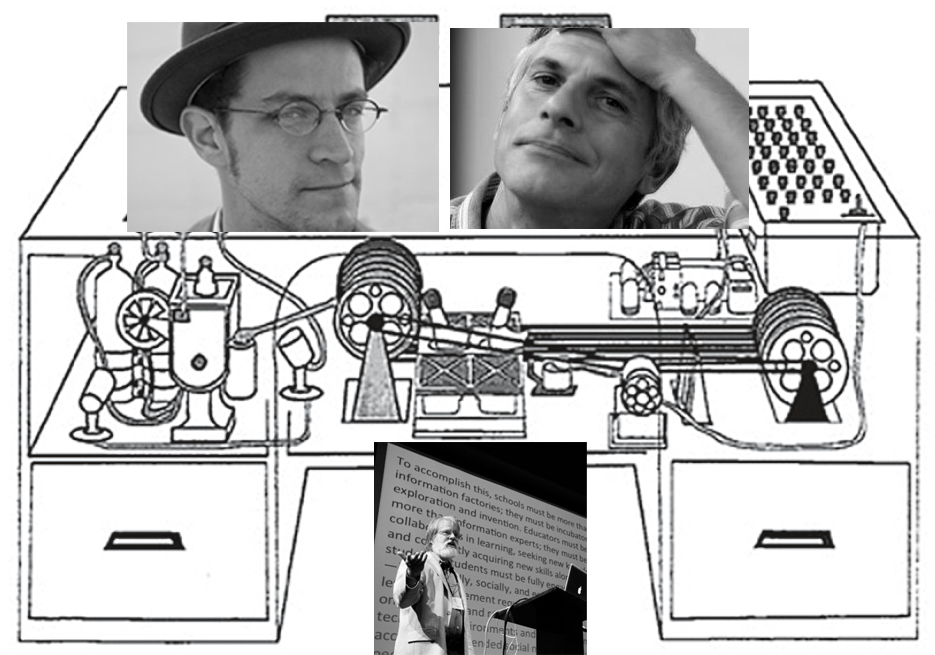
As you’ll hear, Bush’s phrase “associative trails” appropriately wound its way throughout the conversation. I encouraged Jon and Jeremy to reflect on robust resource linking across collaborating minds as well as the more idiosyncratic and sometimes apparently “random” associative trails that are forged within our individual brains. I had probably registered this distinction myself in one of my many earlier passes through this endlessly fascinating essay, but today the distinction became newly vivid for me, and helped me understand areas of connection and disjunction within the essay itself.
Since a classic blog-based distributed conversation brought us together many years ago, I have interacted with Jon on numerous occasions. Some of his own associative trails have grown familiar (and dear, I must say) to me, but he’s always full of surprises, too, and I remain consistently challenged and stimulated by his ongoing work with the Web as a platform for co-constructed knowledge. I have been fortunate to spend more time with Jeremy lately, learning of his literary and musical background, and learning much more about his work with educators who are adopting Hypothes.is in their teaching as a way of helping students learn to scaffold and extend their own learning. It’s fascinating to see two people who are quite distinctive in background and personality nevertheless strongly united in their commitment to building a better world out of deeper, more thoughtful, more educated, and more robust human interaction.
I’m confident you’ll detect my own enduring concerns and commitments here as well. As I reflect on today’s conversation, I can see how my own work, and perhaps my personality as well, are situated almost at the meeting point between Jeremy and Jon. I hope that middle-ness helped to elicit the uniqueness, and the tremendous connections, these two thinkers brought to bear today. My thanks to both of them. I hope we can do this again, and soon.
This post is meant primarily for participants in the Networked Narratives course I am co-teaching with Mia Zamora, where everyone is publishing in their own blog space. Everything here applies as well for the Open Learning ’17 course led by Gardner Campbell; I’m working on both sites at the same time, so things I do on one cross over.
In terms of staying tuned into news and current interesting information, many people these days rely on social media. For me, that is part of my information flow input, but not only one. Yes, I find many useful things shared by other, but it depends on when I tune in, who I follow, and how deep– it’s pretty much accidental serendipity.
My more primary means is checking regularly maybe 150 different websites, mostly blogs. Do I visit 150 blogs on a regular basis? Heck no.
I make use of the same three letter technology that we had you trip over to connect you blogs, RSS. These feeds can pull the stories from hundreds of sites into one interface where I can scan them like subject lines in my email inbox. Just like there, I can skip stuff that is not important or interesting (that’s why blog post titles matter!).
The Flow of Networked Open Courses (aka a lot of blogs)
In an open networked course, I want to be more confident I am scanning the activity, especially for my students. And even more so as a teacher. One thing I can do is go to the course home page, and see the new posts displayed at the bottom. That’s the full flow of all blogs. In a busy course, it starts as a trickle, then becomes like a garden hose, and eventually a high pressure firehose.
With the way I set up syndicated sites, we can slice the flow; in networked Narratives we have a page for posts just by Open Participants or just ones by the Kean University students.
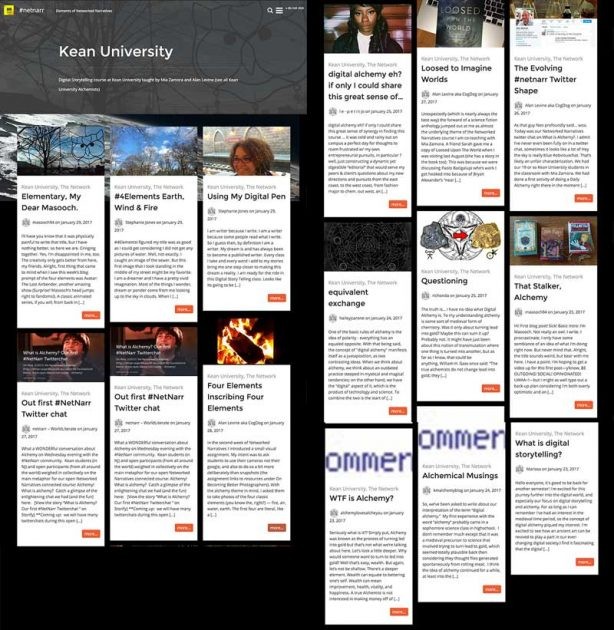
Screen shot montage of the most recent syndicated posts by Kean students; by now it’s already changed
Hocus Pocus… OPML
So I am going to share you some web alchemy, and a magic potion called OPML. You need not know what that stands for (make something up), nor do you even have to look at it (it’s cryptic XML, don’t look).
If you can understand that an RSS feed represents an updated data file that shows the latest content of one blog, and OPML file is a bundle of links to RSS feeds, it’s like a mega subscription file. It’s like a big folder of — okay, the metaphors are getting in the way.
Let’s just do it.
First we need to get these magical mysterious files. I am going to do this with the interest of following just our Kean blogs, but this could work for all of them or the open ones as well. You will find the same links on all.
From each of these “flow” pages, in the header you will find links to a page that lists all of the blogs that are connected, I call them Notebooks — here is the one for Ken alchemists (see also the one for all blogs or open ones).
Check the four orange buttons
Click the buttons for Blogs OPML and the one for Blog Comments OPML (you should do this on a computer, mobile devices probably will cry when you click on these).
Both links will save files to your computer. Just download them. Do not open them.
To set up yourself to be an OPML Alchemist, you need a tool called an “RSS Reader.” There are a number you can use (Google had a great one, and they killed it, sigh. I’m still in mourning).
I will recommend Feedly, but you could easily use other ones. Feedly is free, go create an account. It will give you something blank. Like twitter, they want to suggest things for you. Do that later. Or never.
But do click (if the right side here is not visible) the Discover and Follow button. Way down at the bottom, is the link you want:
So first import the Blogs OPML file you downloaded. Lights may blink and gears are churning.
On the left side, you will see a link that represents all of the blogs listed in the file. On the right will be some kind of listing of the posts from these blogs, the newest ones first.
Posts from all the blogs in one OPML file. Cool!
The titles in bold are ones I have not read. So the interface can tell you at a glance what is new.
Your first view may be more of a graphic grid layout, different from my screenshot above. That’s my preference; you can change the views by opening the small menu to the right of the title:
If there is a title that looks interesting, clicking it opens it so I can read the blog post right here:
Reading one post…
When a post os open, if you click it’s title, you can then jump over to the blog itself if you prefer reading it there (or if you want to add comments).
You can even use keyboard shortcuts to read through them– j loads the next one and k the previous. You can read through many blogs this way.
As they say on late night TV, “but wait, there is more!”
If you click the OPML feed open on the left, you can see the names of all blogs in the subscription. And if you click a blog, you can now scan all the posts from one blog:
Okay, let’s breathe. With this set up, we can read a whole bunch of blogs in one single interface. When a blog publishes new stuff, it will be updated here (there might be some lag in how often feedly checks for updates).
That’s why I consider this one of the few technologies I can safely say that it saves you time.
Okay, but there is the second OPML file. We use the first to read the posts. The second one contains the activity on the comments to all blog posts (this works for blogs published on WordPress or Blogger only).
That’s right, folks– you can monitor the comment conversations on hundreds (or 10 or 3) blogs in one place. AMAZING! ?
Now import the other OPML file, the blog comments one.
In this case, I see the title of the post that was commented on, as well as the name of the commenter, all in my scan view:
Just flip through them (j and k are your friends), and if you want to respond, click the title and jump out to a blog.
And like above, I can quickly see what the activity looks like on a single blog:
Yes, Writeannabella is getting good activity on her new blog– I can see it in a glance, as well as seeing that there are no comments. At once glance, we can get a sense of the participation level on every blog or the community as a whole.
I cannot say enough how critical this alchemy is to stay in touch with the activity in an open networked course. Yes, it is good for teachers, but it is just as useful for participants to take in all the activity in one place.
Are you ready to do some OPML Alchemy? Fear not the funky acronyms!