Category Archives: Featured

Why Write an Open Text

Because I’m continually excited my work on APEX Calculus, I’ve talked with a number of people in an attempt to get them to write an open text, too. Here’s a list of reasons.

  1. You’ll enjoy it. Writing is a creative process, and most people enjoy creating. Do you like creating handouts for your students that explain better (in your opinion) a difficult section of the test? Do you like creating challenging problems that expose the nuances of theory, or demonstrate the application of an idea? If so, you’ll enjoy writing a text. I wrote a math book and even loved the creativity involved with page layout, font selection, and the design of graphics.
  2. You’ll really master the subject. Of course you have mastery over the content of the courses you teach. But writing a book on the subject will take you deeper.
  3. It looks great for tenure/promotion. You have to do something to earn t&p; might as well do something you’ll enjoy (see #1 above). HUGE CAVEAT: get written permission first. Different places regard open materials … differently. Some places won’t give you credit unless a publisher thinks they can make money off of your text and signs a book deal with you. 
  4. The book stays yours. Items 1, 2 & 3 above apply whether your book is open or not. This is the first “why make your book open” item. There are lots of horror stories of people writing under contract where the final book doesn’t really reflect what they, the author, wanted. They’ll make you add material that you don’t think fits because they think it’ll sell better. You’ll get sucked into the “new edition” cycle that you, as a teacher, hate. 
  5. You can make money. Yes, I said that. I went into this staunchly opposed to earning any money. My “payment” was going to be tenure & promotions. Then, 800 pages and countless hours later, my colleagues & wife convinced me it was ok to be paid in dollars, too. I still give the .pdf out for free, but make royalties on the purchase of printed books. Don’t plan on getting rich. But you’ll get a kick out of royalty checks that eventually cover a family vacation. It also offers a nice tether to continually improving your work: if you make your product better, you may get more adoptions, which means more money. The downside: tax season becomes even more memorable. As an author collecting royalties, you are now an independent contractor.
  6. Students will save money. This is often touted as the main reason to write open texts. I saved it for last for a reason. Call me a jerk, but working hard to save other people money is only rewarding for a short time. If items 1 through 5 above didn’t hold true, the cost savings to students wouldn’t be enough to motivate me to write. But students will save money. New calculus books cost up to $300. Mine costs about $45, and is split into 3 $15 volumes (so students only pay a little each semester). And then some buy used, saving even more!!

You may say “Ok, sounds good. I’ve been thinking about writing a text for a while and now I’m convinced to try. What’s next? Any advice on getting started?” Yes, I have such advice. I’ll cover it in my next post.
Getting Started: Open Learning ’17

Open Learning ‘17 launches January 23 … and you’re invited!

There’s a great deal of talk in colleges and universities about “open” these days. Open Educational Resources. Open Access. Open Pedagogy. Open Culture. As part of Virginia’s “Faculty Collaboratives” effort, the AAC&U and the State Council for Higher Education in Virginia are partnering to sponsor a free, online, and open learning experience called “Open Learning ’17.” Somewhere between a course of study and an informal conversation, the experience emphasizes collegial, interactive, networked learning and sharing. Who is this for?

·         Are you open to new ways of motivating student learning?

·         Are you curious about open education, but haven’t really learned much about it before?

·         Do you have experience with some aspects of open education and want to learn about others?

·         Are you an expert already?

If you answered yes to any of these questions, there’s a place for you at Open Learning ’17.

In Open Learning ’17, we’ll explore all the “opens,” as well as the historical, intellectual, and cultural contexts that give them meaning. Each week will feature both synchronous activities (such as webinars, Twitter chats, etc.) and asynchronous activities (readings, reflective blogging, resource sharing, and other ongoing conversations). Participants in Virginia, in other states committed to the “Faculty Collaboratives” project, and beyond, will work together as co-learners.  You don’t have to be an expert in open education; indeed, the majority of participants will not be. The goal is to create an “innovation hub” that reflects and helps to sustain a dynamic conversation about how openness in education can support the learning we seek in active, student-centered pedagogies.

You can join us at a variety of ways.  To get the most out of it, you should register a blog at the main course site http://openlearninghub.net so your ongoing reflections about the course can be easily shared with other participants. Step-by-step directions are at the “Join Up” link on the main menu: http://openlearninghub.net/the-stream/. If you don’t have a blog, please consider starting one; participants’ reflections (including yours) will be invaluable resources for all of us, during the course and after. If we’re thinking about open learning, it makes sense to practice open learning and experience some of these practices first-hand, including the great opportunities for creative expression that come from writing on the web.

You’re also welcome to follow along and contribute in other ways:

·         By following our Twitter hashtag, #openlearning17, and contributing your own thoughts via Twitter.

·         Or by simply following the activity on the hub: http://openlearninghub.net.

We want to emphasize shared creation of content, not just consumption—but the course’s open design makes it possible for people to choose how and when they want to interact with course activities.  In addition, each week is (more or less) independent from the others, so if you miss the beginning it’s not too late to jump in anytime.  If you’re only interested in one topic, dive in there! You’ll get the most out of the experience, though, by participating in the whole course.

Open learning helps us understand, and practice, a richly rewarding way to contribute to the public good. It’s also a form of experiential learning, a high-impact practice. As with any community, there are important norms. We encourage passion and expect civility. And we also emphasize that the focus is on reflective responses and engagement, not right or wrong answers.

Please consider sharing this invitation with anyone at your institution who might be interested. If you have questions, feel free to contact the Hub Director, Gardner Campbell, at wgcampbell AT vcu.edu (substitute @ for AT). We look forward to seeing you soon on the hub, and around the Web!

A conversation with Susan Albertine about Faculty Collaboratives

Virginia’s Faculty Collaboratives “Innovation Hub,” the site of an upcoming connectivist MOOC called “Open Learning,” is now open! (Makes sense, yes?) Please visit our Faculty Collaboratives/Open Learning hub to join up and explore the journey that awaits.

You may wonder, “what’s Faculty Collaboratives?” I put that very question to the AAC&U’s Dr. Susan Albertine, designer and leader of this initiative. In part one of our conversation, Dr. Albertine explains the history, mission, and aspirations of the project.

Click on the image above to access the interview with Dr. Albertine

In part two of our conversation, coming soon, Dr. Albertine expands on the idea of “mind-liberating” education at the heart of Liberal Education and America’s Promise (LEAP).

Virginia is proud to be one of those thirteen LEAP states Dr. Albertine describes. We’re also a Phase 2 Faculty Collaboratives participant. And because Virginia!, we’re doing something unique with this cMOOC learning opportunity.

Join us!


Open Learning Hub launches!

Welcome to Virginia’s Open Learning Hub, site of our spring 2017 online course.

Welcome Video
Click on the image above for the welcome video.

Ready reference from the above video:

For technical support, email Gardner Campbell at gardner.campbellATgmail.com (replace AT with @).

For information on the AAC&U Faculty Collaboratives Initiative: https://www.aacu.org/faculty.

For more details, follow the #openlearning17 hashtag, or the @LEAPVirginia Twitter account.

And once again … welcome!


My Digital Resident & Visitor Map

I’m putting together a session for college and community leaders on digital platforms and professional development. It’s a short session – I only have 30 minutes.   Additionally, there are pre-set criteria for the session that essentially boil down to requiring an experiential adult learning experience. In short, I need to offer a taste of something larger and compelling, but that is also discreet, active, and meaningful on its own.

I’m struggling.  Thirty minutes is not a long time.

However, I often find that all goodness starts with completing a Visitors and Residents Mapping Exercise.  The digital visitor/resident model was introduced by David White, Donna Lanclos, and colleagues in 2011.  The model represents a spectrum of behaviors (visitors to residents) as compared to the older and now debunked digital natives narrative, which focuses on discrete groups of people.

When acting as digital visitors, people consider digital platforms as tools. Their behavior tends to be goal oriented.  They limit their time online to what is required to achieve their goals and tend to get offline without leaving much of a digital trace or identity. In contrast, digital residents perceive digital platforms as spaces more than tools: spaces that can be linked together and inhabited along with other people.  They tend to spend more time on the platform, leaving artifacts and developing identities within those spaces.

resident_visitor
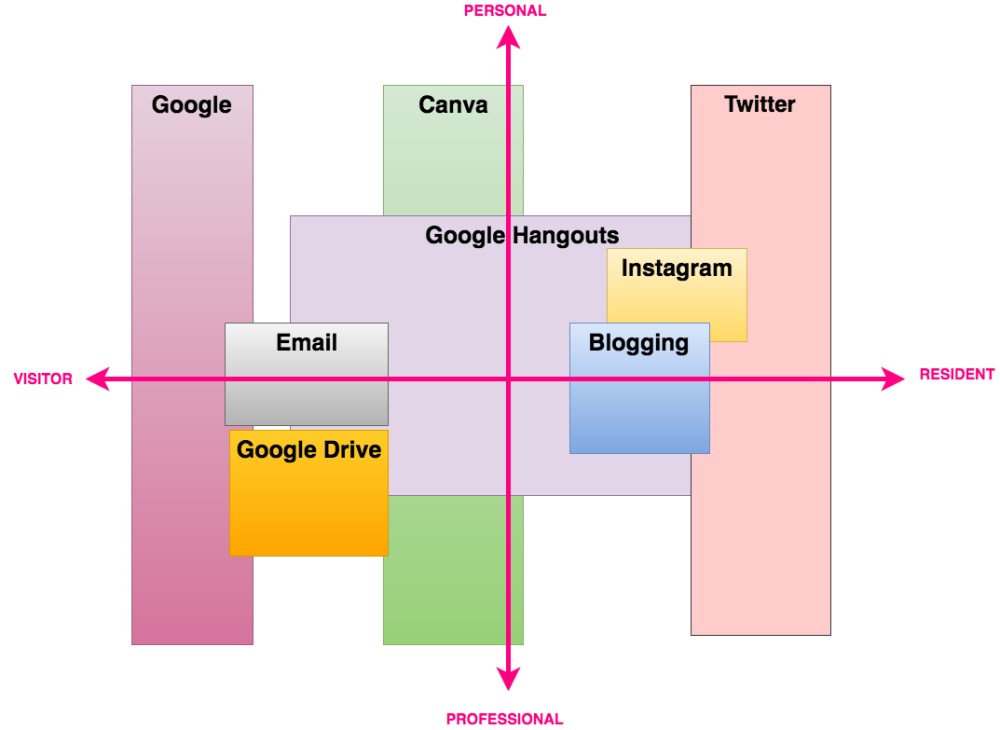
A simplified version of my digital map, as of October 2016

This is my digital map. It shows how someone can be a digital resident and visitor at the same time both within and across platforms.  It shows that I tend to mix my personal and professional use of digital platforms.  It shows Google Hangouts as a significant area of context collapse; I use it as a tool to be sure, but it is also a space where I talk to my friends about their families, conduct research meetings, and give guest lectures…sometimes back-to-back, sometimes in the same hangout.  I have literally had girlfriend chats that shifted into business meetings that shifted back into girlfriend chats – changes signified through the on air button. Another interesting overlap occurs at blogging, instagram, and twitter.  I use these platforms differently, but my followers significantly overlap.  Instagram is kind of like my B side.

I like my map.  Now I just need to jump from this to a micro-presentation.

The Small Random Things That Openness Affords

This kind of small act of near random #ds106 connection will not increase enrollments, will not “fix” education, will not improve institutional metrics… yet I just cannot let it slip by without a small “wow”.

And the ironic thing is that the tweet in which I saw it came into my view about 5 minutes before I had to jump into a video call to Cape Breton University by invitation of Grant Potter. I was asked to say some encouraging things about openness to a faculty group there.

While I am still musing on the takeaway from Catherine Cronin’s OER16 keynote caution about “amazing stories” not being enough to convince people to share openly… I did so anyway because I do believe we have a case to make about shifting teaching to a place where the audience is more than the teacher giving out grades.

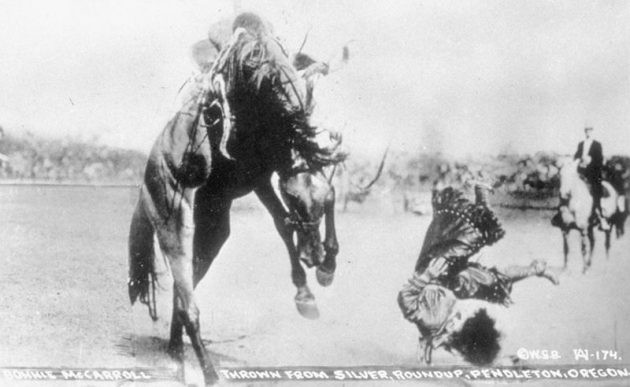
But let’s rewind back to a #ds106 Daily Create from January 25, 2016, when I was still casting most of them in a western theme. In consideration of feedback I heard about westerns being such a male dominated genre, I had been looking to find female western figures, but in fiction, history. I cannot remember the exact search path, but I was rather jaw dropped in reading about an early 20th century rodeo bronco riding star named Bonnie McCaroll:

Bonnie McCarroll, born Mary Ellen “Dot” Treadwell (1897 – September 29, 1929), was a champion rodeo performer and bronc rider most remembered for her death at the Pendleton Round-up in Pendleton, Oregon. She also excelled in steer riding, bulldogging, and automobile jumping.

In 1915, her first year of rodeo competition, McCarroll attracted national attention from a photograph taken of her being thrown from the horse named “Silver” at the Pendleton Round-Up. In her career, she performed before kings, queens, such dignitaries as U.S. President Calvin Coolidge, while he was vacationing in the Black Hills of South Dakota in 1927, and before countless rodeo fans worldwide. After her death, rodeo officials instituted safety regulations and eliminated bronc riding as a women’s sport.

This fantastic photo is what caught my eye and landed me in that Wikipedia article:

Public domain image from Wikimedia Commons

And thus we had a Daily Create on January 25, 2016:

tdc1478

One of the many beautiful responses was Ron’s hand colored photo of Bonnie McCaroll (Ron has been a near perfect ds106 Daily Create Tour de Creative Force)

For some reason, 93 days after Ron tweeted his response, someone replied:

Ann is a bronze sculpture artist from Bridgeport Texas who specializes in works depicting cowgirls (see her web site at http://annayresbronzes.com/).

It’s not a total fluke, I would guess Ann does some regular searches on the figures she uses in her art, but still, here we go again, with an unexpected connection, however small, generated because Ron shared his art in the open.

It would not be possible without an open web.

Keep that in mind was other mega entities are praised for “eating the internet“.

Thanks Ann for finding out little corner of the web.


A screenshot of the sculpture “Bonnie McCarroll 1915 Pendleton Round-Up” by bronze artist Ann Ayres, from her web site http://annayresbronzes.com/

The post “The Small Random Things That Openness Affords” was originally emerged from the primordial ooze and first walked on land at CogDogBlog (http://cogdogblog.com/2016/04/openness-affords/) on April 27, 2016.