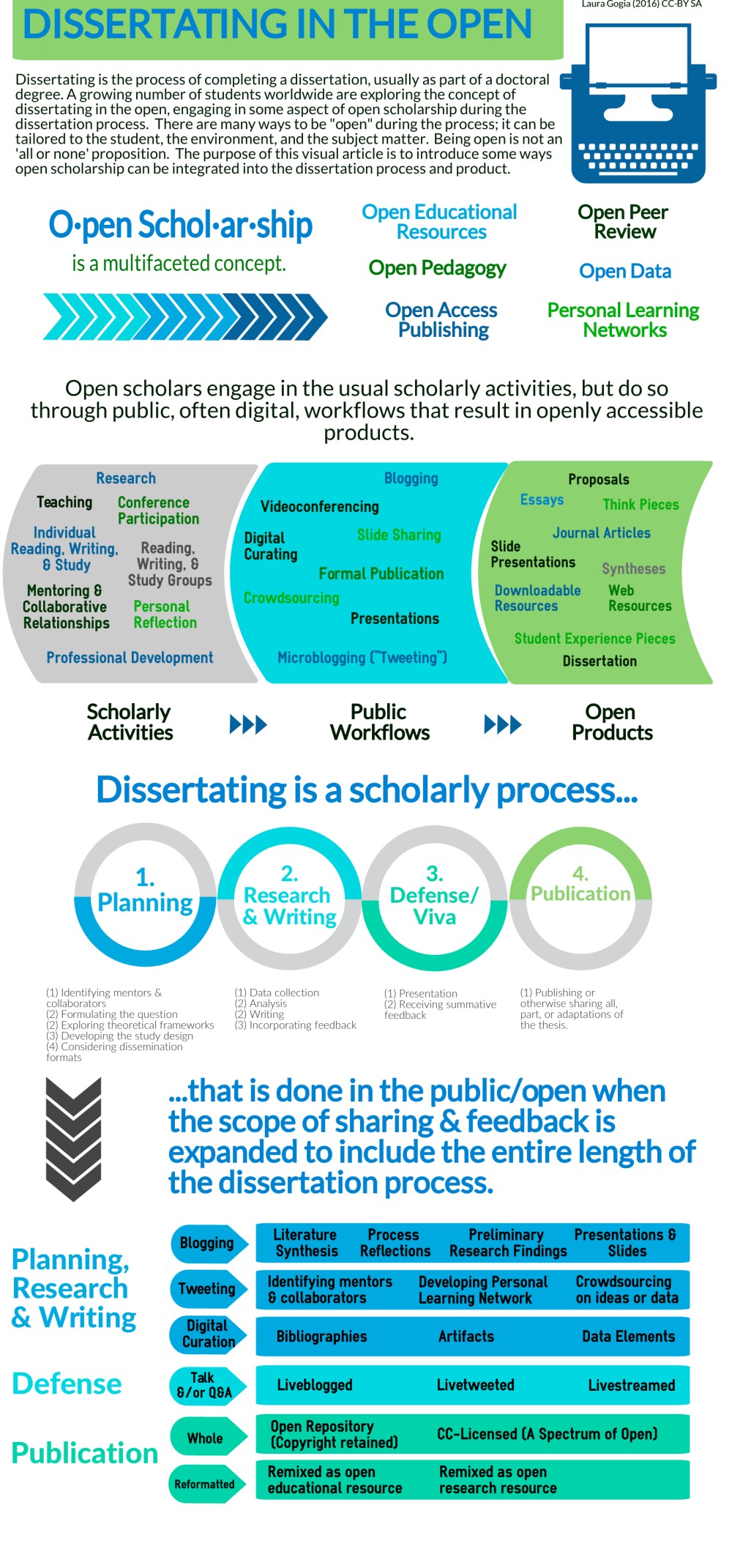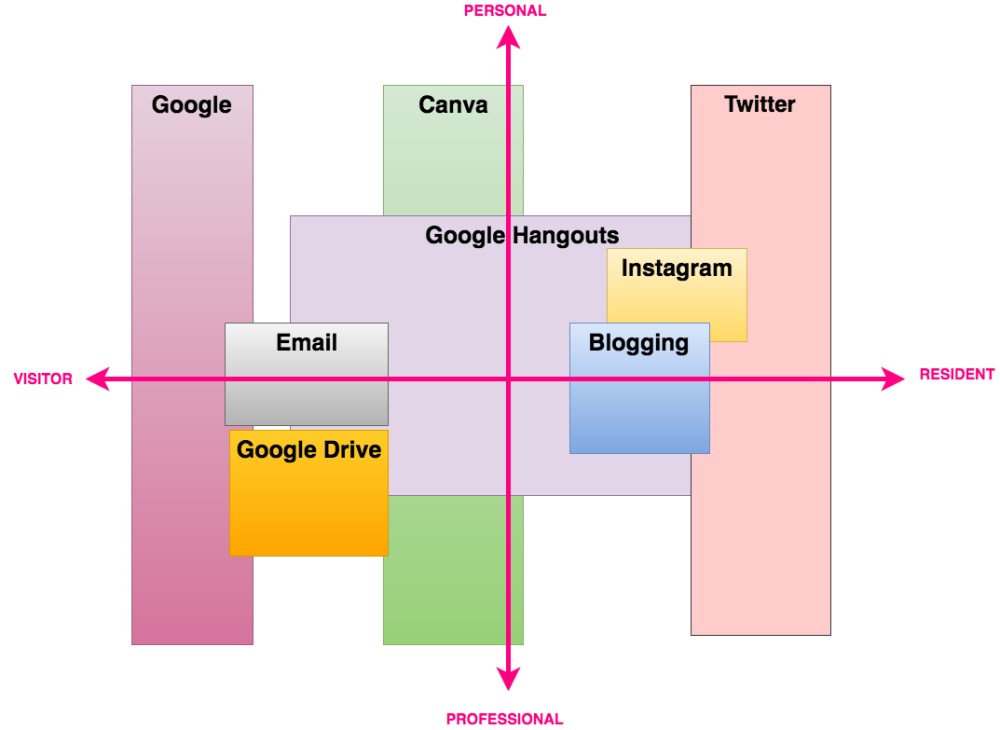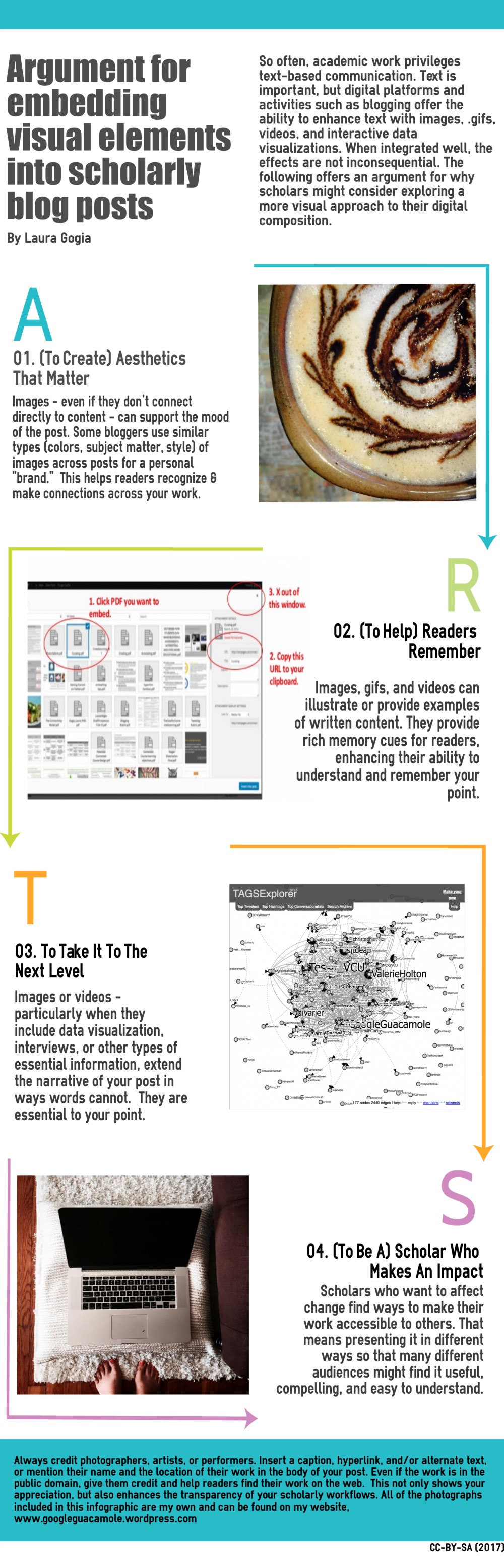


I originally created and published A Little Bird Told Me: Maximizing Your Learning on Twitter in 2015. The one page list of strategies was my first ever pinned tweet. It has been one of my more successful online endeavors, capturing thousands of views and hundreds (maybe close to a thousand if you count across platforms) of downloads. Instructors have incorporated it in their syllabi and I get notifications all the time – one as recently as two days ago – that new seminars and professional groups have passed it around for participant consideration.
A Little Bird has personal significance. It was the first document I created specifically for my own professional need; no one else asked me to make it, nor did I show it to anyone before I published it. I made it for myself, because I was tired of seeing faculty struggle with convincing their students to think about Twitter as a tool for learning. Conceiving, designing, and publishing A Little Bird was the first concrete evidence that I had developed a pedagogical practice and voice. It was my first step in identifying myself as an educator and not just an ex-physician taking classes in education. Like I said, A Little Bird is a personal milepost.
I’ll be honest – although it is only two years old, looking at A Little Bird makes me wince a tiny bit. Content-wise, it is sound. It was never meant to be comprehensive, but what is there is good and reflects the fact that I was more skilled at pedagogical Twitter a year ago than I am now probably. However, the visual presentation – a one paged, tiny font list of bulleted paragraphs – is not how I would present information on the web today. I have been impacted by my subsequent work with Tod Massa, who strongly encouraged me to integrate color, graphics, and design into everything that I do. I no longer put out handouts that look like bulleted lists only.
So. Given the fact that A Little Bird still gets pulled for new classes, seminars, professional development, etc., I wanted to give faculty and participants an option. The original document remains where it has always been. However, yesterday I reformatted the content (and tightened up the copy, but only just a bit) to be an infographic. Yes, I used one of my published color palettes (and yes it saved time). And you can download the infographic as a pdf if you really want to.
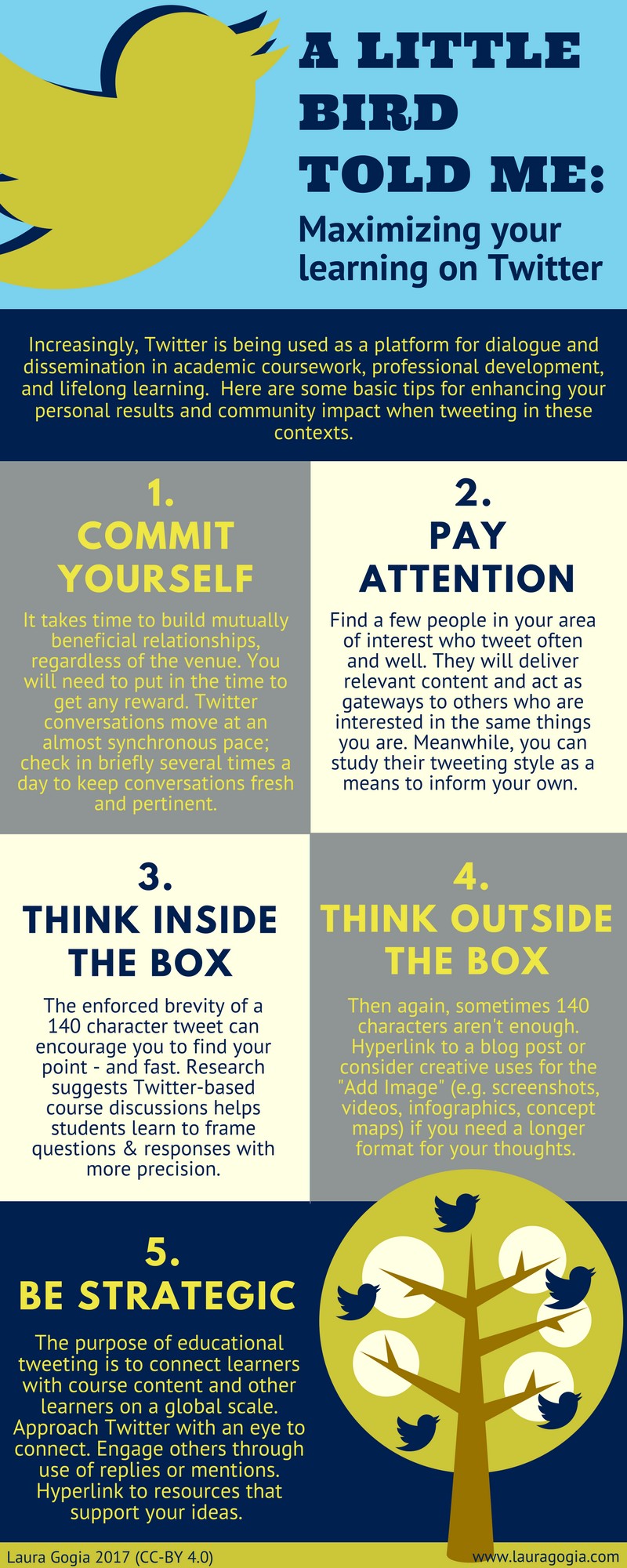


To continue my series of visual articles on educational research, I have branched out (or perhaps come home) to the act of dissertating in the open. The following is meant to introduce the idea – to show the overlap and points of potential integration between open scholarship and the process of planning, implementing, and publishing a dissertation.
Much of what follows is inspired by the writings of Catherine Cronin and George Veletsianos and Royce Kimmons, conversations with Bonnie Stewart, Maha Bali, Virtually Connecting, and #OpenEd2016, and my own work with Jon Becker and Alec Couros. Special thanks again to Maha Bali and Tod Massa who reviewed this and offered their comments.
This is not meant to introduce the idea of open dissertations completely. There are additional things to be said and places to go. This is a part one.


Data visualization. It’s a buzzword we hear frequently, usually in connection to other buzzwords like big data, business intelligence, dashboards, and accountability. However, data visualization doesn’t have to be a buzzword. As a concept, it can be quite simple: it is the act of collecting information and displaying it in ways that illuminate while allowing for informed decision making. Data visualization does not have to be fancy to be effective; in fact, simple is often better. Even the simplest forms of data visualization can drive conversation and change.
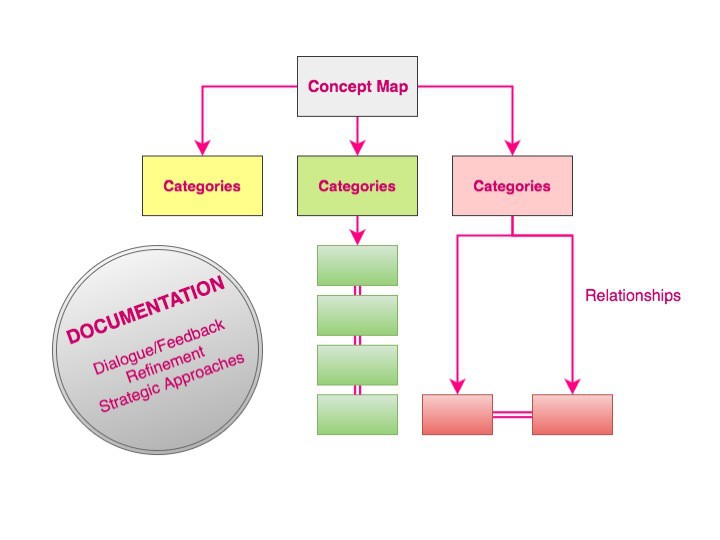
A concept map is a form of data viz that educational researchers have shown since the 1970s to be an effective way to help people grasp complex concepts. According to the research, concept maps work in several ways.
And the best thing about concept mapping is that it can be adapted to be useful in many contexts for facilitating discussion and enabling change.
Let’s work through an example in which we use a simple form of data visualization – concept mapping – to reflect on and discuss our behaviors in digital spaces as a potential form of professional development.

1.Take ten seconds to write down as many answers to this question as possible. Where do you go when you are online? Which platforms, digital spaces, applications – anything you do online – personal or professional.
Go ahead. I’ll wait.
My guess is that you had no problems writing down a handful – search engines, email accounts, entertainment services like Netflix and Spotify, social media (Facebook, maybe Twitter, Instagram). The creatives among you may have some video, music, photo, or graphic design applications on the list – things that help you remix or create things.
2.Circle the ones you use for work or your professional development.
3. Identify five ways that you used those digital platforms or spaces. What sorts of activities were you engaging in? What was your purpose in being there?
Generally speaking, when people get on the Internet, much of what they do can be described through four categories of engagement. These are not necessarily mutually exclusive or a comprehensive list, but they are a way to begin to think about and talk about what you do on the web.
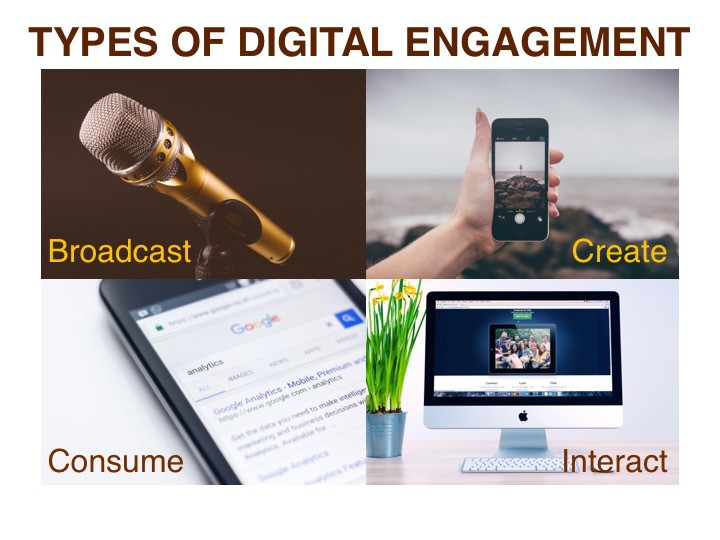
Like I said, these activities aren’t mutually exclusive – sometimes we make things collaboratively, for example. And certainly they can be used in a sequential fashion – in fact, I’m going to give you an example of that in a minute. But I find that these categories can be useful when we are talking about what we are doing on the Internet.
4. So, now that we have a little bit of a vocabulary how can we leverage these spaces and our behaviors to advance our professional development? I want you to take a moment to choose how you are going to frame this question for your own purposes. Are you going to think about your students’ professional development? Your team’s? Your own? All of those would work for the activity that’s coming up – pick the one that interests you the most.
There are plenty of answers to that question, but the one I’d like for us to consider is the idea of a personal learning network, which is a form of strategic digital engagement that fosters, learning, sharing, and professional networking in ways that potentially transcends institutions, geography, and traditional power hierarchies.
So, how do professional learning networks work? I’m going to offer a personal example.
5. As I tell this story, I want you to look for the digital spaces, the types of digital engagement, and how things fit together.
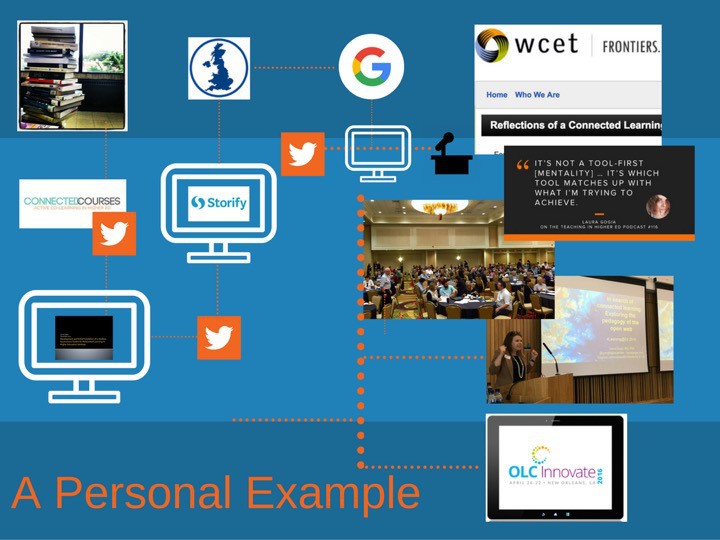
In the fall of 2014, as part of my graduate fellowship, I participated in a massively open online course (MOOC) on faculty development and connected learning. Through my Twitter interactions related to that course, I became recognized in within the connected learning community as someone who researched connected learning as part of my dissertation work. Around that same time, I was developing and presenting a mock prospectus for a dissertation preparation course. I posted my mock prospectus slides on slide sharing platform and then embedded that presentation in a blog post in which I described my research proposal. I advertised my blog post on Twitter using the MOOC hashtag and asked the people from the course to take a look and offer feedback.
As they commented and asked me questions on Twitter, I noticed some themes across their responses. I aggregated their tweets on Storify, which is a storytelling digital platform, and embedded the product into a blog post in which I suggested potential areas for research collaborations based on the questions they were asking. I advertised that post on Twitter, using the MOOC hashtag. Several scholars expressed in interest in collaborating in different areas. For the next 18 months I worked several research collaborations through combinations of Google Hangouts, Docs, and Google Plus. This work led to conference proposals and publications at an international level. The combinations of online and conference presentations led to keynote and plenary addresses, guest blogging assignments, panels and podcast invitations, and consulting work.
Can you identify two or three digital platforms and types of engagement from that story?
So I am not trying to suggest that everyone needs to develop a professional learning network as complex as my own, but what I am arguing is that there can be benefits from approaching digital engagement intentionally.
How can we optimize what we do online the same way we tend to think about optimizing our activities offline?
The answer is to
In terms of digital engagement, the V&R scholars developed a mapping exercise that aims to help people talk about their online activity in terms of being digital visitors and residents. In David White’s words,
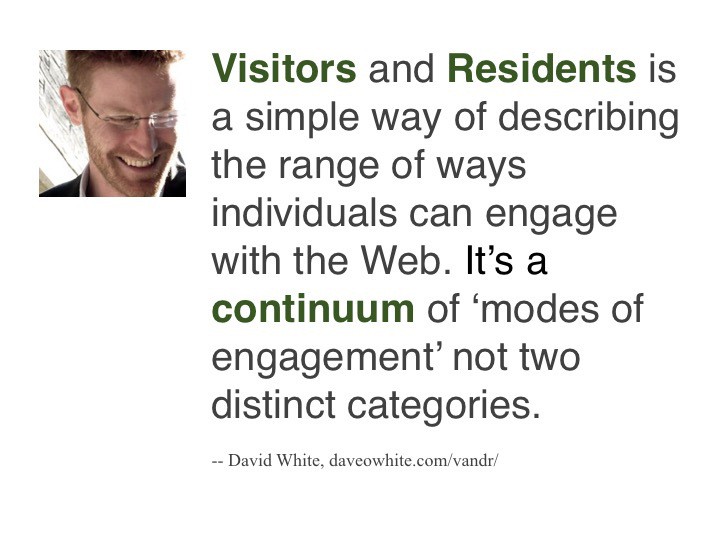 So they describe a spectrum of engagement anchored on both ends by visitor activity, which tends to perceive digital platforms as tools. When we act as visitors, we tend to be goal oriented – we get in and get out without leaving too much of a digital footprint.
On the other side of the spectrum, when we acts as digital residents, we tend to think of the digital in terms of a space that we inhabit along with other people. Activity tends to be more extended and less goal driven. When we act as residents, we are there to build a presence or an identity.
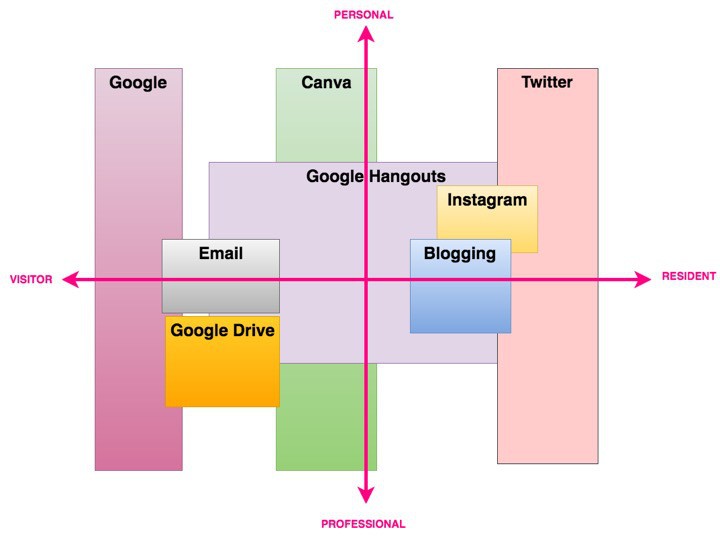
This is a simplified version of my V&R map. I’ve identified my primary digital platforms. There are two axes – the first is the Visitor and Resident axes, which we’ve discussed. In my case I tend to use things like Google search engines in very goal-oriented sorts of ways and I tend to hang out on Twitter – that’s where my community is.
The other axis is personal and professional use – sometimes you’ll see this listed as “institutional.” It’s useful because many people tend to have dual lives in the digital world – in fact you might have one email account up here and a different one down here. But you’ll see that I am not particularly dualistic. I have a lot of overlap – and that’s actually the sort of observation that could lead to discussion on strategy and intentionality, right?
6. Take a moment to draw your own map. It doesn’t have to be comprehensive. You already have a list of platforms to work with.
7. Talk it over with a partner. Consider these things as places to start:
 And when we finish, let’s think about exactly what we did.


I’m putting together a session for college and community leaders on digital platforms and professional development. It’s a short session – I only have 30 minutes. Additionally, there are pre-set criteria for the session that essentially boil down to requiring an experiential adult learning experience. In short, I need to offer a taste of something larger and compelling, but that is also discreet, active, and meaningful on its own.
I’m struggling. Thirty minutes is not a long time.
However, I often find that all goodness starts with completing a Visitors and Residents Mapping Exercise. The digital visitor/resident model was introduced by David White, Donna Lanclos, and colleagues in 2011. The model represents a spectrum of behaviors (visitors to residents) as compared to the older and now debunked digital natives narrative, which focuses on discrete groups of people.
When acting as digital visitors, people consider digital platforms as tools. Their behavior tends to be goal oriented. They limit their time online to what is required to achieve their goals and tend to get offline without leaving much of a digital trace or identity. In contrast, digital residents perceive digital platforms as spaces more than tools: spaces that can be linked together and inhabited along with other people. They tend to spend more time on the platform, leaving artifacts and developing identities within those spaces.

This is my digital map. It shows how someone can be a digital resident and visitor at the same time both within and across platforms. It shows that I tend to mix my personal and professional use of digital platforms. It shows Google Hangouts as a significant area of context collapse; I use it as a tool to be sure, but it is also a space where I talk to my friends about their families, conduct research meetings, and give guest lectures…sometimes back-to-back, sometimes in the same hangout. I have literally had girlfriend chats that shifted into business meetings that shifted back into girlfriend chats – changes signified through the on air button. Another interesting overlap occurs at blogging, instagram, and twitter. I use these platforms differently, but my followers significantly overlap. Instagram is kind of like my B side.
I like my map. Now I just need to jump from this to a micro-presentation.


Recently, I’ve spent much time and energy discussing the pedagogical merits of blogging: a practice that supports skills such as social networking; providing and receiving feedback; developing a sense of audience; and creating a searchable, filterable, organizable record of thinking and growth over time. Alan Levine talks about this last benefit all the time – he can trace his learning for decades through his blog. That’s wicked cool.
I’ve been blogging for about 5 years. It’s really interesting to look at how my practice has changed over time. I had some better stories back then, but I’m better at telling them now. More balanced. I’m growing into my blogging and it shows.
However, a couple of nights ago I was searching through old folders on my PC. I was looking for an image that I needed to edit and submit for an upcoming publication. While I was searching (and cursing my lack of organization in the last days of my dissertation phase) I happened across a folder of old avatar pics, some of them as many as five or six years old. My doctoral program was full of opportunities to establish a digital presence. Blogging, tweeting, and Google Plus were required in one class or another, LinkedIn was often encouraged by the faculty, Skype came in handy, and Instagram wasn’t much of a stretch. Furthermore, I presented at plenty of professional conferences and was interviewed for articles.. all of these required pictures or avatars.
Oh, the avatars. The selfies.
Selfies are somewhat controversial among the general population. Some people have embraced them as opportunities to document, empower, or entertain. Others see them as an alarming trend towards collective narcissism and self-involvement. Since I tend to be the photographer of the family, I see them as the only real visual record of my existence in this world (seriously – and I’m not the only one with this problem).
When I look through the avatar folder, I see my graduate school story unfold as clearly as it does in this blog. In fact, flipping through selfies might be a more visceral experience than clicking through blog posts, because the pictures were taken in a moment rather than composed over hours, days, or weeks. When I look at these pictures, I see more than age changes (although there are plenty of those). I see a growing understanding of social media (that first picture on LinkedIn? really? I was a hot mess). I see signs belonging within academic communities (the Howard Rheingold impression). I see confidence in a professional role (never been more in my element than in that picture with my glasses on the top of my head). I see landmark occasions (graduation). I see my kids. I see some pretty significant depression this summer (the third and second to last pictures… I wince a little when I see them and recovery (what a difference a couple months can make). I see me. The avatars help me lay it all out. They aren’t about self-absorption as much as sharing and recording, just like blogging.




Tomorrow, Lee Skallerup and I will be speaking to Ken Bauer’s #iTec Digital Identity course, a five day bootcamp on digital identity for undergraduate students at Tecnológico de Monterrey on…you guessed it – digital identity. Ken has put together a stunning lineup – Dave Cormier, Bonnie Stewart, Alan Levine, Amy Burvall, and Autumm Caines – and that’s just on the first half of the week.
I’ve heard all of those people speak expertly on digital identity, to the point that I feel a bit superfluous. However, in the spirit of not giving into imposter syndrome, I’ve devoted a bit of time to thinking about what I can bring to the conversation that is special and uniquely my own.
I started by brainstorming on Twitter with 5 thoughts on my approach to digital identity and when I started that list, it became clear to me fairly quickly that I had a problem with the title of this course.
I don’t like to talk about digital identity, because it creates an unnatural divide between digital and other forms of identity. Digital identity is no different than the multiple identities we carry through the day – e.g. our parenting identity, professional identity, peer identities.
Personally, I’ve been working hard over the last five years to consolidate those identities into a balanced, holistic approach to being an authentic human…so to separate out my ‘digital identity’ and talk about it for minutes on end just doesn’t seem to jibe with the rest of my life mission.
I am myself. I am myself in digital spaces. I am myself in the grocery store, in my living room, in my work cubicle. Because my digital experience is so completely integrated into my physical activities, I am my digital self at the very same time that I am waiting in the grocery store line, and in my living room, and in my work cubicle. In fact, I workout early in the mornings to exercise videos stored on my google drive. I can be doing one-legged burpees when I see a Twitter notification pop up in the corner of the screen. Therefore, I am my digital self even as I am very much also my physical self. The distinction is meaningless to me.
I prefer to talk about digital presence.
Presence is closely related to but different from identity. Identity is who you are; presence is how you behave. How you present yourself. How you engage with the space and others in it.
Digital presence. All of the speakers Ken has lined up are brilliant on digital presence, but I can speak specifically to what it means to behave as a learner in a digital space.
My primary goal as a blogger and tweeter is to learn. I am a constructionist at heart; Seymour Papert writes that thinking is made sharper – refined – when it is made concrete. Write a thought down and it becomes less abstract while also becoming something that is available for self reflection and social commentary. I write to make things concrete. I write in digital public spaces to gain access to social commentary.
I blog and tweet to create a record. We learn by studying our own trails (and the trails of others). In 1945, Vannevar Bush called these associative trails. Sure, I could trace my trails through journals and scrapbooks, but I write in digital, public spaces so that I can have access to hyperlinks, tags, filters, multimodal forms of expression. I write in these spaces to have access to digital affordances. The ability to rearrange posts and create serendipitous juxtapositions is magical, happy learning.
Finally, I blog and tweet to be a part of something larger than myself. I have written over and over again on personal learning networks (so has Dave Cormier, probably a little more famously) so I’m not going to belabor the point now. But as I have said before (and so has Howard Rheingold), the key to learning in and on the open web is making oneself useful. There are different ways to make oneself useful. Being a learner is not just about the cognitive stuff; yes, on Twitter I have been known to help people learn their epistemological frameworks and others have helped me learn to code SQL sequences (all true, documentable stories). However, meaningful learning is often emotional. It feels scary sometimes. Isolating. Confusing. Lonely. I make myself useful by making myself available in digital spaces. I help people and they help me as best as we all can, because we are human: humans being humans in digital spaces.
Digital presence as an opportunity to create, record, and share – that’s what I’m going to talk about tomorrow.