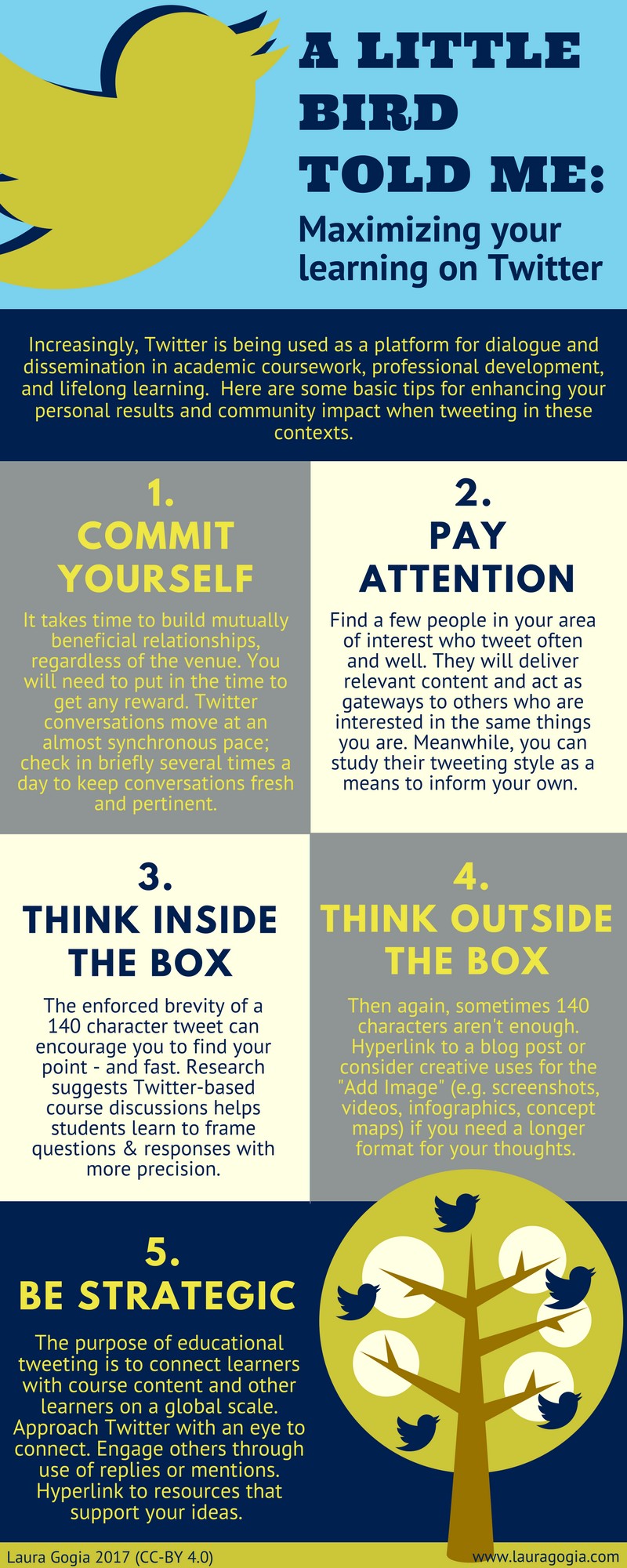
I originally created and published A Little Bird Told Me: Maximizing Your Learning on Twitter in 2015. The one page list of strategies was my first ever pinned tweet. It has been one of my more successful online endeavors, capturing thousands of views and hundreds (maybe close to a thousand if you count across platforms) of downloads. Instructors have incorporated it in their syllabi and I get notifications all the time – one as recently as two days ago – that new seminars and professional groups have passed it around for participant consideration.
A Little Bird has personal significance. It was the first document I created specifically for my own professional need; no one else asked me to make it, nor did I show it to anyone before I published it. I made it for myself, because I was tired of seeing faculty struggle with convincing their students to think about Twitter as a tool for learning. Conceiving, designing, and publishing A Little Bird was the first concrete evidence that I had developed a pedagogical practice and voice. It was my first step in identifying myself as an educator and not just an ex-physician taking classes in education. Like I said, A Little Bird is a personal milepost.
I’ll be honest – although it is only two years old, looking at A Little Bird makes me wince a tiny bit. Content-wise, it is sound. It was never meant to be comprehensive, but what is there is good and reflects the fact that I was more skilled at pedagogical Twitter a year ago than I am now probably. However, the visual presentation – a one paged, tiny font list of bulleted paragraphs – is not how I would present information on the web today. I have been impacted by my subsequent work with Tod Massa, who strongly encouraged me to integrate color, graphics, and design into everything that I do. I no longer put out handouts that look like bulleted lists only.
So. Given the fact that A Little Bird still gets pulled for new classes, seminars, professional development, etc., I wanted to give faculty and participants an option. The original document remains where it has always been. However, yesterday I reformatted the content (and tightened up the copy, but only just a bit) to be an infographic. Yes, I used one of my published color palettes (and yes it saved time). And you can download the infographic as a pdf if you really want to.
Data visualization. It’s a buzzword we hear frequently, usually in connection to other buzzwords like big data, business intelligence, dashboards, and accountability. However, data visualization doesn’t have to be a buzzword. As a concept, it can be quite simple: it is the act of collecting information and displaying it in ways that illuminate while allowing for informed decision making. Data visualization does not have to be fancy to be effective; in fact, simple is often better. Even the simplest forms of data visualization can drive conversation and change.
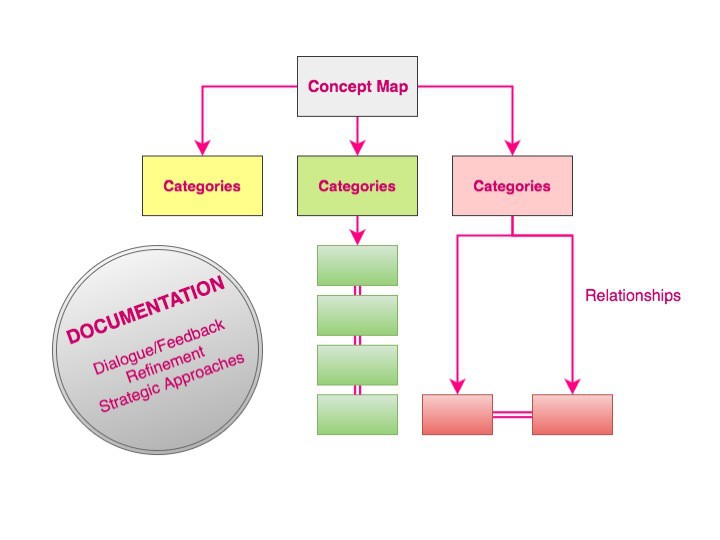
A concept map.
A concept map is a form of data viz that educational researchers have shown since the 1970s to be an effective way to help people grasp complex concepts. According to the research, concept maps work in several ways.
First, concept maps encourage us to organize pieces of information into categories – which in turn allows us to move to a more abstract level of thinking.
Second, they make thinking visible or concrete – which makes the thinking less fuzzy to the person who is trying to think it.
Third, concept maps themselves act as “meeting posts:” places that allow other people to meet our thinking where we are, facilitating conversation and potential collaboration.
Finally, concept maps allow us to maintain a record over time, so that we can reflect on where we were, where we are, and where we might want to go in the future.
And the best thing about concept mapping is that it can be adapted to be useful in many contexts for facilitating discussion and enabling change.
Let’s work through an example in which we use a simple form of data visualization – concept mapping – to reflect on and discuss our behaviors in digital spaces as a potential form of professional development.
1.Take ten seconds to write down as many answers to this question as possible. Where do you go when you are online? Which platforms, digital spaces, applications – anything you do online – personal or professional.
Go ahead. I’ll wait.
My guess is that you had no problems writing down a handful – search engines, email accounts, entertainment services like Netflix and Spotify, social media (Facebook, maybe Twitter, Instagram). The creatives among you may have some video, music, photo, or graphic design applications on the list – things that help you remix or create things.
2.Circle the ones you use for work or your professional development.
3. Identify five ways that you used those digital platforms or spaces. What sorts of activities were you engaging in? What was your purpose in being there?
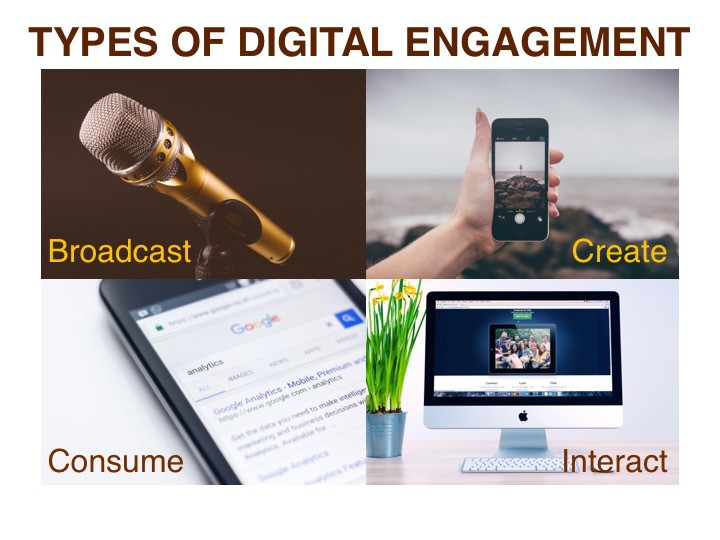
Generally speaking, when people get on the Internet, much of what they do can be described through four categories of engagement. These are not necessarily mutually exclusive or a comprehensive list, but they are a way to begin to think about and talk about what you do on the web.
Broadcasting. People express their ideas and information with no real intention of dialogue, per se. Broadcasting is about getting one’s ideas out there for someone else’s consumption.
So obviously if there are some people broadcasting, there are others who are consuming. We consume when we don’t have the intention of giving a lot of feedback – we consume information when we search databases or search engines. We consume entertainment when we watch Netflix. When we buy things on Amazon.
However, sometimes people can actively participate or interact and provide feedback – we consume when we buy on Amazon, but we are participating or interacting when we opt to leave a review. We are consuming when we read a Wikipedia entry, we are interacting or participating when we make edits. We interact when we engage in dialogue on Facebook or Twitter; we are contributing to a larger narrative.
Finally, sometimes we use the web to create, and I’m thinking about all the web applications that allow us to make things. Making videos, music playlists, picture mashups, editing software, photo albums.
Like I said, these activities aren’t mutually exclusive – sometimes we make things collaboratively, for example. And certainly they can be used in a sequential fashion – in fact, I’m going to give you an example of that in a minute. But I find that these categories can be useful when we are talking about what we are doing on the Internet.
4. So, now that we have a little bit of a vocabulary how can we leverage these spaces and our behaviors to advance our professional development? I want you to take a moment to choose how you are going to frame this question for your own purposes. Are you going to think about your students’ professional development? Your team’s? Your own? All of those would work for the activity that’s coming up – pick the one that interests you the most.
There are plenty of answers to that question, but the one I’d like for us to consider is the idea of a personal learning network, which is a form of strategic digital engagement that fosters, learning, sharing, and professional networking in ways that potentially transcends institutions, geography, and traditional power hierarchies.
So, how do professional learning networks work? I’m going to offer a personal example.
5. As I tell this story, I want you to look for the digital spaces, the types of digital engagement, and how things fit together.
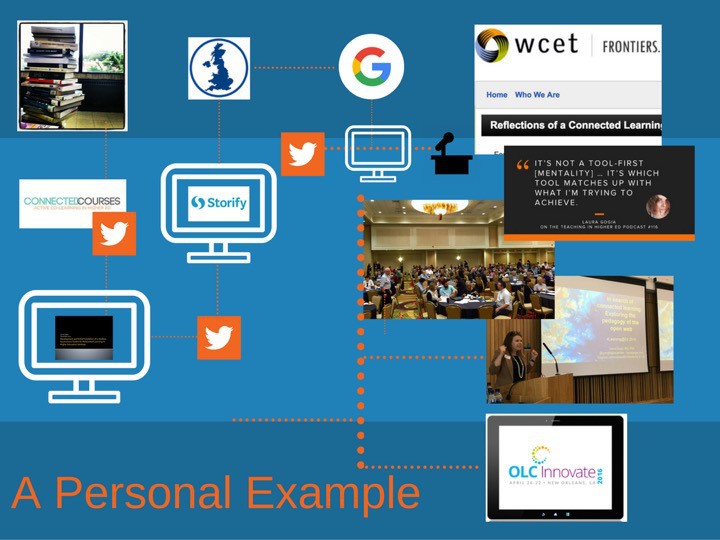
In the fall of 2014, as part of my graduate fellowship, I participated in a massively open online course (MOOC) on faculty development and connected learning. Through my Twitter interactions related to that course, I became recognized in within the connected learning community as someone who researched connected learning as part of my dissertation work. Around that same time, I was developing and presenting a mock prospectus for a dissertation preparation course. I posted my mock prospectusslides on slide sharing platform and then embedded that presentation in a blog post in which I described my research proposal. I advertised my blog post on Twitter using the MOOC hashtag and asked the people from the course to take a look and offer feedback.
As they commented and asked me questions on Twitter, I noticed some themes across their responses. I aggregated their tweets on Storify, which is a storytelling digital platform, and embedded the product into a blog post in which I suggested potential areas for research collaborations based on the questions they were asking. I advertised that post on Twitter, using the MOOC hashtag. Several scholars expressed in interest in collaborating in different areas. For the next 18 months I worked several research collaborations through combinations of Google Hangouts, Docs, and Google Plus. This work led to conference proposals and publications at an international level. The combinations of online and conference presentations led to keynote and plenary addresses, guest blogging assignments, panels and podcast invitations, and consulting work.
Can you identify two or three digital platforms and types of engagement from that story?
So I am not trying to suggest that everyone needs to develop a professional learning network as complex as my own, but what I am arguing is that there can be benefits from approaching digital engagement intentionally.
How can we optimize what we do online the same way we tend to think about optimizing our activities offline?
The answer is to
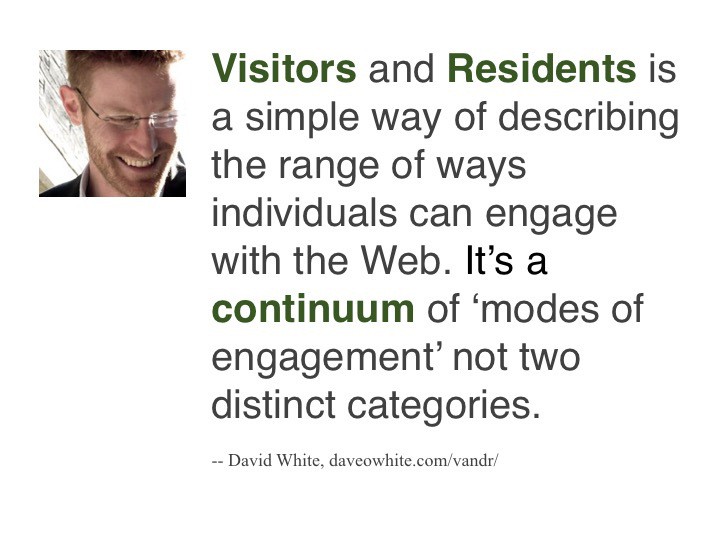
In terms of digital engagement, the V&R scholars developed a mapping exercise that aims to help people talk about their online activity in terms of being digital visitors and residents. In David White’s words,
So they describe a spectrum of engagement anchored on both ends by visitor activity, which tends to perceive digital platforms as tools. When we act as visitors, we tend to be goal oriented – we get in and get out without leaving too much of a digital footprint.
On the other side of the spectrum, when we acts as digital residents, we tend to think of the digital in terms of a space that we inhabit along with other people. Activity tends to be more extended and less goal driven. When we act as residents, we are there to build a presence or an identity.
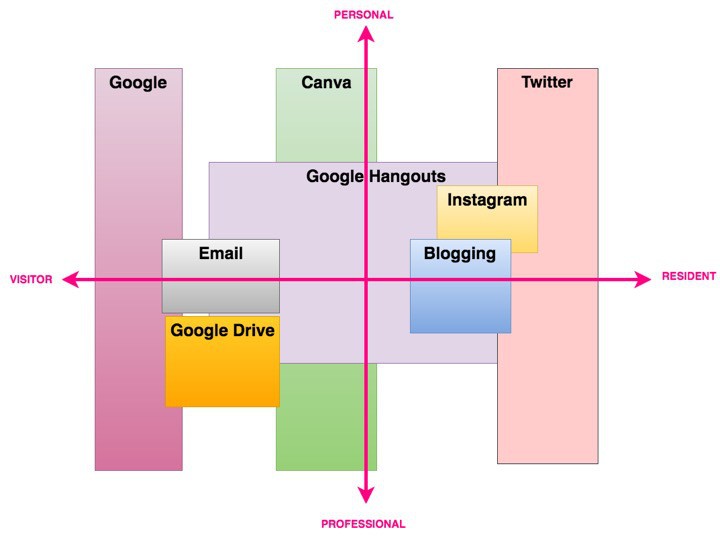
This is a simplified version of my V&R map. I’ve identified my primary digital platforms. There are two axes – the first is the Visitor and Resident axes, which we’ve discussed. In my case I tend to use things like Google search engines in very goal-oriented sorts of ways and I tend to hang out on Twitter – that’s where my community is.
The other axis is personal and professional use – sometimes you’ll see this listed as “institutional.” It’s useful because many people tend to have dual lives in the digital world – in fact you might have one email account up here and a different one down here. But you’ll see that I am not particularly dualistic. I have a lot of overlap – and that’s actually the sort of observation that could lead to discussion on strategy and intentionality, right?
6. Take a moment to draw your own map. It doesn’t have to be comprehensive. You already have a list of platforms to work with.
7. Talk it over with a partner. Consider these things as places to start:
And when we finish, let’s think about exactly what we did.
We made a concept map – a form of data visualization – that anyone could have made regardless of discipline, professional context, technology, or other resources.
We reflected on behaviors and potentially attitudes and belief systems and shared those – in a concrete way with another person. In this case, we talked about digital activity, but it could have been on anything. If we were in a professional development setting, we could have established some goals around that as well as set some plans.
We used active/experiential learning in order to do all of it – an approach consistent with best practices of adult learning.
I have done a significant amount of coursework in adult learning. I’ve read the canon. I’ve taught classes to other educators on adult learning. I’ve published a chapter.
Furthermore, I’ve been accused of being an adult learner. In the first year of my doctoral program, a random faculty member stopped me in the hallway to shake me by the shoulders and say emphatically: “YOU (shake) are the ultimate adult learner! WE (shake) are WATCHING (shake) your EVERY MOVE (shake shake). I can’t WAIT to see WHAT YOU DO (shhhhaaakkkkeeeee)!”
So, I am an adult educator and learner, blah blah blah. When I tweeted this today –
adult learning – particularly when the adult doesn’t want to learn what they are being taught – is a tricky thing.
— Laura Gogia (@GoogleGuacamole)
it had special meaning to me, but it was not intended to be particularly insightful to the casual reader. Every adult educator knows that adults learn better with ‘just in time’ learning and in ‘need to know’ situations. At some level, most adults have to want to learn what they are learning, they have to need to learn whatever it is that they are learning, or they aren’t learning it. Period.
Granted, I’ve never been the average adult. I tend to be curious about everything and capable of learning a lot…well…almost everything. I’ll start learning something before I’m actually legitimately interested in it and without particular need (at least what the average adult would designate as need). That being said, I have a profoundly big blind spot in terms of computer programming and auto repair.
Before I go on, I acknowledge that these are exceedingly useful areas of study, particularly for a woman who hangs out in EdTech circles and who does, in fact, drive automobiles. I also acknowledge that I’ve had ample opportunity to learn a little about both. When I was working as a graduate fellow at ALT Lab, there were people eager to teach JavaScript and similar. They literally came to my office door offering to teach me. Also my husband fixes cars for fun. He knows how to make my car horn blow by pushing a button on a laptop. If I wanted a lesson in basic auto repair all I had (have) to do is open the kitchen door and go outside.
Unfortunately, I have actively and repeatedly turned down invitations to learn anything related to coding and auto repair. Other than how to change my font size in html, I know (actually, now that should be ‘knew’) nothing.
I’ve spent significant time reflecting on my unusual and striking lack of interest. There’s some deeply ingrained gender bias-type things involved that I’m not sure I’ve fully unpacked, even now. Computers and cars don’t play a role in how I see myself, my work, my past experience, or future goals. Also, I’ve always been in situations where the potential teachers are men…the lack of female role models hasn’t helped whatever gender things are going on in my head. In related news, I hate being wrong in front of anyone, but particularly men (it goes back to my medical days where I worked alone in environments of blatant and not-so-blatant sexual harassment and sexism) and when you mix all this together, I have to say it:
I am Laura Gogia MD PhD, and I am intimidated by networked computers and servers and mainframes and software installation and people who know what these things are. Also cars and mechanics, but that’s a different blog post.
About a month ago I was told I would be learning how to code for my job. It was really quite unexpected. In fact, if I had known I would need to learn these things there’s a decent chance I might have turned the job down or not applied for it in the first place, because of the bolded statement I just made.
QUERY: Having to learn things unexpectedly is the norm for my work. I’m good at it. So how come coding felt so different?
ANSWER: This is the first time ever that I have very real, deeply-held personal barriers to what it was I was being asked to learn.
Learning to code has been a pain in the ass. I have been angry – really angry – at myself, at my current the situation, at my previous education, at my previous workplaces. My anger has been exacerbated by and exacerbating for the grief I felt over moving beyond my phd. I have been depressed – really depressed. I have wanted to give up and walk away.
I am willing to bet that this is the way many adults feel when they try to learn something new, particularly when they are told they have to learn it for work. Finally, I am getting a taste of what it’s like to be a real everyday adult learner.
I tend to get emotional about things, but I also always have a strategy. Like I said, I know the adult ed literature. I know that motivation is everything, so I grabbed onto every personal reason to learn coding that I could find: keep my job, develop a skillset for the resume, be a model for my kids, develop my brain in new and interesting ways. The reason didn’t matter, as long as it worked in the moment.
I also knew that expertise begets interest begets expertise. The better I get at something, the more interesting it becomes, the more internally motivated I am, the better I will get. Just. Keep. Working. Things. Will. Happen. It’s my mantra for everything. Most of the time it works.
This time, it’s working. I’m going to be fine.
But what else is important? The teacher. To have someone you can trust, who gives a little space for you to be angry or depressed or frustrated or wrong or just plain weird – this is important. So big collective thanks to all the teachers out there who make this happen for adult learners everyday. You are really important too. Good job. And thank you.



 So they describe a spectrum of engagement anchored on both ends by visitor activity, which tends to perceive digital platforms as tools. When we act as visitors, we tend to be goal oriented – we get in and get out without leaving too much of a digital footprint.
 And when we finish, let’s think about exactly what we did.