Looking at the news these days, I find my blood pressure spiking as my anxiety goes through the roof. It seems to be a widespread problem, but that’s little consolation. I’ve got hypertension and anxiety to begin with, and there’s only so much medication can accomplish. Like many academics, I’ve had an active presence on …
Tag Archives: Twitter
A Virtual Introduction
As the new Associate Director at Virginia Commonwealth University’s Grace E. Harris Leadership Institute (GEHLI), I’ve been getting a lot of virtual introductions that sound like these recently. Spend enough time in higher education, and you will send and receive these things so often that you stop thinking about what they really are, which is a basic form of digital networking.
With the growth of behemoth (horrible) professional (superficial) networking platforms, “networking” in the context of digital platforms has gotten a bad name. In fact, if you read enough Forbes.com, you’ll see that the “soft skills” business gurus want you to stop networking and start connecting. To be completely honest, I do not like Forbes.com (or the terms soft skills, guru, business…or anyone who writes about networking but doesn’t really know what it means), but if you read the article I’ve hyperlinked, you’ll find some truth in the fluff: Networks consist of connections. Therefore, effective networks are made up of effective connections. Effective connections are those which make sense, that work, that are mutually beneficial.
Think this through for a moment: We can create networks of people, ideas, and resources. We forge connections through actions like introducing, conversing, sharing, receiving, co-creating. Our digital connections automatically leave digital trails of emails, tweets, hyperlinks, blog post comments. Don’t worry, I’ll unpack that over time. It’s only the first day of #OpenLearning17.
However, tonight, I have my own virtual invitation to extend and my own a digital connection to forge.
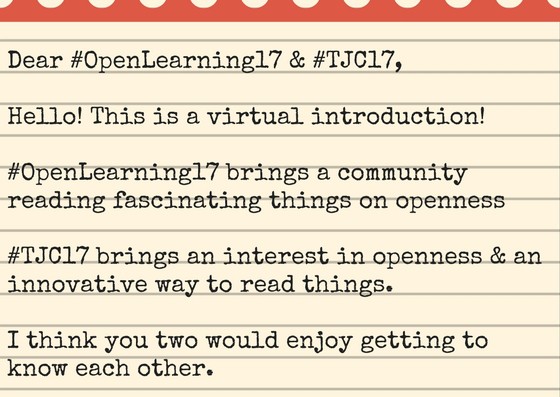
This week, #openlearning17 – an open SCHEV/AACU faculty collaborative experience (I talk more about it here) – is reading a great article called 50 Shades of Open by Jeffery Pomerantz and Robin Peek. It’s so great that Gardner Campbell, the #openlearning17 hub director, thought it might benefit from some special treatment…something akin to the type of reading we did in the Twitter Journal Club (TJC) I founded several years ago.
Some background. TJC was my first real experiment in Twitter-based pedagogy. I was a graduate student who, like all graduate students, was struggling to read everything in the world. When I wasn’t trying to read everything in the world, I was practicing my tweeting by live-tweeting conferences, webinars, presentations, etc (not because I was a graduate student – I did that because I am Laura).
One day, my two worlds collided. I came across an article written by two scholars I knew to be on Twitter, so I began to live-tweet their article as I read it, mentioning their Twitter handles in each tweet so that they would see it. They responded, riveted (so they said) by what this graduate student might make of their writing. Others joined in. Suddenly we were having a Twitter-party-cum-question-answer-session with the article’s authors. It was magical. It had to be repeated.
Out of this emerged a monthly gathering (which sadly has grown dormant over the past year as many of us were completing and defending our dissertations and finding jobs and so forth). But also a website, a peer-reviewed journal article, and an unusual approach to reading scholarly articles.
From the TJC website:
Twitter Journal Club is an open learning experience on Twitter (originally aggregated around the hashtag #tjc15) in which participants read a previously agreed upon article at a scheduled time, live-tweeting as they go. We are now going into our second calendar year and will be working under the hashtag #tjc16…and now #TJC17. The articles – which must be openly available either through pre-print or open access – are recommended by participants via Google Doc and read in order of recommendation.Articles tend to be recently published articles from Open Education/Education Technology/Digital Literacy/Networked or Connecting Learning fields. Article authors are invited to join the conversation via direct invitation.
There is no mandate to read the article in advance (although there is also no mandate to prevent participants from reading in advance). The journal club convenes formally for one hour and while conversations can occur for however long as desired, this hour is archived and published via Storify so that participants can read the transcript if they desireThere are no pre-arranged talking points or questions for the discussion. It just IS.
As I wrote in Hybrid Pedagogy, the TJC approach doesn’t result in the same sort of outcomes as a typical journal club. You don’t delve deep into the article as much as spring forth from it. There is a celebratory buzz around these events, not a somber or studious hum. TJC sparks conversations and if you come away with one or two nuggets, a list of difficult to answer questions, a bazillionty more references to check out, and you STILL NEED TO READ THE ENTIRE ARTICLE…well then you have been #TJC’ed.
Gardner and I are dusting off the #TJC..now #TJC17 hashtag and rousing the community for a reunion because we think #openlearning17 and #TJC17 might have some fun together around this article. I’ll be sending out the word (you’ll see it…in all my Twitter glory for those of you who have never seen it before), but you who have gotten to the end of this post will hear it first.


A Little Bird Gets a New Look (Visual Article Series)
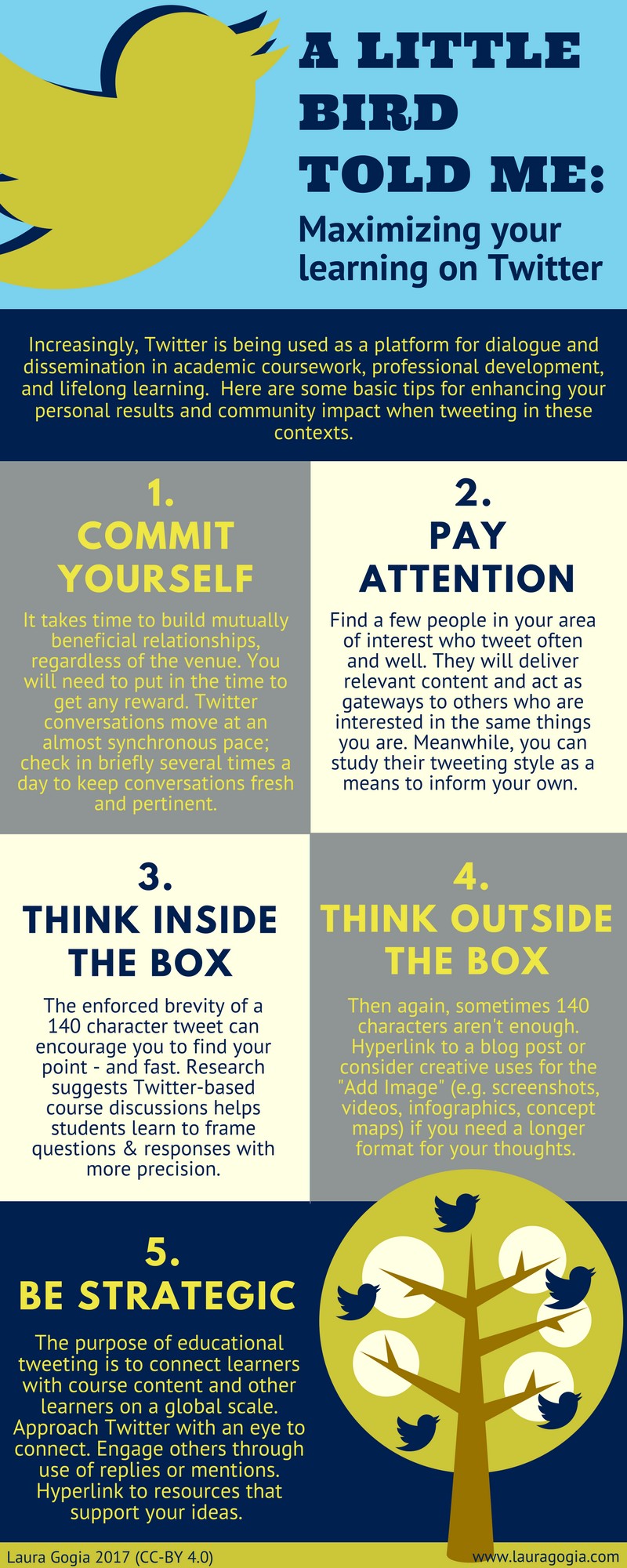
I originally created and published A Little Bird Told Me: Maximizing Your Learning on Twitter in 2015. The one page list of strategies was my first ever pinned tweet. It has been one of my more successful online endeavors, capturing thousands of views and hundreds (maybe close to a thousand if you count across platforms) of downloads. Instructors have incorporated it in their syllabi and I get notifications all the time – one as recently as two days ago – that new seminars and professional groups have passed it around for participant consideration.
A Little Bird has personal significance. It was the first document I created specifically for my own professional need; no one else asked me to make it, nor did I show it to anyone before I published it. I made it for myself, because I was tired of seeing faculty struggle with convincing their students to think about Twitter as a tool for learning. Conceiving, designing, and publishing A Little Bird was the first concrete evidence that I had developed a pedagogical practice and voice. It was my first step in identifying myself as an educator and not just an ex-physician taking classes in education. Like I said, A Little Bird is a personal milepost.
I’ll be honest – although it is only two years old, looking at A Little Bird makes me wince a tiny bit. Content-wise, it is sound. It was never meant to be comprehensive, but what is there is good and reflects the fact that I was more skilled at pedagogical Twitter a year ago than I am now probably. However, the visual presentation – a one paged, tiny font list of bulleted paragraphs – is not how I would present information on the web today. I have been impacted by my subsequent work with Tod Massa, who strongly encouraged me to integrate color, graphics, and design into everything that I do. I no longer put out handouts that look like bulleted lists only.
So. Given the fact that A Little Bird still gets pulled for new classes, seminars, professional development, etc., I wanted to give faculty and participants an option. The original document remains where it has always been. However, yesterday I reformatted the content (and tightened up the copy, but only just a bit) to be an infographic. Yes, I used one of my published color palettes (and yes it saved time). And you can download the infographic as a pdf if you really want to.



Digital Presence: A Scheduled Chat with Ken Bauer’s Students
Tomorrow, Lee Skallerup and I will be speaking to Ken Bauer’s #iTec Digital Identity course, a five day bootcamp on digital identity for undergraduate students at Tecnológico de Monterrey on…you guessed it – digital identity. Ken has put together a stunning lineup – Dave Cormier, Bonnie Stewart, Alan Levine, Amy Burvall, and Autumm Caines – and that’s just on the first half of the week.
I’ve heard all of those people speak expertly on digital identity, to the point that I feel a bit superfluous. However, in the spirit of not giving into imposter syndrome, I’ve devoted a bit of time to thinking about what I can bring to the conversation that is special and uniquely my own.
I started by brainstorming on Twitter with 5 thoughts on my approach to digital identity and when I started that list, it became clear to me fairly quickly that I had a problem with the title of this course.
I don’t like to talk about digital identity, because it creates an unnatural divide between digital and other forms of identity. Digital identity is no different than the multiple identities we carry through the day – e.g. our parenting identity, professional identity, peer identities.
Personally, I’ve been working hard over the last five years to consolidate those identities into a balanced, holistic approach to being an authentic human…so to separate out my ‘digital identity’ and talk about it for minutes on end just doesn’t seem to jibe with the rest of my life mission.
I am myself. I am myself in digital spaces. I am myself in the grocery store, in my living room, in my work cubicle. Because my digital experience is so completely integrated into my physical activities, I am my digital self at the very same time that I am waiting in the grocery store line, and in my living room, and in my work cubicle. In fact, I workout early in the mornings to exercise videos stored on my google drive. I can be doing one-legged burpees when I see a Twitter notification pop up in the corner of the screen. Therefore, I am my digital self even as I am very much also my physical self. The distinction is meaningless to me.
I prefer to talk about digital presence.
Presence is closely related to but different from identity. Identity is who you are; presence is how you behave. How you present yourself. How you engage with the space and others in it.
Digital presence. All of the speakers Ken has lined up are brilliant on digital presence, but I can speak specifically to what it means to behave as a learner in a digital space.
My primary goal as a blogger and tweeter is to learn. I am a constructionist at heart; Seymour Papert writes that thinking is made sharper – refined – when it is made concrete. Write a thought down and it becomes less abstract while also becoming something that is available for self reflection and social commentary. I write to make things concrete. I write in digital public spaces to gain access to social commentary.
I blog and tweet to create a record. We learn by studying our own trails (and the trails of others). In 1945, Vannevar Bush called these associative trails. Sure, I could trace my trails through journals and scrapbooks, but I write in digital, public spaces so that I can have access to hyperlinks, tags, filters, multimodal forms of expression. I write in these spaces to have access to digital affordances. The ability to rearrange posts and create serendipitous juxtapositions is magical, happy learning.
Finally, I blog and tweet to be a part of something larger than myself. I have written over and over again on personal learning networks (so has Dave Cormier, probably a little more famously) so I’m not going to belabor the point now. But as I have said before (and so has Howard Rheingold), the key to learning in and on the open web is making oneself useful. There are different ways to make oneself useful. Being a learner is not just about the cognitive stuff; yes, on Twitter I have been known to help people learn their epistemological frameworks and others have helped me learn to code SQL sequences (all true, documentable stories). However, meaningful learning is often emotional. It feels scary sometimes. Isolating. Confusing. Lonely. I make myself useful by making myself available in digital spaces. I help people and they help me as best as we all can, because we are human: humans being humans in digital spaces.
Digital presence as an opportunity to create, record, and share – that’s what I’m going to talk about tomorrow.

