Tag Archives: Blogging

A free weekend

Friday, 1:04 PM ET.
A text from me to my husband:


Do we need to take anyone home


Indeed, as a newly-minted director with people working for me, a significant amount of my work has turned into emailing people instructions, giving feedback, and distributing tasks.  By Friday afternoon, I had sent out all the emails I had to send and would need to wait for the results before moving forward on any of my projects.  Given the timing…I decided I could leave the office (metaphorically since I work from home) for the week.

I checked in with myself: Did I feel guilty?  No. I’ve put in more than enough hours in my first month as a director to allow for a handful of half days, let alone a couple of hours. Also, would I need to spend the weekend on family commitments which—let’s face it—can feel more like work than work? Nope, none of that either.  Were we traveling anywhere, which I always love but it can still be exhausting? That is a big. fat. N-O.

Last week I saw a tweet discussing an article on workplace productivity.  Not having the time or energy to read the article in the middle of a workweek, I can’t tell you what article actually said, but the accompanying tweet suggested that long workweeks tend to shoot employers in the foot: A true 40-hour workweek (with protected nights and weekends) leads to greater productivity and creativity among employees.

In general, I dislike the higher-ed Twitterverse’s insistent hammering on work-life balance and not working so-long hours just because you can (because it’s ableist!).  I don’t like this particular rabbit hole because some inhabitants will shift the responsibility (and the blame) for toxic work-life to the individual worker instead of employers or reward systems or work culture.

However, the idea in this tweet—that free weekends provide opportunities for mental breaks and curricular activities and therefore can enhance your productivity—I really can’t imagine anyone or anything arguing against that statement, so neither will I. Therefore, I will grab on to the premise with both hands and test it out.  I have an opportunity for a free weekend, so what will I do with it?

It’s approximately 1:00 pm ET Sunday, 48 hours after I knocked off a little early from work on a Friday.  Here’s what I did and how I feel about it.

I napped and

Yeah, I don’t do this unless I’m sick and rarely then. I’m not saying it will be a go-to activity but it was a 30 minutes well-spent at the moment.

Also checked out a Power Class at the gym

I’m not usually a group fitness person (it’s been 15 years since my last class), but my husband wanted to try it out.  What I noticed (beyond my really sore chest muscles) is that it’s a great opportunity to find friends, and I really need and want more friends in my life.  Note to self: this activity is a keeper.

Before roaming around a Barnes and Noble where 

So this was a promise to our daughters—the only way my husband and I could get them to the gym (right next to the Barnes and Noble). And it meant that I got to look at every magazine layout and book display while the kids were struggling with their book choices. Favorite teen quote: “Let me just tell you…that Oscar Wilde?  Man, he had to deal with a LOT.” While I was there I got some great ideas for work projects AND a fun book for me too.

I considered starting a book club.

Yeah, so this happened at Barnes and Noble when I was watching the groups of women sitting in the cafe, wondering how I might be able to find friends who would meet with me in the local Barnes and Noble on Sunday morning.  I am a little chagrinned that the group I thought was a book club was actually a group of admins putting together a CME conference agenda, but hey—my dream of having friends to meet at Barnes and Nobel lives on.

The whole family also did dinner out with friends 

And at a new restaurant at that. I just said I need more friends and yet I’m eating out with friends, so let me explain: these friends really belong to my husband.  I can sometimes feel a little bored at these dinners in part because these good people aren’t the type to help me dissect the menu font or consider the color palette of the room or how Billie Eilish and Jackson Pollack might be the same phenomenon or the photography exhibit at the VMFA or how to plan a hypothetical trip to Estonia…in other words, sometimes I struggle to connect with my husband’s friends. However, I made the decision not to drink alcohol and my sobriety helped me stay engaged.  I was able to find questions to ask them that I actually cared to have answered.  It was a really nice outing.  Note to self: sobriety makes things more enjoyable.

And I texted another friend. 

Because let’s be clear—I do have some friends. This weekend I actually had time to chat with one and it made me feel more grounded.  Note to self: Sometimes you get in your own head with work stuff and NOT in a good way.  Connecting with friends and family is what talks you down from the ledge.  

I also ate a leisurely breakfast with the family and

Sunday morning. At the kitchen counter. Bagels. Will all the accompaniments. Espresso. Listened to the Mamas and the Papas. Considered how the sun changed the colors of the cut flowers at the end of the counter.  Talked absolute nonsense about very little. It was lovely.

Eavesdropped on a teenage card game while also

I live-tweeted a little about this on Saturday.  I love my daughter’s friends.  They listen to Paganini and swear in several languages and argue over exactly which is the best ship to stan in Merlin (the TV show), but ultimately they are really just sweet kids. Their noisy card playing added a great element to what I was doing at the time downstairs which was…

Studying two information graphics books I ordered last week.

More ideas.  Still flummoxed though on how to take interesting pictures of books for IG.

I also uploaded pics of the teen cave to Instagram

Because I’m also flummoxed on how to take interesting room shots for IG.  Maybe practice has to make perfect at some point.

And listened to Bossanova music

Because in the workweek I get stuck in the grind of what works for me while I’m working (classic rock and 90s alt), driving (80s pop), and waking up (Beatles). Paganini and Mamas and the Papas is one thing, but Bassanova elevates the non-musical grind experience to a whole new level.

While I got a brilliant idea for a work project.

Indeed. I already messaged my boss. That whole productivity part? I know what my next project is.

Finally, we will be watching a family movie tonight and 

We stick to 30-minute classic comedies on the weekdays because that’s about all we can stay awake for.  We are all in on the 2-hour storyline for tonight…

Take notice—I blogged. 

I haven’t done it in a really long while.  I started this post with the intention to record and remember and also to appreciate what a good, solid weekend off can do.  But in the process, I noticed something—most of my notable activities are about making connections with friends and family, as well as taking a moment to explore music and books and ideas that don’t necessarily directly fulfill the requirements of work products.

However, it’s funny how so many of these weekend activities will also feed into my work-life.  That may be related to the type of work I do and the freedom I have in guiding the creative direction on many projects (thank you, work).  But that’s kind of an aside here. Really, the real lesson is that weekends are for making connections, deepening relationships, and trying new things—and for this reason, it’s fundamentally important to protect them.
Featured Image: Photo by Jon Tyson on Unsplash

Why #openlearning17 should consider embedding visual elements in blog posts

As the connected learning coach for the AACU Virginia Faculty Collaboratives Experience, #OpenLearning17, it is my pleasure to wind my way through the open learning hub,  focused predominantly on how participants are making connections through their blog posts and tweets.  There has been a lot to love in the first two weeks of blog posts.  As I mentioned in my greetings and hyperlinking posts, connected learning takes place when learners network their current learning/thinking across disciplines, contexts, people, and time. Digital platforms have unique affordances that allow us to make and reveal our connections.  As Autumm’s #openlearning17 post on digital citizens, fake-news, and microtargeting demonstrates, hyperlinking is an amazing way to connect ideas and build infrastructure around a post; if you need additional convincing, check out how she used hyperlinks to define, cite, provide examples, and contextualize.

What do visual elements add?

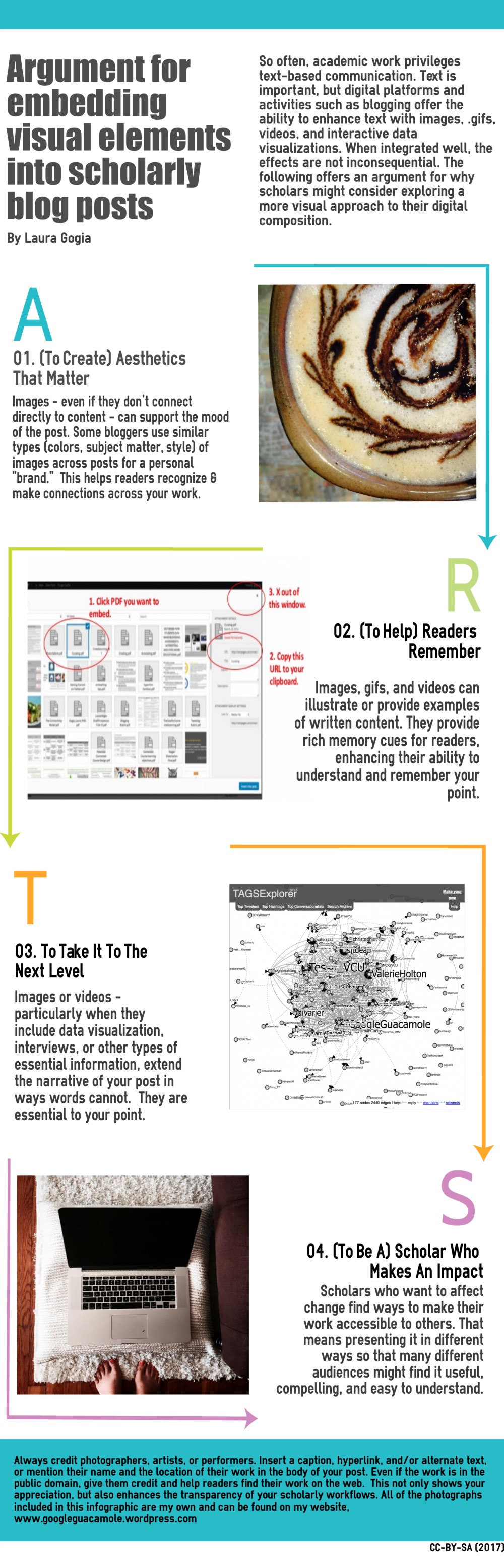
Hyperlinks are important.  However, blogging also allows for the embedding of visual elements (including but not limited to photographs, images, data visualizations, videos, and gifs). Visual elements can enhance the message of a blog post by establishing mood, illustrating points, and extending the narrative. I’ve created an infographic on the topic, but I have also found many wonderful examples among the #openlearning17 blog posts.

Aesthetics. Images can establish or consolidate a mood within a post.  Use the same type (meaning color, theme, style etc) of image across multiple blog posts and you can establish a personal brand: a way for your readers to recognize your work in a glance.  In #openlearning17, Erin Crane, creator of the Crane Librarian, has established a clean and compelling aesthetic across her blog posts. Check out her most recent post in which the meandering intermingled color flumes in the large centered image match her title, Are We There Yet? perfectly. Camille Freeman has also created an aesthetic around beautiful photographs in her introductory post. Her choice of the partially unfurling plant aligns well with her self-described “tentative toe dip.”

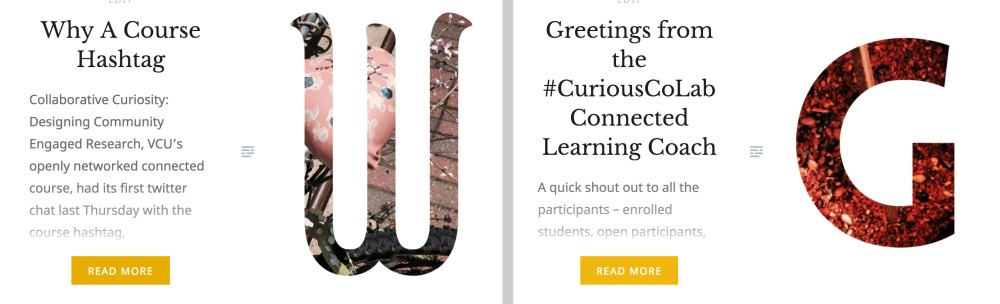
Additionally, check out an example of my own: As the connected learning coach for #CuriousCoLab, I created digital letters from my own photographs to use as featured images for all of my coaching-specific blog posts.

Two blog posts by the author, each with a featured image that includes a large letter filled with an image
From my blog posts. Note the pattern in the featured image.

Illustrations. Images, videos, and gifs can help illustrate the point of your post. John Stewart’s post, Open Note Databases and the Promise of the Memex, not only incorporates the relevant #openlearning17 video panel discussion but also offers readers several compelling visual examples from open note databases.

Outside the realm of #openlearning17 (but juxtaposed with it in my Twitter timeline), are the social media hashtag phenomena of #dresslikeawoman and #actuallivingscientist. Take a moment to reflect on how the addition of an image impacts the power of the message.

An actual living scientist tweet that includes a photograph of a smiling African American female scientist working in the field
A actual living scientist and dress like a woman tweet that includes a smiling female conservationist working in the field
A actuallivingscientist tweet that does not include a picture beyond the avatar

Extending. Finally, bloggers can integrate images, data visualizations, and videos into the posts so that they extend the narrative of the post beyond the text.  In the #openlearning17 hub, check out the way RaptnRent incorporated a song and music video into the post….Making the connection between the song and the week’s readings is the primary theme of the post.  Also check out Alan Levine’s post in which he moves seamlessly between text and illustrations – it’s hard to tell where one begins and the other leaves off.

Alternatively, check out my first post on why embedding visual images into blog posts makes an impact, in which I interviewed my eldest daughter who explained everything you need to know over a slice of pizza at the Virginia Museum of Fine Arts. This video basically served as an advanced organizer for the rest of my post.

What about the learning?

With all this talk about using visual elements to express oneself, it might be easy to forget the learning aspects of using embedded images and videos.  How does going to all of the extra work to embed non-text based elements into your post contribute to your learning?

Making connections across books, music, maps, photos, charts, and .gifs means making connections across disciplines, contexts, people, and time. Consider that adding visual components takes time: time that is mostly spent on considering what you are trying to say and how you might express it through other avenues.  Reflecting on what you are trying to say and considering it in other contexts is always a good thing for learning.

What about the technicalities?

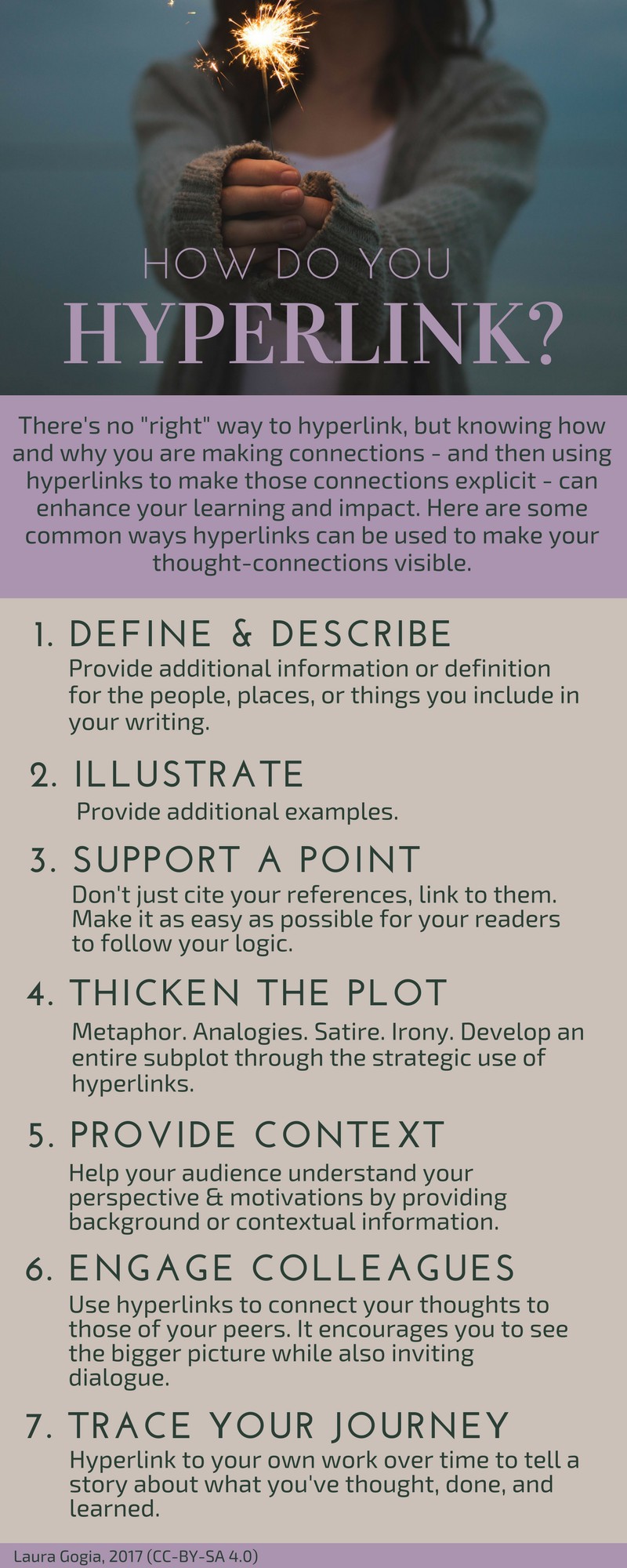
If you need more specific details on how to embed, how to create your own images, or where to go to find CC-licensed or public domain offerings, check out my previous blog post on visuals.

As always, please remember to cite your image sources. Videos that are embedded from Vimeo or YouTube are self-citing…click on them and you automatically go to the original video publishing platform; photos and images are different.  You must give credit to the image creator and provide a url somewhere in the post. Caption, hyperlink, integrate it into the post text – just do something!  And consider this, I know that CC-0 and public domain images do not technically require citation, but you should consider doing it anyway for reasons of karma and transparency.

Additionally, please add alt text to your images so that it can be read by text readers.  A little description is fine, just enough to keep those who use text readers in the loop.  It’s a good practice.

Reflections on (Im)perfection

When I talk about blogging with students (or faculty) who are just starting to blog, someone almost always asks “how do I know what’s good enough to share?”

It’s a great question. I ask it of myself almost every single time I sit down to write a post. It seems to me that the question reveals two separate but related types of uncertainty:

  1. “What if I’m wrong?”
  2. “What if my audience doesn’t like it?”

This post is about the first uncertainty: the fear of being wrong or otherwise imperfect.

Despite all the educational texts and scholars who reassure us that we learn through mistakes and grow through conflict, I have a major, lifelong problem with a fear of being imperfect. For what it’s worth medical training does not help those with natural tendencies; in fact, it makes it much worse.  Learning in the open, specifically blogging, has been one way for me to hack away at the conditioning just a bit.

I blog, therefore I reveal my imperfections.  Often.  In public.

This morning Lee Skallerup and I spoke with Ken Bauer’s class on digital identity, just like I threatened to in my last post.  Lee was great.  I was absolutely horrible.   I couldn’t make eye contact with the camera to save my life.  I know this because I watched the video later this afternoon.  It was a distracting amount of a lack of eye contact. It was subpar. It was definitely imperfect.

My impulse, of course, was to rip myself to shreds. I had a parent’s night at my daughter’s school tonight.  My husband stayed home to watch the kids  and as I drove alone  to the school I started the ritualistic self-pugilism.  It may sound overly dramatic to call it self-pugilism but no – no one will ever be as hard on Laura Gogia as I am on myself.

However, as I pulled up to the school I said to myself: You’ve had a migraine for the last four days. You still have a migraine. Your head hurts like hell. You’re exhausted and ragged and you didn’t do great today but don’t you think it’s time you gave yourself a break?

Giving yourself a break.  It’s impossible under some circumstances to do your best, let alone be perfect.  Everyone deserves a break, even you.  Even me.

Perfection comes through practice – from trying and failing and picking yourself up and trying again.  I didn’t do great today but I could learn from the effort.  Migraine or no, I’ve gotten into a bad habit of not making eye contact with the camera during video conferences.  Friends have been mentioning it since April.  It’s a lazy move – I’m an introvert. I write better than I speak, and when I have to think and speak at the same time it’s easier for me to focus (or maybe I just enjoy it more) if I crawl back into myself and pretend no one else is there. I talked it over with my family (I showed them parts of the video) and we decided that I should tape a picture of them next to the camera lens and talk to that the next time I do a video conference – for a little while, just to get me back into the habit of actually TRYING to present well.

There’s a meaning to this brief, rough blog post – because, like I said today, I never hit the publish button unless I think at least one person out there might find something in it useful. I (you) can get better, but first comes

  1. screwing up
  2. giving my(your)self a break when I (you) screw up.
  3. take what I (you) can from the experience and strategize.
  4. get better.

We all have to learn that.  Blog to find out how to blog. Only then will you know what’s worth sharing.


Digital Presence: A Scheduled Chat with Ken Bauer’s Students

Tomorrow, Lee Skallerup and I will be speaking to Ken Bauer’s #iTec Digital Identity course, a five day bootcamp on digital identity for undergraduate students at Tecnológico de Monterrey on…you guessed it – digital identity.  Ken has put together a stunning lineup – Dave Cormier, Bonnie Stewart, Alan Levine, Amy Burvall, and Autumm Caines – and that’s just on the first half of the week.

I’ve heard all of those people speak expertly on digital identity, to the point that I feel a bit superfluous.  However, in the spirit of not giving into imposter syndrome, I’ve devoted a bit of time to thinking about what I can bring to the conversation that is special and uniquely my own.

I started by brainstorming on Twitter with 5 thoughts on my approach to digital identity and when I started that list, it became clear to me fairly quickly that I had a problem with the title of this course.

 I don’t like to talk about digital identity, because it creates an unnatural divide between digital and other forms of identity.  Digital identity is no different than the multiple identities we carry through the day – e.g. our parenting identity, professional identity, peer identities.

Personally, I’ve been working hard over the last five years to consolidate those identities into a balanced, holistic approach to being an authentic human…so to separate out my ‘digital identity’ and talk about it for minutes on end just doesn’t seem to jibe with the rest of my life mission.

I am myself. I am myself in digital spaces.  I am myself in the grocery store, in my living room, in my work cubicle.  Because my digital experience is so completely integrated into my physical activities, I am my digital self at the very same time that I am waiting in the grocery store line, and in my living room, and in my work cubicle. In fact, I workout early in the mornings to exercise videos stored on my google drive. I can be doing one-legged burpees when I see a Twitter notification pop up in the corner of the screen. Therefore, I am my digital self even as I am very much also my physical self. The distinction is meaningless to me.

I prefer to talk about digital presence.

Presence is closely related to but different from identity.  Identity is who you are; presence is how you behave. How you present yourself.  How you engage with the space and others in it.

Digital presence. All of the speakers Ken has lined up are brilliant on digital presence, but I can speak specifically to what it means to behave as a learner in a digital space.

My primary goal as a blogger and tweeter is to learn.  I am a constructionist at heart; Seymour Papert writes that thinking is made sharper – refined – when it is made concrete. Write a thought down and it becomes less abstract while also becoming something that is available for self reflection and social commentary.  I write to make things concrete.  I write in digital public spaces to gain access to social commentary.

I blog and tweet to create a record. We learn by studying our own trails (and the trails of others).  In 1945, Vannevar Bush called these associative trails. Sure, I could  trace my trails through journals and scrapbooks, but I write in digital, public spaces so that I can have access to hyperlinks, tags, filters, multimodal forms of expression.  I write in these spaces to have access to digital affordances. The ability to rearrange posts and create serendipitous juxtapositions is magical, happy learning.

Finally, I blog and tweet to be a part of something larger than myself.  I have written over and over again on personal learning networks (so has Dave Cormier, probably a little more famously) so I’m not going to belabor the point now.  But as I have said before (and so has Howard Rheingold), the key to learning in and on the open web is making oneself useful. There are different ways to make oneself useful. Being a learner is not just about the cognitive stuff; yes, on Twitter I have been known to help people learn their epistemological frameworks and others have helped me learn to code SQL sequences (all true, documentable stories). However, meaningful learning is often emotional.  It feels scary sometimes.  Isolating.  Confusing. Lonely.  I make myself useful by making myself available in digital spaces.  I help people and they help me as best as we all can, because we are human: humans being humans in digital spaces. 

Digital presence as an opportunity to create, record, and share – that’s what I’m going to talk about tomorrow.