Tag Archives: Connected Learning

Connected learning goes to medical school

Connected Learning has evolved since I wrote my dissertation on it a couple years ago. Back then, the Connected Learning Alliance was promoting an awkward framework that combined learner perspectives and instructional design in the same space (who does that?).  But now they have boiled their messaging down to the essence:

Connected learning is an educational approach that combines learner interests, relationships, and opportunities to promote deeper, inclusive, and powerful learning. To break it down, briefly:

  • Learner interests emerge from a spectrum of contexts including personal passions, community and culture, and career goals and aspirations.
  • Relationships between peers and mentors allow everyone to engage in information sharing, knowledge construction, and feedback for the purpose of benefiting everyone.
  • Opportunities are authentic, real-world activities brokered* by faculty, student mentors, and institutions (*brokered =  sharing information and resources, making introductions, providing funding, smoothing out the logistics, etc).
  • Deeper learning means effective learning, in terms of increased retention, better application, and easier transfer.
  • Inclusive learning means that which clicks with more and more diverse student bodies.
  • Powerful learning is that which makes a difference in terms of empowering learners but also benefiting something or someone beyond the individual learner.

Okay, now that that is explained…

Connected learning has reached medical education, although it is not called by that name. You can find connected learning in the Genes to Society curriculum at Johns Hopkins University.  They call it Precision Education.

Johns Hopkins has prioritized digital platforms that allow students to consume, share, and collaborate in the construction of knowledge with their peers and faculty.  They learn to choose what they consume strategically and based on personal interest.  Their mentors focus on helping students make connections between those interests and career goals. In providing a digitally-driven network of resources (peers, faculty mentors, and well-curated content), they are reaching and supporting students of diverse backgrounds and goals.  That’s my summary, but here’s the article:

Excerpts from Precision Education in the [Johns Hopkins] School of Medicine’s 125th Year

Goldberg and his team are designing a system where medical students can explore facets of particular subjects that interest them before, during and after traditional classroom lectures. An online network of articles, videos, discussions and even notes from other students opens up new options for class preparation and engagement. He adds that not only can students assume greater control over their own learning, but that this approach allows courses to grow into dynamic collections of materials shared by faculty as well as students.

I started to bold the parts of this quote with direct connections to connected learning, but I had more words bolded than not, so I gave up. But note the dynamic collections of materials created by FACULTY AND STUDENTS. To continue here is more about community and peer support…

“The idea is that we are creating a community of learners, that we’re all in this together,” says Goldberg. “It’s often more difficult for the expert to explain something to the person who is not the expert than it is for a colleague to explain it to that non-expert.”

and some more about empowering students to see the connections between personal interests and potential career pathways…

“This has the potential to help students learn more about themselves,” he says. “If a student takes an interest in a particular area, such as biomedical ethics, that may be something he or she could make a career of.”

and let’s end with some diversity and inclusivity…

Precision education also addresses the disparate experiences and interests that exist among students who come to medicine from different academic backgrounds.

“Currently, every student receives the same information regardless of their academic needs. Such standardization compromises our ability to enhance creativity, wonder and academic diversity of thought,” Harry Goldberg says.

The digital pedagogies are sinking in, even if people aren’t naming them correctly.  In fact, I can’t think of anything worse than “precision education” as a name for connected learning. Currently, I’m imagining the connected learning gurus hearing that term and immediately turning off and tuning out, thinking that they are about to hear another promotion for learning analytics. Get Johns Hopkins a new branding team for goodness sake but don’t throw away what they actually mean by it, because it’s all good.


Featured Image: Owen Beard on Unsplash

My Digital and Medical Education Mash-up

It’s been almost a year since I joined the iDesign team as a learning architect and nine months since I was promoted to senior learning architect.  For much of that, I have worked with Mayo Clinic School of Medicine on the creation of a flipped classroom experience for first- and second-year medical students.  We designed templates, iconography, workflows, material tracking systems, organizational and file naming structures, transition policies and procedures, and change management strategies even as we designed courses at a remarkable pace. It’s been an intensely creative experience and I am so grateful to Mayo and iDesign for giving me the opportunity to learn from and contribute to this project.

Our task was to design a new digital component for the pre-clerkship (undergraduate medical education Y1 and Y2) learning experience.

Learning to be a doctor is hard. An unprecedented amount of content must be committed to memory with a fluency that is not interchangeable with being information literacy.  Don’t get me wrong – the information literacy is important for lifelong learning, problem-solving,  communication, and collaboration.  The best physicians are digital thinkers, but their capacity for connected learning is situated in a larger context characterized by the ability to manage massive amounts of data in their own heads. 

The face-to-face learning experience at Mayo Clinic already includes the best teaching and learning practices of our times: case-based and team-based learning, interactive whole group sessions, simulations, early clinical and patient interaction, integrated curriculum.   It is a lively, rigorous, multifaceted, active learning program with a lot of moving pieces as well as a lot of course content.  However, from my viewpoint as an educated observer, I think it might be easy for students (and maybe some faculty) to get caught in the busy weeds and lose sight of the big picture.

Our vision for the digital learning space was to provide a deceptively simple map that organizes course logistics, materials, activities, assessments, and resources through motifs that repeat themselves across all courses. If successful, the map would work to strip away cognitive clutter and convey information so clearly that pedagogical meaning and relationships reveal themselves without additional words.

My medical background facilitated an intuitive understanding of how the learning activities fit together (and to what end). However, I leaned heavily on information sciences to inspire design. I read cartography texts.  I studied maps and infographics as influencers and storytellers. I referenced Edward Tufte almost every day.  I placed it all in the pedagogical context of Vannevar Bush, George Siemens and my previous experience with designing connected courses.

As I transition away from the Mayo Clinic Project, I am thinking about writing an article about what it means to design a course site as a map. If anyone thinks that might be of interest, please let me know.


Featured Image by rawpixel on Unsplash


Public + Private Community Spaces: Week Four Reflections

Last week I asked what connected learning would look like in a humanities course. I found my answer through Dr. Laura Gibbs, who teaches online courses for the University of Oklahoma in mythology and folklore and epics of Ancient India. Dr. Gibbs doesn’t lecture at all – she aggregates resources, provides structure, and an assignment to blog, comment, and revise. Students read through collected (free, open) fables and myths, and many blogging assignments revolve around rewriting these narratives.

Some thoughts:

  • This course is largely writing-based. While writing instruction isn’t the focus, it is an outcome. In this interview, Dr. Gibbs says it was hard to connect with students writing in the classroom, and the move online was natural. As everyone probably knows by now, I work primarily with writing faculty, including some who tell me that writing can only be taught with pen and paper. I’m just happy to hear a counter-narrative.
  • Her courses are built using a variety of platforms which have changed over time. If you take the time to look through some of her courses, you will find places where content was once on a Google Doc and now lives elsewhere, or in the above video she talks about moving from Ning to Blogger. I think there is a reason that “design for evolution” is the first design principle for communities of practice listed in Wenger, McDermott, and Snyder (2002). Flexibility – in terms of content AND structure – is key to ensuring a successful CoP.
  • The first week of both courses serves as an orientation to how students will learn in the course, not content. Students are responsible for designing their own assignments, schedule, even grade – taking “inviting student input into course design” to the next level and creating an environment that supports transformative learning (Gauthier, 2016). Dr. Gibbs also has students read and reflect on growth mindset learning theory – supporting metacognition by explicitly having students think about their own learning.
  • Dr. Gibbs on her own role as instructor: “I spend a lot of time building the space, collecting resources…like managing a three ring circus.” She offers lots of framing and feedback, but even grading is largely responsibility of students.

Switching gears to talk more about communities of practice (but not really, since that is exactly what the above course is) – I have found that the most useful CoP for me is the cohort of this course, rather than the other CoP’s I have explored over the past few weeks. Two main reasons I think I have learned more here than elsewhere:

  1. Structure and rhythm – Expectations and scaffolding are more explicit within a course structure. Pretty obvious observation, but one worth thinking about. So much of learning is motivation, so if I am the type of learner that needs that context to thrive, a CoP that is more designed and scheduled is going to help me engage more thoroughly.
  2. Public and private community spaces – Writing this blog has really transformed my learning this course, and is something I think Bethany should maybe think about implementing the length of the certificate! Defining my own learning goals has been key, and reflecting in this less-constrained space has allowed me to really think about connections and past learning. I feel a more concrete sense of “knowledge building” week to week.

One final thing I wanted to share re: communities of practice was Howard Rheingold’s (one of the founders of Connected Learning Alliance) Peeragogy Handbook. “Peeragogy” is a model for peer learning and peer knowledge production – I haven’t gotten the chance to explore too deeply, but to me it seems like a CoP that supports developing rich CoP’s! The handbook is linked with Hypothesis, a tool for annotating web content, so it is a live document, and they also have an active Google+ community.

Week 4 Resources

Connected Learning Alliance, “Teaching the Humanities Online”

Dr. Laura Gibbs, MLLL 3043 Mythology and Folklore of the World

Dr. Laura Gibbs, Mythology and Folklore UN-Textbook and Storybook blog (student final projects)

The Peeragogy Handbook

Connectivism + Connected Learning in Week Three

This week was all about finding the value in connectivism, and battling the cold that won’t quit. Apologies for posting a day late, hopefully some of the grogginess has passed and I am ready to work through my learning from last week.

Learning Goals

I actually began the week exploring some of the different instructional theories exploring blending formal and informal learning, most notably, connected learning. I had been exposed to Mimi Ito a little bit in library school, but haven’t heard much about connected learning since. In a connected learning model, a learner exists within a personal learning network, and learning takes place through connecting people and information within that network. This network expands beyond the classroom, and there is an emphasis on integrating experiences, collaborations, and resources from a multitude of sources.

Immediately “learning as a network” brought to mind connectivism – learning as a process of connecting information within a network, and choosing “what” to learn is key, rather than specific content knowledge. I agree with some basic connectivist tenets: informal learning is important part of our learning experience, and learning is a life-long process. However, connectivism seems mostly about “learning literacy” – learning how to learn most effectively, how to evaluate information, and so on. While this is certainly a useful 21st century skill, I still believe it must be combined with more constructivist approaches to create successful learners.

Through my reading I think connected learning seems to do just that, combining connectivism with experiential learning to create a constructivist, networked learning process. According to Rob Reynolds, “The Promise of Connected Learning,” connected learning experiences are all:

  • participatory – learners connect to content based on common goals and interests, and engage through shared learning activities
  • interactive – learning is production-centered across multiple modes of expression
  • openly networked – learners should be linked together with peers, instructors, and other learning communities

Some questions that I hope to puzzle through this week:

  • Connected learning seems especially well suited to certain disciplines, especially sciences and practical fields such as nursing, dental, social work, etc. where real-life scenarios are essential to learning. What does connected learning look like in a humanities classroom? Is it digital humanities? Is it public history?
  • What does assessment look like in a connected learning model? I imagine a combination of reflection and learning analytics measuring activity and engagement within the network. What actions would we collect data on specifically?
  • How do we keep learning rigorous when dealing with individual personal learning networks?

I’m working on a concept map that connects the multiple theories I’ve been learning about this week. If anyone has any additional theories or resources that investigate blending formal and informal learning, I’d be glad to hear of them. Adaptive learning is a theory that popped up in my reading, so I will be adding that to learning goals for next week.

Communities of Practice

In terms of CoP, I’ve been looking into the Linked In Higher Education group suggested to me by James last week – I have just been accepted and hope to find it a little more active and relevant than the other communities I’ve joined. I’ve found that even though I haven’t gotten much out of interactions with other CoP members, I have found other useful communities – and plenty of resources. Much of my reading this week was found on Educause (all my reading is linked below), and through Shift eLearning I found the Cult of Pedagogy blog. While K-12 focused, I have found her simple explanations of instructional and learning theories easy to follow and understand. She also offers a plethora of instructional strategies and digital tools that are easily adapted to a higher education environment.

In terms of interacting with other ID throughout the past three courses, I think what has been the most helpful to me is seeing how other instructional designers revise and edit their work each week. Seeing how they apply theory and our reading into practice has really helped me think about how to do the same with my own courses. Within my own office, this draft and revision process is not nearly as transparent. It has definitely pushed me to ask more questions of my colleagues, and to share my work at multiple stages instead of just final products.

Week 3 Resources

Educause, “7 things you should know about Connected Learning”

Educause, “The Connected Learning Environment”

Rob Reynolds, “The Promise of Connected Learning”

Siemens, George (2005, January 1). “Connectivism: A Learning Theory for the Digital Age“. International Journal of Instructional Technology and Distance Learning, Vol. 2 No. 1

Beyond the Content

It’s been a busy summer.

Last semester, I was honored to be a part of the Virginia AAC&U Faculty Collaboratives Open Learning Hub steering committee. As part of my responsibilities, I was asked to evaluate and write the final report on the experience.  It was an informal and exploratory sort of document, which fits the exploratory pilot that was #OpenLearning17. This report was also the first time I let myself loose in Adobe inDesign in, say, the last twenty years. There was a learning curve, but I learned alot – you could say that writing this report was my own connected learning experience (personal passion, authentic learning task, active learning) within a connected learning experience.


Beyond the Content


Featured Image: Dev Benjamin on Unsplash

Connection & Digital Architecture

Yesterday I had the great honor of dropping by the Digital Pedagogy Lab Institute (#digped) to spend the day with Kate Bowles and Maha Bali and participants of the networks track. Informally, I was there to be with my friends who challenge, inspire, and remind me of who and how I want to be in the world. They did not disappoint.  Formally, I was there to give a 15 minute talk on practical ways to start conversations with students around the ideas of networking and connectivity.

The talk really never happened, as we opted instead to wind in and out of some of my slides, leading to a 90 minute conversation on voice, audience, and performativity. It was a deep talk. Clearly, the people in the room were hungry to hear and express meaty thoughts.  We only crossed into the ‘doing’ realm once, a rabbit hole conversation on care bots, their implications and potential impact.  I failed at keeping our attention in the translational space altogether. No one wanted to stay there with me.

Thinking is unfulfilling without the doing, and vice versa. Freire and Dewey taught us that. DaVinci taught us that. In Time and Free Will, Henri Bergson, wrote:

Let us consider…the feeling of grace. At first it is only the perception of a certain ease, a certain facility in the outward movements. And as those movements are easy which prepare the way for others, we are led to find a superior ease in the movements which can be foreseen, in the present attitudes in which future attitudes are pointed out and, as it were, prefigured. If jerky movements are wanting in grace, the reason is that each of them is self-sufficient and does not announce those which are to follow. If curves are more graceful than broken lines, the reason is that, while a curved line changes its direction at every moment, every new direction is indicated in the preceding one. Thus the perception of ease in motion passes over into the pleasure of mastering the flow of time and of holding the future in the present.

In considering of the arc from thinking to doing, we must consider the in-between as well. The translation from thinking to action is an interpretive art, not a given.  Thoreau on the difference between a genius, an artist, and an artisan speaks to this.

Translation is a form of connection and it deserves time and respect. Possibly it is elusive and therefore uncomfortable. I need to get better at inspiring people to stay in that space.

But anyhow, here is the talk.


John Dewey famously wrote that “education is a process of living and not a preparation for future living.” He demonstrated this in his laboratory school, where children worked together on everyday tasks, driving their own collaborative inquiry about the world around them.  DaVinci, too, had great reverence for learning through living and tinkering in the world. He put it a bit more directly than Dewey: “Learn how to see. Realize that everything connects to everything else.”

How “everything connects” speaks to context. In a recent talk, Jon Udell said, “Context is a service we provide each other. It is a fluid thing, a negotiation across parties.” If this is true, if we accept that we drive each other’s learning through iterative, multi-faceted, and multi-sourced forms of feedback, what does ‘providing context’ it look like in teaching and learning environments, particularly digital ones?

Laura DPLI Prez

What are some of the things students gain by learning on the open web? Why do we have them blog instead of turning in assignments on paper?  Why do we have them annotate readings in Hypothes.is rather than reading photocopied packets? Why do we hold Twitter chats?

Beyond the superficial reasons (“it’s an online course”) and more basic than the values of accessibility and transparency (which only hold up in some contexts and for some people), digital spaces have a quality that paper-based spaces do not have.

Dig archetecture

Digital architecture facilitates intentional and serendipitous connection.  Hyperlinks link documents across disciplinary silos, geography, and time.  Hashtags cross communities and personal networks. The embedding of images, video, .gifs, and audio takes the phrase “here, let me show you” to an entirely different level. Tags enable the curation (collection, connection) of documents through more than one conceptual planes (I like to think of them like strings through a stack of swiss cheese slices). FSS feeds will juxtapose content in the most interesting patterns – this is the primordial stuff of discovery.

At a fundamental level, digital spaces function through acts of connecting.  So how can we capitalize on digital architecture to help students grow their connective fluency, their capacity for thinking in, building, and seeing connections?

Harel and Papert (1991) wrote:

Students faced with performing or creating a product for an audience will learn more deeply because they must externalize their thoughts for the purpose of sharing them. Once thoughts are made explicit, they can be studied, refined, and made sharper through the process.

Students need concrete things to hold onto particularly at the beginning of their learning journey.  They need to see a thing, fiddle with it, correct their own thinking, show it to other people for feedback.  These concrete things, or “meeting posts” (I probably co opted meeting posts from Wenger’s communities of practice work) are extremely useful tools for instructors, as they provide a shared, concrete space for mentoring.

So what if we use aspects of digital architecture to talk with students about cultivating their understanding of connections and contexts?

The idea of starting with basic building blocks is so basic. Why do we not do it in digital composition or expression?  Why do we force students to work at the transcendent level of the gestalt?

Recently I took a three night adult-only art workshop. It was an interesting experience for a number of reasons. I was surprised by the fear expressed by the women around me: fear of making mistakes, fear of painting something childlike, fear of using too much paint, the list went on and on. (I did not share their specific fears, much to their collective dismay. One literally sniffed at me: “You’re not afraid of anything, are you?”). The teacher guided them effectively through their fear by breaking things down into the basics.

art

Shapes. Positioning. Shadow. Color combinations. Balancing positive and negative space. These are basics – basics that she could remind us to see (“Remember to look at your negative space!”), basics that she could provide feedback about (“Your shadow should be darkest right under the subject!”). Her method worked.

I spent several years studying how students in higher education incorporated digital architecture into their compositions. The full dissertation is here, along with additional student-facing and faculty-facing information, assessment ideas, and so forth. Briefly, I discovered that students were instinctively using hyperlinks, images, and hashtags to make really interesting sorts of connections across concepts, disciplines, people, and their own learning across time.   However, no one was helping them refine these ideas so that they could improve their connective expression. No one, at least in my environment, was helping to guide them to making it an intentional, artful practice.

What I found by working as a connected learning coach in these digital environments was that digital architecture was a wonderful place to start conversation around audience, voice, connectivity, and providing context. You can provide examples, social network visualizations, advice. These are concrete things that students can look at, play with, and discuss like shapes, positions, color, and shadow.

slide12

slide 13

Talk with students about digital architecture. Talk to them about it to calm their fears about blogging. But also talk to them about it as a jumping off point for deeper, more abstract conversations about voice, audience, identity, performativity. Talk to them about it as a means to enrich their self-expression, build and leverage their social networks, enhance their capacity to provide context, create collective knowledge, privilege connection as an (the) act of learning.

Why #openlearning17 should consider embedding visual elements in blog posts

As the connected learning coach for the AACU Virginia Faculty Collaboratives Experience, #OpenLearning17, it is my pleasure to wind my way through the open learning hub,  focused predominantly on how participants are making connections through their blog posts and tweets.  There has been a lot to love in the first two weeks of blog posts.  As I mentioned in my greetings and hyperlinking posts, connected learning takes place when learners network their current learning/thinking across disciplines, contexts, people, and time. Digital platforms have unique affordances that allow us to make and reveal our connections.  As Autumm’s #openlearning17 post on digital citizens, fake-news, and microtargeting demonstrates, hyperlinking is an amazing way to connect ideas and build infrastructure around a post; if you need additional convincing, check out how she used hyperlinks to define, cite, provide examples, and contextualize.

What do visual elements add?

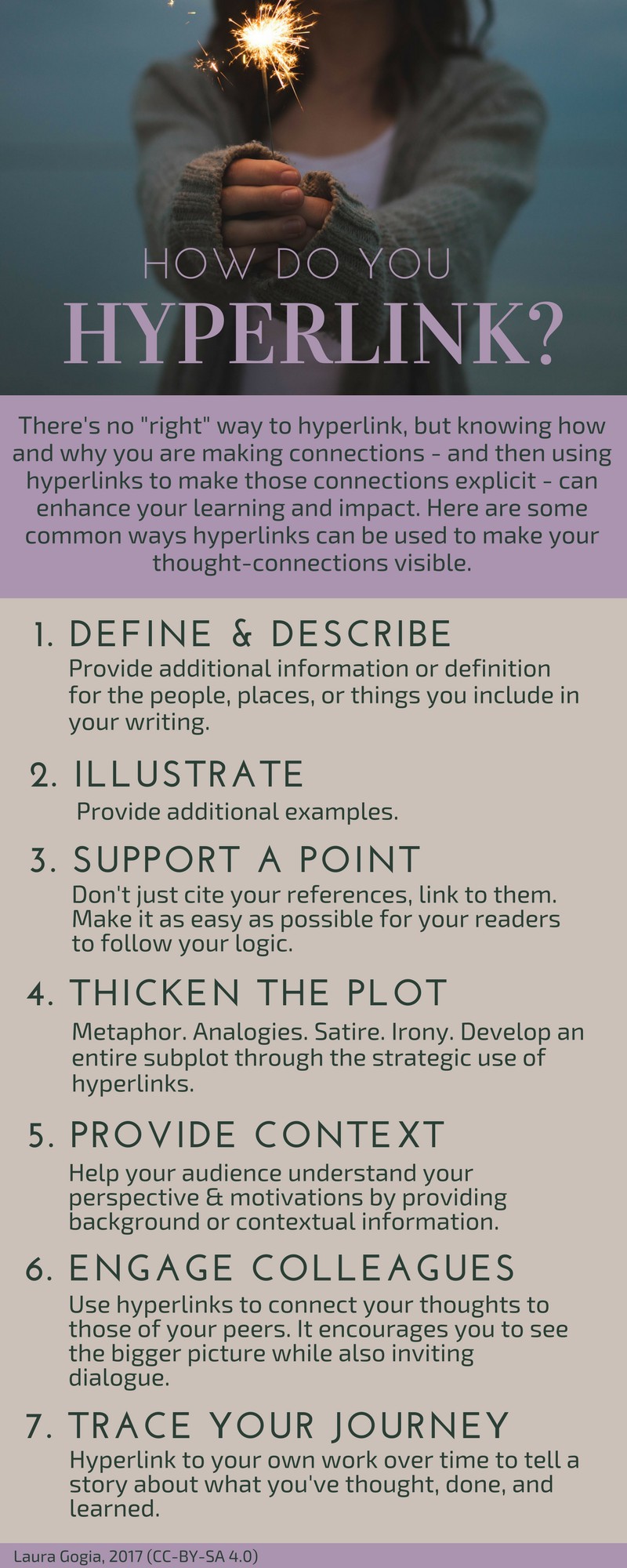
Hyperlinks are important.  However, blogging also allows for the embedding of visual elements (including but not limited to photographs, images, data visualizations, videos, and gifs). Visual elements can enhance the message of a blog post by establishing mood, illustrating points, and extending the narrative. I’ve created an infographic on the topic, but I have also found many wonderful examples among the #openlearning17 blog posts.

Aesthetics. Images can establish or consolidate a mood within a post.  Use the same type (meaning color, theme, style etc) of image across multiple blog posts and you can establish a personal brand: a way for your readers to recognize your work in a glance.  In #openlearning17, Erin Crane, creator of the Crane Librarian, has established a clean and compelling aesthetic across her blog posts. Check out her most recent post in which the meandering intermingled color flumes in the large centered image match her title, Are We There Yet? perfectly. Camille Freeman has also created an aesthetic around beautiful photographs in her introductory post. Her choice of the partially unfurling plant aligns well with her self-described “tentative toe dip.”

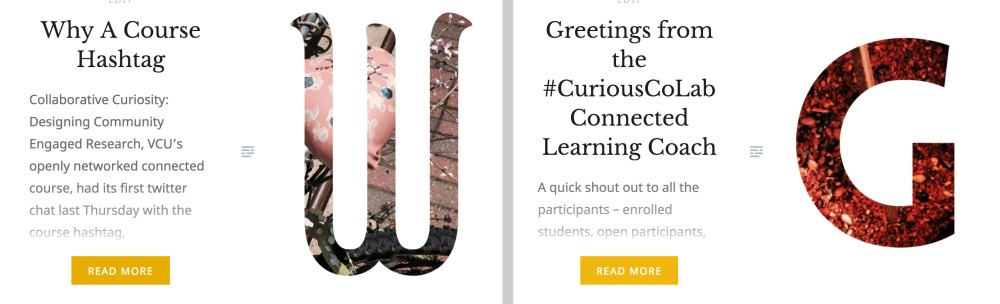
Additionally, check out an example of my own: As the connected learning coach for #CuriousCoLab, I created digital letters from my own photographs to use as featured images for all of my coaching-specific blog posts.

Two blog posts by the author, each with a featured image that includes a large letter filled with an image
From my blog posts. Note the pattern in the featured image.

Illustrations. Images, videos, and gifs can help illustrate the point of your post. John Stewart’s post, Open Note Databases and the Promise of the Memex, not only incorporates the relevant #openlearning17 video panel discussion but also offers readers several compelling visual examples from open note databases.

Outside the realm of #openlearning17 (but juxtaposed with it in my Twitter timeline), are the social media hashtag phenomena of #dresslikeawoman and #actuallivingscientist. Take a moment to reflect on how the addition of an image impacts the power of the message.

An actual living scientist tweet that includes a photograph of a smiling African American female scientist working in the field
A actual living scientist and dress like a woman tweet that includes a smiling female conservationist working in the field
A actuallivingscientist tweet that does not include a picture beyond the avatar

Extending. Finally, bloggers can integrate images, data visualizations, and videos into the posts so that they extend the narrative of the post beyond the text.  In the #openlearning17 hub, check out the way RaptnRent incorporated a song and music video into the post….Making the connection between the song and the week’s readings is the primary theme of the post.  Also check out Alan Levine’s post in which he moves seamlessly between text and illustrations – it’s hard to tell where one begins and the other leaves off.

Alternatively, check out my first post on why embedding visual images into blog posts makes an impact, in which I interviewed my eldest daughter who explained everything you need to know over a slice of pizza at the Virginia Museum of Fine Arts. This video basically served as an advanced organizer for the rest of my post.

What about the learning?

With all this talk about using visual elements to express oneself, it might be easy to forget the learning aspects of using embedded images and videos.  How does going to all of the extra work to embed non-text based elements into your post contribute to your learning?

Making connections across books, music, maps, photos, charts, and .gifs means making connections across disciplines, contexts, people, and time. Consider that adding visual components takes time: time that is mostly spent on considering what you are trying to say and how you might express it through other avenues.  Reflecting on what you are trying to say and considering it in other contexts is always a good thing for learning.

What about the technicalities?

If you need more specific details on how to embed, how to create your own images, or where to go to find CC-licensed or public domain offerings, check out my previous blog post on visuals.

As always, please remember to cite your image sources. Videos that are embedded from Vimeo or YouTube are self-citing…click on them and you automatically go to the original video publishing platform; photos and images are different.  You must give credit to the image creator and provide a url somewhere in the post. Caption, hyperlink, integrate it into the post text – just do something!  And consider this, I know that CC-0 and public domain images do not technically require citation, but you should consider doing it anyway for reasons of karma and transparency.

Additionally, please add alt text to your images so that it can be read by text readers.  A little description is fine, just enough to keep those who use text readers in the loop.  It’s a good practice.

That time when the AACU Virginia FacCollab held a Twitter Journal Club Event

On January 27, 2017, the AACU Virginia Faculty Collaboratives Experience (#OpenLearning17) teamed up with Twitter Journal Club (#TJC17) for a synchronous reading & discussion of Jeffrey Pomerantz & Robin Peek’s 50 Shades of Open.  Through serendipitous networking (thank you, Phil Edwards), author Jeffrey P. discovered the event and made himself available to provide additional background, resources, and insights into the nature of the article and the concept of open (Thank you again, Jeffrey!).

A diverse group participated, tweeting in from Mexico, California, Texas, Washington, New Mexico, Pennsylvania North Carolina, Maryland, and Virginia.  The Virginia institutions of higher education represented during the event included University of Mary Washington, James Madison University, George Mason University, Virginia Commonwealth University, and Virginia Tech. (*Disclaimer: This is not be a comprehensive list, though I can make it comprehensive if you give me a compelling reason to do so.)

Tweets came in from both hashtags, but due to time constraints I’ve focused on only on tweets that included the #TJC17 hashtag.  We were active in this space, tweeting approximately than 300 times in less than an hour.  Many participants were so engaged in the conversation that they continued to talk with each other (and with the hashtag) well after the event was over.  Days later, pieces of the conversation are still being retweeted by people who were not involved in the original conversation.

I’ve lightly organized these tweets (bearing in mind I collected only those from the #TJC17 hashtag) into conversational threads and storified them, here.

Loosely, conversations emerged around the following themes:

  • The stability and evolution of ‘open.’  While some participants focused on the extreme stability of the meaning of open over the years, others focused on how the ever-changing world has led to different and more nuanced uses of the word.  The concept of valuing a thing for what it is versus valuing it for how it can be used…it came up again and again in different ways throughout the conversation.
  • Marveling over all the types of ‘open.’ Many participants hadn’t thought about all the contexts of open before reading this article; they mentioned which ones struck them as particularly interesting or new.
  • Implications of ‘open skies.’ Of those new ways of considering open, the “open skies” conversation took on a life of its own, revealing tensions between hospitality, use, ownership, surveillance, and accessibility.
  • ‘Open’ in terms of accessibility versus use. General agreement that once we take accessibility for granted, our focus turns almost entirely to how we are able to use that which is accessible.  Some participants reminded us that accessibility is still a huge issue for many people.  We must balance our focus on accessibility and use.
  • The source code of pedagogy. In many ways the heart of the conversation. In what started as a reference to open software, some participants wove through the concept of education as ‘made’ and codified…codified in ways that can potentially be shared, remixed, and reused.  We moved past open-as-availability and into the realm of open-as-transparency, allowing for links across theory, practice, and learner’s goals. We moved from valuing-as-is to valuing-as-application.
  • The commons. As part of that conversation, we moved through references to the commons, most notable for the number of outside references that were added to the overall conversation, as people shared their favorite authors and resources with each other.
  • Connecting ‘open’ to liberal education. This conversation is worth reading in whole from the storify. Gardner Campbell asked: “How do you think 50 shades of open connect w ideals of “mind-liberating education,” aka “liberal learning”? The article’s author, Jeffrey Pomerantz, responded: “Short answer? I think openness is not necessary to liberal learning but sure helps. Liberal learning must aim for self-sufficiency in the student. Openness encourages exploration.”
  • The Twitter Journal Club experience (a meta-commentary). Some people watched the stream with an eye for meta-analysis and commented on it at regular intervals. When I say “most people,” I mean mostly me and it was the preliminary work for this post. However, it also included people talking about other activity on the hashtag, their learning experiences, and their physical surroundings.

Participants linked this event to the following entities: 

In terms of my own experience:

For critics who say nothing can be learned in this sort of chaotic, unscaffolded digital environment, I merely point you to the summary and analysis above. For those who were disconcerted by the porn bots sharing our hashtag (yes, #TJC17 must mean something else…to someone), well, to be honest, I loved it.  Absolutely loved it.  We do not own hashtags – hashtags are open or shared resources.  I can’t think of a better way of demonstrating the concept of openly shared resources than academe sharing a hashtag with porn bots.  Furthermore, as I was discussing with Gardner Campbell after the event, the strangeness of such a juxtaposition can be liberating, if you let it be so.

The freewheeling thinking associated with Twitter Journal Club will always be one of my favorite approaches to informal knowledge construction.  I realize that it isn’t for everyone, nor does it fulfill every scholarly need. However, we cannot spend our days approaching scholarly articles in the same way, from the same direction.  We need to mix up scholarly thoughts, challenge them, throw them against the wall, enter into them with our minds open and academic defenses down. Twitter Journal Club offers me – and presumably those of us who keep coming back – that opportunity.  I always emerge feeling rejuvenated, connected, and even more curious than before.  For me, this is what a joyful approach to liberal education looks like.

Featured Image by Jon Eric Marababol


Greetings from the #OpenLearning17 Connected Learning Coach

This week marks the opening of Open Learning: A Connectivist MOOC for Faculty Collaboratives, a 15-week course that aims to “design and provide a helpful and stimulating learning experience for all participants that results in measurable improvement in the use of digital affordances and sustainable professional development connections across Virginia and other areas.”

For the uninitiated, faculty collaboratives are part of the American Association of Colleges & University (AACU) LEAP initiative.  Since 2005, LEAP (Liberal Education & America’s Promise) has promoted college learning that involves high-impact educational practices and authentic assessments; faculty collaboratives support LEAP success by creating large-scale, sustainable networks of resources meant to support faculty development on LEAP-related principles, practices, & outcomes.  The #OpenLearning17 MOOC represents a partnership between AACU and the State Council for Higher Education of Virginia (SCHEV) and is the faculty collaborative experience for Virginia that seeks to enhance digital literacy and leadership among the faculty of institutions of higher education in Virginia and beyond.

Hello, I am Laura Gogia, your Connected Learning Coach for the #OpenLearning17 Course.

giphy-4
Wait, what?

More explanation may be needed :).  Here are the obvious questions that come to mind.

Question: WHAT IS CONNECTED LEARNING & WHAT DOES IT HAVE TO DO WITH A CONNECTIVIST MOOC?

If you participate in #openlearning17, you will be working to enhance your ability to make connections in and across digital platforms, building visible networks of ideas, people, and personal/professional resources over time.  It is one example of a connected learning experience.

Connected learning is a progressive educational approach (think Dewey) contextualized for the digital world. The National Writing Project does a great job of providing case studies and examples, Mimi Ito and colleagues’ agenda for connected learning research and instructional design goes into a bit more detail, and I’ve written a white paper on how connected learning was executed at Virginia Commonwealth University.  If you read through all of these things, you’ll see that the purpose of connected learning is to create inclusive, creative, social, authentic learning environments meant to help students recognize, strategically reflect on, and forge new connections between people, contexts, ideas, and personal experiences. Although connected learning does not have to be executed in open digital environments, to do so opens the door to an entirely different level of access to and opportunity for authentic audiences, creative resources, and personal learning network development.

john-dewey-o

Connected Learning = Dewey in the digital world.


Question: AS A LEARNER, HOW DO I ENGAGE IN CONNECTED LEARNING?

As I mentioned above, connected learning is really a form of experiential learning, so we can think about it in terms of Kolb’s experiential learning cycle.  I’ve  written about it in more detail elsewhere. However, to cut to the chase, connected learners deepen their understanding by making connections:

  • with other people (social learning)
  • across their own thought trajectory, over time (reflective learning)
  • across disciplines and contexts (interdisciplinary and cross-contextual)
  • through different types of expression (multimodal; visual/audio/kinesthetic/etc)

Digital platforms allow us to makes those connections explicit via hyperlinks, embedded images, audio, and video which brings us to the final question…

Question: WHAT IS A CONNECTED LEARNING COACH?

Short answer: I am and this is not the first time I have done this; in fact, for more details, you can check out this WCET blog post. During this course – usually in the form of blog comments or tweets or infographics– I will be asking you to consider how you can use the affordances of the web to enhance your communication and learning.

For example, I might ask you to think about how a hyperlink – one form of a digital affordance – might make your thinking more explicit, increase your communicative impact, and enhance your own learning.  If you click through the hyperlinks in this blog post, you will see that I made connections between my current thinking and:

  • the course website & AACU website
  • my past work
  • other references, and
  • other forms of expression (hint: the gifs)

In doing so, I not only demonstrated a understanding of audience (e.g. I provided context and additional resources for them), but also connected this current activity with my other scholarly work.  I reconfirmed my purpose and position.  I also put a lot of thought into what gifs would express what was going on in my head…which made me think about what was actually going on in my head more than I would have otherwise.

giphy-5
Connections

Digital spaces – particularly public digital spaces – allow you to do certain things that you cannot do on paper or in a closed classroom space. Of course, the reverse can be true as well…and we can reflect on that too. It is my HOPE, my genuine hope, that you will join me in exploring the digital nature of #OpenLearning2017 with curiosity as a truly unusual learning space.

Thanks – you’ll see me around 🙂