Tag Archives: Connected Learning Coaching

Why #openlearning17 should consider embedding visual elements in blog posts

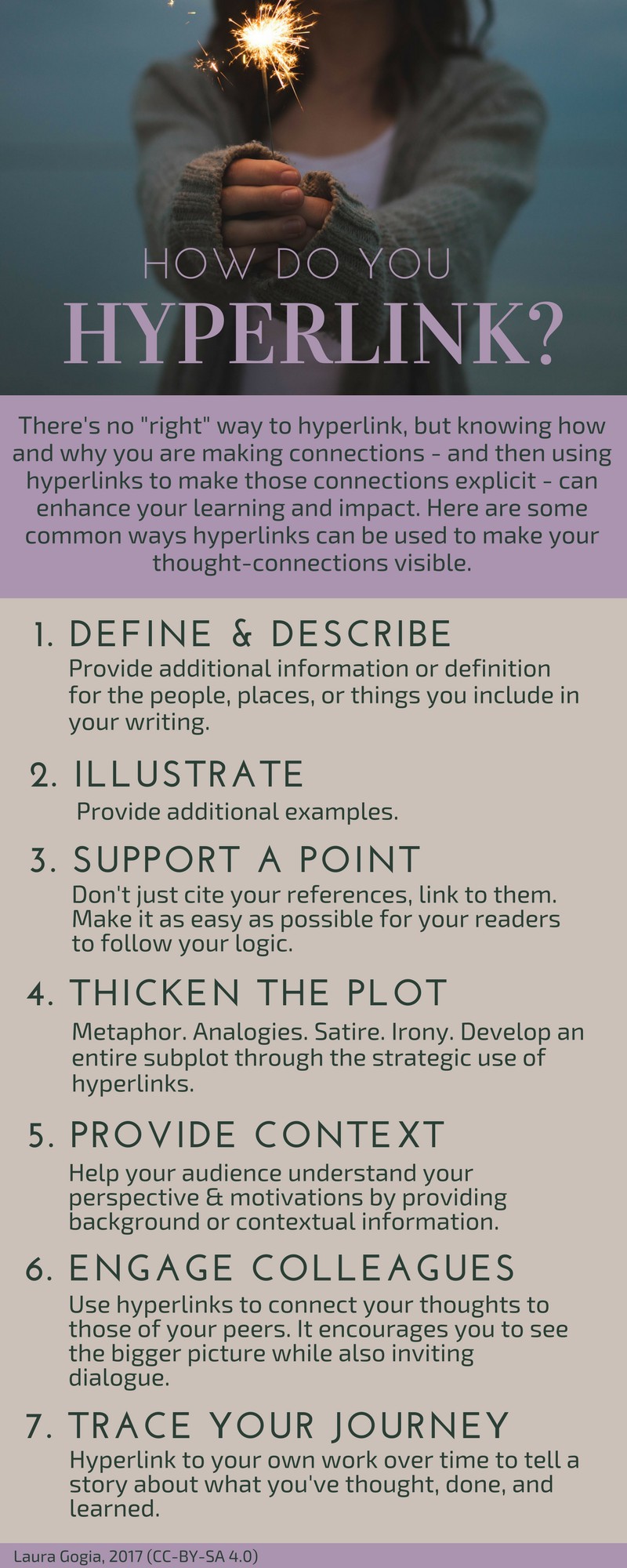
As the connected learning coach for the AACU Virginia Faculty Collaboratives Experience, #OpenLearning17, it is my pleasure to wind my way through the open learning hub,  focused predominantly on how participants are making connections through their blog posts and tweets.  There has been a lot to love in the first two weeks of blog posts.  As I mentioned in my greetings and hyperlinking posts, connected learning takes place when learners network their current learning/thinking across disciplines, contexts, people, and time. Digital platforms have unique affordances that allow us to make and reveal our connections.  As Autumm’s #openlearning17 post on digital citizens, fake-news, and microtargeting demonstrates, hyperlinking is an amazing way to connect ideas and build infrastructure around a post; if you need additional convincing, check out how she used hyperlinks to define, cite, provide examples, and contextualize.

What do visual elements add?

Hyperlinks are important.  However, blogging also allows for the embedding of visual elements (including but not limited to photographs, images, data visualizations, videos, and gifs). Visual elements can enhance the message of a blog post by establishing mood, illustrating points, and extending the narrative. I’ve created an infographic on the topic, but I have also found many wonderful examples among the #openlearning17 blog posts.

Aesthetics. Images can establish or consolidate a mood within a post.  Use the same type (meaning color, theme, style etc) of image across multiple blog posts and you can establish a personal brand: a way for your readers to recognize your work in a glance.  In #openlearning17, Erin Crane, creator of the Crane Librarian, has established a clean and compelling aesthetic across her blog posts. Check out her most recent post in which the meandering intermingled color flumes in the large centered image match her title, Are We There Yet? perfectly. Camille Freeman has also created an aesthetic around beautiful photographs in her introductory post. Her choice of the partially unfurling plant aligns well with her self-described “tentative toe dip.”

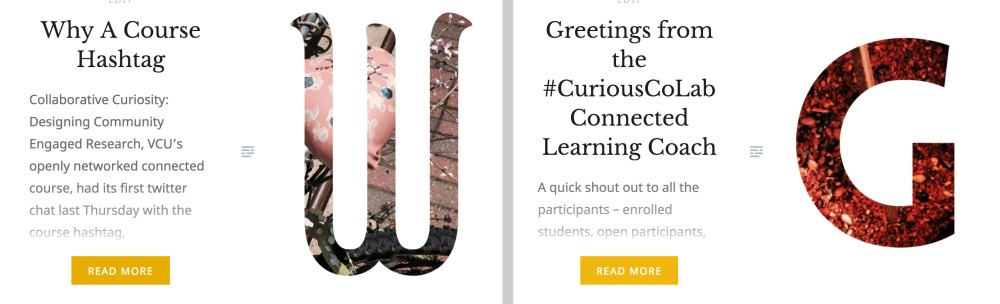
Additionally, check out an example of my own: As the connected learning coach for #CuriousCoLab, I created digital letters from my own photographs to use as featured images for all of my coaching-specific blog posts.

Two blog posts by the author, each with a featured image that includes a large letter filled with an image
From my blog posts. Note the pattern in the featured image.

Illustrations. Images, videos, and gifs can help illustrate the point of your post. John Stewart’s post, Open Note Databases and the Promise of the Memex, not only incorporates the relevant #openlearning17 video panel discussion but also offers readers several compelling visual examples from open note databases.

Outside the realm of #openlearning17 (but juxtaposed with it in my Twitter timeline), are the social media hashtag phenomena of #dresslikeawoman and #actuallivingscientist. Take a moment to reflect on how the addition of an image impacts the power of the message.

An actual living scientist tweet that includes a photograph of a smiling African American female scientist working in the field
A actual living scientist and dress like a woman tweet that includes a smiling female conservationist working in the field
A actuallivingscientist tweet that does not include a picture beyond the avatar

Extending. Finally, bloggers can integrate images, data visualizations, and videos into the posts so that they extend the narrative of the post beyond the text.  In the #openlearning17 hub, check out the way RaptnRent incorporated a song and music video into the post….Making the connection between the song and the week’s readings is the primary theme of the post.  Also check out Alan Levine’s post in which he moves seamlessly between text and illustrations – it’s hard to tell where one begins and the other leaves off.

Alternatively, check out my first post on why embedding visual images into blog posts makes an impact, in which I interviewed my eldest daughter who explained everything you need to know over a slice of pizza at the Virginia Museum of Fine Arts. This video basically served as an advanced organizer for the rest of my post.

What about the learning?

With all this talk about using visual elements to express oneself, it might be easy to forget the learning aspects of using embedded images and videos.  How does going to all of the extra work to embed non-text based elements into your post contribute to your learning?

Making connections across books, music, maps, photos, charts, and .gifs means making connections across disciplines, contexts, people, and time. Consider that adding visual components takes time: time that is mostly spent on considering what you are trying to say and how you might express it through other avenues.  Reflecting on what you are trying to say and considering it in other contexts is always a good thing for learning.

What about the technicalities?

If you need more specific details on how to embed, how to create your own images, or where to go to find CC-licensed or public domain offerings, check out my previous blog post on visuals.

As always, please remember to cite your image sources. Videos that are embedded from Vimeo or YouTube are self-citing…click on them and you automatically go to the original video publishing platform; photos and images are different.  You must give credit to the image creator and provide a url somewhere in the post. Caption, hyperlink, integrate it into the post text – just do something!  And consider this, I know that CC-0 and public domain images do not technically require citation, but you should consider doing it anyway for reasons of karma and transparency.

Additionally, please add alt text to your images so that it can be read by text readers.  A little description is fine, just enough to keep those who use text readers in the loop.  It’s a good practice.

A Virtual Introduction

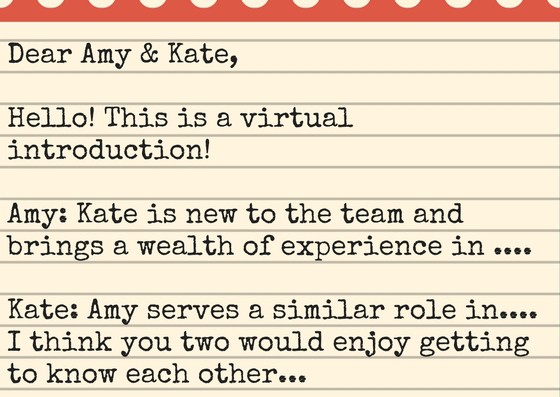
dear-i-want-to-introduce-you-to-laura-gogio-gehlis-new-associate-director-she-is-new-to-the-team-and-brings-a-wealth-of-experience-in-research-evaluation-and-adult-learning-laura-kasey-formerly

As the new Associate Director at Virginia Commonwealth University’s Grace E. Harris Leadership Institute (GEHLI), I’ve been getting a lot of virtual introductions that sound like these recently. Spend enough time in higher education,  and you will send and receive these things so often that you stop thinking about what they really are, which is a basic form of digital networking.

With the growth of behemoth (horrible) professional (superficial) networking platforms, “networking” in the context of digital platforms has gotten a bad name.  In fact, if you read enough Forbes.com, you’ll see that the “soft skills” business gurus want you to stop networking and start connecting. To be completely honest, I do not like Forbes.com (or the terms soft skills, guru, business…or anyone who writes about networking but doesn’t really know what it means),  but if you read the article I’ve hyperlinked, you’ll find some truth in the fluff: Networks consist of connections. Therefore, effective networks are made up of effective connections. Effective connections are those which make sense, that work, that are mutually  beneficial.

Think this through for a moment: We can create networks of people, ideas, and resources. We forge connections through actions like introducing, conversing, sharing, receiving, co-creating. Our digital connections automatically leave digital trails of emails, tweets, hyperlinks, blog post comments. Don’t worry, I’ll unpack that over time. It’s only the first day of #OpenLearning17.

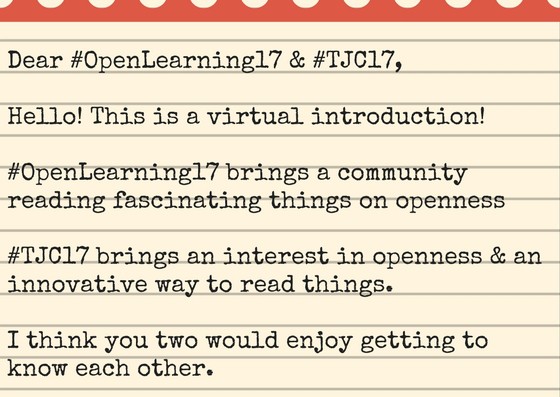
However, tonight, I have my own virtual invitation to extend and my own a digital connection to forge.

dear-i-want-to-introduce-you-to-laura-gogio-gehlis-new-associate-director-she-is-new-to-the-team-and-brings-a-wealth-of-experience-in-research-evaluation-and-adult-learning-laura-kasey-formerly

This week, #openlearning17 – an open SCHEV/AACU faculty collaborative experience (I talk more about it here) – is reading a great article called 50 Shades of Open by Jeffery Pomerantz and Robin Peek.  It’s so great that Gardner Campbell, the #openlearning17 hub director, thought it might benefit from some special treatment…something akin to the type of reading we did in the Twitter Journal Club (TJC) I founded several years ago.

Some background.  TJC was my first real experiment in Twitter-based pedagogy.  I was a graduate student who, like all graduate students, was struggling to read everything in the world. When I wasn’t trying to read everything in the world, I was practicing my tweeting by live-tweeting conferences, webinars, presentations, etc (not because I was a graduate student – I did that because I am Laura).

One day, my two worlds collided.  I came across an article written by two scholars I knew to be on Twitter, so I began to live-tweet their article as I read it, mentioning their Twitter handles in each tweet so that they would see it.  They responded, riveted (so they said) by what this graduate student might make of their writing.  Others joined in. Suddenly we were having a Twitter-party-cum-question-answer-session with the article’s authors.  It was magical.  It had to be repeated.

Out of this emerged a monthly gathering (which sadly has grown dormant over the past year as many of us were completing and defending our dissertations and finding jobs and so forth). But also  a website, a peer-reviewed journal article, and an unusual approach to reading scholarly articles.

From the TJC website:

Twitter Journal Club is an open learning experience on Twitter (originally aggregated around the hashtag #tjc15) in which participants read a previously agreed upon article at a scheduled time, live-tweeting as they go.  We are now going into our second calendar year and will be working under the hashtag #tjc16…and now #TJC17. The articles – which must be openly available either through pre-print or open access – are recommended by participants via Google Doc and read in order of recommendation.

Articles tend to be recently published articles from Open Education/Education Technology/Digital Literacy/Networked or Connecting Learning fields.  Article authors are invited to join the conversation via direct invitation.

There is no mandate to read the article in advance (although there is also no mandate to prevent participants from reading in advance).  The journal club convenes formally for one hour and while conversations can occur for however long as desired, this hour is archived and published via Storify so that participants can read the transcript if they desire
There are no pre-arranged talking points or questions for the discussion.  It just IS.
As I wrote in Hybrid Pedagogy, the TJC approach doesn’t result in the same sort of outcomes as a typical journal club.  You don’t delve deep into the article as much as spring forth from it.  There is a celebratory buzz around these events, not a somber or studious hum.  TJC sparks conversations and if you come away with one or two nuggets, a list of difficult to answer questions, a bazillionty more references to check out, and you STILL NEED TO READ THE ENTIRE ARTICLE…well then you have been #TJC’ed.
Gardner and I are dusting off the #TJC..now #TJC17 hashtag and rousing the community for a reunion because we think #openlearning17 and #TJC17 might have some fun together around this article.  I’ll be sending out the word (you’ll see it…in all my Twitter glory for those of you who have never seen it before), but you who have gotten to the end of this post will hear it first.
twitter-journal-club-tjc17

Greetings from the #OpenLearning17 Connected Learning Coach

This week marks the opening of Open Learning: A Connectivist MOOC for Faculty Collaboratives, a 15-week course that aims to “design and provide a helpful and stimulating learning experience for all participants that results in measurable improvement in the use of digital affordances and sustainable professional development connections across Virginia and other areas.”

For the uninitiated, faculty collaboratives are part of the American Association of Colleges & University (AACU) LEAP initiative.  Since 2005, LEAP (Liberal Education & America’s Promise) has promoted college learning that involves high-impact educational practices and authentic assessments; faculty collaboratives support LEAP success by creating large-scale, sustainable networks of resources meant to support faculty development on LEAP-related principles, practices, & outcomes.  The #OpenLearning17 MOOC represents a partnership between AACU and the State Council for Higher Education of Virginia (SCHEV) and is the faculty collaborative experience for Virginia that seeks to enhance digital literacy and leadership among the faculty of institutions of higher education in Virginia and beyond.

Hello, I am Laura Gogia, your Connected Learning Coach for the #OpenLearning17 Course.

giphy-4
Wait, what?

More explanation may be needed :).  Here are the obvious questions that come to mind.

Question: WHAT IS CONNECTED LEARNING & WHAT DOES IT HAVE TO DO WITH A CONNECTIVIST MOOC?

If you participate in #openlearning17, you will be working to enhance your ability to make connections in and across digital platforms, building visible networks of ideas, people, and personal/professional resources over time.  It is one example of a connected learning experience.

Connected learning is a progressive educational approach (think Dewey) contextualized for the digital world. The National Writing Project does a great job of providing case studies and examples, Mimi Ito and colleagues’ agenda for connected learning research and instructional design goes into a bit more detail, and I’ve written a white paper on how connected learning was executed at Virginia Commonwealth University.  If you read through all of these things, you’ll see that the purpose of connected learning is to create inclusive, creative, social, authentic learning environments meant to help students recognize, strategically reflect on, and forge new connections between people, contexts, ideas, and personal experiences. Although connected learning does not have to be executed in open digital environments, to do so opens the door to an entirely different level of access to and opportunity for authentic audiences, creative resources, and personal learning network development.

john-dewey-o

Connected Learning = Dewey in the digital world.


Question: AS A LEARNER, HOW DO I ENGAGE IN CONNECTED LEARNING?

As I mentioned above, connected learning is really a form of experiential learning, so we can think about it in terms of Kolb’s experiential learning cycle.  I’ve  written about it in more detail elsewhere. However, to cut to the chase, connected learners deepen their understanding by making connections:

  • with other people (social learning)
  • across their own thought trajectory, over time (reflective learning)
  • across disciplines and contexts (interdisciplinary and cross-contextual)
  • through different types of expression (multimodal; visual/audio/kinesthetic/etc)

Digital platforms allow us to makes those connections explicit via hyperlinks, embedded images, audio, and video which brings us to the final question…

Question: WHAT IS A CONNECTED LEARNING COACH?

Short answer: I am and this is not the first time I have done this; in fact, for more details, you can check out this WCET blog post. During this course – usually in the form of blog comments or tweets or infographics– I will be asking you to consider how you can use the affordances of the web to enhance your communication and learning.

For example, I might ask you to think about how a hyperlink – one form of a digital affordance – might make your thinking more explicit, increase your communicative impact, and enhance your own learning.  If you click through the hyperlinks in this blog post, you will see that I made connections between my current thinking and:

  • the course website & AACU website
  • my past work
  • other references, and
  • other forms of expression (hint: the gifs)

In doing so, I not only demonstrated a understanding of audience (e.g. I provided context and additional resources for them), but also connected this current activity with my other scholarly work.  I reconfirmed my purpose and position.  I also put a lot of thought into what gifs would express what was going on in my head…which made me think about what was actually going on in my head more than I would have otherwise.

giphy-5
Connections

Digital spaces – particularly public digital spaces – allow you to do certain things that you cannot do on paper or in a closed classroom space. Of course, the reverse can be true as well…and we can reflect on that too. It is my HOPE, my genuine hope, that you will join me in exploring the digital nature of #OpenLearning2017 with curiosity as a truly unusual learning space.

Thanks – you’ll see me around 🙂