I’m putting together a session for college and community leaders on digital platforms and professional development. It’s a short session – I only have 30 minutes. Additionally, there are pre-set criteria for the session that essentially boil down to requiring an experiential adult learning experience. In short, I need to offer a taste of something larger and compelling, but that is also discreet, active, and meaningful on its own.
I’m struggling. Thirty minutes is not a long time.
However, I often find that all goodness starts with completing a Visitors and Residents Mapping Exercise. The digital visitor/resident model was introduced by David White, Donna Lanclos, and colleagues in 2011. The model represents a spectrum of behaviors (visitors to residents) as compared to the older and now debunked digital natives narrative, which focuses on discrete groups of people.
When acting as digital visitors, people consider digital platforms as tools. Their behavior tends to be goal oriented. They limit their time online to what is required to achieve their goals and tend to get offline without leaving much of a digital trace or identity. In contrast, digital residents perceive digital platforms as spaces more than tools: spaces that can be linked together and inhabited along with other people. They tend to spend more time on the platform, leaving artifacts and developing identities within those spaces.

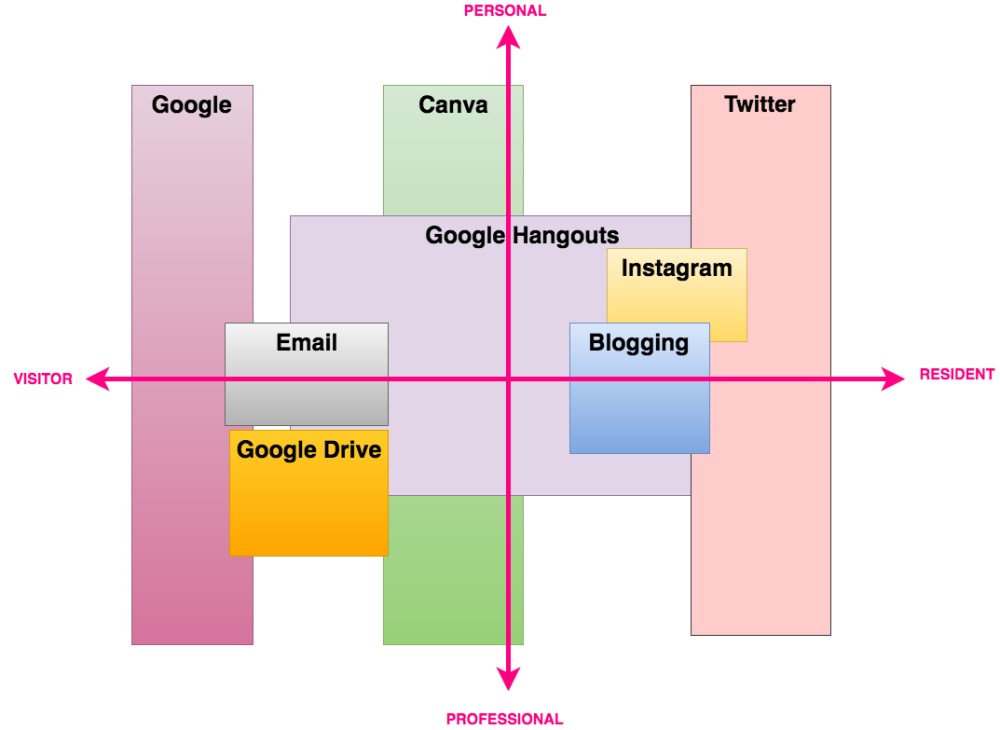
This is my digital map. It shows how someone can be a digital resident and visitor at the same time both within and across platforms. It shows that I tend to mix my personal and professional use of digital platforms. It shows Google Hangouts as a significant area of context collapse; I use it as a tool to be sure, but it is also a space where I talk to my friends about their families, conduct research meetings, and give guest lectures…sometimes back-to-back, sometimes in the same hangout. I have literally had girlfriend chats that shifted into business meetings that shifted back into girlfriend chats – changes signified through the on air button. Another interesting overlap occurs at blogging, instagram, and twitter. I use these platforms differently, but my followers significantly overlap. Instagram is kind of like my B side.
I like my map. Now I just need to jump from this to a micro-presentation.

