I’ve been (slowly) working my way through the 23 Things List, a project on digital literacy from the University of Edinburgh. Thing number 4 was Digital Security. While we include Web Security in a lot of our digital literacy prorams, I’m not a huge WebSec person. It’s not something that I think about or worry about to the extent that ….. does.
Probably because WebSec hasn’t been a huge concern for me, I was surprised by what I found on Google Maps Timeline.
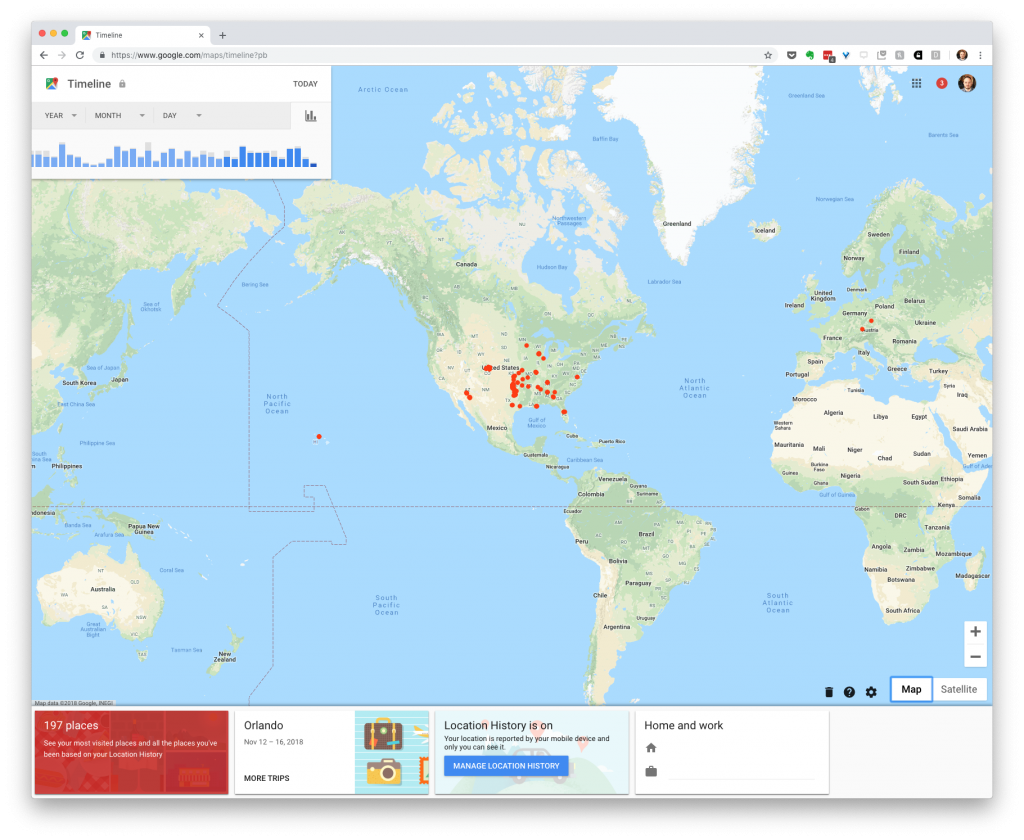
My data on Google Maps Timeline
If you go to https://www.google.com/maps/timeline, you will likely find your own movement history for the past several years. As you can see in the picture above, Google knows my home and work addresses (I’ve removed them from the screenshot), the cities that I’ve been to, and even the modes of transportation I took to get there.
I can go through the data and find out how many times I’ve been to my favorite coffee shops over the past week or year. Google has data on my location dating back to 2009, which is probably when I got my first phone that tracked geolocations. The data is a bit patchy for the early years, but pretty thorough since about 2015.
My colleague Keegan Long-Wheeler has been doing some work on reconstructing his memories from the past few years. He had a brain tumor removed earlier this year, so he has been going back through the softwares that track him to retrace his steps and reflect on his activities.
If we want to be very generous to Google, we can suppose for a moment that this is how they intended such data to be used. I enjoyed spending about 15 minutes looking back through my data and remembering some of the trips from the past couple of years. Google also uses this data to send us notifications about how long it’s going to take to get to work in the morning and what the traffic is like around us. They put our maps through algorithms to understand our daily routines, and build that information into their phones, watches, and assistants.
However, I think we all realize that the reason Google collects this information is so that they can use it for marketing. Google is an ad company and a data company. They want to micro-target us with ads, and they want to sell our data to companies that will be most interested in us. Knowing literally everywhere that I’ve been over the past 10 years is valuable for their business model.
If you haven’t done it yet, go to https://www.google.com/maps/timeline and look at your data. Play around with it for a few minutes. Reminisce about those trips and your favorite spots around town.
Now look at the little black trashcan at the bottom of the screen, and seriously think about deleting all that location data. If you didn’t know about this service until today, and if you don’t care about those notifications you get to your phone, you won’t be missing anything and Google won’t be able to sell all of your location data any more. If you love your Google notifications, and you’ve got a Google Home listening to your every move at home, then maybe leave it on. Either way, control of your data should be up to you. You can find more about your data security in the Thing 4 walkthrough or check out this Medium post by Nick Rosener on Personal Cybersecurity.
As part of the 23 Things MOOC from the University of Edinburgh, I did a little bit of searching today to see what my digital footprint looks like.
I have an extremely common name, so most of what I found with a Google search was links for information about Jon Stewart and links for the Green Lantern. There are various important historical John Stewarts (John Stewart Mill for one), so my footprint is buried.
However, if you Google search John Stewart OU, you’ll find a lot more about me. Most of the Google results from my computer (influenced by my Google search history and all of the other data Google has on me) pointed at my blog and my other professional profiles.
I have taught workshops on how to manage your digital presence, so this pretty well fit with my expectations. In these presentations, I stress that you should create a digital presence that you control rather than letting people stumble upon your old photos from Facebook. While it’s still possible to find pictures of me doing dumb things as an undergrad, most people will click instead on my blog or LinkedIn account or other, professional profiles.
I am interested in the multiple personas/facets that we each present out on the internet. You might have an Instagram persona – the you that lives your best life. You might even have multiple Instagram personas. There might be a different you on Facebook that your parents and grandparents can deal with. On Twitter, we might find the the media critic version of you that watches Netflix all day and shares some thoughts. There are probably some professional profiles and some less than professional relics of earlier days floating around. Perhaps one day, we’ll have a centralized collection of our stuff that we can mete out to people based on which version of ourselves we want them to see, hiding the other personas behind a wall. For now though, if you post it online, assume that your mom, your grandparents, and your future employer will all find it.
This week I registered for an open, online class called 23 Things for Digital Knowledge offered out of the University of Edinburgh.
I’m currently planning out my own digital literacy course for next summer, so I signed up mostly to see what they’ve focused on and how they tie it all together. For my own class, my early and very partial list of stuff that I want students to work on includes:
media literacy – critically evaluating the sources, biases, and rhetoric of the information they’re getting
the digital divide – investigate the reasons why power structures are reflected in access to and control of digital knowledge systems
web literacy – what are the different types of sites (blogs, wikis, forums, databases, static sites, etc.) and how do you build them
information systems – how to structure data in a csv, how to harvest data, how to clean data, how to analyze and visualize it
digital privacy – what kind of data are we leaking, how do businesses collect it, what do they do with it, and how do we mitigate all of this
digital security
digital citizenship
technological diffusion
algorithms (of oppression)
the funding of technological innovation
governmental use of technology
If we somehow built all of these skills and discussed the history of technology and the construction of cultures of knowledge, there would still be whole fields of psychological, sociological, educational, rhetorical, and economic analysis that we could delve into.
The first of 23 Things’ asynchronous blogging assignments asks what you hope to get out of the MOOC. I’m hoping just to see how they managed to narrow the scope of Digital Knowledge to 23 things.
As part of his work in introducing Domain of One’s Own at Ontario Extend, Alan Levine posted the questions that I answer below. I haven’t been blogging enough recently, so I thought this was a good chance to document some of my own DoOO thoughts and kickstart my writing.
What is your domain name and what is the story, meaning behind your choice of that as a name?
My domain name is https://johnastewart.org. From front to back, the difference between https and http is a security certificate. Our partners at Reclaim Hosting make it dead easy to get an SSL certificate, and I think all of the internet search engines are going to increasingly favor sites with security certificates over the next few years.
My domain name itself is just my name. John Stewart is an incredibly common name, so I threw in my middle initial for some small degree of disambiguation.
I chose .org rather than .com because of their historical significance. Originally, .com meant that you were visiting a commercial website, and .org signified a non-profit organizational site. I work for a university, and when I set up my site, I was an adjunct lecturer, which is about as non-profit as it gets. I still advocate open pedagogy, OER, open note-taking, open coding, and a general distrust of capitalism, so I think it fits.
What was your understanding, experience with domains before you got one? Where were you publishing online before having one of your own?
I had been trying to set up a couple of .php based websites for a few years before I started this domain. Early in my grad career, I tried to start an online, open journal for publishing work by graduate students studying the History of Science. At the time, my university only offered 5MB of webspace and only supported HTML in that space. Eventually, I registered both that journal and a separate Digital Humanities project (situatingchemistry.org) with a corporate web host.
In 2013, the University of Oklahoma launched the pilot for OU Create, a Domain of One’s Own initiative. I went to the initial pitch by Jim Groom and Adam Croom, and was user number #13 with this domain.
What was a compelling feature, reason, motivation for you to get and use a domain? When you started what did you think you would put there?
I really wanted to be able to run modern CMS apps, particularly Drupal. Both my Situating Chemistry site and the Open Journal System I built are built on Drupal and require a LAMP environment. With this site, I wanted to start blogging – or thinking out loud as Laura Gogia and others in the DoOO community call(ed) it.
What kinds of sites have you set up one your domain since then? How are you using them? Please share URLs!
I’m currently the project manager for OU Create. We have about 5000 users and 6000 websites, so I feel like all of them are part of my current work on domains. You can see recent posts on our Feed WordPress site, community.oucreate.com/activity and you can get a sense of what type of sites people are using at community.oucreate.com/sites.
I have about 30 sites up and running on my domain. Most are demonstration sites that I use when introducing DoOO to either classes or faculty development groups. My larger projects include the Situating Chemistry site and subdomains like my Wiki faculty development workshop: flc.johnastewart.org. I also have designed sites for faculty projects on the history of education in Oklahoma (docnarr.oucreate.com):
What helped you or would have helped you more when you started using your domain? What do you still struggle with?
I really like sites like cog.dog. I think these simple sites built in HTML are faster and more elegant than most WordPress based sites. If I had to do it over again, I’d build my main site using an HTML5up.net landing page with lots of other projects in subdomains.
What kind of future plans to you have for your domain?
I think I will probably do what I said above. I think I can move the blog feed into a subdirectory (johnastewart.org/blog), leave all the posts where they are, and create a space for a nice landing site.
For OU Create more broadly, we are playing with what DoOO v2 looks like. We are trying to figure out how to help people get into the apps they want to use more quickly, how to support non-SQL based systems (MongoDB, node.js, etc), and how to keep costs as low as possible.
What would you say to other educators about the value, reason why to have a domain of your own? What will it take them to get going with their own domain?
My usual pitch centers on the superabundance of information available to us now. When I start a research project or try to figure out some new system, I search the internet. There’s a cornucopia of resources, so I generally find a ton of great information, and I quickly start working through my project. If you’re not on the internet, if you don’t have a website, there’s a roughly 0% chance I will come across your work. It doesn’t matter if you’ve written 5 books and 20 great articles, if you and they are not online, I’m not going out of my way to find them. But if I come across one of your articles, and I can look you up and find your other work, I will do a deep dive into everything you’ve ever said. Your discoverability as a teacher is also vital to attracting grad students who want to know what you’re researching.
For the next few weeks, I will be taking a history course, something I thought I would never do again after I finished my dissertation. Shawn Graham is teaching an online digital history course at Carleton University and has opened it up for non-matriculating students.
The entire design of the course is fantastic for open learners. Rather than just allowing us to watch from the rafters, Shawn has set up a Slack team and is active in the channels. Shawn asks that students blog for the course and use github to keep a record of their progress in the coding exercises. The course readings are all openly accessible and Shawn has asked that the students use Hypothes.is so that their reading notes are open (you can find them in the Hypothes.is stream with the tag hist3814o).
For the first week, Shawn has assigned a set of readings on the concept of open notes research within history and the humanities more broadly. Open notes research is more commonly practiced in the sciences. Jean Claude-Bradley was advocating for the concept in chemistry as early as 2006. Open notes science improves reproducibility and verifiability of results, and it also opens up the vast array of information that is gained during research but never published.
Open notes research has been slow to catch on, and it doesn’t take long to brainstorm possible objections. Publications are the coin of the realm in academia, and sharing your research notes could possibly allow someone to scoop your ideas. However, I agree with the readings that Shawn has curated and his push during this week of the course that open notes research is the best practice. Clearly, as I am writing this blog, I feel that sharing my thought processes helps me to clarify my thoughts and develop my understanding of my research. Sharing our reading notes with Hypothes.is and collecting our code in GitHub take this a step further. We’re thinking, reading, and experimenting (coding) out loud.
I am taking Shawn’s course, because I want to see how he uses Slack, and because I think the course design is fantastic. I’m already a convert for open notes research and have blogged about it repeatedly here, here, here and in many other posts. This site as a whole is an argument for open notes research and the related ideas of getting rid of disposable assignments and empowering students to contribute to a broader knowledge community. However, I did enjoy the week’s readings, especially Caleb McDaniel’s post that turned me on to open notes research a few years ago. I look forward to joining in for the exercises next week (this week everyone was learning MarkDown and Git). Most of all, I want to encourage any readers in the ed tech world who have not taken a digital history or digital humanities course to at least poke around Shawn’s course to see the wonderful overlap between that knowledge domain and the current ed tech focus on digital literacy and citizenship.
Wondering whether an associative thinking exercise could weave together reflections from bloggers and glimpse connections to and renewal of general and liberal education. Answer is yes.
Information literacy as hopeful vision of creativity and flow as students develop self-awareness of their own associative trails and perspective on those of others–in other words as they perceive themselves in context of other learners and dare to try collective learning beyond the print book. As they learn in these new ways, they find it easier to cross disciplinary boundaries and go after the kinds of wicked problems so many of us hope they’ll address. They could revitalize the humanities through collective historical and interpretive work across disciplines and fields.
Below are the passages I used in the exercise. It was way fun!
Autumm Caines writes “for me it is a call for better general and liberal education. I think the first step may just be in realizing (and getting students to realize) that my internet is different from your internet. Where possible, taking ownership for our own ‘associative trails’ and demanding that ownership when it is kept from us. Finally, simply realizing that there are political forces and companies with lots of your data… which has always been the case but maybe realizing that they are trying to influence you in increasingly intimate ways” http://autumm.edtech.fm/2017/02/04/digcizfakenewsmicrotargeting/
raptnrent.me writes: “If we work to understand the hows and whys of information creation and flow, what I would call information literacy, then presumably we will be better able to review our shady present. That would elevate my spirit. Until then, there’s always Aretha” “One for the Hippie Hub.”
Morris Pelzel: “Jon Udell, I believe, used the phrase ‘context is a service we provide each other.’ I’m still puzzling out what this means, but I’m guessing that it refers to the ideal of accessing and processing information, not in an abstract and depersonalized manner, but within the context of other learners and practitioners in ‘trust networks.’ And that’s the difference between reading ‘As We May Think’ on my own, and working through it in this community, this network of fellow learners.” “Notes and Trails”
Erin Crane, Librarian reflects on actual challenges of working with students who prefer physical books to annotatable e-text in “Are We There Yet?”
Samantha Veneruso imagines ways to help students learn through integrative thinking and problem solving: “I can see how Bush was looking at the depth of information increasing, but as he talks about new forms of encyclopedias because of new associations of knowledge, I think of the idea of solving wicked problems, and the increasing intersection of disciplines– or the break downs of strict disciplines, which I think is characteristic of where we are going today in education or where we should be going today.” “Connections and Associations”
John Stewart’s “Open Note Databases” observes, “While we certainly hope that our database will be used by and be useful to historians of chemistry, the real point of the project is to enable the collaborative epistemology proposed by Vannevar Bush. History and humanities more generally are dominated by the single-author article and monograph, so a system built to pool research notes may seem counterintuitive. However, we need to remember that the point of these publications is to share our knowledge. If we all share our coffee stained notebooks, idiosyncratic excel files, and shoeboxes full of notecards, we can engage in deeper and more nuanced studies in the history of chemistry and science more broadly. Without sacrificing traditional academic products, we can collectively populate searchable, interlinked reference guides that will accelerate research and model our methodologies for the generations to come.”
In 1945, Vannevar Bush wrote a now famous piece for The Atlantic called “As We May Think.” In it, he proposed the development of a machine called the Memex. This desk shaped machine would be able to display printed and handwritten texts and would be able to record notes made with a special stylus. The machine would be able to record meta-data noting connections between various sources and all of this information could be stored on removable cards.
The Memex served as inspiration in the development of the modern personal computer. Hundreds of articles in the 1990s pointed to the invention of the World Wide Web as the culmination of Bush’s vision, and those comparisons have continued into the new millennium with the modern Internet. But while the stylus-touch interfaces of modern tablets and the proliferation of online media do fulfill much of Bush’s technological vision, the key underlying epistemic concept put forth by Bush has been largely neglected.
The rapid sharing of ideas was an obvious use of the Memex, but Bush proposed that the educational value of the tool would be the ability to retrace the thought processes and connective strands that others had made through the ever growing sea of data. Bush said, “The inheritance from the master becomes, not only his additions to the world’s record, but for his disciples the entire scaffolding by which they were erected.” While academia is slowly moving towards open access models of publication, this deeper level of sharing the cognitive “scaffolding” of our theories has received far less consideration.
On Wednesday, Jeremy Dean and Jon Udell of Hypothes.is joined with Gardner Campbell as part of #openlearning17 to discuss how web annotation is allowing us to record and retrace our thoughts as we move from one website to the next. The collective pooling of reading notes, along with the ability to retrace the steps of an individual go a long way to fulfilling the epistemological vision of Bush’s Memex.
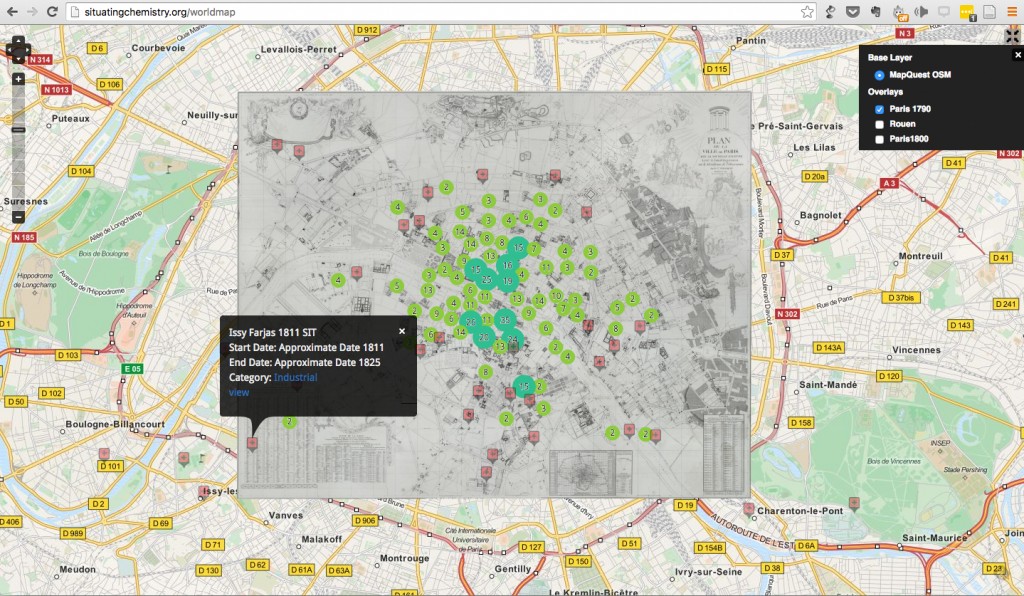
Here though I want to propose a different kind of database as an alternative and complimentary implementation of Bush’s vision. I have been working on an open note database called Situating Chemistry for a couple of years now. The concept is that researchers interested in the history of chemistry (don’t laugh, we exist) can come together to share a wide variety of notes. In addition to reading notes, the system can be used to create a profile of a historical person to record biographical notes compiled from both archival and secondary sources. These people can then be linked to each other to show familial, business, educational or any other type of relationship. Users can also record notes on the places that chemistry was done. A record can be created for a paritcular factory site, a university lab or lecture hall, or the site of an important conference. These sites can be linked back to the people who used them and mapped. Here we see a map from the 18th century of Paris with clustered pins representing the sites in our database:
In addition to people and places, users can use the system to record notes on organizations, events, courses, sources, objects, collections, processes, and theories. The key is that researchers can use the database to take notes on any facet of their studies and then connect that facet to both its particular context and the broader population of notes within the system. Users can choose to put a password on their records, but the default and usual practice is to leave the note sets open to all users so that we can extend each others’ individual records and pool our collective research.
Designing an Open-Notes Database
Web-based databases of historical people like the Prosopography of Anglo-Saxon England (PASE) and the Prosopography of the Byzantine World were produced as conclusive publications of completed research. As such, the developers could accommodate, truncate, or omit problematic pieces of data. Published databases can also choose data visualizations that best highlight key records or insights. Researchers with Stanford’s Mapping the Republic of Letters, put together this beautiful dashboard to explore the correspondence of Enlightenment thinkers.
Unlike these published databases, an open note system is designed to accommodate active note taking. Rather than structuring database fields to best present the data already collected, Situating Chemistry was built to be flexible. Because a researcher will more often than not have incomplete data, the only required field is the title of the record. The fields to record dates of birth and death can be partially filled out when only a year or year and month are known. They can also be marked approximate to indicate ambiguity in the historical record. Similarly, visualizations are employed to bring the researcher’s attention to interesting data and suggest new pathways for research.
Within any prosopographical project, the amount of biographical information available for the research subjects can vary widely. One project in Situating Chemistry focuses on the students of the noted Scottish professor William Cullen (1710-1790). In 1756, fifty-nine students attended Cullen’s chemistry course at the University of Edinburgh. Amongst them was George Fordyce (1736-1802) of Aberdeen who would go on to earn his medical degree from Edinburgh and become a lecturer of chemistry and medicine in London. Although there is no monograph length biography of Fordyce, he has entries in the Dictionary of National Biography and the Dictionary of Scientific Biography and is a relatively well-documented individual.
The other fifty-eight attendees of the course are less known. We know from Cullen’s notes that Robert Cumming was from Edinburgh, that John Richardson was from Northumberland, and that Henry Dunston was from some unspecified part of England. More surprisingly, at least two of the attendees were from Virginia—Thomas Clayton and James Taylor—and one was from Antigua—Christopher Hodge. Clayton, Fordyce, and eight other students would go on to earn their MDs from Edinburgh.
In designing Situating Chemistry database we wanted to ensure that we could capture structured, machine-readable data on someone like George Fordyce, or for that matter William Cullen. Additionally, we also wanted to be able to create records for people like Henry Dunston, for whom we had only a name and relationships of interest, in this case that he was a student in Cullen’s chemistry course, in Edinburgh, in 1756, with these other people, and he was from England.
The record for any individual can be linked to other individuals in several different ways. In addition to familial relations, we also have structured fields to collect information on instructor-student relationships and correspondents. There is also a somewhat generic person-to-person connection field that offers a list of relationships that can be expanded when needed. We designed the database such that every individual is the subject of their own record. A field denoting that a person was active in chemistry is automatically checked for every new record, but can be deactivated for familial relations, business partners, and others who are of interest but were not actively ‘doing’ chemistry even in the broadest definition.
In addition to linking a person to other individuals within the system, a person can also be linked to many other kinds of data. The database was initially conceived of as a way to catalogue sites of chemistry. We thus started the database with a table to collect information on apothecary shops, lecture halls, pharmaceutical manufactories, bleach fields, labs, etc. For a given site, the latitude and longitude of the site along with a modern address can be recorded along with information about the ownership and financial history of the site, the chemical activities associated with it, the organizational history, related images, documents, sources, etc. For each individual in the system, we display the sites that they owned and operated and also those additional sites that they were associated with.
After developing tables for the sites and people involved in chemistry, we developed further tables for chemical substances collections, courses, documents, events, images, letters, objects, organizations, primary and secondary sources, processes and techniques of chemistry, and archival and museum repositories. Any two records can be connected with an extensible series of subject-predicate-object relationships. For example a given individual could be a member of an organization or might have studied a particular chemical substance or been a practitioner of a particular process or technique of chemistry. Every record, whether it be for a person or any other type of data, can and should be sourced by linking it to primary and/or secondary sources. For the system as a whole then, we have tables for more than a dozen types of information and hundreds of structured data fields, all strung together into a relational web of information.
Interoperability & Extensibility
In its first conception, the Situating Chemistry database was thought of as a single table for sites with about a dozen fields. However, this variety of tables and fields grew organically through discussion of the research questions and practices that we, as historians of chemistry, conduct. The goal for the project was not to publish a completed set of sites or records, but rather to facilitate active research. A researcher could enter the data that they were collecting for a research project to organize and analyze the information, and they could take the database with them into the archives to continue to collect information. Researchers can access their records and add new records to Situating Chemistry from a laptop, tablet, or even a phone.
To accommodate both offline note-taking and the rapid upload of external data sets, the database has also been designed so that users can upload CSV files (excel-type tables). Any data in the system can in turn be downloaded as a CSV or in other structured formats including XML, RDF, and JSON. Because Situating Chemistry was designed as a research tool rather than a data-publication, the goal of the database is to allow users to both enter and access whatever fields and records sets they consider interesting. Several visualizations including tables, graphs, and a timeline are built into the system. The user can also extract whatever structured data they want to pull from the system, so that she can also generate her own visualizations using tools like Tableau or programming languages like Python and R.
The schema of the database is not specific to our current project, nor to the period 1760-1840. It could be readily adapted for use by other historians of chemistry (and alchemy) and historians of other sciences. If you were to dump out the 5000 records that we have input into the system, you could convert the project into a Sites of Archeology database and record the digs of the 19th and 20th century. You could just as easily record the observatories, telescopes, and astronomers of the 16th and 17th centuries or plot the biological specimens collected by Linnaeus’s correspondents.
While we certainly hope that our database will be used by and be useful to historians of chemistry, the real point of the project is to enable the collaborative epistemology proposed by Vannevar Bush. History and humanities more generally are dominated by the single-author article and monograph, so a system built to pool research notes may seem counterintuitive. However, we need to remember that the point of these publications is to share our knowledge. If we all share our coffee stained notebooks, idiosyncratic excel files, and shoeboxes full of notecards, we can engage in deeper and more nuanced studies in the history of chemistry and science more broadly. Without sacrificing traditional academic products, we can collectively populate searchable, interlinked reference guides that will accelerate research and model our methodologies for the generations to come.
Please visit our site to learn more about the project and let me know if you would like to set up an account or get a copy of the code.
Reading “Fifty Shades of Open” by Jeffrey Pomerantz and Robin Peek in First Monday http://firstmonday.org/article/view/6360/5460 one considers the parallel between the growth of fan fiction and the growth of *open* across the array of meanings the word carries. It is a tempting if baffling parallel. Wondering how to grasp a meaning of *open,* I thought of questions for Open Learning ’17. What do the principles and practices of open learning share with liberal education and undergraduate general education—teaching, learning, and assessment in practice right now? What utility in bringing together liberal education practitioners with open learning practitioners? The Faculty Collaboratives project at AAC&U http://www.aacu.org/faculty has been supporting and nurturing communities of practice among educators for liberal and general education. Why? We want to offer the best possible college education to all students, no matter their program or type of institution they attend. There is a focused and principled goal for the project. We’re building networks and infrastructure for educators across states and state systems so that they can in turn do their best work in meeting and reaching all students. We want to emphasize the learning and success of the large numbers of undergraduate students who have the most to benefit from higher education. Students who have not been served well by public education are first in my mind and in the minds of many colleagues. Equity in student success is a great goal. That is the story I offered Gardner Campbell in the interview at http://www.gardnercampbell.net/blog1/?p=2638. I hope students will benefit if we do a better job of collaborating as educators across communities within and among states and state systems. As I see it, the experiment of Open Learning ‘17 will give us a chance to answer the questions above. I confess I want to find stronger ties than I am seeing right now. It is true that information literacy is one of the outcomes of the Liberal Education and America’s Promise or LEAP initiative http://www.aacu.org/leap. Will we find richer points of convergence?
This is my first post for Open Learning. I’ve created a blog and am now linking my posts by a feed to the Open Learning collectivist MOOC. This cMOOC is an experiment organized by the Virginia Open Learning initiative as part of a project with the Association of American Colleges & Universities (AAC&U; www.aacu.org). The easy way to understand: This cMOOC will try an experiment in community building for academics who are devoted to general and liberal education and who want to collaborate in using open education resources. It’s a crossover project, a boundary-crossing project. I am hoping that the collective of people who join the MOOC will make discoveries together. If we do, we can advance liberal education for all students by working within a larger community of educators than we may have been reaching. It’s all about liberal education, inclusive pedagogies, and open learning together. That sounds easier than it is going to be!