For the next few weeks, I will be taking a history course, something I thought I would never do again after I finished my dissertation. Shawn Graham is teaching an online digital history course at Carleton University and has opened it up for non-matriculating students.
The entire design of the course is fantastic for open learners. Rather than just allowing us to watch from the rafters, Shawn has set up a Slack team and is active in the channels. Shawn asks that students blog for the course and use github to keep a record of their progress in the coding exercises. The course readings are all openly accessible and Shawn has asked that the students use Hypothes.is so that their reading notes are open (you can find them in the Hypothes.is stream with the tag hist3814o).
For the first week, Shawn has assigned a set of readings on the concept of open notes research within history and the humanities more broadly. Open notes research is more commonly practiced in the sciences. Jean Claude-Bradley was advocating for the concept in chemistry as early as 2006. Open notes science improves reproducibility and verifiability of results, and it also opens up the vast array of information that is gained during research but never published.
Open notes research has been slow to catch on, and it doesn’t take long to brainstorm possible objections. Publications are the coin of the realm in academia, and sharing your research notes could possibly allow someone to scoop your ideas. However, I agree with the readings that Shawn has curated and his push during this week of the course that open notes research is the best practice. Clearly, as I am writing this blog, I feel that sharing my thought processes helps me to clarify my thoughts and develop my understanding of my research. Sharing our reading notes with Hypothes.is and collecting our code in GitHub take this a step further. We’re thinking, reading, and experimenting (coding) out loud.
I am taking Shawn’s course, because I want to see how he uses Slack, and because I think the course design is fantastic. I’m already a convert for open notes research and have blogged about it repeatedly here, here, here and in many other posts. This site as a whole is an argument for open notes research and the related ideas of getting rid of disposable assignments and empowering students to contribute to a broader knowledge community. However, I did enjoy the week’s readings, especially Caleb McDaniel’s post that turned me on to open notes research a few years ago. I look forward to joining in for the exercises next week (this week everyone was learning MarkDown and Git). Most of all, I want to encourage any readers in the ed tech world who have not taken a digital history or digital humanities course to at least poke around Shawn’s course to see the wonderful overlap between that knowledge domain and the current ed tech focus on digital literacy and citizenship.
About three years ago, I recreated my own domain. I had had a fairly extensive website back in the late 1990s, when Web 1.0 ruled the universe, but when I came to JMU in 2005, I found that faculty overwhelmingly used Blackboard and hid their syllabi and assorted pedagogical aids away from public sight. It has been interesting to watch the shift toward open ed occurring here in the last decade. As more and more faculty, generally the younger ones, experimented more and more with WordPress and Omeka and similar tools, I did, too. And as I added blogging assignments, digital exhibits, and web-based portfolios to my classes, I realized that it was high time to put my own self out there again. How could I ask my students to create their own domains and post their own work under their own names if I was not willing to do the same thing myself?
I admit that I’m still anxious about the kinds of privacy and surveillance issues that Audrey Watters raises in her recent keynote, Ed-tech in a Time of Trump, but that anxiety is now part of my approach to open pedagogy, which I understand to be a real thing, after all:
I love that you’re like ‘I didn’t know there was a name for it.’ There is a name for it, as soon as I pretend there’s a name for it. Open Ped is kind of in a phase where it’s becoming a thing, but it may or may not actually be a thing. I don’t know when you get to say something is a thing. Robin DeRosa
In my Introduction to Public History, students create their own web domains as their semester-long project. I have an undergraduate working with me, Edel Rimando, who is serving this semester as a fellow in the Digital Communication (DigiComm) Center. It’s a sweet deal: she is an effective peer mentor, since she is one of them, and she holds her own consultation hours in addition to leading three (three!) hands’ on workshops in class. The first time I assigned students to create websites I required them to use WordPress, which is my preferred platform, however, I was not comfortable enough with the myriad options to be an effective guide. The second time, I allowed them to choose between WordPress and Wix and Weebly, the drag-and-drop options that DigiComm recommends to first-timers. All of the students in that class chose Wix or Weebly, so this semester, that is what we (Edel and I) went with. I don’t use them and I don’t like them for all the reasons DeRosa notes in her interview, but they are user-friendly, efficient, and get the job done.
Last semester’s Intro to Public History class working on their domain projects.
The students have freedom to design their domains as they want. We discussed professional designs, branding, and so forth. We also discussed some basic ways to protect privacy. Each person has to have a simple resume and a biographical statement that explains what the site’s function will be. Is it merely to fulfill this class’s requirement or will he or she use it to curate excellent work from multiple classes? Many of my students are public history concentrators, so they have required internships for which they have to create a blog, which they can link to their domain. Other students are in the teaching licensure program and create links to lesson plans they have made, while others still are in graphic design and use their domains to showcase their commercial work. I have been amazed at the range of talents and projects that my students showcase on their domains–from photography to music videos to traditional research papers.
To meet the outcomes for public history the students must include two projects specific to this class’s content. The first is an analysis of a city block in downtown Harrisonburg; each student is assigned a section of an historic fire insurance map that documents how a block appeared ca 1960 and then she has to physically walk the block today paying attention to and interpreting changes in the cultural landscape from then to now. Although the students initially produce traditional written essays, they are actually generating content for their individual domains. Transforming that essay, with its written text and digital maps and photographs, into a webpage poses an interesting and instructive challenge that fits the open pedagogy model in the way it employs a learner-driven process and connects to the wider public. The assignment asks them to consider writing for a public audience instead of me, their professor, and to play with design and navigability among other things. By putting their work online they are clearly doing a kind of public history, although they understand that they are not doing digital public history in the sense of inviting the public to participate in the project or comment on their work. The project does not, in other words, involve the community itself, and I can only say “next time” to that criticism.
Rear view of Montpelier showing location of historic slave quarter, which is under reconstruction.
A second project that they must complete offers a different challenge. It involves a field trip to Montpelier, the home of James and Dolley Madision, which serves as a case study for many of the different branches of public history we study: historic preservation, historic house museums, exhibit design, virtual tourism,, archaeology. In effect, they choose a particular aspect of public history that appeals to them and they use their visit as an opportunity to explore how that aspect works at an actual historic site. Of course, they must then figure out to present their analyses on their domains. Although they have examples and a rubric, I try not to direct them too much. They need to feel ownership and have agency for the assignment to succeed.
As they build their sites they work with their fellow classmates, not just me and Edel. I requested and got approval to teach in one of JMU’s EPIC classrooms, which has six tables or pods seating six students each. During the regular class meetings, students plug their laptops into the various outlets and take turns projecting their screens to a wall-mounted monitor. As they work through in-class digital exercises and discuss readings, they have been building a sense of community that will serve them in good stead when they present their domains in the final weeks of class. These days have been scheduled well in advance and serve as design charettes. Each student’s URL will be added to a common Google doc so that the entire audience can navigate along with the presenter and provide feedback to be used prior to final submission for grading.
This assignment, well, this entire class isn’t nearly as open as it could be or I’d like it to be. In other classes I have experimented with different open pedagogical practices, baby-stepping my way toward something more radical. I appreciated reading about Robin DeRosa’s extreme makeover: pedagogy edition and seeing her candid acknowledgement of the time it takes to build your network of outsiders who are willing to participate in the students’ open learning experience. I also found it helpful to think about the tension between content transfer and skill development in many courses, especially upper-level ones in the major, as mine is. Content transfer has definitely taken a back seat to community building and students’ self-efficacy. My role is that of facilitator, and despite my worries about the risks (privacy, surveillance, trolls) associated with open learning, I find the whole open pedagogy thing energizing.
Today is March 8 – International Women’s Day, which is being marked in the US by the #Daywithoutawoman campaign. I’ve struggled to get clarity on my own stance here — I’m especially sensitive to the point that striking is a privilege not everyone enjoys and have settled for the following demonstrations of solidarity: I’m wearing red (glasses), only spending money at my favorite local businesses owned by women, (mostly) staying off social media, reminding the world that we still / will always deserve equal pay and paid family leave, and holding off until tomorrow to post this.
I should also point out that this holiday has deep connections to the Russian Revolution, that women protesting bread shortages in St. Petersburg helped bring on the crisis that toppled the tsar in 1917 (the Bolsheviks implemented calendar reform along with so much else, so the “February Revolution” is now commemorated in March), and that seventy years of Soviet power were not enough to overcome the tyranny of housework, the hegemony of the short-handled broom, or the cultural norms that still tether women to both.
Maha Bali and Sue Erickson coordinated a rich and diverse discussion of Open Access, which Maha has already written about. (You can also find updates on this and on the week as a whole on the cMOOC hub.) What follows are some not entirely random but far from coherent responses to the hangout:
On Chris Friend’s overview of the editorial process at Hybrid Pedagogy: I find the (emerging) model of “double open” peer review (using a googledoc) really attractive. I’m also really encouraged that a journal like Hybrid Pedagogy has managed to do (at least) three really important things in a short time: 1) serve as the incubator and main publishing venue for a new interdisciplinary field; 2) become one of the most prestigious publications in the field; and 3) develop an innovative editorial policy that embodies the main tenets of that field, thus amplifying, fortifying and disseminating them. It’s pretty impressive.
The devil is in the details of Open Access. The premises that contour the details are inflected differently for different audiences (scholars and students) and stakeholders (which include institutions and publishers as well as scholars, students and the public). I keep thinking that discussions of viability and transformation in scholarly publishing have some things in common with discussions of healthcare reform but if I go there now this will not get done today.
So….
I learned a lot listening to Peter Suber and Frances Bell, and we’ve been annotating Peter’s book this week in hypothes.is. Teaching (mostly) in the open makes it easy to direct students to high value materials on the open web, but mine still need access to proprietary databases.
My specific frame of reference here is Soviet History, for which there are many openly accessible, legal-to-use, on-line materials. But for students who don’t speak Russian (so, 90+ percent of my undergrads), translations of primary materials are essential and less abundant. Fortunately we have the “Current Digest of the Russian Press,” Founded by the ACLS and SSRC in 1947, the Current Digest (published weekly) makes an overview of the news available to the Soviet (now Russian) public accessible to English-speaking audiences. During the Cold War it was a mainstay of information about life in the Soviet Union, and it remains a valuable source.
The good news is that our library, which had subscribed (intermittently ) to the print edition of the digest acquired a digital subscription a few years ago (Thank you, Newman Library!). The digital version is much easier to use than the print version (because searching), but also quite expensive. There was a significant upfront fee for the “archive” (which is what my students mainly use), plus there’s an annual fee of a couple thousand dollars to keep our subscription current. My students use and cite articles from the Current Digest on their blogs, but of course they are behind a paywall. You have to be logged into the university’s network to access the database. This is the less good news.
Having read and loved Chris Gilliard and Hugh Culik’s article on Digital Red Lining, I wonder if access to materials like the Current Digest might present another inflection of that issue. Chris notes that students become aware of “the line” when they bump up against a paywall as they search for materials. In my case the students wouldn’t even know the materials were there unless I showed them how to find the database and use it. (The Current Digest is aggregated with other databases we get from the same vendor, so I have to show students how to navigate the interface so they are search in the right place.) I help them cross the line (pointing out that the library’s subscription to this database makes that possible), but the line then becomes visible in their posts, because they cite articles that readers can’t access unless they also have a subscription. I don’t know that I think about this. Part of my role as a prof is to filter forward the materials I think will best facilitate learning and spark curiosity. Leaving aside any thoughts I might have about the ethics of the pricing structure for things like the Current Digest, I want my students to know that these things exist and learn how to use them. In their working and intellectual lives going forward, they will be using a range of resources. And they will want to have access to different kinds of information sources. I want them to see the value in paying for a newspaper or magazine subscription, for example. I also want them to be able to afford a newspaper subscription. But at the same time, I want to minimize the obstacles that keep them from reading those things. Especially paywalls. Especially in education.
The kind of red lining Chris addresses speaks to an even greater challenge, and one that we really have to work on if we’re going to transform higher ed in ways that enlighten and democratize rather than creating (more) elites and blurring the boundaries of privilege that protect them. All libraries are not created equal. As Chris points out, the community college JSTOR is not the same as the JSTOR of the R-1 University. And students of color and students from economically disadvantaged groups are more likely to be at a community college than at an R-1 University. So it’s hard to make any kind of claim about equal access to library resources – Open Access or otherwise. (And no, I don’t think good, even great Inter-Library loan is sufficient.)
I tweeted about this during the hangout, but will just note again here, that I was really struck by the resonances between the way digital red-lining works and the historical effects of red-lining that Dale Winling and others have charted in their Mapping Inequality project.
I want to push back against the idea that open access for students means open access textbooks and that it means something different for their teachers. In my field (history, the humanities more broadly), I mainly want us to think about what we mean by “textbooks” (open or otherwise), why we use one (or not), and what the adoption of a “textbook” says about how we think learning happens (or not).
Keywords are multivalent. That’s one of the qualities that makes them keywords. We started talking about “Fifty Shades of Open” and have already seen how complex the connotations of Open can be even within a particular dimension of Open such as Open Access. So I’m intrigued by the way the ancillary fields are claim and define their Keywords. Two collaboratively authored books are doing this right now:
The MLA’s curated collection Digital Pedagogy in the Humanities is organized around Keywords, the first one of which is Access. The definition focuses mainly making content accessible and usable to different and diversely-abled audiences. The kinds of ideology and legal underpinnings of what we’ve been talking about this week vis-a-vis Open Access are taken up in the Open section, and elaborated on in the entry on Public. Meanwhile, Digital Keywords explicitly invokes Raymond Williams’ classic text to frame a collection of twenty-five salient terms in digital media studies, but neither “open” nor “access” made the cut.* In fact the overlap between the two volumes is pretty limited. The only keywords to appear in both are: archive, community, gaming, hacker/hacking, information, and prototype.
Strange.
*Both are, however, in the expanded (200+) keyword index at the back of the book.
In 1945, Vannevar Bush wrote a now famous piece for The Atlantic called “As We May Think.” In it, he proposed the development of a machine called the Memex. This desk shaped machine would be able to display printed and handwritten texts and would be able to record notes made with a special stylus. The machine would be able to record meta-data noting connections between various sources and all of this information could be stored on removable cards.
The Memex served as inspiration in the development of the modern personal computer. Hundreds of articles in the 1990s pointed to the invention of the World Wide Web as the culmination of Bush’s vision, and those comparisons have continued into the new millennium with the modern Internet. But while the stylus-touch interfaces of modern tablets and the proliferation of online media do fulfill much of Bush’s technological vision, the key underlying epistemic concept put forth by Bush has been largely neglected.
The rapid sharing of ideas was an obvious use of the Memex, but Bush proposed that the educational value of the tool would be the ability to retrace the thought processes and connective strands that others had made through the ever growing sea of data. Bush said, “The inheritance from the master becomes, not only his additions to the world’s record, but for his disciples the entire scaffolding by which they were erected.” While academia is slowly moving towards open access models of publication, this deeper level of sharing the cognitive “scaffolding” of our theories has received far less consideration.
On Wednesday, Jeremy Dean and Jon Udell of Hypothes.is joined with Gardner Campbell as part of #openlearning17 to discuss how web annotation is allowing us to record and retrace our thoughts as we move from one website to the next. The collective pooling of reading notes, along with the ability to retrace the steps of an individual go a long way to fulfilling the epistemological vision of Bush’s Memex.
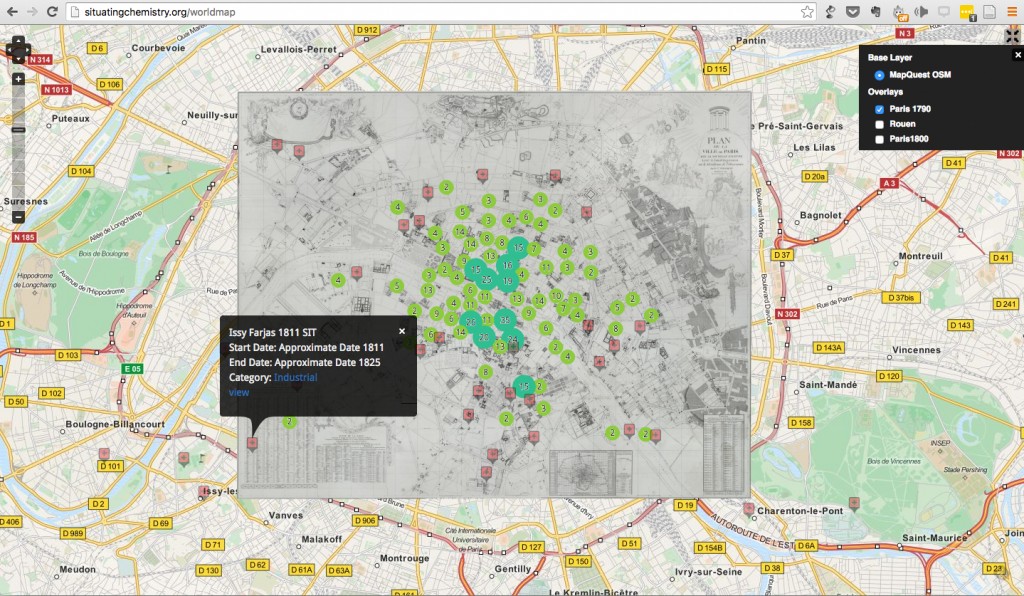
Here though I want to propose a different kind of database as an alternative and complimentary implementation of Bush’s vision. I have been working on an open note database called Situating Chemistry for a couple of years now. The concept is that researchers interested in the history of chemistry (don’t laugh, we exist) can come together to share a wide variety of notes. In addition to reading notes, the system can be used to create a profile of a historical person to record biographical notes compiled from both archival and secondary sources. These people can then be linked to each other to show familial, business, educational or any other type of relationship. Users can also record notes on the places that chemistry was done. A record can be created for a paritcular factory site, a university lab or lecture hall, or the site of an important conference. These sites can be linked back to the people who used them and mapped. Here we see a map from the 18th century of Paris with clustered pins representing the sites in our database:
In addition to people and places, users can use the system to record notes on organizations, events, courses, sources, objects, collections, processes, and theories. The key is that researchers can use the database to take notes on any facet of their studies and then connect that facet to both its particular context and the broader population of notes within the system. Users can choose to put a password on their records, but the default and usual practice is to leave the note sets open to all users so that we can extend each others’ individual records and pool our collective research.
Designing an Open-Notes Database
Web-based databases of historical people like the Prosopography of Anglo-Saxon England (PASE) and the Prosopography of the Byzantine World were produced as conclusive publications of completed research. As such, the developers could accommodate, truncate, or omit problematic pieces of data. Published databases can also choose data visualizations that best highlight key records or insights. Researchers with Stanford’s Mapping the Republic of Letters, put together this beautiful dashboard to explore the correspondence of Enlightenment thinkers.
Unlike these published databases, an open note system is designed to accommodate active note taking. Rather than structuring database fields to best present the data already collected, Situating Chemistry was built to be flexible. Because a researcher will more often than not have incomplete data, the only required field is the title of the record. The fields to record dates of birth and death can be partially filled out when only a year or year and month are known. They can also be marked approximate to indicate ambiguity in the historical record. Similarly, visualizations are employed to bring the researcher’s attention to interesting data and suggest new pathways for research.
Within any prosopographical project, the amount of biographical information available for the research subjects can vary widely. One project in Situating Chemistry focuses on the students of the noted Scottish professor William Cullen (1710-1790). In 1756, fifty-nine students attended Cullen’s chemistry course at the University of Edinburgh. Amongst them was George Fordyce (1736-1802) of Aberdeen who would go on to earn his medical degree from Edinburgh and become a lecturer of chemistry and medicine in London. Although there is no monograph length biography of Fordyce, he has entries in the Dictionary of National Biography and the Dictionary of Scientific Biography and is a relatively well-documented individual.
The other fifty-eight attendees of the course are less known. We know from Cullen’s notes that Robert Cumming was from Edinburgh, that John Richardson was from Northumberland, and that Henry Dunston was from some unspecified part of England. More surprisingly, at least two of the attendees were from Virginia—Thomas Clayton and James Taylor—and one was from Antigua—Christopher Hodge. Clayton, Fordyce, and eight other students would go on to earn their MDs from Edinburgh.
In designing Situating Chemistry database we wanted to ensure that we could capture structured, machine-readable data on someone like George Fordyce, or for that matter William Cullen. Additionally, we also wanted to be able to create records for people like Henry Dunston, for whom we had only a name and relationships of interest, in this case that he was a student in Cullen’s chemistry course, in Edinburgh, in 1756, with these other people, and he was from England.
The record for any individual can be linked to other individuals in several different ways. In addition to familial relations, we also have structured fields to collect information on instructor-student relationships and correspondents. There is also a somewhat generic person-to-person connection field that offers a list of relationships that can be expanded when needed. We designed the database such that every individual is the subject of their own record. A field denoting that a person was active in chemistry is automatically checked for every new record, but can be deactivated for familial relations, business partners, and others who are of interest but were not actively ‘doing’ chemistry even in the broadest definition.
In addition to linking a person to other individuals within the system, a person can also be linked to many other kinds of data. The database was initially conceived of as a way to catalogue sites of chemistry. We thus started the database with a table to collect information on apothecary shops, lecture halls, pharmaceutical manufactories, bleach fields, labs, etc. For a given site, the latitude and longitude of the site along with a modern address can be recorded along with information about the ownership and financial history of the site, the chemical activities associated with it, the organizational history, related images, documents, sources, etc. For each individual in the system, we display the sites that they owned and operated and also those additional sites that they were associated with.
After developing tables for the sites and people involved in chemistry, we developed further tables for chemical substances collections, courses, documents, events, images, letters, objects, organizations, primary and secondary sources, processes and techniques of chemistry, and archival and museum repositories. Any two records can be connected with an extensible series of subject-predicate-object relationships. For example a given individual could be a member of an organization or might have studied a particular chemical substance or been a practitioner of a particular process or technique of chemistry. Every record, whether it be for a person or any other type of data, can and should be sourced by linking it to primary and/or secondary sources. For the system as a whole then, we have tables for more than a dozen types of information and hundreds of structured data fields, all strung together into a relational web of information.
Interoperability & Extensibility
In its first conception, the Situating Chemistry database was thought of as a single table for sites with about a dozen fields. However, this variety of tables and fields grew organically through discussion of the research questions and practices that we, as historians of chemistry, conduct. The goal for the project was not to publish a completed set of sites or records, but rather to facilitate active research. A researcher could enter the data that they were collecting for a research project to organize and analyze the information, and they could take the database with them into the archives to continue to collect information. Researchers can access their records and add new records to Situating Chemistry from a laptop, tablet, or even a phone.
To accommodate both offline note-taking and the rapid upload of external data sets, the database has also been designed so that users can upload CSV files (excel-type tables). Any data in the system can in turn be downloaded as a CSV or in other structured formats including XML, RDF, and JSON. Because Situating Chemistry was designed as a research tool rather than a data-publication, the goal of the database is to allow users to both enter and access whatever fields and records sets they consider interesting. Several visualizations including tables, graphs, and a timeline are built into the system. The user can also extract whatever structured data they want to pull from the system, so that she can also generate her own visualizations using tools like Tableau or programming languages like Python and R.
The schema of the database is not specific to our current project, nor to the period 1760-1840. It could be readily adapted for use by other historians of chemistry (and alchemy) and historians of other sciences. If you were to dump out the 5000 records that we have input into the system, you could convert the project into a Sites of Archeology database and record the digs of the 19th and 20th century. You could just as easily record the observatories, telescopes, and astronomers of the 16th and 17th centuries or plot the biological specimens collected by Linnaeus’s correspondents.
While we certainly hope that our database will be used by and be useful to historians of chemistry, the real point of the project is to enable the collaborative epistemology proposed by Vannevar Bush. History and humanities more generally are dominated by the single-author article and monograph, so a system built to pool research notes may seem counterintuitive. However, we need to remember that the point of these publications is to share our knowledge. If we all share our coffee stained notebooks, idiosyncratic excel files, and shoeboxes full of notecards, we can engage in deeper and more nuanced studies in the history of chemistry and science more broadly. Without sacrificing traditional academic products, we can collectively populate searchable, interlinked reference guides that will accelerate research and model our methodologies for the generations to come.
Please visit our site to learn more about the project and let me know if you would like to set up an account or get a copy of the code.
Yesterday Steve Greenlaw ( @stevegreenla ) asked me why a “typical faculty member” who teaches and pursues their own research might get involved in Open Education. His question was a tad disingenuous, of course. We know that the “typical” faculty member is as much a fiction as the typical student. But his invitation to explain … Continue reading Open on the Edges and in the Middle→
 For the next few weeks, I will be taking a history course, something I thought I would never do again after I finished my dissertation. Shawn Graham is teaching an online digital history course at Carleton University and has opened it up for non-matriculating students.