All posts by @purling4peas

Collaborative Syllabus Design – Students at the Center

“Democratically co-creating learning outcomes with students, based on their goals for the class, situates them at the center of your pedagogy.” – Christina Katapodis I have been meaning to write about collaborative syllabus design for ages. This week’s workshop on learner-centered syllabi in GEDI / Grad 5114 combined with a very cool article by Christina Katopodis on Writing …

Log Jam No More

Never mind why it’s been so long since I’ve posted (insert long whine here about being over-extended, distracted, and just plain tired….). It’s the first week of #OpenLearning18 and Mindful Learning week in GEDI. Causes to celebrate for sure. And as my planner helpfully notes, “Done is better than perfect.”  So…… While everyone is moving …

Can’t Let it Go — Inclusive Pedagogy With #Gedivt

We are deep in the heart of the Contemporary Pedagogy Syllabus and last week’s session on Inclusive Pedagogy left me reeling — in a good way. Talking with a diverse group of people about how to cultivate inclusive and diverse classrooms is always interesting, and often quite challenging, but this session was especially noteworthy for …

Reflections on #OpenLearning17

How will your experience in #OpenLearning affect your teaching practice or scholarship? Why? #OpenLearning17 has provided lots of inspiration for making my teaching practices more open and accessible. The course has also helped me better understand some of the choices I’ve made about the learning environment I want to create with my students.  I have …

Contemporary Pedagogy at VT: A Conversation with Shelli Fowler

Working with the Open Learning cMOOC  (#OpenLearning17) has given me the opportunity to re-connect with one of the most inspirational and talented educators I know. During her long tenure at Virginia Tech Dr. Shelli Fowler developed and taught a graduate course  called “Pedagogical Practices in Contemporary Contexts.”  A jewel in the crown of certificate programs in Transformative Graduate Education and Training the Future Professoriate, Contemporary Pedagogy brings together graduate students from across the university in a seminar devoted to developing a distinct teaching praxis. Shelli designed the course, which is known across campus as “GEDI” (the Graduate Education Development Institute) to help graduate students acquire the diverse and flexible skill sets they need to succeed and lead as teacher/scholar/professionals in the changing landscape of higher education. It works at multiple levels — as a professional development forum for early-career teachers, as an interdisciplinary discussion of the challenges and commonalities of engaging undergraduates at a Research I university, and as a site of critical engagement over the connections between the philosophical underpinnings and practical application of pedagogy (praxis).

When Shelli moved to VCU in the fall of 2015, she asked me to continue offering the class for the graduate school. I was delighted to help, because the course, its creator, and its constituency had terrific reputations. I also welcome any and all opportunities to work with students outside my main area of expertise.  As I’ve learned to teach GEDI over the last few terms I have been inspired by the passion students bring to the linked endeavors of professional development, interdisciplinary dialogue, and critical engagement with pedagogy. I have been invigorated by their talent and willingness to grow and learn from each other.  And above all, I have been mightily impressed with the form and substance of Shelli’s curriculum.  I have tweaked the corners of the reading list, updating a few things here and there. But the only major change I made to was to shift more of the interaction and content creation into the open and into connected spaces. The arc and substance remain Shelli’s.

Busy as she is in her position as interim Dean of University College at Virginia Commonwealth University, Shelli generously agreed to help facilitate this week, and to answer a few questions about the history and design of GEDI.*

*Pronounced like “Jedi” – as in “GEDI’s use the Force to Cultivate Curiosity.” The current course website is here: http://amynelson.net/gedis17/ Find us on Twitter @GEDIVT and #gediVT.

AN: Tell me about the Genesis of GEDI: Where (and when) did you start, and how did you move from concept to implementation? What was your main goal for the course?

SF: GEDI began in the spring of 2003 as a pilot graduate seminar with around 18 students.  I was a new addition to the Learning Technologies division (new TLOS) at Virginia Tech.  The VP of my unit, Dr. Anne Moore met with the new Dean of the Graduate School, Dr. Karen DePauw, to explore how her unit might collaborate with and support the new Dean’s Transformative Graduate Education (TGE) initiative.  The idea of a professional development experience focused on teaching and learning for the 21st century, one that supplemented and moved beyond mentoring at the departmental and college levels, was born.  Because of my work in faculty development and critical pedagogy, I was tapped to create GEDI.  The first couple of semesters it was a small graduate seminar and I worked with the graduate student participants to discover what they knew about teaching and learning, what they wanted to know, and how we could co-create a semester-long seminar experience that provided opportunities to move beyond the still over-utilized ‘stand and deliver’ content-delivery approach that informed their disciplines, both in the experiences as learners and, for those who had done some teaching, in the ways they were expected to teach.  The main goal for GEDI was to create a dynamic, active co-learning environment that continually challenges us to reexamine traditional teaching strategies and explore active, connected, critically engaged co-learning across the disciplines and in a wide range of learning environments–small and large, face-to-face, blended, fully digital.  As such, I really intended from the very beginning to ‘gently disrupt’–a favorite descriptive phrase of mine, the status quo of teaching and learning practices that students suggested were based on ‘we’ve always done it this’ or ‘it’s efficient and easy to assess,’ or ‘just follow the teaching tips on the handout provided.’ Interestingly, the emphasis on (and some might argue epidemic overvaluing of) assessment as the driver for curricular and pedagogical praxis very often leads to over-simplified student learning outcomes and an attempt to standardize assessment in ways that indicate the teaching (and coverage) of material occurred but that fails to gauge student agency and engagement with, or ability to apply and build upon, curricular knowledge.  What was unexpected was how quickly the course grew.  By the third semester, the course had gone through the university-wide approval process and became a three-credit, graded, semester-long graduate seminar, GRAD 5114, and a core requirement of the “Preparing the Future Professoriate” nine-credit graduate certificate.  This is not a GTA workshop or a college teaching: tips and tricks one-credit course that are common at many institutions.  GEDI is a dynamic graduate seminar taught each semester.  Until I left Virginia Tech in May 2015, I worked with approximately 90-100 graduate students each year in the course.  Doing paradigm-busting with GEDI Knights (as they began to call themselves) has been a great experience for me as both a teacher and a learner.  While I love the challenges and opportunities of my new gig at VCU, I miss–and will always miss–the unique TGE program at VT, all of the remarkable GEDIs and the opportunity to work with and learn from our future faculty in that arena.

AN: The syllabus presents a lovely balance between the practical and the theoretical.  We start by talking about the mechanics of connecting online via the website, which makes for an easy segue into the concepts of connected learning and active co-learning, which makes it easy to problematize and interrogate some pretty important and often unexamined assumptions about the significance of what we as faculty “do” in our classes, what traditional assessment modalities do (and don’t do), and even what we mean by “learning.” These meta-level issues become concrete in discussions about authentic and sideways learning, and by examining how different teaching modalities work on the ground. Then students have the opportunity to integrate all of this into a learner-centered syllabus. How did this particular configuration of topics come into being and how did you determine how best to integrate the theoretical and applied components of the course?

SF:  The exploration and development of one’s own teaching praxis is a central focus of GEDI.  A critically engaged Freirean approach requires us to embrace the ways in which our theory must inform our praxis, but also reminds us that our teaching experiences in different contexts must also inform our the theoretical approaches.  The specific sequencing of topics on the GEDI syllabus evolved with input from the graduate students.  The focus on disrupting unexamined status quo practice is a constant current, no matter what activities and co-created deliverables. That requires reflection, of course.  A critically self-reflexive awareness of who one is as a teacher, of how one’s ‘teaching self’ is read and misread, and empowered and/or disempowered, is an important part of the process, too.  That work begins in week one of the seminar and informs the work we do together in the readings and the creation of curricular materials that students do relevant to their current or future teaching.

AN: I’m also struck by how the intensity of the course builds through the first seven weeks (and the syllabus project). The topics from these weeks lay the foundation for heart of the matter —  Inclusive Pedagogy and Paulo Freire’s Critical Pedagogy.  Why are these two topics so important and how do they inform your own teaching praxis?

SF:  While an inclusive praxis informs all we do in GEDI, I discovered from the GEDIs that the most honest, deep-dive, open and vulnerable engagement with the topic of diversity, social justice, equity, inclusive excellence occurred after the community of co-learners had been challenging themselves and each other of less fraught topics.  We become better listeners, more attentive to the cultural differences among us, when we’ve been doing some collective ‘paradigm-busting’ as a learning community.  Rather than begin week one right out of the gate with Freire and inclusive pedagogy–a focus that might unintentionally be (mis)perceived as a prescriptive methodology when a Freirean praxis is intentionally non-prescriptive and essentially an anti-methods pedagogy–GEDIs begin by exploring the broader category of teaching and learning in contemporary U.S. higher education (or K-16 +).  They begin to reflect and interact and support and challenge as they discover or articulate what they think and why in their blogging and as they begin to challenge unexamined assumptions about what teaching should be or what constitutes learning.  In my work, adapting a Freirean pedagogical praxis is essential, regardless of disciplinary field(s) or course content.  The very difficult work for all of us is to invent and (re)invent our praxis so that it is dynamic, rather than static, and stays attentive to equity and access and social justice, domestically and globally.  In the GEDI seminar, we begin that process and intend for it to shift and evolve not just throughout the remainder of our seminar but over the span of our teaching.

AN: After the heavy-hitting weeks devoted to inclusivity and Freire, the momentum again shifts in more practical directions. Once again the “deliverables” (a teaching philosophy statement and Problem-Based-Learning / Case study assignment) find powerful undergirding from meta-level framing at the same time they are shaped by very practical “how to” thought-pieces and flowcharts. How did you develop this part of the course in ways that speak to future faculty in all fields — the engineers and other STEM specialists as well as those of us working in the humanities and social sciences?

SF: One of the things that occurs with the move back to what the GEDIs affectionately refer to as ‘tangibles,’ (items such as those you name above that they will use as they construct, or reenvision, their teaching praxis), is a rethinking of the ways their assignments reify traditional power structures in our learning environments.  In GEDI, the meta-level framing encourages participants to foster collaborative and inclusive learning environments not just via their syllabus redesign, but in their PBL/case study assignments, for example, with the integration of ethical dilemmas that require students to navigate the complexities of systemic inequities as they learn and apply content to become problem-solvers and problem-posers, including in the STEM fields.  I have found that GEDIs in engineering, the sciences, and vet med to be some of the most think-outside-the-box innovators when provided the opportunity to do PBL/case study/ethics curricular design.

AN: The last thing I want to comment on and commend is the way the final module (on ethics in the 21st-Century academy) bring the student back to the notion that we are all in this together. As faculty we face the same challenges and imperatives as our students. We need to commit to learning from and with each other, and to identifying the best ways to make our educational system more humane, ethically oriented, and responsive to a rapidly changing world. Would you like to speak to this?

SF: We are facing similar challenges and imperatives, you’re right.  The final curricular segment in GEDI uses a Parker Palmer article, “A New Professional: The Aims of Education Revisited,” to spark awareness that we as faculty need to foster learning environments that encourage learners’ sense of agency and their understanding that their actions as (future) professionals always have ethical repercussions to which they should attend.  And that is the same for those of us in academe, too.  It is increasingly important in this current moment–how do we best leverage the power of networked co-learners to build and to shape more humane, ethical, equitable, and responsive educational opportunities and non-institution-like institutions of higher ed?  One of my takeaways from working with GEDIs is that it is possible to do this if we value working with and learning from our students.


Some Keywords: Access, Redlining and Divides

Today is March 8 – International Women’s Day, which is being marked in the US by the #Daywithoutawoman campaign. I’ve struggled to get clarity on my own stance here — I’m especially sensitive to the point that striking is a privilege not everyone enjoys and have settled for the following demonstrations of solidarity: I’m wearing red (glasses), only spending money at my favorite local businesses owned by women, (mostly) staying off social media, reminding the world that we still / will always deserve equal pay and paid family leave, and holding off until tomorrow to post this.

I should also point out that this holiday has deep connections to the Russian Revolution, that women protesting bread shortages in St. Petersburg helped bring on the crisis that toppled the tsar in 1917  (the Bolsheviks implemented calendar reform along with so much else, so the “February Revolution” is now commemorated in March), and that seventy years of Soviet power were not enough to overcome the tyranny of housework, the hegemony of the short-handled broom, or the cultural norms that still tether women to both.

short handled brooms
By Vladimer Shioshvili – it’s all about cleanliness, CC BY-SA 2.0, Link

Moving on to thoughts about yesterday’s Hangout for #Openlearning17:

Maha Bali and Sue Erickson coordinated a rich and diverse discussion of Open Access, which Maha has already written about. (You can also find updates on this and on the week as a whole on the cMOOC hub.) What follows are some not entirely random but far from coherent responses to the hangout:

  1.  On Chris Friend’s overview of the editorial process at Hybrid Pedagogy: I find the (emerging) model of “double open” peer review (using a googledoc) really attractive.  I’m also really encouraged that a journal like Hybrid Pedagogy has managed to do (at least) three really important things in a short time: 1) serve as the incubator and main publishing venue for a new interdisciplinary field; 2) become one of the most prestigious publications in the field; and 3) develop an innovative editorial policy that embodies the main tenets of that field, thus amplifying, fortifying and disseminating them. It’s pretty impressive.
  2. The devil is in the details of Open Access. The premises that contour the details are inflected differently for different audiences (scholars and students) and stakeholders (which include institutions and publishers as well as scholars, students and the public). I keep thinking that discussions of viability and transformation in scholarly publishing have some things in common with discussions of healthcare reform but if I go there now this will not get done today.
    So….
  3. I learned a lot listening to Peter Suber and Frances Bell, and we’ve been annotating Peter’s book this week in hypothes.is. Teaching (mostly) in the open makes it easy to direct students to high value materials on the open web, but mine still need access to proprietary databases.
    My specific frame of reference here is Soviet History, for which there are many openly accessible, legal-to-use, on-line materials. But for students who don’t speak Russian (so, 90+ percent of my undergrads), translations of primary materials are essential and less abundant. Fortunately we have the “Current Digest of the Russian Press,”  Founded by the ACLS and SSRC in 1947, the Current Digest (published weekly)  makes an overview of the news available to the Soviet (now Russian) public accessible to English-speaking audiences. During the Cold War it was a mainstay of information about life in the Soviet Union, and it remains a valuable source.
    The good news is that our library, which had subscribed (intermittently ) to the print edition of the digest acquired a digital subscription a few years ago (Thank you, Newman Library!). The digital version is much easier to use than the print version (because searching), but also quite expensive. There was a significant upfront fee for the “archive” (which is what my students mainly use), plus there’s an annual fee of a couple thousand dollars to keep our subscription current. My students use and cite articles from the Current Digest on their blogs, but of course they are behind a paywall. You have to be logged into the university’s network to access the database. This is the less good news.
  4. Having read and loved Chris Gilliard and Hugh Culik’s article on Digital Red Lining, I wonder if access to materials like the Current Digest might present another inflection of that issue. Chris notes that students become aware of “the line” when they bump up against a paywall as they search for materials.  In my case the students wouldn’t even know the materials were there unless I showed them how to find the database and use it. (The Current Digest is aggregated with other databases we get from the same vendor, so I have to show  students how to navigate the interface so they are search in the right place.) I help them cross the line (pointing out that the library’s subscription to this database makes that possible), but the line then becomes visible in their posts, because they cite articles that readers can’t access unless they also have a subscription.  I don’t know that I think about this. Part of my role as a prof is to filter forward the materials I think will best facilitate learning and spark curiosity. Leaving aside any thoughts I might have about the ethics of the pricing structure for things like the Current Digest, I want my students to know that these things exist and learn how to use them. In their working and intellectual lives going forward, they will be using a range of resources. And they will want to have access to different kinds of information sources. I want them to see the value in paying for a newspaper or magazine subscription, for example. I also want them to be able to afford a newspaper subscription. But at the same time, I want to minimize the obstacles that keep them from reading those things. Especially paywalls. Especially in education.
  5. The kind of red lining Chris addresses speaks to an even greater challenge, and one that we really have to work on if we’re going to transform higher ed in ways that enlighten and democratize rather than creating (more) elites and blurring the boundaries of privilege that protect them.  All libraries are not created equal. As Chris points out, the community college JSTOR is not the same as the JSTOR of the R-1 University.  And students of color and students from economically disadvantaged groups are more likely to be at a community college than at an R-1 University. So it’s hard to make any kind of claim about equal access to library resources – Open Access or otherwise. (And no, I don’t think good, even great Inter-Library loan is sufficient.)
    I tweeted about this during the hangout, but will just note again here, that I was really struck by the resonances between the way digital red-lining works and the historical effects of red-lining that Dale Winling and others have charted in their Mapping Inequality project.
  6. I want to push back against the idea that open access for students means open access textbooks and that it means something different for their teachers. In my field (history, the humanities more broadly), I mainly want us to think about what we mean by “textbooks” (open or otherwise), why we use one (or not), and what the adoption of a “textbook” says about how we think learning happens (or not).
  7. Keywords are multivalent. That’s one of the qualities that makes them keywords.  We started talking about “Fifty Shades of Open” and have already seen how complex the connotations of Open can be even within a particular dimension of Open such as Open Access. So I’m intrigued by the way the ancillary fields are claim and define their Keywords. Two collaboratively authored books are doing this right now:
    The MLA’s curated collection Digital Pedagogy in the Humanities is organized around Keywords, the first one of which is Access. The definition focuses mainly making content accessible and usable to different and diversely-abled audiences. The kinds of ideology and legal underpinnings of what we’ve been talking about this week vis-a-vis Open Access are taken up in the Open section, and elaborated on in the entry on Public.  Meanwhile, Digital Keywords  explicitly invokes Raymond Williams’ classic text to frame a collection of twenty-five salient terms in digital media studies, but neither “open” nor “access” made the cut.* In fact the overlap between the two volumes is pretty limited. The only keywords to appear in both are: archive, community, gaming, hacker/hacking, information, and prototype.
    Strange.
    *Both are, however, in the expanded (200+) keyword index at the back of the book.

Subjective Digital Literacy?

I’m still catching my breath  It’s been nearly a week after Bryan Alexander’s invigorating tour through a “week of Digital Literacy” in our Open Learning cMOOC. Among many other things, the week helped me appreciate how fun and difficult it can be to stay abreast of a free-wheeling Twitter chat, how delightful it is to meet new people and work on shared intellectual concerns collaboratively, and how much I have to learn — not just about digital literacy, but but about learning itself.

The latter connects powerfully to the crisis of knowledge and knowing that has engulfed most communication channels since the new administration’s war on the media began under the banner of “Fake News.”  Like many others, I have spent many hours searching my soul, reading (and reading), and talking with people seeking understanding — not just of how we got to what still feels like a surreal moment, but what can and must be done to move us forward — or maybe it’s backward — to a time when dissembling, manipulating, and simply lying about what happened or what one said might not have been unheard of, but wasn’t projected at a national level as an acceptable, indeed expected mode of engagement.

I hoped to find refuge and even salvation in The American College of Research Libraries’ Framework for Information Literacy for Higher Education, which was our focal text for the week, (see two Hypothes.is annotation streams here and here).  As a historian trained on the cusp of the analog / digital divide, I’m pretty comfortable with my competency in the information literacy realm.  But I am not  a librarian, so looking at how research librarians see information literacy as part of an educational reform movement that capitalizes on the changing landscape of higher education and the new information ecosystem seems essential.

I found all six of the frameworks (and even more importantly, the “knowledge practices” and “dispositions” that articulate their implementation) compelling.  And what I most  liked was the synergy and integration among them.  It seems as though we are (finally) getting past a linear conception of the research process (id topic, compile sources, read sources, write about topic) to something more dynamic — a process of knowledge production that understands information creation as a process, sees scholarship and research as interactive conversations, and appreciates the constructed and contextual nature of authority.

[It is a bit odd that the frameworks don’t engage the networked digital ecosystem and and Open Learning more explicitly. I think we all saw connections there and wondered if they were so extensive that we took them for granted? Fodder for another post, perhaps.]

The rubber still hits the road, however, when the frameworks (for knowing) engage the content (of what we know). Our discussions of digital literacy focused on cultivating habits of mind and method among students. Skills. But underneath the desiderata of digital literacy practices and mindsets another set of questions lurked: How do we know what we know? How do we discern “truth” from fiction, real news from fake news? Why do we persist in believing things that are demonstrably wrong or at a minimum not supported by statistical evidence, scientific consensus or any other hallmark of accuracy? (i.e. owning a gun makes your safer, vaccines cause autism, humans are not major players in climate change.)

In “Fake News: Not Your Main Problem”  Maha Bali suggests that focusing on digital literacy per se lets the main culprit off the hook:

The problem isn’t the fake news itself, as much as the historical consciousness that allows so many to willingly believe it with no skepticism.

And what is that historical consciousness? It is one where the emotional and psychological dimensions of knowing play powerful yet elusive roles. Emotion and personal belief. Those are the keys.  Thus, Maha suggests, that promoting digital literacy alone will not win the war on Fake News.  Literacy  – digital or otherwise – is about much more than cognition. We need to address the moral and socio-emotional dimensions of the consciousness our students develop as they make their way through the world — by learning about it.

Maha further proposes, and I think this is crucial, that “expanding and redirecting our inner compass toward social justice and understanding” will be essential, rightly noting that exposure to and appreciation of difference comprise foundational elements of self-awareness and understanding. A combination of experience, guidance, and curiosity can support the development of critically engaged attitudes, but nurturing these things (in ourselves and others) takes time.

Maha’s highlighting of the emotional and psychological aspects of  critical thinking really resonated with me, as one of those “hiding in plain sight” kind of moments.  We know we aren’t really / only rational beings, yet our work with students tends to emphasize the rational, logical, and the empirical — even as we (think) we are encouraging the development of subjectivity, cross-cultural awareness, and insight. Elizabeth Kolbert’s recent article in the New Yorker,  “Why Facts Don’t Change our Mind,” has some interesting things to say about why this is so.

Looking at three books advancing new research in cognitive science — all written before the November 2016 elections, Kolbert revisits the paradox of human irrationality (i.e. our lingering attachment to the assumption that humans are rational creatures in the face of mountains of evidence to the contrary ).  In the first book, The Enigma of Reason, Hugo Mercier and Dan Sperber situate reason in evolutionary context, proposing that reason developed as a way to handle the challenges of living socially.  We might call ourselves Homo Sapiens, but solving abstract problems emerged as a byproduct of our need to address the challenges of living cooperatively in groups.

This perspective on reason as an adaptive trait helps explain the phenomenon of “confirmation bias” — that tendency to accept input that conforms to or supports what we already believe. As Kolbert puts it: “If reason is designed to generate sound judgements, then it’s hard to conceive of a more serious design flaw than confirmation bias.” On the other hand, if reason evolved to help us win arguments and maintain standing in our communities, then confirmation bias (Mercier and Sperber prefer the term “my-side bias) could be seen as an advantage rather than a handicap.

Cognitive Bias Cheat Sheet

In The Knowledge Illusion. Why We Never Think Alone, Steven Sloman and Philip Fernbach examine another dimension of the interface between cognition and social behavior, namely the collaborative way we produce and share knowledge.  Sloman and Fernbach note that the way we learn from and with each other has some under-appreciated implications. We routinely rely on the knowledge of others.  Indeed we collaborate and divide cognitive labor so well that we often don’t recognize the boundaries of our own knowledge from those of our associates. And we think we know more than we do because we rely on what others know (or what we assume they know). Shared understanding can, of course, be enormously productive, but it also facilitates something Sloman and Fernbach call ” the illusion of explanatory depth.” This comes into play when we rely on a source or individual for expertise or validation without ascertaining how expert they actually are or learning about the problem ourselves.  We generally agree with John so we ask him what he thinks about issue X. We assume he knows what he’s talking about and since we agree with him we think we know what we’re talking about as well. Confirmation bias will lead us to find support for our feelings about a particular principle or issue, but it will not push us to verify that those sources of support are credible or more knowledgeable than we are.  Just because lots of people agree with you doesn’t mean you are right.

In the spring of 2014, many Americans had strong opinions about how the US should respond to Russia’s military intervention in Ukraine.  It turned out, though, that the more people favored some kind of military intervention, the less likely they were to be able to find Ukraine on a map (the median guess was off by nearly 2,000 miles!).  That’s alarming on many levels, of course, but I think what’s significant for our purposes is not so much the ignorance of basic geography (don’t get me wrong, I do think that’s a problem), as the fact that people relied on an inaccurate shared understanding of where Ukraine is and didn’t self-correct when given the chance to do so.

So, while I am used to seeing social learning as a huge plus, this book suggests that the “illusion of explanatory depth” can be powerful in ways that are not at all conducive to critical thinking.  This gives me cause to revisit how I approach critical thinking and literacy in my teaching.  I will definitely be asking students (and myself) to engage in more framing / metacognitive work around the idea of authority. This fits with the ACRL Framework’s emphasis on the constructed and contested nature of authority and credibility.

I will also be looking for ways to engage the emotional side of cognition rather than ignoring it or trying to overwhelm it with reason, evidence and critical thinking. Pascal’s affirmation of the co-dependency of the intuitive and the analytical mind should be helpful here. As should strategies that nurture what Paul Silvia calls the “knowledge emotions” — surprise, interest, confusion and awe. (Thank you, Gardner Campbell for directing me to this article.) These are emotions that motivate us to engage with new things — to explore, learn and reflect, to update our understanding of how things work and why they are the way they are. These emotions also support the development of relationships via collaborative problem solving.  So, perhaps the challenge is to identify ways to focus specifically on the positives of social learning? I also come back to the role of subjectivity  in all of these literacy initiatives.  To understand the self as a unique, socially-situated, contested and constructed entity — one that is both coherent and under-construction requires the engagement of critical faculties and an receptivity to dialogue, difference and change. I’m not sure exactly how to proceed but will thinking about this a lot in the coming weeks. Thoughts?


#Openlearning17 — Ted Nelson

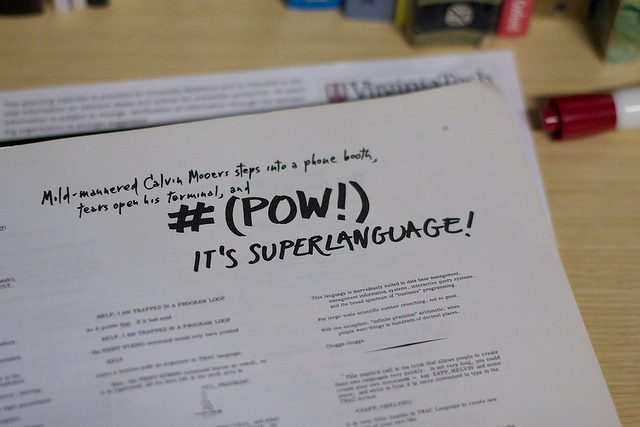
Photo of Computer Lib, Dream Machine
POW! It’s Super Language, Alan Levine 2011


Repost of For the Wholiness of the Human Spirit (2015)

Re-watching Ted Nelson’s eulogy for Doug Engelbart last week reminded me of one of the many (many) reasons Nelson’s thinking about computers and society resonates so powerfully with me. Mourning the loss of one of the most pivotal stars of the new media revolution by indicting his colleagues and making them laugh (nervously), invoking the tropes of classical funeral orations and quotes from Shaw and Shakespeare, and recounting the highlights and tragedies of Engelbart’s career, Nelson’s eulogy is a tour de force in terms of form (technique) and content.  He insists, as passionately as he had in 1974, that computers should support our dreams, indeed that technology is an expression of those dreams.  And dreams, of course, are as much about the emotions as they are about reason and calculation.

 Movies and books, music and even architecture have for all of us been part of important emotional moments. The same is going to happen with the new media. To work at a highly responsive computer display screen, for instance, can be deeply exciting, like flying an airplane through a canyon, or talking to somebody brilliant. This is as it should be…..

In the design of our future media and systems, we should not shrink from this emotional aspect as a legitimate part of our fantic (see p. 317) design. The substratum of technicalities and the mind-bending, gut-slamming effects they produce, are two sides of the same coin; and to understand the one is not necessarily to be alienated from the other.

Thus it is for the Wholiness of the human spirit, that we must design. (NMR, p. 307)

The democratizing, radically-reimagining agenda laid out in Computer Lib / Dream Machines is as relevant today as it was in 1974.  In the early seventies, computing was about inscrutable calculations, fiendishly massive quantification, and the expertise of, yep, experts.  Nelson summoned every woman to “understand computers,” to engage with them, and to create with them. He insisted (rightly) that we are creatures of culture and of interaction as much (perhaps even more so) as we are creatures of reason and calculation. And he wanted us to use computers to develop a “fantic space” (inspired by Eisenstein’s and Pudovkin’s concept of filmic space) to help us communicate emotionally as well as cognitively:

 RESPONSIVE COMPUTER DISPLAY SYSTEMS CAN, SHOULD AND WILL RESTRUCTURE AND LIGHT UP THE MENTAL LIFE OF MANKIND. (NMR, p. 317)

Forty years later, the landscape has changed, but the challenge remains.  We carry computers with us all day long, communicate with people downstairs and around the world in the blink of an eye, and can summon nearly all the world’s texts and many of its numbers to our screens with a few key strokes and a good internet connection. I do feel that my mental life has been illuminated and transformed by the innovations Nelson envisioned. But do we understand computers and the networked world in the way that Nelson thought we needed to? Has the Computer Priesthood” been ousted? Or just changed clothes?  And what about “Computer Aided Instruction” (CAI, as Nelson calls it)?  I look at computerized testing,  video taped lectures, the march of MOOCs, the “Learning Management System” industry, and the relentless pressure to scale, standardize, measure and homogenize an experience that should be so much more….and I think we still need to focus instead on using this technology to provide students (and ourselves) with a real education:

Instead of devising elaborate systems permitting the computer or its instructional contents to control the situation, why not permit the student to control the system, show him how to do so intelligently, and make it easy for him to find his way? Discard the sequences, items and conversation, and allow the student to move freely through materials which he may control. Never mind optimizing reinforcement or validating teaching sequence. Motivate the user and let him loose in a wonderful place” (NMR, p. 313).

I want to keep my beacon set on that wonderful place.

“….it really gets hard when you start believing in your dreams….” — Doug Engelbart

In the hope that anything worth posting once can be re-posted again (different audiences?), I’m offering this reflection / question I wrote for Gardner’s New Media Seminar a couple years ago .  Thoughts, anyone?


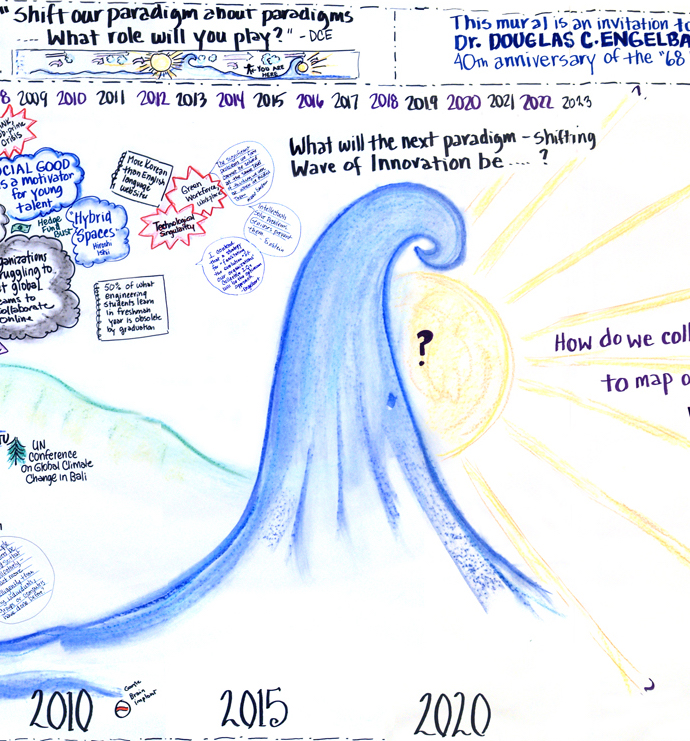
I’ve posted before about how central Doug Engelbart is to the Awakening of the Digital Imagination. This time I’m going to let an image — or more precisely, a mural — do the talking.  Created by Eileen Clegg and Valerie Landau for the fortieth anniversary of the Mother of All Demos, this graphic representation of the interaction between cultural change, technological innovation, and what Engelbart called “collective intelligence” suggests how we have co-evolved with our technology since the early twentieth century.  At the end of the mural, a blue wave asks us to think about “the next paradigm-shifting wave of innovation”….which seems to be happening in 2015.  I mean, RIGHT NOW.

OLYMPUS DIGITAL CAMERA

So I ask you, looking at the elements of the mural and the interactions and shifts it depicts — can we imagine and work for a future using technology and our collective intelligence to deal with the world’s “increasingly complex problems” in ethically responsible and constructive ways? Put another way, can we afford not to do this?

“Help Me Grok it and I’ll Help You Make it Real” / Filtering Forward the High Value Trails

Grok Hybrids?

Wednesday’s webinar and twitter chat with Hypothes.is founders Jon Udell and Jeremy Dean — masterfully MC’d by OpenLearning17′s  Gardner Campbell — gave me so much food for thought.  We are starting to use Hypothes.is in the graduate pedagogy class I teach and we read “Working Openly on the Web” (7 Ways to Think like a Web) during the first week of class. So getting to listen to these three in action was a huge treat.

Our jumping off point  was Vannevar Bush’s “As We May Think,” published in the Atlantic in 1945 as the imperative to leverage the technological innovations of wartime to more peaceful purposes seemed especially compelling.  Bush’s vision of the memex – a computerized combination of note cards, annotations and information sources that could extend the reach (capacity) of any one learner by integrating that individual’s knowledge with the sources that informed it in a durable medium that could then be used and developed by others — underpins web annotation projects such as Hypothes.is. It also supports networked learning frameworks that facilitate collaborative learning, knowledge production and reflection.

As a historian, I’ve been intrigued by Hypothes.is since it first came to my attention last year. Historians are trained to think about how knowledge is produced and organized as an essential element of the research process: What was the author of this essay, article, book trying to say? Why was this archive created? Why are the records organized the way they are? Why did they keep what they kept? What are the assumptions behind the Dewey decimal or LOC cataloguing systems? In what context was this book, manuscript, court record, ship’s manifest created?)

Once you have a handle on those questions you need to figure out how to find where the resources you want to consult are and how to get to them. There is a dialogic process to this that involves reading, searching, thinking, taking notes, making lists, thinking, reading more, going back to your bibliography, supplementing it with new things you find, reading those things, taking more notes, thinking, going back to the older notes, etc…..I realize as I’m typing that this I might be describing a pretty generic research practice for many fields….

Anyway, at some point in there, I think two conceptual maps of a project emerge that overlay each other. The first is defined by types of sources — not so much a list, like a bibliography — but more like a grid of different kinds of evidence with points of overlap as well as nodes of distinction and empty spaces that still need to be filled in. The empty spaces let you know what you need to keep looking for and what silences your work might have to address. The points of overlap provide nuance, depth and corroboration, and the points of distinction raise new questions, redirect the inquiry or foreground a significant problem that might not have been evident when considering one source in isolation.

The second structure comprises the notes and annotations that are attached to those sources but also connected to each other (in your head or on a piece of paper or in your word processor) by the interpretation you are developing about the evidence. I see Hypothes.is as a medium through which those annotations can be assembled AND shared, which is just mind-blowingly wonderful.  (Hypothes.is annotations for “As We May Think” are here.) While the analog or un-networked digital version of note taking certainly allows for all kinds of remixing and re-purposing, with Hypothes.is the annotations can themselves become nodes on or elements of a new kind of crowd / collaborative / collective “source” – a distributed conversation about a particular web page. We’re used to thinking about different kinds of sources: primary, secondary, web-based, archival, print, biographical, testimonial, etc.. Maybe a set of Hypothes.is annotations on a particular article would be a Web 3.0 source? A networked source? A memex-cubed source?

Two points in the wide-ranging Twitter chat especially resonated with me. We had been talking about how Hypothes.is helped realize Bush’s vision of “associative trails” and I asked if Jon and Jeremy saw those trails as supplements to or replacements for conventional taxonomies. Jon thought they were complementary, and Jeremy cautioned that the annotations alone might not constitute “trails” — they needed to be connected or flagged somehow, perhaps by a tag. (I like  the metaphor of trail blazes.)


So, annotations become associative trails when they are marked out by tags or blazes — or any durable and accessible symbolic representation of the cognitive framework that helps you knit meaning into the tapestry (or navigate the cacophony?) of information about the world. And those trails serve as jet-packed complement to the conventional taxonomies for organizing knowledge. YES!!!!!

But how to get to the trails you really want or need? I’m imagining a future when a good chunk of the web has been trailed by Hypothes.is. And I’m imagining that all trails will not be created equal.  I won’t be able to read it all, and I don’t want to fall down a rabbit hole without some warning, so how am I going to know where the good stuff is? How will the high value trails get  filtered forward?

And here came the second nugget moment: Jon Udell responded to a query about this by saying “Help me grok it and I’ll help you make it real.”

Oh wow.

I’m pretty  sure I haven’t groked* it myself.  But here goes:

As teachers we spend a lot of time helping students learn how to find, sort through and evaluate resources. (Crane Librarian has spoken to the challenges of doing that in the library.) And as researchers our own successes (and failures) in finding the sources and communities we need depend largely on a somewhat ineffable combination of content expertise / experience, and skill — the “scaffolding” we’re always talking about providing and developing for learners. In this sense, I do feel like I have groked the research process. But the prospect of having something so powerful and potentially overwhelming as a Hypothes.ized web makes me think I’ll need to develop another kind of sensibility and that the trails and webs marked out by Hypothes.is will need some kind of context sensitive markers to help direct individual users where they want to go.  At the most basic level this would be a system whereby spam and trolls (they are, I fear inevitable) could be marginalized. But even more valuable would be a marker that would flag certain kinds of annotations — and the connections between them — and also allow for the dynamic process of ongoing annotation. What would that look like? I don’t know yet. But it would be cool. And I think it’s worth thinking about. I know I’m hoping for something that would make the web more akin to Doug Dorst’s and J. J. Abram’s book S. and would not like to see a set of user-conditioned algorithms  turn Hypothes.is into a colonial outpost of my Facebook feed.  It also seems that the conceptualization behind sites like Jon Stewart’s Open Note Database project could be really helpful. I’m just not sure how.

So there you go. Not at all groked, I’m afraid. But maybe glimpsed as a desirable future? Thanks for encouraging me to think about this. I will continue to do so.

*my working understanding of “grok” falls closer to the flower child sense of mastery that is so intuitive it feels innate than the techie understanding of internalizing a concept so completely it feels like second nature. But grok is also the only Martian word I know, so that might be an issue.