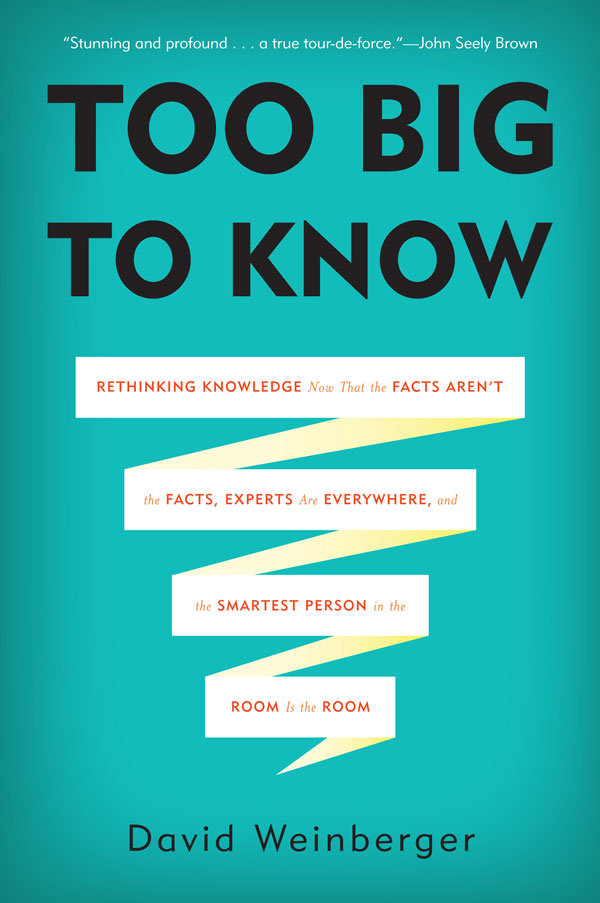
We have a late-breaking, serendipitous opportunity tomorrow morning to talk about David Weinberger’s book, Too Big To Know on Twitter. Weinberger, a philosopher and technologist who writes about the effects of the internet on human relationships, is currently a senior researcher at Harvard’s Berkman Center. In light of current discussions about the nature of facts and their alternatives, the book’s subtitle — “Rethinking Knowledge
Now that the Facts aren’t the Facts,
Experts are Everywhere, and
the Smartest Person in the Room
is the Room.” — is especially compelling.
Dr. Weinberger will be Skyping into Tom Ewing‘s undergraduate course on Data in Social Context at Virginia Tech to talk about Too Big To Know with Tom and his students.
I will be live tweeting the conversation tomorrow (Monday) from 10:10 to 11:00 am EST. If you’re familiar with the book or Weinberger’s work please join us. And if you aren’t please join us anyway! You can follow along and send questions and thoughts to #Openlearning17 and #Faccollab.
Followers of #gedivt — I will try to flag you all as well, but the best bet would be to check #OpenLearning17
Twitter Handles: Data in Social Context: @DiSCVT ;David Weinberger: @dweinberger ; Tom Ewing: @EThomasEwing
My what a couple of weeks it’s been….So much anticipation, trepidation, incredulity, outrage, sorrow….resolve…
No, I’m not talking about #OpenLearning17. The course launch last week provided a wonderfully affirming forum for engaging with the forces of enlightenment. Laura Gogia’s masterful facilitation of a Twitter Journal Club (#TJC17) on Friday brought folks together around a close reading of Jeffrey Pomerantz’ and Robin Peek’s Fifty Shades of Open, and through Twitter magic and generosity Jeffrey Pomerantz was able to participate in the discussion. Some of us even carried the conversation further by annotating it on Hypothes.is . And because the #TJC17was open and coincided with the annual AAC&U conference in San Francisco, conference participants could join the fun and those of us who were not physically in attendance could share in some of the buzz generated by the big gathering.
But locally, last week was a time when I was reminded, rather brutally, that teaching collaboratively and in the open takes time, is messy, and is totally worth it.
First of all, there’s just the time commitment to building out the digital spaces where my courses grow. While I was working on my book last semester I seem to have remembered how cool it is when you get a website tricked out and looking nice, but forgotten just how time consuming it is to:
Create the motherblog, choose a template, add feedwordpress, hook up JetPack, pick out fonts, and colors and other design features, customize the template so it will be easy to update the front end as new content comes in, create a shadow blog for the comments and feed that through an RSS feed on the main site…..
None of that’s hard, but it all takes time. And then you have to get the students hooked up and ready to roll (ah yes, add form to site that they can fill out so you can harvest the URL..)
You see where this is going — there’s lots of set up work to do before the first class session.
And then there are the human factors — they include a couple of outstanding GTAs for the grad course and an editorial team for my undergrad course (two peer-editors, veterans of the course who comment on posts and help identify content to feature in the weekly edition, plus a WordPress savvy grad student who handles a lot of the weekly maintenance). So that’s really two “teaching teams” for these learner-centered hybrid courses.
And figuring out how we are going to best facilitate learning in the course and establishing a weekly work flow, with time built in for dialogue and troubleshooting, can be pretty messy. We need to figure out which affordances to use for what kinds of interaction (Slack for sure, also a shared Drive folder….e-mail only when smoke signals fail). We all have different strengths and intersecting but not 100% overlapping domains of expertise. Like everyone else, we are busy. And like everyone else we learn by doing. So, the first couple of weeks can be pretty bumpy, as we coordinate our individual tasks with our other time commitments, learn (or remember) some new tricks (how do you get the sleeping dogs to be in the center of the photo in the slider?), and figure out how to best work together to help leverage the students’ contributions into a robust and interesting place that showcases and enables “acts of cognition” (focused either on Soviet History of contemporary pedagogy in higher ed):
And to me, that’s why working in the open — in a medium where we can all create and engage collaboratively with the content — is not just worth it, but necessary. I did spend less time on my classes before the 2.0 version of my teaching — I think we are all familiar with that feeling that sometimes it’s just plain easier to do something by yourself or the way you’ve always done it. But I do see real (positive) differences in the way we learn (students, course assistants and instructor) in these networked, open learning spaces. And the takeaways for the students, in the form of the critical thinking, writing and research skills they develop by working on the open web, the insights they gain about the course content and their own learning, as well as the digital portfolio that they create, make the extra time and effort well worth the investment on my part.
In an era of Alt-Facts and gathering storms around the ethical tenets of our democracy, learning together in the open seems especially important. (I know I’m being hyperbolic and I hope I’m wrong about the storm clouds, but I’m still going to throw down behind open pedagogies.)
Yesterday Steve Greenlaw ( @stevegreenla ) asked me why a “typical faculty member” who teaches and pursues their own research might get involved in Open Education. His question was a tad disingenuous, of course. We know that the “typical” faculty member is as much a fiction as the typical student. But his invitation to explain … Continue reading Open on the Edges and in the Middle→
I’ve been working with a great group of higher ed folks affiliated with the AAC&U Faculty Collaboratives project for the last several months. The collaboratives are state-level efforts to enlist faculty in the far-reaching and essential challenges of re-imagining role of liberal education at this time of transformation across the higher education landscape. In January […]