Tag Archives: Faculty Collaborative

#Openlearning17 — Ted Nelson

Photo of Computer Lib, Dream Machine
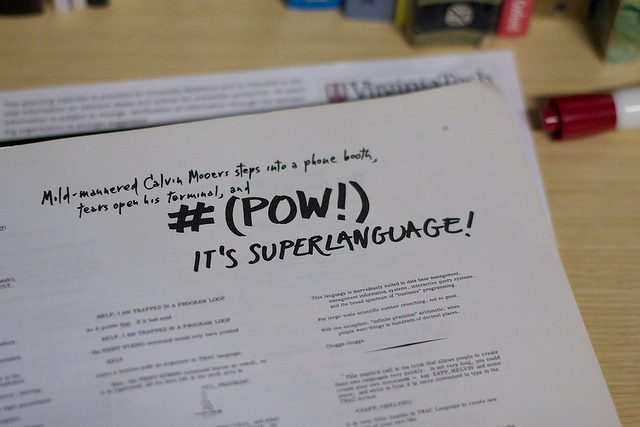
POW! It’s Super Language, Alan Levine 2011


Repost of For the Wholiness of the Human Spirit (2015)

Re-watching Ted Nelson’s eulogy for Doug Engelbart last week reminded me of one of the many (many) reasons Nelson’s thinking about computers and society resonates so powerfully with me. Mourning the loss of one of the most pivotal stars of the new media revolution by indicting his colleagues and making them laugh (nervously), invoking the tropes of classical funeral orations and quotes from Shaw and Shakespeare, and recounting the highlights and tragedies of Engelbart’s career, Nelson’s eulogy is a tour de force in terms of form (technique) and content.  He insists, as passionately as he had in 1974, that computers should support our dreams, indeed that technology is an expression of those dreams.  And dreams, of course, are as much about the emotions as they are about reason and calculation.

 Movies and books, music and even architecture have for all of us been part of important emotional moments. The same is going to happen with the new media. To work at a highly responsive computer display screen, for instance, can be deeply exciting, like flying an airplane through a canyon, or talking to somebody brilliant. This is as it should be…..

In the design of our future media and systems, we should not shrink from this emotional aspect as a legitimate part of our fantic (see p. 317) design. The substratum of technicalities and the mind-bending, gut-slamming effects they produce, are two sides of the same coin; and to understand the one is not necessarily to be alienated from the other.

Thus it is for the Wholiness of the human spirit, that we must design. (NMR, p. 307)

The democratizing, radically-reimagining agenda laid out in Computer Lib / Dream Machines is as relevant today as it was in 1974.  In the early seventies, computing was about inscrutable calculations, fiendishly massive quantification, and the expertise of, yep, experts.  Nelson summoned every woman to “understand computers,” to engage with them, and to create with them. He insisted (rightly) that we are creatures of culture and of interaction as much (perhaps even more so) as we are creatures of reason and calculation. And he wanted us to use computers to develop a “fantic space” (inspired by Eisenstein’s and Pudovkin’s concept of filmic space) to help us communicate emotionally as well as cognitively:

 RESPONSIVE COMPUTER DISPLAY SYSTEMS CAN, SHOULD AND WILL RESTRUCTURE AND LIGHT UP THE MENTAL LIFE OF MANKIND. (NMR, p. 317)

Forty years later, the landscape has changed, but the challenge remains.  We carry computers with us all day long, communicate with people downstairs and around the world in the blink of an eye, and can summon nearly all the world’s texts and many of its numbers to our screens with a few key strokes and a good internet connection. I do feel that my mental life has been illuminated and transformed by the innovations Nelson envisioned. But do we understand computers and the networked world in the way that Nelson thought we needed to? Has the Computer Priesthood” been ousted? Or just changed clothes?  And what about “Computer Aided Instruction” (CAI, as Nelson calls it)?  I look at computerized testing,  video taped lectures, the march of MOOCs, the “Learning Management System” industry, and the relentless pressure to scale, standardize, measure and homogenize an experience that should be so much more….and I think we still need to focus instead on using this technology to provide students (and ourselves) with a real education:

Instead of devising elaborate systems permitting the computer or its instructional contents to control the situation, why not permit the student to control the system, show him how to do so intelligently, and make it easy for him to find his way? Discard the sequences, items and conversation, and allow the student to move freely through materials which he may control. Never mind optimizing reinforcement or validating teaching sequence. Motivate the user and let him loose in a wonderful place” (NMR, p. 313).

I want to keep my beacon set on that wonderful place.

The (medium) Hard Work of Open

Long Trail

My what a couple of weeks it’s been….So much anticipation, trepidation, incredulity, outrage, sorrow….resolve…

No, I’m not talking about #OpenLearning17. The course launch last week provided a wonderfully affirming forum for engaging with the forces of enlightenment.  Laura Gogia’s masterful facilitation of a Twitter Journal Club (#TJC17) on Friday brought folks together around a close reading of Jeffrey Pomerantz’ and Robin Peek’s Fifty Shades of Open, and through Twitter magic and generosity Jeffrey Pomerantz was able to participate in the discussion. Some of us even carried the conversation further by annotating it on Hypothes.is . And because the #TJC17was open and coincided with the annual AAC&U conference in San Francisco, conference participants could join the fun and those of us who were not physically in attendance could share in some of the buzz generated by the big gathering.

But locally, last week was a time when I was reminded, rather brutally, that teaching collaboratively and in the open takes time, is messy, and is totally worth it.

First of all, there’s just the time commitment to building out the digital spaces where my courses grow. While I was working on my book last semester I seem to have remembered how cool it is when you get a website tricked out and looking nice, but forgotten just how time consuming it is to:

Create the motherblog, choose a template, add feedwordpress, hook up JetPack, pick out fonts, and colors and other design features, customize the template so it will be easy to update the front end as new content comes in, create a shadow blog for the comments and feed that through an RSS feed on the main site…..

None of that’s hard, but it all takes time. And then you have to get the students hooked up and ready to roll (ah yes, add form to site that they can fill out so you can harvest the URL..)

You see where this is going — there’s lots of set up work to do before the first class session.

And then there are the human factors — they include a couple of outstanding GTAs for the grad course and an editorial team for my undergrad course (two peer-editors, veterans of the course who comment on posts and help identify content to feature in the weekly edition, plus a WordPress savvy grad student who handles a lot of the weekly maintenance).  So that’s really two “teaching teams” for these learner-centered hybrid courses.

And figuring out how we are going to best facilitate learning in the course and establishing a weekly work flow, with time built in for dialogue and troubleshooting, can be pretty messy. We need to figure out which affordances to use for what kinds of interaction (Slack for sure, also a shared Drive folder….e-mail only when smoke signals fail). We all have different strengths and intersecting but not 100% overlapping domains of expertise. Like everyone else, we are busy. And like everyone else we learn by doing. So, the first couple of weeks can be pretty bumpy, as we coordinate our individual tasks with our other time commitments, learn (or remember) some new tricks (how do you get the sleeping dogs to be in the center of the photo in the slider?), and figure out how to best work together to help leverage the students’ contributions into a robust and interesting place that showcases and enables “acts of cognition” (focused either on Soviet History of contemporary pedagogy in higher ed):

And to me, that’s why  working in the open — in a medium where we can all create and engage collaboratively with the content — is not just worth it, but necessary.  I did spend less time on my classes before the 2.0 version of my teaching — I think we are all familiar with that feeling that sometimes it’s just plain easier to do something by yourself or the way you’ve always done it. But I do see real (positive) differences in the way we learn (students, course assistants and instructor) in these networked, open learning spaces. And the takeaways for the students, in the form of the critical thinking, writing and research skills they develop by working on the open web, the insights they gain about the course content and their own learning, as well as the digital portfolio that they create, make the extra time and effort well worth the investment on my part.

In an era of Alt-Facts and gathering storms around the ethical tenets of our democracy, learning together in the open seems especially important. (I know I’m being hyperbolic and I hope I’m wrong about the storm clouds, but I’m still going to throw down behind open pedagogies.)


Virginia Faculty Collaborative cMOOC Countdown

I’ve been working with a great group of higher ed folks affiliated with the AAC&U Faculty Collaboratives project for the last several months. The collaboratives are state-level efforts to enlist faculty in the far-reaching and essential challenges of re-imagining role of liberal education at this time of transformation across the higher education landscape. In January […]