Tag Archives: Ted Nelson

“Magical Combinations:” Notes from a Ted Talk

How does one respond to the blooming, buzzing mind of Ted Nelson? I don’t really know…trying to follow the associative trails in that mind is quite the adventure. I’ll take my fallback approach, which is to gather some fragments or nuggets of thought (or, as Jon Udell might now term them, “segments of interest“), throw them together on the page, and see what happens. This is after watching the video interview and hacking my way through Computer Lib/Dream Machines. Maybe a composition of sorts will emerge, though it will at this point be a largely impressionistic set of quick jottings.

Ted tells us that one of the reasons he got into computers was that “I wanted a satisfactory system of taking notes.”  That resonates; most of us, I think, have our personal knowledge management systems that we tweak and seek to improve. I was reminded of our previous discussions of Hypothes.is as a “web annotation infrastructure” and also of John Stewart’s “Digital Note-taking in the History Classroom.” These open notebook practices facilitate that rearrangement and recombination of ideas that Engelbart spoke of. Nelson says that wanting to use his filecards in many places (in other words, to move them around and rearrange them) led to the notion of “transclusion” (a term I’d never heard of until Udell’s use of it a couple of weeks ago) and thence to the possibility of new compositions of ideas and expressions. And sometimes, just maybe, those new compositions, open to interaction with the compositions of others, can lead to “magic combinations,” structured and designed in novel and complex ways. Again, carrying forward the torch of Engelbart.

The branches of philosophy…well, this is definitely a novel mind at work. Schematics (“the study of structure and representation”), normatics (“the philosophy of ‘shoulds’”), gamics (“the structure of situations and maneuvers in situations), and idemics (“the representations of the tokens that we present our ideas with and argue with and manipulate as we redesign ideas”). I don’t claim to understand much if any of this, but what caught my attention with regard to idemics (sp?) are his examples of “designing sitcoms, theology, and software.” Nelson may be the first person to ever juxtapose those three domains…what on earth could he possible mean? I’m a theologian by disciplinary background, and I would love to hear more! This is a tease, especially since he apparently would not have had much use for theology, if Wikipedia is to be believed.

Quickly scanning Computer Lib/Dream Machines, there is too much to respond to, but my highlighter got busy at the description of “fantics,” by which Nelson means “the art and science of getting ideas across, both emotionally and cognitively … ‘presentation’ could be a general word for it” (319). Now I had already been stunned earlier in the essay with a quote from Bertrand Russell–“The reason is, and by rights ought to be, slave to the emotions” (306). Bertrand Russell (channelling Hume?) said this?  I mean, yes, embodied cognition and all that, but… And now Ted goes on to flesh it out. What comes across in a presentation always has a dual character: explicit declarative structure imbued with connotative impressions, feelings, and sensibilities. And so, as we consider our pedagogies,

The reader or viewer always gets feelings along with information, even when the creators of the information think that its ‘content’ is much more restricted…. Fantics is thus concerned with both the arts of effect–writing, theater, and so on–and the structures and mechanisms of thought, including the various traditions of the scholarly event (article, book, lecture, debate, and class). These are all a fundamentally inseparable whole, and technically-oriented people who think that systems to interact with people, or teach, or bring up information, can function on some “technical” basis–with no tie-ins to human feelings, psychology, or the larger social structure–are kidding themselves and everyone else (319).

This is the work of “writers and editors, movie-makers and lecturers, radio announcers and layout people and advertising people” … and, it seems, the work of teachers and learners. Let’s make some magic combinations.

Creativity – the gift that keeps on giving

I remember watching Gardner Campbell’s interview with Ted Nelson (YT). Along with a related interview with Alan Kay (YT), it made quite an impression on me. Even the edited, half-hour version (YT) is packed with information and insights. I started to take a few notes, but really couldn’t keep up with what he had to say, what I needed to look up, and what it inspired in me. So I will be coming back to it eventually.

The early part (YT), discussing his ideas on General Wrongfulness stood out to me. Our system of education “greatly reduces the human potential and the human spirit,” he says. This doesn’t exactly speak well of my chosen profession, although I like to think that as a librarian, I’m in a liberating sector of higher ed. But Nelson has a vision of open education, one shared by others at the time and worth remembering today, that involves making students empowered rather than compliant, by “mak[ing] the process and products of education more transparent, understandable, and available to all the people involved.” I think that this empowerment is what we are trying to do when we promote information literacy – to help people learn how to learn, to engage in informed learning.

Is your motivation to get a degree and a dumb job? Or is your motivation to be a learned person? (YT)

It’s that matter of motivation – bringing the students’ motivations into the system, and letting them guide and drive the learning activities -none of which is easy to do within the systems that we have.

That other thing I loved about it was Nelson’s Nothing magazine. There is a freedom in the simple technology – trailing edge technology – because it is not encumbered by complexity, because it is so physically manipulable. Perhaps we forget that sometimes.

I’m fascinated by handmade magazines anyway, because we had a pile of them in my house when I was growing up. My father made these things when he was ten years old or so, and somehow managed to hold on to them. I digitized them and used them as an excuse to play with Omeka. They may be child-like, but there is a sophistication in the humor they contain and in the commitment they represent. Maybe that’s why they were preserved for so long. I think they’re valuable anyway, as products of creativity, and I can try to make something out of them. Creativity – the gift that keeps on giving. That’s also one of the points of DoOO, in that it lets students document what they make and preserve their creations. The record makes learning and creativity persistent, so we can still learn from and build upon ideas from decades past.
#Openlearning17 — Ted Nelson

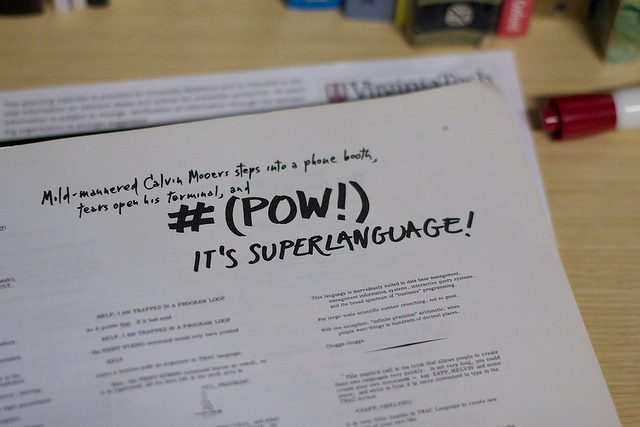
Photo of Computer Lib, Dream Machine
POW! It’s Super Language, Alan Levine 2011


Repost of For the Wholiness of the Human Spirit (2015)

Re-watching Ted Nelson’s eulogy for Doug Engelbart last week reminded me of one of the many (many) reasons Nelson’s thinking about computers and society resonates so powerfully with me. Mourning the loss of one of the most pivotal stars of the new media revolution by indicting his colleagues and making them laugh (nervously), invoking the tropes of classical funeral orations and quotes from Shaw and Shakespeare, and recounting the highlights and tragedies of Engelbart’s career, Nelson’s eulogy is a tour de force in terms of form (technique) and content.  He insists, as passionately as he had in 1974, that computers should support our dreams, indeed that technology is an expression of those dreams.  And dreams, of course, are as much about the emotions as they are about reason and calculation.

 Movies and books, music and even architecture have for all of us been part of important emotional moments. The same is going to happen with the new media. To work at a highly responsive computer display screen, for instance, can be deeply exciting, like flying an airplane through a canyon, or talking to somebody brilliant. This is as it should be…..

In the design of our future media and systems, we should not shrink from this emotional aspect as a legitimate part of our fantic (see p. 317) design. The substratum of technicalities and the mind-bending, gut-slamming effects they produce, are two sides of the same coin; and to understand the one is not necessarily to be alienated from the other.

Thus it is for the Wholiness of the human spirit, that we must design. (NMR, p. 307)

The democratizing, radically-reimagining agenda laid out in Computer Lib / Dream Machines is as relevant today as it was in 1974.  In the early seventies, computing was about inscrutable calculations, fiendishly massive quantification, and the expertise of, yep, experts.  Nelson summoned every woman to “understand computers,” to engage with them, and to create with them. He insisted (rightly) that we are creatures of culture and of interaction as much (perhaps even more so) as we are creatures of reason and calculation. And he wanted us to use computers to develop a “fantic space” (inspired by Eisenstein’s and Pudovkin’s concept of filmic space) to help us communicate emotionally as well as cognitively:

 RESPONSIVE COMPUTER DISPLAY SYSTEMS CAN, SHOULD AND WILL RESTRUCTURE AND LIGHT UP THE MENTAL LIFE OF MANKIND. (NMR, p. 317)

Forty years later, the landscape has changed, but the challenge remains.  We carry computers with us all day long, communicate with people downstairs and around the world in the blink of an eye, and can summon nearly all the world’s texts and many of its numbers to our screens with a few key strokes and a good internet connection. I do feel that my mental life has been illuminated and transformed by the innovations Nelson envisioned. But do we understand computers and the networked world in the way that Nelson thought we needed to? Has the Computer Priesthood” been ousted? Or just changed clothes?  And what about “Computer Aided Instruction” (CAI, as Nelson calls it)?  I look at computerized testing,  video taped lectures, the march of MOOCs, the “Learning Management System” industry, and the relentless pressure to scale, standardize, measure and homogenize an experience that should be so much more….and I think we still need to focus instead on using this technology to provide students (and ourselves) with a real education:

Instead of devising elaborate systems permitting the computer or its instructional contents to control the situation, why not permit the student to control the system, show him how to do so intelligently, and make it easy for him to find his way? Discard the sequences, items and conversation, and allow the student to move freely through materials which he may control. Never mind optimizing reinforcement or validating teaching sequence. Motivate the user and let him loose in a wonderful place” (NMR, p. 313).

I want to keep my beacon set on that wonderful place.