Tag Archives: #openlearning18

Open Learning 2019

I am getting ready for Open Learning 2019. I am interested in this because in cMOOCs, I have met some fantastic people which led to some great projects. I also want to keep up on the world of open and OER, but I am particularly interested in open pedagogy and practices. I am posting this to make sure my blog is connected to Open Ed Hub and also at 58, it is handy to have the relevant links and info all in one spot 🙂

From Open Learning Hub: “Open Learning ’19, a cMOOC about open learning now in its third iteration will begin on March 17th and run for three weeks. Week 1 will be preceded by a “pre-cMOOC” week for anyone who is new to connected learning.” 

And then this notice was posted by Sue Erickson on her blog:

Open Learning ’19, a cMOOC about open learning now in its third iteration will begin on March 17th and run for three weeks. Week 1 will be preceded by a “pre-cMOOC” week for anyone who is new to connected learning, new to MOOCs (and especially to cMOOCs) or new to open learning concepts. Starting on March 10th, all are welcome to join in for the pre-cMOOC week led by Gardner Campbell, Open Learning’s original hub director.

The schedule for Open Learning ’19:

3/17-3/23 Week 1: Open Educational Resources and Open Access

3/24-3/30 Week 2: Open Pedagogy

3/31-4/6 Week 3: Open Faculty Development

These are topics that we’ve explored in previous iterations of Open Learning, and you will find a wealth of resources already on the Hub site: http://openlearninghub.net/.

To begin, start tuning in to the hashtag on Twitter: #OpenLearning19 and syndicate your blog to the Hub (don’t have a blog, this is a great chance to start one!) and use #OpenLearning19 for relevant posts. See instructions in the “Join Up!” link.

I look forward to learning with you!

Your humble Hub Director for Open Learning ’19,

Sue Erickson

Further Education Adventures of an Adult Student Spring 2018

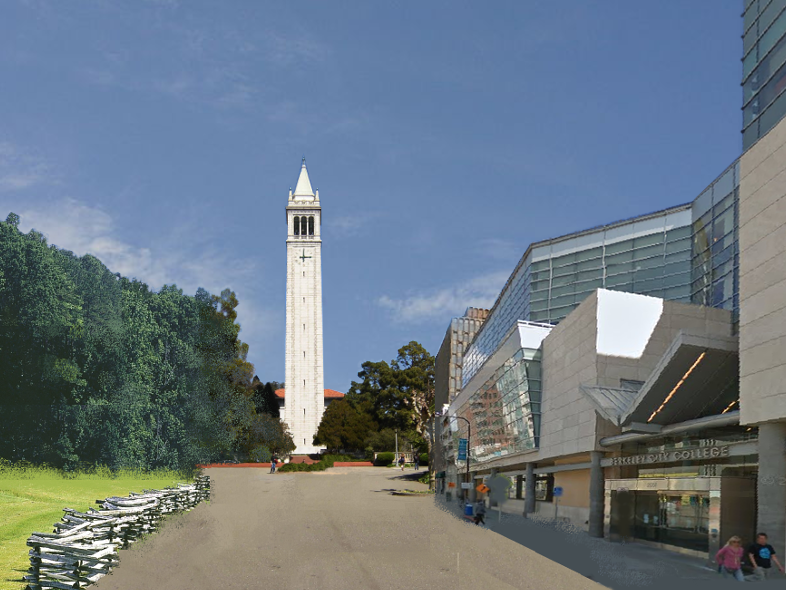
A mashup I made from a google map image of Berkeley City College, a picture of the Campanile at UC Berkeley and an inviting meadow leading into a thicket.

Above – Stay on the Path
A mashup I made from a google map image of Berkeley City College, a picture of the Campanile at UC Berkeley and an inviting meadow leading into a thicket of distractions.

One year ago (April 2017), having struggled with the culture of incompetence across the Peralta Community College District (PCCD) during my years of service as a student representative, I emailed my counselor and asked what was needed to complete my two Associate’s degrees. She replied; “I am on spring break and will check when I return on Monday.” The following week she checked with the Admission and Records Office (A&R) and reminded me of the classes I needed to complete my education plan. Life intervened again (but in a good way this time) and I didn’t finish my final class until Fall semester. As soon as grades are posted I emailed my counselor my completed education plan and pointed out my sociology degree was completed with “highest honors.” A month later she replied; “Sorry for the late response as I was out of the country. Please complete the petition for AA degree…” and added a link to the forms. Being able to access the forms online. Just a few years ago, I would have had to go to the counseling office and stand in line to pick up the forms and then stand in line again to turn them in. I filled out the forms and emailed them back to her.

After not hearing anything for 6 weeks, at the end of February I emailed my counselor to ask if there was anything left to be done. She replied; “I have submitted your petition to the Admission and Records Office. I think we are waiting for the substitution approval for Psych 1A from Rio Hondo. You will receive a status of your petition in April and invitation for the graduation ceremony in May.” This referred to a class I took a 1973, on a transcript they had received more than five years ago. Last week (April 9th) I received three letters fromPCCD, one stating I still need “Substitution/waiver for Psych 1A to meet the requirement” for my Sociology degree. I emailed my counselor and asked “how long can this possibly take?” She replied; “I am in a meeting and will check if substitution for psych 1A is approved when I return to the campus this afternoon. Will get back to you then. By the way, I will be on vacation for the next 2 weeks. If there is any question, please see a counselor or go to admission office.” Groan That afternoon she checked with A&R and my substitution was approved, I’m going to receive my degrees. Also, according to the letters I received, my diplomas will be available sometime in August. I also received a follow-up email:

Dear 2018 Berkeley City College Graduates!!!
On Behalf of the Berkeley City College Graduation Committee, Congratulations on your recent accomplishment!
…
A black gown & cap with a tassel is required for all graduates. The cap and gown will be available for purchase at our campus bookstore located on the 5th floor after May 1, 2018. The regalia purchase price is $35 + tax, which includes the cap, gown, tassel and courtesy 5-pack of announcements. At the commencement ceremony graduates will also receive a BCC diploma cover and BCC zipper pull. The regalia set that you purchase is yours to keep. It is not a rental. (my emphasis) Since there are no dressing rooms at Zellerbach, you are encouraged to arrive in your cap and gown. Note: The bookstore only accepts cash, credit and debit cards for payment.
Honor Students: If you are an academic honor student, your honor cord will be included in your cap & gown set. Please refer to the section of this letter regarding “honors at graduation” to see if you are eligible to receive the honor cord (Honors pertains only to Associate Degree candidates). Your name will be on an honors list at the bookstore.

After my experiences in the PCCD (Berkeley City College is one of the four Community Colleges that make up the PCCD), I have no interest in participating in the graduation ceremony. I would like my “honor card” and tassle but doubt I’ll go to the “GradFest” (is everything branded?) and pay another $35 + tax. From the posting of my final grades to receiving an official document of my accomplishment – eight months. Good thing I don’t need my diploma to get a job; and this is the new and improved Peralta Community College District! The email thread with my counselor showed it was exactly one year to the day from my inquiry about graduating to receiving notice that my forty-five year old transcript was accepted. Happy Friday the 13th to me!

Last month, based on my experiences in the Peralta Community College District, I called my Distance Education (DE) advisor at my new school Metropolitan State University (Metro State), inquiring about registering for summer classes. I was concerned about an Incomplete grade I have and wondered if I had to clear it before registering. She told me she didn’t think the incomplete would affect my ability to register and I should wait until my registration date and try to register. I followed her advice and the day my registration window opened, I tried to register. I was blocked by a hold for a math assessment placed last fall until my transcripts could be articulated (classes checked to conform to Metro States class descriptions). Soon afterwards I received a “Math Assessment Exemption Granted” based on my C in Trigonometry from 1982. After failing to register I went to my eServices account to check my Degree Audit Report (DAR). I had already pointed out to my advisors how hard it is for a DE student to find their DAR, it was a constant topic on the discussion boards in our orientation class. Five clicks through three menus, but that’s another story. My “Math Assessment Exemption Granted” with a green check mark was still there. I went to the Contact Us page and submitted a request through Student Services; “Can someone review my DARS and remove the assessment hold…?” I got a quick response; “Upon reviewing your account, I do see that you have an assessment hold on your account. It states that the Math Assessment is needed. …If you need someone to review your DARS, please contact your academic advisor…” I replied I do not need a math assessment and sent a screenshot of my DARS, with the green check mark. They replied I needed to contact the Assessment office. I emailed my academic advisor informing him of my predicament. To make a long story short(er), it took ten days of daily emails between my academic advisor and the Assessment office with me trying to register each day to see if the hold was removed. This reminded me of when I had recently gone online and updated my address for my bank account. My checking account and debit card were frozen for ten days, with daily calls to my “Private Banker” until the IT department figured out why. Imagine what regular customers have to endure.

Finally I was able to register at Metro State, but when I went to the payment page I was shocked to see $138 in fees for services I will never use as a DE student. Then I remembered I was sitting on a deck at Stanford University waiting for a meeting when I was cleared to register last fall. I was surprised and happy to find out I could register using my phone. I don’t recall seeing a list of fees. For students in a hurry to complete a degree, that’s $414 a year (with summer session) for services we will never use, including a $48 parking pass! I emailed a screenshot of the fees to my DE and academic advisors, the director of student life and the student ombudsperson and asked why students are charged for services they can never access. The silence was deafening. After 10 days I called my DE advisor and asked if she had seen my email. She replied that she had been at a conference the past week and was just catching up on email. I mentioned that no one else had replied and asked what could be done. “Nothing” she replied, the state trustees had approved the fees and it would take a statewide campaign to get them to remove them. I couldn’t find the number of DE students statewide in Minnesota, but Metro State has $1,500 DE students. That’s over $400,000 for two semesters and over $600,000 for three semesters, each year. Nevermind academic fraud, isn’t this consumer fraud?

A screenshot of the student fees charged at registration at Metro State U.

I’m the first student at Metro State approved to document their learning for college credit on a personal e-portfolio, on my own domain, through prior learning assessment (PLA). I’ve been working with e-portfolios for a few years and have been a member of the Association for Authentic, Experiential and Evidence-Based Learning (AAEEBL) since attending their conference in Boston three years ago. Last year, for the first time, the conference was in a different city, Portland, Oregon, so I attended. I had seen a presentation on e-portfolios for adults in Canadian native cultures at an Association of American Colleges & Universities (AAC&U) conference in San Francisco. I saw the author at the AAEEBL conference and after introducing myself and telling him about my project, he introduced me to the DE advisor for Metro State. That’s how I became a Metro State student, but I digress.

After my first AAEEBL conference I started a dialog with the President, Dr. Trent Batson, about creating an ontology (or controlled vocabulary) for eportfolios. This would help students, faculty and adult learners connect and share resources on the internets (Semantic Web 2.0). He approved of my idea but cautioned AAEEBL was focused on a research project that would lead to e-portfolios being added to Dr. George D. Kuh’s list of “High-Impact Educational Practices” and thus promoted by the AAC&U. Last year the research was published as “High-Impact ePortfolio Practice: A Catalyst for Student, Faculty, and Institutional Learning” by Drs. Bret Eynon and Laura M. Gambino, with a foreword by Dr. George D. Kuh. I’m proud to have read their book as soon as it was published as I participated in Open Learning 2017, an open online collaboratory hub where Dr. Eynon and “High-Impact ePortfolio Practice” were featured. Now that this project was finished, I took the opportunity of being at the AAEEBL conference to present my ontology idea to the Practices & Pedagogies Special Interest Group (P&P SIG). It was favorably received, with several AAEEBL officers voicing their approval. As fall became winter, not much was happening in the P&P SIG. I continued to ask the SIG leaders about moving forward and finally created a model ontology for the groups consideration. I received zero constructive feedback. Then the call for conference proposals went out. I contacted the P&P SIG leaders inquiring if they had plans for a proposal. They suggested I submit one. I submitted three: one for my ontology idea, one to promote a student self-assessment rubric developed by two Professors at California State University, Sacramento, who can’t attend the conference, and one about my portfolio for Metro State. As an opportunity to learn about conference presentations, I made each a proposal for a different presentation format. When I got my responses, each was an almost identical form letter stating there were too many submissions in my preferred format, and then suggesting I resubmit my proposals for another presentation format. None of the letters referred to a specific proposal. I think I could decipher which is which, and modify them accordingly, but I wanted to be certain. I emailed my contact at AAEEBL but she said the President had sent the letters and would have to be the one to respond. I reminded my contact that the deadline was approaching but she responded that she was leaving her role at AAEEBL. The due date for the revised proposals has come and gone and I have yet to hear anything more. I have other influential AAEEBL members to reach out to, but my enthusiasm for doing all the work alone by myself has waned.

I won’t even start to include the ICT (information and communication technologies) issues I’ve experienced during this time. Why aren’t ISPs (internet service providers) regulated as public monopolies? Distance education still holds tremendous promise, especially for adult learners, but it sure can be alienating for students.
What does it digital spring break look like anyway?

Thoughts on Open Faculty Development

In catching up on the materials from Open Learning 18 in the past few weeks, I find myself thinking about the claim in the week 7 syllabus that “open faculty development in higher education offers a vital, unique, and uniquely effective opportunity for shared learning in the digital age.” I wanted to reflect on my own learning outcomes from this experience because I think I will draw on them for future faculty development opportunities I’ll create as an instructional designer.

I never realized how many rich conversations take place on Twitter and how valuable they can be for my own learning. I’m not really sure I had a strong opinion of Twitter. I knew it had been a powerful (if not contested) tool for social activism and I had even taught a few sessions on social media activism in my “environmental activism” course, but I didn’t really know what it was all about since I had never participated in this space myself. Once I joined Twitter a few months ago in part for Open Learning 18, I realized that there are actually really deep, rich and thoughtful conversations going on in this space. Also I never knew about Twitter Chats, but learned it was a really great way to be connected with others around a topic in a really short amount of time.

I’m still learning how to manage the flow of information from the web and there was a whole ton of information flowing from Open Learning 18. I excelled at managing information while writing my dissertation almost 2 years ago, but those skills have waned as the nature of my work changed (part-time teaching/stay at home mom-ing). Now that I find myself back in front of a computer for most days at work, I need those skills to stay focused. During one of the Twitter chats, I opened a bunch of new browser tabs with articles people had linked to. I forget what I searched for to discover the Tab Snooze browser extension, but I now use it to save browser tabs for when I’m ready to read. I’ve been using this tool regularly since that Twitter chat, as well as regularly opening lots of new tabs from what I see on Twitter. Now that  Twitter has become another portal for information in addition to Feedly, list-servs, etc. I’ve realized the need for personal information management, which perhaps is part of information literacy?

I also used Hypothes.is for the first time as part of this course. It was a really great way to feel connected to other people reading the same article. It made the articles come alive in a way that I had never really imagined, as if I could see the people reading the same articles that I do. Plus I can now read comments that people leave on any site that I visit. Actually using this tool (just like Twitter) was eye-opening.I can definitely see how this could be used for collaborative annotation in courses that faculty teach, or perhaps in faculty development contexts.

Along those lines, one of the best things I’ve taken away from Open Learning 18 is seeing how the web and digital media tools can be a platform for shared learning. In the past, I’ve only ever experienced the platform of learning management systems (Blackboard, Moodle, Google Classroom) so it was exciting to participate in a more open and fluid space for learning that creatively made use of all these other digital tools like Twitter, Hypothes.is, a mother blog, etc. Those other learning management systems now seem so static and rigid compared to this open learning hub. Experientially learning as a participant in these spaces has really helped me envision ways to tap into these powerful tools to created shared learning platforms for all sorts of contexts.

Thanks for all the inspiration Open Learning 18!


Faculty Development in the Open

What does it mean to do faculty development in the open? How is it different than typical faculty development experiences?

For me, faculty development in the open allows me to connect with learners I might not otherwise encounter. My professional development tends to focus on library conferences where I get to talk and network with other librarians and learn about things that are relevant to my day to day work. Faculty development in the open allows me to encounter colleagues from other areas of higher education that I might not otherwise have a chance to meet. We explore issues that are relevant in higher education on a broader scale than any of our respective “day jobs.” I have conversations with economists, literature scholars, education experts, historians, instructional designers, educational technologists and others. We can find connections that cross disciplines, areas of expertise, regions, and even continents. Language barriers are minimized and connections are formed over shared excitement about the possibilities of working in the open. Perhaps even collaborations emerge. I may never meet some of these colleagues face to face, but I feel a kinship having traveled on a journey with my co-learners.

OpenLearning17 and 18 have been rich experiences for me and I look forward to future iterations! I hope you will join us!

Tolstoy, Economics and OER

OpenStax - $ Contribution page

David Wiley wrote a recent blog post that had me scratching my head. In the post, David argued that OER is in a feature of the resource, not who is providing it and whether the provider is offering it for free. This whole thing got me thinking about OER, commercial publishers and non-profit providers.

I know there are people who are opposed in principle to publishers who charge for their products in order to make a profit. I don’t have a problem with profit. If a chef opens a restaurant in my community and offers good food at a reasonable price, I am happy if they make a profit with the business, because that means they are likely to stay around. What I do have a problem with is excess profit. My favorite example, which some of you will remember, is Blockbuster Video. Blockbuster offered lousy service and charged too much. But they were the only game in town, so if you wanted to watch a video that night, you pretty much had to go to Blockbuster.

The first rule of economics is that nothing is produced for free; if it’s free to use, someone else is paying. This is not a moral judgment. Rather, it’s a fact of life. Everything (or almost everything) has a cost to produce. Image of Leo Tolstoy dressed in peasant clothing

Leo Tolstoy gave up the copyright to his early novels, and adopted a peasant lifestyle.   I can’t imagine what his family thought of that. Most of us are not like Tolstoy. We all need to provide for ourselves, and our families. When I helped write OpenStax’ Principles of Economics, I was paid a reasonable stipend to compensate me for the time. It didn’t make me rich, but it was enough. If I was one of those heroic authors, like my colleague Caitie Findlayson, who writes an open textbook without the support of any publisher, I would be able to do it only because I had the luxury of time as part of my professional responsibilities as a tenured faculty member. In other words, I would be implicitly compensated by my institution, but the cost would be the other scholarly work I wasn’t able to do in that time. There is always an opportunity cost. If I was working 9 to 5 somewhere, I wouldn’t be able to do the project at all.

OpenStax is a nonprofit organization. Where did they get the money to pay me, and to pay the other expenses of producing the book? The answer is grant funding. Grants are great, but they run out. Then what? How does OpenStax pay for the servers on which the book resides? How do they pay for updates and corrections? How do they pay for new editions? This is a perpetual challenge for non-profits. As far as I can tell, OpenStax has a four-pronged approach:

  1. They ask for donations. I don’t know how successful this us, but I suspect it’s not much.
  2. Ten percent of their adoptions are in print form. They sell these at slightly over cost, which means those copies generate some revenue.
  3. They look for more grants, but granting agencies prefer to fund new books to maintaining existing ones.
  4. They find commercial partners to work with, like Sapling Learning. Sapling offers the OpenStax text with online end-of-chapter problem sets and quizzes. In return, Sapling gives OpenStax a modest kickback, and then OpenStax markets the Sapling option. (I mention Sapling because I used their product after I adopted OpenStax. OpenStax has many more partners than Sapling.)

Do people criticize OpenStax because of their affiliation with Sapling who charges a fee for the book plus ancillaries? I may be wrong, but I don’t think so. Do they criticize OpenStax for openly allowing Sapling to use their open texts? I’ve not heard that criticism. Have people criticized Sapling for exploiting the open license of OpenStax? I haven’t heard that either.

The elephant in the room is commercial publishers who are beginning to offer OER wrapped in a package for a price. Traditional proponents of OER are rightly suspicious of commercial publishers who are new to the OER field. Commercial publishers have a long history of charging very high prices for textbooks, higher than can be justified by costs.

Take “Inclusive Access” for example. If you’re not familiar, Inclusive Access is a marketing venture by commercial publishers to rent digital texts to an entire class for a discounted price. Students are on the hook to their university for the bill, unless they opt out, so the “nudge” is in the wrong place. Inclusive Access strikes me as akin to OpenWashing. While the digital text is cheaper than a new print edition, at my school at least it’s not very cheap, coming in a bit under $100. It’s a pretty good deal for the commercial publishers, since the marginal cost of a digital copy is about zero. And Inclusive Access is certainly not OER since the access goes away at the end of the term.

When is it legitimate to charge for OER? Like any product, charging is appropriate if the product adds value, in this case to the OER. Sapling added value to OpenStax Principles of Economics because it offered a feature that OpenStax didn’t have. The problems & quizzes helped students learn better than just with the text alone. Similarly, Lumen Learning adds value in its Waymaker platform for the same reason.

Of course, one can argue that the value added isn’t worth the price. In the older model of commercial publishers, they charged for the book and then offered the ancillary products, including online quizzes and problems for free. But the package was pricey. Cengage is currently charging over $200 for their market leading Principles of Economics book.  That price has come down from its original $385.  Sapling charged about $40 for its product, which included OpenStax Principles of Economics. Lumen Learning charges $25 for its Waymaker Principles of Economics. Sapling struck me as a bargain for what it offered my students. Waymaker, which I’ve used for the last three years, is even better, especially since my own statistical analysis has shown that the average student does at least as well with Waymaker as with the previous commercial text I used. Perhaps more importantly, Waymaker seems to help weaker students more than stronger ones.

Commercial publishers have traditionally charged too high a price for their books two reasons: First, because they have a higher cost structure (due to their large sales force). Second, they have exploited their market power to charge more than a reasonable price for their products. Netflix mailing envelope w/DVD insideMonopolies often fall when a technological improvement creates better alternatives. Thus, Netflix supplanted Blockbuster.  Only when OER came on the scene did cracks appear in the commercial textbook oligopoly. (For non-economists, an oligopoly is an industry dominated by a small number of firms that exploit their joint monopoly power.) Newcomers like Sapling brought textbook prices down to under $50. And Lumen Learning brought them down to $25. Is $200 too much to ask a student to pay for a textbook? In my opinion it is, especially given the alternatives. Is $25 too much to ask? I’ve asked my students that question every semester that I’ve used Waymaker, and no student has ever said yes.

Lumen Learning deserves some kudos: For every course for which they offer their Waymaker value-added OER, they also offer a free version of the Waymaker content without the added features. This free version is openly licensed to include the 5Rs. It’s hard to ask more than that.

Disclosure: I’m the lead subject matter expert for Waymaker Principles of Economics and I’ve taught with Waymaker for the last three years.


Image credits:

OpenStax website

Image By Ilya Repin – ugFXC9F7-NWM9Q at Google Cultural Institute maximum zoom level, Public Domain, https://commons.wikimedia.org/w/index.php?curid=21854099

Image Netflix courtesy of Abhijit Bhaduri via flickr.com

Enough

I made a digital postcard to commemorate students in dozens of cities in all 50 states staged demonstrations and observed a moment of silence to honor the 14 students and three adult staff killed a month ago at Marjory Stoneman Douglas High School in Parkland, Florida.

I made a digital postcard to commemorate the students from Granada Hills High School in Southern California (and in cities in all fifty states) who walked out of their classes, staged demonstrations and observed a moment of silence in honor of the fourteen students and three adult staff killed a month ago at Marjory Stoneman Douglas High School in Parkland, Florida. I’m proud the students are politically savvy and followed what Granada Hills alum John Elway does, not what he says, regarding politics.

Thoughts on some OER FAQs

In advocating for OER on my campus, I’ve run into many misconceptions. I’ve also found a few people in influential positions, with influential reputations, who are actively spreading these misconceptions. This FAQ is a useful document for addressing some of them.

OER help “to ensure that resources are up-to-date”

How up-to-date are commercial textbooks? There is an investment of time and money that goes into revisions and printing new editions, so publishers don’t want to do that any more than necessary. They also have a vested interest in eliminating the market for used books, so there is a financial benefit to updating editions frequently. Faculty can OER whenever they please, due to the Creative Commons permissions. Some may see this as a drawback, if they would rather have someone else be responsible for keeping materials current. I can see benefits to building the updating process into a course though. Students could look to current research, events and issues to see how they intersect with course subject matter, and be charged with proposing revisions. This type of an assignment would have them actively thinking about the relevance of what they’re learning, how they are learning it, and how to get ideas and concepts across to others. Students would gain experience in managing their own learning processes at the some time as they learn the course content.

“Can OER be high quality if it is free?”

Are commercial textbooks high quality because they’re expensive? What kind of review process do they actually go through? How do we rate quality anyway? What factors are considered important? What matters is student learning and student success. Writing, editing and design will have an impact on that. So will accessibility and cost. I imagine it is relatively easy to compare textbook A to textbook B and decide which is better based on content and presentation. It would be more difficult to determine if textbook A is $100 better than textbook B, or if students would derive $100 more of value from it. Due to CC permissions, OER can be modified to fit the needs of an institution, a department, an instructor, and a group of students. They can be continually modified to improve student success.

Week 5: Open Educational Resources

OER, which is an acronym for Open Educational Resources, seems like a no-brainer to me. In my 30+ year career teaching Principles of Economics, I have used a variety of books, including traditional commercial textbooks, books written on economic subjects for lay audiences (in lieu of a standard textbook), and no text book at all. I’ve concluded that most intro books are pretty much the same, and that any experienced instructor can teach effectively using pretty much any intro text. Why then should we ask our students to use commercial textbooks that cost $75, $175 or $375, when there are free or very inexpensive alternatives available? Yes it takes some time and effort to adopt and transition to using a new text. I don’t discount this, but as professionals don’t we have an obligation to do that if we think it would be better for our students?


Over the last few years, I’ve adopted OER for my intro courses. Before we go further, let’s get a few myths out of the way. When I talk about OER this week, I’m not referring to class materials, bits of content, what used to be called learning objects. I mean open source, complete printed or digital texts usually edited and published by organizations with solid reputations.

For faculty who don’t have experience with OER, there are five key questions we will explore this week:

  1. What is OER?
  2. What are faculty and student perceptions of OER?
  3. How good are open source textbooks?
  4. Why adopt OER? Why start an OER initiative at your institution?
  5. How to find OER in your discipline?

Monday: What is OER?

Open educational resources are much more than simply free resources. OER give students and teachers the following five rights:

  1. Retain – the right to make, own, and control copies of the content (e.g., download, duplicate, store, and manage)
  2. Reuse – the right to use the content in a wide range of ways (e.g., in a class, in a study group, on a website, in a video)
  3. Revise – the right to adapt, adjust, modify, or alter the content itself (e.g., translate the content into another language)
  4. Remix – the right to combine the original or revised content with other material to create something new (e.g., incorporate the content into a mashup)
  5. Redistribute – the right to share copies of the original content, your revisions, or your remixes with others (e.g., give a copy of the content to a friend)

It is because of these permissions, that OER are free.

While you may not yet fully understand the “5 Rs,” as David Wiley calls them, but understand this: they dramatically change the role of a textbook in a course (or at least they offer the potential for that).

And/or

And

  • Join in – Open Dialog Session, 4pm EDT; Tune in via Google Hangout (link TBA)& submit questions via Twitter, hashtag #openlearning18.

Tuesday: Faculty and student perceptions of OER

What do faculty know about OER at your institution?

What do instructors and students who use OER think of them?

  • Join in – Twitter chat 2:00-3:00 pm EDT

Wednesday:  The Quality of Open Source Textbooks

How can we be sure that the quality is equal to that of traditional commercial textbooks? Are open source textbooks peer-reviewed? Do they go through a comparable quality control process?

And

And

Thursday:  The Case for OER

  • Conversation with Rajiv Jhangiani, 2:00-3:00pm EDT via Zoom (link TBA) & submit questions via Twitter, hashtag #openlearning18.

Are you concerned about higher education access and affordability? Open textbooks can help ease the burden of textbook costs for students and provide faculty with high quality, customizable course content. Join us for a discussion of textbook costs, student success, and more.

Archived videoconference:

Friday:  Finding OER in One’s Discipline


  • Join In: Find an open textbook in your discipline (administrators too, please!) using the information above.  Take a quick look at it and tell us what you think on Twitter.  3:00-4:00  pm EDT


Page by Steve Greenlaw, edited for Open Learning ’18 hub by hub director Gardner Campbell

Anxiety about the New Thing

This week has been about anxious feelings about new things. New technology, new ideas, it all provokes an anxious feeling. What is enlightening is that on consulting Merriam-Webster for the multiple meanings of anxious, I am reminded that it not only means “characterized by extreme uneasiness of mind or brooding fear about some contingency,” it also means “ardently or earnestly wishing.” That sums it up for me. I feared the failing of technology, or more accurately my ability to understand new technology fully in order to control it, but ah, I also wished for it to work to bring important conversations to others across the Web! Jenny Dale, in our conversation about the Framework for Information Literacy, talked about her anxiety about the document when it first came out, but she also talked with excitement about how she has come to embrace the Framework and even teach others about its usefulness. An anxious feeling isn’t a bad thing, just temporary unease and a hope for understanding.

Trudi Jacobson and Craig Gibson shared the past and future of the Framework in another interview discussed their latest work that connects the Framework to High Impact Practices (HIPs). I detected some ardent wishing in their voices that showed hope of helping others make this connection. Their passion was contagious and I found myself excited about the prospect of exploring these connections. I am eagerly awaiting this month’s issue of RUSQ where their article will appear.

I am anxiously awaiting your blog posts and eager to know whether you enjoyed the selected readings and the interviews!

Week 4: Open Access

PLOS Open Access webpage header

From co-facilitators Maha Bali and Sue Erickson:

Cross-continental greetings from Maha and Sue!

Our plan for this week is to have participants explore issues around Open Access (OA) and share their motivations for participating in OA.  With a variety of activities and platforms, we hope to facilitate learning from each other’s experiences and practices with open access and open scholarship.  We will also explore particular issues around OA in a global context.

Sunday, March 4 & Monday March 5

Begin reading Peter Suber’s book Open Access, focusing mainly on chapter 1: What is Open Access? If you participated in OpenLearning17 and have already read chapter 1, feel free to move on to chapter 2.

We will be collectively annotating chapter 1 of Suber’s Open Access in Hypothes.is,  but feel free to annotate other chapters that interest you throughout the week, and to blog your reflections.

The home page for Suber’s book, with updates and supplements, can be found at:

https://cyber.harvard.edu/hoap/Open_Access_(the_book)

The direct link to the book where we’ll do our annotating is here:

https://mitpress.mit.edu/sites/default/files/titles/content/9780262517638_Open_Access_PDF_Version.pdf

Instructions for annotating PDFs offline via Hypothes.is:


https://hypothes.is/blog/synchronizing-annotations-between-local-and-remote-pdfs/


Tuesday, March 6

3-4pm EST (8-9pm UTC). Watchlink below. Contribute questions and comments during the hangout on Twitter: #openlearning18.


Google Hangout on Air across three continents and 5 countries with guests:

  1. Peter Suber, Director of the Harvard University Office for Scholarly Communication, and Director of the Harvard Open Access Project (@PeterSuber),
  2. Thomas Hervé Mboa Nkoudou, International President of APSOHA, the Association for the Promotion of OpenScience in Haiti and Africa (@mboathomas) and
  3. Ivonne Lujano Vilchis,  DOAJ Ambassador, Latin America and works at Universidad AutĂłnoma del Estado de MĂ©xico. (@ivonnelujano). There is space for 5 additional participants – if you would like to join the conversation on video, please tweet to @bali_maha or @SueErickson10 – or ask questions on Twitter via #OpenLearning18)

Read the guests’ work on Open Access here:

The home page for Suber’s book, with updates and supplements, can be found at:

https://cyber.harvard.edu/hoap/Open_Access_(the_book)

Peter has also made a list of 40+ organizations working for #openaccess in the global south.

Thomas Hervé Mboa Nkoudou co-authored articles below in French, but you can find a synthesis of them in English by Andy Nobes at Must We Decolonize Open Access? Perspectives from Francophone Africa:

You can find this article by Ivonne and Federico Vasin (Spanish – but try Google Translate): http://www.revistas.unam.mx/index.php/rmcpys/article/view/58652  “National classification systems for scientific journals in Latin America: recent trends and implications for academic evaluation in social science”


Wednesday, March 7

New for #OpenLearning18: Andy Nobes’ article Must We Decolonize Open Access? Perspectives from Francophone Africa  (- Hypothes.is annotation.


Thursday, March 8

Explore and share your learning: Sherpa-Romeo and SPARC Open

A useful resource for those who care about open access is http://sparcopen.org/ – and a useful resource within it for evaluating “how open is it?” https://sparcopen.org/our-work/howopenisit/

Also, see the SPARC Open Access Author Addendum – have you used it? Would you? If not, why not? Post your response to Twitter using #OpenLearning18.

What are the main differences between green OA and gold OA? [Suber has a concise description of each here:  http://legacy.earlham.edu/~peters/fos/overview.htm].

Sherpa Romeo is a great resource for learning about open access policies of subscription journals: http://www.sherpa.ac.uk/romeo/index.php – do you have articles in subscription-based journals which can be made available via Green OA? If not, make them available and tweet them to #OpenLearning18


Friday, March 9

Write a blog post or make a meme about something new you learned about Open Access this week. Be sure to use the #openlearning18 hashtag.


Post by co-directors Sue Erickson and Maha Bali
Edited by hub director Gardner Campbell