Tag Archives: open education

Introductions

Hi, my name is Elizabeth.

I am starting this blog as part of the #OpenLearning19 MOOC, but hope to expand beyond the course.

I have been an academic librarian for 6 months now, but was a public librarian for almost 5 years before then. Being an advocate for open access in higher education has come natural for me transitioning from public librarianship. It is also a huge component of my current job description.

As I blog more I hope to get to know those of you in the open community better and we can continue to work together to help improve open education!

Open Learning 2019

I am getting ready for Open Learning 2019. I am interested in this because in cMOOCs, I have met some fantastic people which led to some great projects. I also want to keep up on the world of open and OER, but I am particularly interested in open pedagogy and practices. I am posting this to make sure my blog is connected to Open Ed Hub and also at 58, it is handy to have the relevant links and info all in one spot 🙂

From Open Learning Hub: “Open Learning ’19, a cMOOC about open learning now in its third iteration will begin on March 17th and run for three weeks. Week 1 will be preceded by a “pre-cMOOC” week for anyone who is new to connected learning.” 

And then this notice was posted by Sue Erickson on her blog:

Open Learning ’19, a cMOOC about open learning now in its third iteration will begin on March 17th and run for three weeks. Week 1 will be preceded by a “pre-cMOOC” week for anyone who is new to connected learning, new to MOOCs (and especially to cMOOCs) or new to open learning concepts. Starting on March 10th, all are welcome to join in for the pre-cMOOC week led by Gardner Campbell, Open Learning’s original hub director.

The schedule for Open Learning ’19:

3/17-3/23 Week 1: Open Educational Resources and Open Access

3/24-3/30 Week 2: Open Pedagogy

3/31-4/6 Week 3: Open Faculty Development

These are topics that we’ve explored in previous iterations of Open Learning, and you will find a wealth of resources already on the Hub site: http://openlearninghub.net/.

To begin, start tuning in to the hashtag on Twitter: #OpenLearning19 and syndicate your blog to the Hub (don’t have a blog, this is a great chance to start one!) and use #OpenLearning19 for relevant posts. See instructions in the “Join Up!” link.

I look forward to learning with you!

Your humble Hub Director for Open Learning ’19,

Sue Erickson

The internet and information literacy

Sigh… So work got away from me so I didn’t get to participate as much as I would have liked so this is my attempt to catch up.

Week 2 we examined the Internet and how it relates to education and open access.  I did the reading early and then didn’t have time to fully participate to get my questions answered.  When I read and annotated the Tim Berners-Lee article I didn’t get the chance to respond to some of the questions I was asked about my comments, which deserve to be answered.  As I read the article I was struck by the income bias.  The article while very informative and enlightening, has a bias toward those who can afford access. Gardner Campbell noted my concerns and is I believe on the right track with inclusive access for all.  Gardner also provided a link to Pew research showing the increase in usage of the internet.  But as I looked through this data I was struck by how we are still biasing access with income and education.  While general use has increased, lower income and education have just now reached the use point of higher income and education individuals were at 18 years ago.  And home use of the internet via home broadband for low income is at 53% and low education at 34% verses high income and high education’s 93% and 91%.  This is not taking into consideration location (data is provided).  Also of note in that same research is that lower income and education individuals are more dependent on their smartphones for all their internet access.  The internet has an inherent bias to those who can afford access, and I think it’s important to recognize that.

Week 3 we examined information literacy and open access.  As a librarian who teaches a credit bearing research course, Facing the Frames just confined what I do.  Although there are differences since my class is 16 weeks and we go into more then just information literacy (we also cover some aspects of writing), the concepts of teaching the student to analyze every aspect of what they are doing is important for librarians to understand and use in every aspect of what they do.  Critical thinking and evaluation is the most important thing we teach.  Which lead into Beyond Buttonology… I have to say I was surprised at this article, because I had thought that librarians had moved beyond teaching the mechanics already.  Critical thinking and metacognition has always been emphasized where I have worked.

That’s my $0.02.


Kal-toh, chess, and tic-tac-toe

This week we peeked into the world of open and flew into a worm hole.  There is sooo much that can be read into one word, and so many uses of the concept that it gets difficult for me to see the multidimensionality of it.  I have a tendency to stay on the surface because that’s what I understand.

On the surface, open education is teaching through a free means.  Open educational resources are the items used in the teaching that are also free.  I’m good here, this is easy to understand.  No cost to teachers or students for textbooks, articles, or any materials the instructor wants to use.

Chess
“Kal-toh is to chess as chess is to tic-tac-toe.” (Tuvok: VOY: “Alter Ego”)

But let’s talk about free.  Free starts to get complicated because free should just be that, but it isn’t.  Just like free from a library isn’t free if you can’t get to the library or you live outside the service area, free on the internet isn’t free if you can’t get onto the internet.  You need a computer and access to get to the free. So what exactly is free? and how do we provide it to ALL to create real openness?  Also, is free, free when we make students pay to be taught?  And here is when I stop playing kal-toh and go back to tic-tac-toe.

So how does this relate to my own idea of open education?  I’m not sure I have an idea about open education… yet.  I do know that  in my practice I want to save the student from having to purchase material to learn something when practical application and discussion can accomplish the same thing.  But the materials we use are the library databases that are not free since they are licensed via the library budget.  So even though they don’t have a textbook, their tuition pays for the subscriptions, so in all technicality that is not free or open.

Can I create assignments that are completely open?  The easy answer is yes, by using open access articles to do information literacy objectives, I could use all free materials. But again… this is not truly free for the student who doesn’t have a computer or the internet at home, because they would not be able to access the material anyway.  To further complicate this, they have already paid for my class.  I’m not sharing my expertise free of charge, which again technically would not be completely open or free.  I keep getting stuck in the free aspect of open.  Because really, nothing in our society is free.

I keep thinking about Star Trek.  The open society where you explore your passions for self-improvement, self-enrichment, and the betterment of all humanity. There is no money.  Everyone (supposedly) has the same opportunities for learning and working.  In this world open education is open and free.  In our world, there are too many facets to “open” and “free” to truly be either.

So until we can live in the Star Trek world, we do the best we can and cut cost to the student where it is feasible.  To me that means, finding ways to provide open educational resources to the faculty to use, finding ways to integrate what the library already owns into an easier medium for the faculty and student to use, and to explore whatever options present themselves to make the life of the student easier.  As a librarian, I am a facilitator of access.

More Questions Than Answers (about Open Ped)

Now that the Keene State spring 2017 semester Open Education speaker series and Open Pedagogy Learning Community have come to an end, I wanted to write a wrap-up post. I know I can’t capture everything that I have been thinking for a whole semester in this blog post, but I will try to hit some main points. The presentations were fabulous. And I wrote about our first few speakers in my Student Drivers post.  I think the best part about having Open Ed guest stars on campus was all of the informal conversations, interactions and meals that allowed us to dig into some deeper discussions.

Meanwhile, the Open Ed world has been on fire with tweets and blog posts and hangouts and such where there has been much discussion aimed at trying to answer the question- ‘What is Open Pedagogy’?  See Maha Bali’s excellent curation of posts on Open Pedagogy.

Well I’ve been facilitating an Open Pedagogy Learning Community at Keene State where we set out with that question- and like I always tell my students, the best investigations end up generating more questions, not answers:

  • Do you have to use or create OER for it to ‘count’ as Open Pedagogy? (we actually discussed this back in January/February before David Wiley’s controversial post).
  • Who gets to decide what Open Pedagogy is?
  • Isn’t just calling it Open Practices better?
  • What is Open anyway?
  • What counts as OER?
  • What is ‘content’ for that matter? Is it anything that is ‘captured’ (written or recorded)?
  • Once anyone posts something online, is it “captured”? And therefore copyrightable? And therefore you could put a CC license on it?  And therefore it could become the stuff of Open Pedagogy?

And also meanwhile the students in my two different biology courses starting tweeting at each other and sharing ideas and articles and hashtags- they opened up the edges of their classes and nobody asked them to- Is that Open Pedagogy? Shrug.

And then Jim Groom writes about choosing ‘awesome’ over open, and I think “Yeah!” And then Maha reminds us…once again…about privilege (oh yeah.)

Then, Martha Burtis comes to campus and says:

“We can’t say that our questions are only pedagogical- they have to be technical and pedagogical.” 

This realization smacks me upside the head. I like learning about tools, but I have always thought the point was for them to be easy to learn and use, for people like me that are not experts at coding and stuff.

But Martha emphasizes to us that the ‘appification’ of the internet – has enabled students and others not to learn the technical. That those ‘apps’ control how people interact with and learn from the internet, the web. The people that control THAT are controlling nearly everything. Like Google and Facebook and Amazon. (Duh Karen!).

Google can say “Oh, it’s the algorithm, it’s not our fault” (when a search returns a bunch of racist results on a topic), and this deception is widely swallowed by those of us not in the know.  Damn. There is an activist agenda to this. We have a responsibility to learn the technical aspects of the web; to create spaces, and algorithms and apps or whatever that are cognizant of diversity, inclusion, social justice and the rest of the pedagogical principles that we espouse so boldly when we talk about our teaching practices, our pedagogy. Students (and others) need to not just learn technical skills, but the IMPLICATIONS of those technical skills. We need to push back on the idea that is it ok to say “I’m not technically savvy”.

“I want us to realize that the web is not something that is happening to us, but rather it is something we are creating.”  From Beyond Websites, by Martha Burtis

So more questions:

  • Who makes the web?
  • Who could/should be making the web?
  • What is a domain? Who needs to own one?
  • Who owns your data?
  • What does your institution do with its data?
  • Why is a non-institutional, non-vendor-built space so critical?
  • If students take part in making the web, using their own domains, in the context of being guided by professors using educational/social justice principles, is this Open Pedagogy?

If you’re not sure that these are important questions, you don’t need to look much further than the biting wisdom of Audrey Watters whose ability to cut straight to the educational technology chase is uncanny. If you haven’t read her ‘Why a Domain of One’s Own matters (to the future of knowledge)’ and ‘Education Technology’s Completely Over’, read them now.

Last summer, I wrote this:

“For those of us that believe that our job is to help students become agents that can transform the society we live in, not just replicate it, the potential of Open Ed was like breathing fresh air…”

Open HAS to be political. Anything that is potentially transformative is political. I wouldn’t have put as much energy into learning about and participating in the Open Ed movement if it wasn’t.  And make no mistake, it is a movement. I recruited faculty into our KSC Open Pedagogy Learning Community by emphasizing the political power and potential of Open. And I said:

“Practitioners of Open Pedagogy actively critique and confront the industrial and corporate approach of co-opting and packaging ‘teaching technology’ to turn students into consumers.  Instead, they utilize the as web a place for uncontrolled discovery, creativity and analysis, and as a venue for dialogue with the wider public.”

So Bonnie Stewart’s recent post about her Keene State talk gets me thinking even further about the politics of Open, and Open as activism.

Bonnie pointed to some complicated relationships between digital identity and digital citizenship.  In her talk, she said “[Digital] citizenship means we need to think about what we open up to the public. Our empires today are not all nation-states. Empires are places that we bring our students into when we ask them to engage online. And identity is the price of admission.”

There is so much to say about the importance of helping students think about how they shape their digital identity and the complexities between media literacy and digital identity. And this reminds me of Maha Bali’s Fake News: Not Your Main Problem where she says-

“The solution isn’t going to be by focusing on promoting digital literacies to combat fake news. It’s got to be about nurturing cross-cultural learning attitudes and skills that help make our knee-jerk reactions to news in general more socially just and empathetic.”

  • Is ‘nurturing cross-cultural learning…’ a central tenet of Open Pedagogy (or should it be)?

Then Bonnie says in her post,

“Digital identity isn’t just the wrong lens for figuring out digital scholarship, or encouraging participatory engagement in learning. It’s actually the wrong lens for building towards any vision of digital citizenship that makes for a liveable, decent digital social sphere to inhabit.”

So I am thinking that maybe she means the narcissistic, isolated ways that some people build their ‘digital identities’? (maybe she doesn’t, so I apologize for any incorrect interpretation). But if the focus is solely on the created digital self, then this likely works counter to building a social movement.

And more questions,

  • Are domains about identity? (Are wikis better than blogs for community building?)
  • Is Open Pedagogy about guiding that process of digital identity development towards building a social movement that is about connection, compassion, authenticity and addressing global issues?
  • Does it start with students seeing the potential of using the web to be helpful to someone else?


well lit rabbit holes

Noon I ducked down to our local “Maker Space,” which has open hours ’til 1:00.   I’ve been going there for years whenever something’s weird with whatever version of my dynamo hub light I’m trying to get rolling.

Long story short:   the person who knows how to take gadgets apart & put ’em together was coming for the 1:00 thing, which seems to be an open Python and things like that session.   Facilitator is a person who teaches Python to people in Information Science grad students who are “non-STEM,” and, she says, often phobic about math as soon as it turns into “x=” something so she has found other ways.   It was interesting to hear conversations among people in the University community.

It also took ’til 4:00 to figure it all out and get it back together and get it charged and… now I have to find the right thingy to put it on the bike, and no I didn’t so much as *touch* the tech project.

This a.m. I discover a tweet talking about David Wiley of Lumen Learning’s latest blog which talks about people using “open” in ways that aren’t open enough…we need those 5Rs…  oh, and the comments are closed. Nothing ironic there, is there?  The comments and tweets on blogs about that blog make me realize again what a tight-knit group these guys are (lots of insider references).  (My opinion:  if you’re going to want a certain definition for a term, then don’t give the term a name like “open.”   Hello?   It already has a ton of meanings and interpretations. Name it after somebody, maybe… )

It’s time to do some courage-seeking …


Student Drivers

Our spring break is just around the corner, and as we reach the middle of the semester I am thinking about how things have been going so far with our efforts to bring awareness to the value of Open Education at Keene State College. Jenny Darrow (@gobman) and I have spent many hours this semester immersed in planning and in wonderful conversations about how we can raise awareness about the value of Open Education to our campus.  We’ve worked hard identifying and trying to motivate faculty who would be early adopters, excited to rise to the challenge of doing something new.  Our faculty Open Pedagogy Learning Community has been humming along with great discussions emerging from that group.  We have also put energy into numerous conversations and emails with administrators.  (The admin reaction sometimes feels like high enthusiasm and sometimes feels like ‘pat-on-the-head’ support. Perhaps they just haven’t taken us seriously enough to be hostile yet says my cynical self!)  But the way our work has been developing this semester has shown us that the students might just be the drivers of this Open Ed bus, the real ambassadors.  A New England snowstorm ‘flipped’ the order of our first few guest speakers, and shifted my thinking about what we were doing.

If one of the important tenets of Open Pedagogy is that it is student-driven, then why shouldn’t an Open Education movement itself be student-driven?

compliancesigns.com

The first speakers in our open education speaker series were students: Andrew Rikard, from Davidson College, and Erika Bullock, from Georgetown University.  Their visit started with a conversation with our OPLC faculty, and I have to say that the dialogue that emerged, really blew my mind.   Our faculty were riveted as the students talked about what it meant to them to take ownership of their learning.  (This phrase- ‘students take ownership of their learning’ -really sunk in so much more deeply for me even though I had heard it and thought about it many, many times before).

Erika and Andrew spoke earnestly to professors of their fears about questioning faculty authority, an authority for which they have great respect, and they very much did not want to appear disrespectful or challenging.  But they hoped that faculty would “respect the authority of students in their own experiences”.  Faculty looked students in the eyes and spoke earnestly about their fear of being perceived as ‘not doing their job’.  Students told of feeling uncomfortable with a professor when they ‘don’t know what you want’.  We all wondered, how do we make it feel like ownership, not a burden?  Erika and Andrew went even further to suggest that students themselves could decide whether Open is really the best path to learning for them. “What is my vision for myself?”  “Do I enjoy being a collaborator and sharing?” Faculty pondered “How do we (if we can) increase student intrinsic motivation?”

Erika and Andrew suggested that faculty should be very transparent with students about what they are doing in order to convey a sense of ‘we are all in this together’.  When Erika told us about a faculty member that shared her life story in the first class that ended with “…and this is why I am here, why I am teaching this”, it was extraordinarily moving for her.  At one point Andrew said, “I got to watch somebody who I thought knew everything, learn.” And Erika said, “I was deconstructing my definition of a student”.  Erika also spoke eloquently about her experiences with Open Pedagogy as academic and co-curricular collaboration (a topic for a whole other post).  I think there was something particularly powerful for our faculty to hear these kinds of statements directly from the mouths of students. It was also brought up that many of these ideas about student ownership and connected learning aren’t necessarily new, but that they weren’t easy or possible when many of us started teaching, but now technology and domain spaces are making so much more of this possible now.  There were so many other amazing moments in this conversation (like how ‘scientists cultivate frustration’); I wish I could have written them all down, but I was too transfixed.

This exchange really got me thinking that Open Pedagogy faculty ‘development’ might be most effectively achieved by having students do the ‘training’.

The presentation, (Trust, Power and Agency) that Andrew and Erika gave later was (without planning it this way) mostly to a student audience, and we ended with a rich roundtable discussion with Andrew, Erika, KSC students and visiting students from Plymouth State University. That discussion moved even further into student engagement- how students should be influencing college policies, designing courses and making curriculum decisions. I wish I would have also periscoped that conversation with students from four different institutions. So much great stuff – take a look at the #KSCollab twitter feed from Feb 24 for some of it.

Enter @actualham.

Photo by Celia Rabinowitz

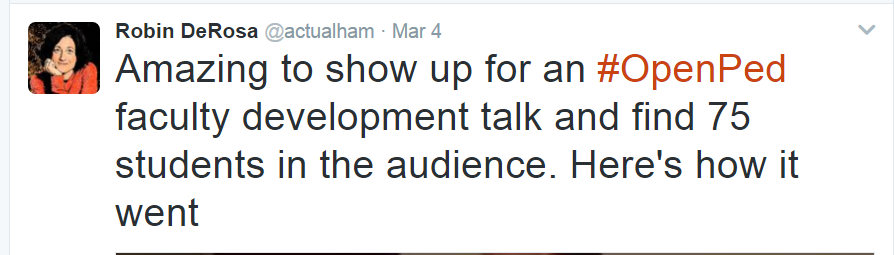
We originally scheduled Robin DeRosa to be our first speaker in the KSC Open Ed speaker series. Of course, we wanted to begin with a big splash and get everyone fired up and who better than @actualham?  But due to the weather, Robin followed Andrew and Erika.  And, our OPLC faculty were already fired up by the students!  And then, when it came time for Robin’s talk, apparently all of our advertising that said, ‘make sure you bring students too’-   resulted in an unexpected 75-80% of the audience being students, and the rest faculty (we counted a single administrator).

But the talented and audacious @actualham (and Robin is surely ready to kill me with all of my adjective use lately, but this one really works here and I love the alliteration), instantaneously transformed her presentation, Putting the Public back in Public Education, for a mostly student audience.  And I mean instantaneously. I think she had about 3 minutes to think about it.  (She IS a genius among geniuses and anyone who thinks I am just another ‘over-the-top actualham fan’, will mark my words some day).

What was particularly great, was that Robin got the students fired up, not mainly about textbook costs (although they certainly cared about that too), but about the Open Pedagogy! They were excited about learning in a different way, and especially in learning beyond their class.

One student, after the talk, even asked Robin where she can get her own e-port.  She was psyched about the idea of having her own domain space where she could create there, without some faculty member requiring it for a course. Now that’s student empowerment. The consequences of Robin’s presentation are still incubating, but I am already sensing a significant shift in my own students who attended.

Perhaps Adrienne Rich’s (another woman ahead of her time) 1977 call to students to Claim their Education (HT Mark Long), is finally emerging, about 40 years later.


Thoughts on ‘As We May Think’

This week – last week, really (I am running a bit behind) – as part of #openlearning17 we were asked to read As We May Think, an article written in The Atlantic by Vannevar Bush in 1945.I was struck by how abrasive the use of “man” to refer to people in general and scientists more […]

The post Thoughts on ‘As We May Think’ appeared first on Camille Freeman.

Thoughts on ‘As We May Think’

This week – last week, really (I am running a bit behind) – as part of #openlearning17 we were asked to read As We May Think, an article written in The Atlantic by Vannevar Bush in 1945. I was struck by how abrasive the use of “man” to refer to people in general and scientists more […]

The post Thoughts on ‘As We May Think’ appeared first on Camille Freeman.

Associative Trails Around DigCiz, Fake News, and Microtargeting

Microtargeting: A Digital Citizen’s Perspective

I started writing this post about fake news and microtargeting a few days ago and then I was reminded that #OpenLearning17 was talking about Vannevar Bush’s As We May Think this week. I began to see connections between how they might relate. It made this post even longer but I think it was worth it.

Some background if you don’t know: Bush’s article was written in 1945 as the war was ending. He was the Director of Scientific Research and Development during this time so he was all about applying science in warfare. In the article he is envisioning where scientists will put their energies as the war is ending.

Now, as peace approaches, one asks where they [scientists] will find objectives worthy of their best.

The article focuses on the connections we make when we build knowledge. How we associate past discoveries with current ones and tie things together. Bush advocates using technology to track the connections that we make in this process to extend memory for better reflection on those connections. Many credit this article with predicting the Internet.

He uses this term “associative trails” to describe indexing knowledge based on connections that we define. He thinks this is more powerful than typical kinds of indexing like sorting by number or alphabetizing. But I note that this is a much more personalized kind of indexing.

He is advocating for metacognition, that is, realizing what you are thinking and where your trails lie so you can better understand what you are researching, yes, but more importantly your own thought processes. What I am wondering about is what happens when you get the technology part but you leave out the metacognitive part? Bush does not seem to consider this option but I think this is often the world that we live in today.

When I start thinking about fake news and microtargeting I have to ask what if a person does not have access to their associative trails? What if they don’t even realize they are leaving a trail? What if they think that their trail is not so important? What if someone’s trail could be bought and sold? What does the record of all our connections say about us and can it be used in ways that might be exploitive?

I’m not a data scientist. I’m not a journalist. I’m not a librarian.

I am a technologist. I am an educator. I am a person. A person who lives some of her life on the web. I want to say a lot of her life on the web…. But “a lot” is a relative term.

Often it is journalists and librarians that tackle the fake news topic. I think that both of these groups add an important perspective to the conversation but I also think that there is the perspective of a digital citizen and those that advocate for such concepts; the perspective of someone using the web as a place of expression, a place to learn, and to be heard and to listen to others.

What is microtargeting?

When I bring the idea of microtargeting up I’ll start with something like “well you know they track a lot of your data from the internet to try to influence you” and most often, before I can continue, I hear “oh yes of course I know that”. Then there is the inevitable story of shopping for an item on one site and then continuing to see ads for it on other sites. But that is rather mild and not really what concerns me.

I’m not just talking about the machine realizing that you were looking at a product on another site or that you clicked on something from your email, that is cookies and web beacons, that is rudimentary stuff.

I’m talking about gathering thousands of data points, combining them, and analyzing them. Everything from shopping history to facebook likes and what church you attend can be gathered and combined with traditional demographics to create a “personalized experience” meant to influence you with emotional and psychological messaging.

The big story around microtargeting right now has to do with a little company called Cambridge Analytica (CA) in London. They are the big story because they’ve had well known wins with customers like the Brexit Leave and Donald Trump campaigns.  

In this eleven minute video during the Concordia Summit their CEO Alexander Nix explains how they work. In the video Nix explains that demographic and geographic information is child’s play. That the idea of all people from one demographic getting the same message: “all women because of their gender, all African Americans because of their race, all old people because of their age” is ridiculous. That those things are of course important but they are only part of the picture; that psychographics are a much more complete picture because then you are targeting for personality.

The big shocker where people feel a little creeped out is when they learn that CA uses those silly little facebook quizzes (you know the ones that you click the “connect to facebook” button on before you are allowed to take them) to profile your personality. What! Those quizzes are not just there for free for you to have fun with… as they say: if the service is free consider that you might be the product.

As we may forget

CA is not the only one doing this; they are just the popular story right now and the quizzing is only part of things. For me the big part is that connection to facebook which can give the owner of the quiz (be it CA or some other company) access to all of your account information, your likes, your posts, and often much of your friend’s information. Of course, much of your personal and consumer data can be purchased so throw that into the mix. Imagine aligning all of this data for a person. It is a lot. Often people don’t even realize what they are giving away.

You authorize the connection so that you can take the quiz or play the game or whatever and then it is over for you – you have had your fun and you move on. But the app still has that connection to your account and will continue to unless you go in and specifically delete it. This means that it can continue to gather data. Apps will vary of course and I can’t speak for any specific one but I know that all of you are reading the terms of service of each app before you connect it – right?

In this case the user is continuing to make associative trails on facebook through friending and liking. However, they are not using those trails for metacognition. They are not using technology to extend their memory so that they may better reflect on the connections that they are making. Instead they plow forward forgetting many of the connections and the fact that they have authorized someone/thing else access and track their connection trails. The trails are being harvested by an outside entity and the user, more than likely, has no idea who that entity is – did I mention that they could change the terms of service, the name of, or the nature of the app at any moment?

But how much can someone really do with all that data?

I have seen the data scientist folks that I follow sort of look at the CA story a little sideways and it seems every day there is a new article downplaying the impact CA had on the Trump and Brexit campaigns. Interestingly though not too many saying that the idea behind this, using big data and psychographics to personalize experiences, is invalid. Just that CA might be more hype than pay off.

This much more comprehensive story about the origins of CA in Motherboard states that Cambridge is not releasing any empirical evidence on how much or how little they are affecting the outcomes of campaigns. And though CA is more than happy to tout their wins as proof of their effectiveness I’ve yet to see anything about their losses which is a classic vendor ploy.

In this recent Bloomberg article, The Math Babe, Cathy O’Neil points out that what Trump was doing during the campaign is not uncommon and that the Hillary campaign was also doing it. Also, that U.S. companies have for decades been tracking personality. O’Neil points out that “To be sure, there’s plenty to be appalled at in this story…. It is just not specific to Trump”.  She states that Hillary had access to more data than Trump because she had access to Obama’s archive of data from the previous elections. 

But then I think about Bush. As We May Think considers information storage and to be sure the amount of data is important. However, I think the real meat is in the connections. It is here that I have a hunch that having the right context or being able to see the right connections could be more powerful than having more data – well at least if we are talking about the difference between a lot of data and a whole heck of a lot data. Did I mention that I am not a data scientist?

Paul Olivier Dehaye has written about how CA was targeting “low information voters” for the Trump campaign. This article hypothesizes that CA used data (citing CA’s claim to have 5000 data points for every adult American) to specifically look for voters who had a low “need for cognition” for microtarged political advertising. These are the type of folks who would be more likely to not dig too deep or question stories that were presented to them. These folks are not doing a lot of metacognition. I don’t blame them for this, but I’ll get to that in a bit.

What is real and how can we tell?

As I remember it, when the term fake news first started being thrown around during the campaign it was largely being used to define sites that were not run by major news organizations or even particular journalists but rather individuals who knew how to buy a domain name, hosting, and throw up a WordPress site but who were only interested in click revenu. They would come up with crazy stories and even crazier headlines just to get people to click. As these started to be called out as “fake news” some began to create lists of these sites and place parody and satire sites alongside of them.

But then it got more challenging with accusations that major news sources were in fact fake news and that we could tap into “alternative facts” to get to the truth.

Journalists receive training to be sensitive to bias and context and to not let it interfere with their reporting, so they should be more prepared to consider context and fight against bias, especially their own. However, you will never be able to completely remove bias and context; much of it can be hidden and not realized till later. It is here that education is asked to step in and create critical citizens who will hold journalists responsible for what they report and it is here that we see the calls for greater digital and information literacy in regards to fake news.

Fake news, microtargeting, and digital citizenship

Bush envisioned people using technology to extend their memory to be more metacognitive about the connections they were making while they were building knowledge. These seem like rather “high cognition” kind of folks to me but what about those “low cognition” kind of people that Dehaye thinks CA could be after? Who are they?

I mean I’ll admit that I’m guilty myself. I don’t read every terms of service for every new app I download. I have forgotten that I’d given access to some app only later to find it hanging out in my facebook or accessing the geolocation of my phone. But I think that it is really some of the most vulnerable among us that are at risk here.  

What if you work 40/50 hours a week and care for children, parents, or grandparents? What if you have a disability or illness to manage? What if you grew up surrounded by technology and this kind of technology usage is your normal? Do you have time to build all of those literacies? 

Building critical literacies around information and digital technologies takes time. It requires more than just a list of which websites are fake, which are satire, and which are backed by trained journalists. It requires more than a diagram of which news sources lean in which direction politically.

You need the ability to critically look for the nuance of things that could be off. For instance a .com.co is different than a .com. Kin Lane talks about “domain literacy” for which goes much deeper than this basic understanding of domains but I hope you see what I mean. We need to read the article and then ask is it really reporting first hand or are they reporting on reporting as Mike Caulfield points out when he calls for the first step in fact checking to not be evaluating the source but rather determining who the source is!

Once you determine the true source you need to evaluate it – who wrote this, what are their political leanings, are they being backed by other influences (like money) somewhere? You should click on the article’s links and/or look at its sources and read those articles to get context before you make a definitive decision about it’s worth. All of this takes access, and knowledge, and constant practice.

Maha Bali writes about how fake news is not our real problem. She points out how fake news is good for critical thinking and states that we need more than just a cognitive approach; what we really need is cross-cultural dialog, learning, and skills. This is where education and community need to step up to the plate.

It seems like a lot and for me it is a call for better general and liberal education. I think the first step may just be in realizing (and getting students to realize) that my internet is different from your internet. Where possible, taking ownership for our own “associative trails” and demanding that ownership when it is kept from us. Finally, simply realizing that there are political forces and companies with lots of your data… which has always been the case but maybe realizing that they are trying to influence you in increasingly intimate ways.

This article (images and words) are CC-BY Autumm Caines