All posts by @bali_maha

Free as in Puppies, and Other Metaphors #OpenLearning17

Reading Time: 3 minutes

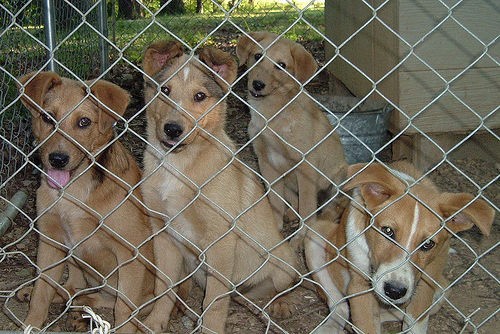
I was reading and annotation (via Hypothes.is) the first reading Fifty Shades of Open and I was struck by something I’d never heard of before… the notion of “free as in puppies” (to be distinct from free as in gratis/beer and free as in libre/speech). Now finding an image for this took longer than I expected because… you know… cute puppies!!! But in the end I settled on the one below…

DSCF0983 flickr photo by Cherie Priest shared under a Creative Commons (BY-NC-SA) license

The notion of “free as in puppies” is meant to focus on the fact that someone can give you a puppy for free, but keeping the puppy alive and happy is not at all free – it costs money and time. But also when I saw the image above, I realized that free puppies aren’t really free… not in the way a street dog is free (with whatever disadvantages that may bring) or in the sense that wolves (themselves the non-domesticated version of a dog, ancestor?) are free.

But anyway 🙂 Back to the original meaning… I like that someone had developed a simple way of expressing this notion. In the way that, e.g. Moodle as an LMS is free to use but costly to maintain (in terms of manpower for support at least).

I wonder if there is a way to express “free but” options… that are NOT equivalent at all to “open” – and what would a good metaphor for them be… “free as in ride”? I’m saying “free ride” because a ride ends and then you probably have to pay for the next one. So I’m thinking of spaces like WordPress.com where you can use the free version up to a point (and not a bad point) but at some point you might want to use something that’s not available in the free version and you’ll need to buy. And it’s also not open in the sense of its source code, but you can create plugins, so it’s an interesting in-betweener in a way… Still a commercial entity, but you can self-host it for free (well you’re paying for hosting and DNS but not paying WordPress to install it). This may seem really silly or naive to people who are really into this sort of thing, but I do think these things need to have a name for what they are…

There’s of course another one that needs a name. The “free” stuff that forces you to be under the mercy of the commercial owners – like Facebook, Twitter, Google. It’s free to the user in terms of money, but… users are being used for data and for marketing and more (I don’t actually know what more, but I sense some sinister things every now and then, like surveillance anyone?) – what do we call this? “Free as in not really” or “Free as in sell me your soul”?

And  yet this free but not open stuff is really important and to people in a certain space, really empowering. I can’t say that WordPress and Twitter don’t support my empowerment. I can’t say that Google (especially via Hangouts, because of VirtuallyConnecting.org specifically) doesn’t support my empowerment. If these weren’t free, where would we be?

Anyway, thought I’d just open this conversation… of the free that isn’t open. And what metaphor to use for them, because it ain’t beer (eww why did they have to choose beer? something I wouldn’t take even if it were free?) or speech or puppies…

I’m only halfway through the article… maybe the answer is in there somewhere, but I’m actually more interested in what YOU have to say 🙂

Some Open Questions for #OpenLearning17

Reading Time: 2 minutes

They say when one door closes, another opens (or a window, maybe). But we don’t usually talk about how sometimes opening a particular door might actually close another. For the same people, or different ones.


Open/Shut flickr photo by sarae shared under a Creative Commons ( BY-ND ) license

I’m really looking forward to #openlearning17, with a bunch of really awesome people discussing different dimensions of open learning…

I’m particularly interested in asking questions about open for whom, by whom, for what purpose? Can we think about issues like access, and recognize how just being “open” does not mean we are necessarily making something accessible for others? Just by being “free” (as in gratis, zero cost to the user) does not mean everyone has equal access to it? I want to ask about the privilege of open, and what our responsibilities are when we have the privilege of open… how can we think critically about the different approaches of open learning, from OERs to open scholarship to open pedagogical practices…and these aren’t issues no one has talked about before, and I’m particularly influenced by the work of sava singh, Robin DeRosa and Catherine Cronin and others on this…

Could a social justice orientation to openness occasionally mean being closed to a privileged group in order to create openness for marginal groups? Why do we, and why should “we” care about advocating for openness for marginal groups? What are the most respectful ways to do that as allies, and what’s the role of the semi-privileged open educator who lies at the borders/intersections?

Looking forward to some deep discussions. inshallah

On a more practical note, check out Creative Commons new “one-click attribution” tool in beta

Also, do you know about cogdog’s Flickr CC attribution helper bookmarklet? That’s how easy it is to do attribution for CC Flickr images on your blog, as I’ve done above… it’s possibly my favorite tool EVER. Now if only I could get my students to use it 🙂