New Year, New Look

It was long past time to update my site and I decided that ringing in a new year would be a good time for a refresh. I’ve been doing a bit of consulting lately, and would love to do more so I’ve added a section indicating what I can offer. Please take a look and let me know what you think.

I hope this year brings us all good things!

On moving away from Facebook

Time to move and refocus

The idea is to post once a week here on this blog, with all my thoughts for the week, and then link to it from Facebook. So I am not giving up on FB completely, but only accessing it on the weekends. I have taken it off my phone and am avoiding the urge to post. I hope to have the process down by the new year. (I may blog more often, if it becomes sustainable).

I have noticed, though, that my outrage is mitigated by posting to the blog instead of FB. It requires a bit more contemplation, some thought, and more consideration. The zing is less, but that, in my opinion, is a good thing. Zing is addictive and destructive.

Instead of having FB open on my phone, I have WordPress ready to go. I have reworked the site here, mostly ignored in 2017, but ready for a resumption.

What you guys can do to move away from the FB ecosystem is to use one that I have used over the years, and you may have done too. RSS. Get a reader. I use Feedly, Mac people like Inoreader. You can even set up Flipboard as an RSS reader if you are using that. You will see, after the initial investment to set up your feeds (the websites you monitor), that the control you get is well worth it. I end 15 minutes of FB enraged; I end 15 minutes of Feedly enlightened.

And if you do make it over to my blog at kevinryan.com, you are welcome to make comments. I have to approve your first comment (this is spam control), but once approved, you can comment any time.

Google Maps Timeline & Digital Security

I’ve been (slowly) working my way through the 23 Things List, a project on digital literacy from the University of Edinburgh. Thing number 4 was Digital Security. While we include Web Security in a lot of our digital literacy prorams, I’m not a huge WebSec person. It’s not something that I think about or worry about to the extent that ….. does.

Probably because WebSec hasn’t been a huge concern for me, I was surprised by what I found on Google Maps Timeline.

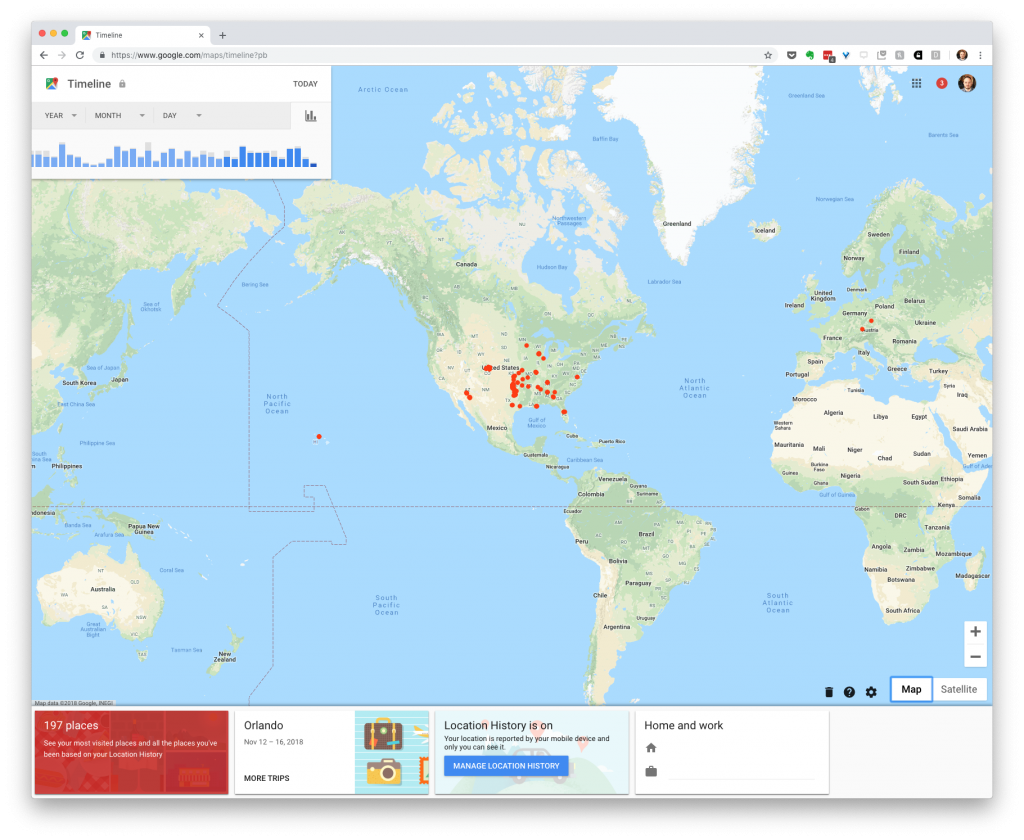
My data on Google Maps Timeline

If you go to https://www.google.com/maps/timeline, you will likely find your own movement history for the past several years. As you can see in the picture above, Google knows my home and work addresses (I’ve removed them from the screenshot), the cities that I’ve been to, and even the modes of transportation I took to get there.

I can go through the data and find out how many times I’ve been to my favorite coffee shops over the past week or year. Google has data on my location dating back to 2009, which is probably when I got my first phone that tracked geolocations. The data is a bit patchy for the early years, but pretty thorough since about 2015.

My colleague Keegan Long-Wheeler has been doing some work on reconstructing his memories from the past few years. He had a brain tumor removed earlier this year, so he has been going back through the softwares that track him to retrace his steps and reflect on his activities.

If we want to be very generous to Google, we can suppose for a moment that this is how they intended such data to be used. I enjoyed spending about 15 minutes looking back through my data and remembering some of the trips from the past couple of years. Google also uses this data to send us notifications about how long it’s going to take to get to work in the morning and what the traffic is like around us. They put our maps through algorithms to understand our daily routines, and build that information into their phones, watches, and assistants.

However, I think we all realize that the reason Google collects this information is so that they can use it for marketing. Google is an ad company and a data company. They want to micro-target us with ads, and they want to sell our data to companies that will be most interested in us. Knowing literally everywhere that I’ve been over the past 10 years is valuable for their business model.

If you haven’t done it yet, go to https://www.google.com/maps/timeline and look at your data. Play around with it for a few minutes. Reminisce about those trips and your favorite spots around town.

Now look at the little black trashcan at the bottom of the screen, and seriously think about deleting all that location data. If you didn’t know about this service until today, and if you don’t care about those notifications you get to your phone, you won’t be missing anything and Google won’t be able to sell all of your location data any more. If you love your Google notifications, and you’ve got a Google Home listening to your every move at home, then maybe leave it on. Either way, control of your data should be up to you. You can find more about your data security in the Thing 4 walkthrough or check out this Medium post by Nick Rosener on Personal Cybersecurity.

Digital Footprint

As part of the 23 Things MOOC from the University of Edinburgh, I did a little bit of searching today to see what my digital footprint looks like. 

I have an extremely common name, so most of what I found with a Google search was links for information about Jon Stewart and links for the Green Lantern. There are various important historical John Stewarts (John Stewart Mill for one), so my footprint is buried.

However, if you Google search John Stewart OU, you’ll find a lot more about me. Most of the Google results from my computer (influenced by my Google search history and all of the other data Google has on me) pointed at my blog and my other professional profiles.

I have taught workshops on how to manage your digital presence, so this pretty well fit with my expectations. In these presentations, I stress that you should create a digital presence that you control rather than letting people stumble upon your old photos from Facebook. While it’s still possible to find pictures of me doing dumb things as an undergrad, most people will click instead on my blog or LinkedIn account or other, professional profiles. 

I am interested in the multiple personas/facets that we each present out on the internet. You might have an Instagram persona – the you that lives your best life. You might even have multiple Instagram personas. There might be a different you on Facebook that your parents and grandparents can deal with. On Twitter, we might find the the media critic version of you that watches Netflix all day and shares some thoughts. There are probably some professional profiles and some less than professional relics of earlier days floating around. Perhaps one day, we’ll have a centralized collection of our stuff that we can mete out to people based on which version of ourselves we want them to see, hiding the other personas behind a wall. For now though, if you post it online, assume that your mom, your grandparents, and your future employer will all find it.

Digital Knowledge MOOC

This week I registered for an open, online class called 23 Things for Digital Knowledge offered out of the University of Edinburgh.

I’m currently planning out my own digital literacy course for next summer, so I signed up mostly to see what they’ve focused on and how they tie it all together. For my own class, my early and very partial list of stuff that I want students to work on includes:

  • media literacy – critically evaluating the sources, biases, and rhetoric of the information they’re getting
  • the digital divide – investigate the reasons why power structures are reflected in access to and control of digital knowledge systems
  • web literacy – what are the different types of sites (blogs, wikis, forums, databases, static sites, etc.) and how do you build them
  • information systems – how to structure data in a csv, how to harvest data, how to clean data, how to analyze and visualize it
  • digital privacy – what kind of data are we leaking, how do businesses collect it, what do they do with it, and how do we mitigate all of this
  • digital security
  • digital citizenship
  • technological diffusion
  • algorithms (of oppression)
  • the funding of technological innovation
  • governmental use of technology

If we somehow built all of these skills and discussed the history of technology and the construction of cultures of knowledge, there would still be whole fields of psychological, sociological, educational, rhetorical, and economic analysis that we could delve into. 

The first of 23 Things’ asynchronous blogging assignments asks what you hope to get out of the MOOC. I’m hoping just to see how they managed to narrow the scope of Digital Knowledge to 23 things. 

Systematic Inquiry: A design perspective

The following post consists of the lightning round remarks I made as part of the OLC Accelerate 2018 Research Summit.  I was asked to speak on systematic inquiry – what is it and why it is important – to a group of higher ed online instructional designers, faculty, and administrators. 

I was an interesting choice as a panelist. The other members of the panel were CAOs, CEOs, and internationally known researchers.  I am a designer, not a researcher.  I am not a CAO or a CEO or a director. However, I am an online learning research super-user, a sometimes action-researcher, and a sympathetic critic who wants something more for our field and the people in and around it. These were the credentials I took up with me when I got on the stage.

This talk resonated with about 10% of the room and therefore cannot be considered well-received.  However, I’m used to being different and I’m glad I participated – I said exactly what I needed to say. 

Also, I owe much of what I said to this essay by RE Wyllys.  I credited Dr. Wyllys throughout my talk, but you should read his essay for yourself.


When I was asked to speak on systematic inquiry, I think I probably did the same thing that you all would have done: I googled it, read some articles and essays from a variety of disciplines, and then checked in with my Twitter followers just to make sure I wasn’t missing something big in terms of a discipline-specific meaning or theoretical framework.

Ultimately, I found a definition that seemed to make everyone happy – which may be the first and only time that happens on Twitter.  All sources seemed to agree that systematic inquiry is the careful, deliberate effort to understand a problem or an unknown.  It is the primary way in which we develop formal knowledge or practice within a discipline or field of study. In general, systematic inquiry is what people typically mean when they say something is “good” research, scholarship, or evaluation.


Slide2


In Zen and the Art of Motorcycle Maintenance, Robert Pirsig describes systematic inquiry as an artful combination of inductive and deductive logic that is best laid out formally to help promote reflection and sharing. He goes on to list the classic scientific method as what one should write down in their notebook.


Slide3


The scientific method is a great example of systematic inquiry, but when we consider what systematic inquiry means beyond a single question – through time and across networks of people – we need an orientation that goes beyond the scientific method.  Systematic inquiry can also be considered as a way of being in and interacting with a world that is relational, fluid, ethical, and emergent. It hinges on the act of questioning everything.

What are the values that drive our questions and designs? What are the politics of our descriptions? Why am we valuing these methods over others? What is our purpose and how does it align with our impact? For whom are we writing and why?

These are the sorts of questions that we must ask and answer as part of a longitudinal or systems-level vision of systematic inquiry.


Slide5


There are reasons we strive for systematic inquiry. The first can be found in Zen and the Art of Motorcycle Maintenance (although Albert Einstein also said something very similar):

“The real purpose of the scientific method is to make sure Nature hasn’t misled you into thinking you know something you don’t actually know.”

The world is complicated and we must approach it methodically or else we will get lost in the web of independent, dependent, constant, confounding, mediating, co-variables, and other things that are currently unimaginable that make up most things worth understanding.


Slide6


The second argument for systematic inquiry is deeply rooted in the social sciences. The act of reflecting on and seeking out diverse forms of feedback about every aspect of our work not only helps protect us from Nature, but also helps protect us from ourselves.

The cautionary tale of the streetlight effect is real; many of us make the mistake of focusing our attention on areas which are already familiar or easier to measure while ignoring other possibilities that are more difficult to pursue.


Slide7


Finally, systematic inquiry provides an infrastructure of shared language and practices that supports other forms of knowledge discovery and propels them forward. Roald Hoffman, the Nobel-prize winning chemist, writes that serendipitous discovery will occur when the mind has been prepared by intense, preferably interdisciplinary study, our institutions have provided space and opportunity for knowledge sharing, we have cultivated our senses of curiosity and wonder, and we have committed ourselves to hard work.

In considering the state of systematic inquiry in our field’s research literature, I am grateful to the online learning researchers who engage in systematic inquiry.  In fact, we have some of the best online learning researchers here in this room with us today.

However, as a field, online learning has arrived at a point in its development when it is time to reconsider how we approach online learning research – particularly at the level of teaching, learning, and instructional design – so that it is meaningful and useful to others in our field and beyond.


Slide8


It would be impossible to cover all aspects of online learning in a lightning speech, so I am going to focus on educational social media research: the body of literature that addresses the use of social media – including wikis, blogs, Twitter, YouTube, etc. – in the higher ed classroom.

As part of an ongoing project, Drs. Jessica Knot, Laura Pasquini and I recently reviewed almost 500 empirical articles on the use of social media in higher ed.

Our initial analysis indicates that educational social media literature is dominated by perception and use surveys and descriptive studies.  In general, these descriptive studies are written by practitioner-researchers who implement a social media tool in the classroom and are reporting on their experience and the learner’s perceptions of their experience.  Less than 10% of studies involved quasi-experimental or experimental design. Relatively few of the descriptive studies identified a specific qualitative research methodology and those that did rarely met baseline standards for rigor (or even discussed rigor).


Slide10


Our findings were consistent with Kimmerle et al (2015), which also looked at educational social media research: many of the articles written about social media use in the classroom focused on the technological aspects and specific functionalities of particular tools without consideration for their pedagogical purpose or associated learner outcomes.

As a field, our literature is hyperfocused on tools and often fails to place digital tools in the larger context of teaching, learning, and instructional design.

We cannot claim to be supporting systematic inquiry into online learning until we diversify our research questions and enhance the overall rigor of our research methodologies.

How do we fix this problem?  How do we design our systems and foster a culture to promote a systematic understanding of online teaching and learning?


Slide13


I have more questions than answers and I’m hoping we can continue the discussion through the breakout sessions, but here are a few observations and ideas to get us started.

Based on the hyperfocus on tool functionality, the limited discussions of instructional design, and thin applications and descriptions of research methodologies, I question how much pre-planning goes into the action research that accounts for a large portion of the online teaching and learning literature.  I also question the support many of these faculty, who are first and foremost subject matter experts, are receiving from instructional designers and methodologists as they write these articles.

At the theoretical level, collective IQ plays a large role in the value system of digital pedagogies and participatory culture.  So how can we operationalize collective IQ in a knowledge development context? How do we increase the inclusion of instructional designers, methodologists, learners, as well as instructors in the research process?


Slide14


One of the biggest weaknesses in the online teaching and learning literature is a lack of communication; there appear to be major differences in how researchers are defining key terms, instructional approaches, and research methodologies. I think a lot of that comes from the interdisciplinary nature of our field.

How do we foster interdependency and community within our interdisciplinary field so that we might create a shared understanding of key terms and methodologies?

Alternatively, if this is not possible, how can we promote transparency and thick descriptions so that readers can understand what is being described and judge the results for themselves?  Is that something that could be encouraged at the functional level of peer reviewers, editors, and journals?


Slide15


And finally, if we enhance the rigor around what counts as research, how can we make room and promote value for other important types of knowledge creation?  The sharing of design ideas and anecdotal experiences are valuable to other educators and designers, but perhaps they belong in other places or formats beyond the empirical journal article.  How do we create those spaces and encourage others to value them as they do a peer-reviewed research journal?


Slide16


These are some of the questions, I hope we will address today and through future conversations.  Thank you.


Connectivism mathified #el30

I am in this online course, an extension of a MOOC, called E-Learning 3.0, hosted by Stephen Downes. Over 10 weeks (12 if you count the warm-up) we look at the technical and social sides of where learning online (edtech?) is going, or at least where it is right now. 

MOOCS have been closely associated with Connected Learning over the last 10 years, especially for Stephen and a group of thinkers “connected” to him. I, for example have been “connected” since the first MOOC in 2008, and since then in a couple of other online events. Building a personal learning envirionment (PLE) or similar is expanding your connections to other resources and people, thus the name “Connected Learning”. But others have taken that idea and refined it so that it could be considered an alternative to Constructivist (think Piaget), Constructionist (think Papert) (disambiguation) or Behaviorist (think Skinner).  

Connectivism came about as a result of the environment. The web was maturing, and the web is based on nodes with anchors, links and targets to other nodes. Brain science (OK, neuroscience) was going great gangbusters with a new tool called FMRI, discovering all these links between neurons. I was reading Linked by Albert-Lazlo Barabasi. It was only natural that we try to apply these advances to learning (and by extension, to teaching, and finally to education). 

Back to the present. In our 3rd week of #el30 we are looking at some highly technical roots of connectionism, mostly mathematical concepts that underlie how tech works, how we work with tech, and how we work with each other.  Last week we talked about tree structures, which look like the sentence diagrams we wrote at kids when Chomsky was applied to everything. It also looks like the sports league championship diagrams. 

But this week we move from trees to graphs. All trees are graphs (a subset), but graphs can be more like networks, with multiple connections in all directions, without–and this is crucial–a center. From there the thinking widens to neural networks and machine learning. Note again that these can be applied to networks of machines or of people. It is a way to look at the world, a way to see that the connections are just as important as the nodes of content. I can see how this can even get philosophical. 

I don’t understand much of this. When I studied this stuff in the ’90s, about Speech Recognition, there was the Markov Model and not much else. It has blossomed as I have ignored it. My silly prediction that SR would be viable was premature by at least a decade. But now we have SR, many of us use it every day, and it is based on these ideas of graph theory. This is my corner of the connected part of this course. You can jump in any time. 

E Learning 3.0, A MOOC for the Future

I have been working at the intersection of language teaching and technology for almost 30 years (had to know when it started, the connection). One of the best influences I have discovered, following the sharing of new content in the Tokyo PC Users Group (an excellent learning experience), was a MOOC. I was a member of the first real MOOC 10 years ago, hosted by our current host as part of a team of 3 or 4. A truly revolutionary idea to tap the expertise around the globe on a topic of great interest to me. Connected Learning.

E Learning 3.0: And now we have a look at how this idea of MOOC is morphing, how it is influenced by other factors, technical and social, and where we might be headed as I head for retirement. Like Sylvia Curry, another “Old Fogie” and my first connection in what I hope will be a rich web, this is a personal look for my future, as well as my current students at a women’s university in Tokyo.

I hope to see you there.  I was interviewed by iTDi last week, if you have an hour, you can find out about where I stand on most of these issues.

#el30

The network is the deliverable