Hatching a PLN

This is a blog post version of my talk this morning at the Fleming College Spring Teaching & Learning Day. I spoke about how using Twitter can help you grow a professional learning network. And maybe a little bit about how PLN building is not a shmoozefest just for your own personal benefit. It can and should also be of service to others.

I only had 25 minutes, and I’m writing this before it happens, so here everything is in a more lasting format. What I hope happens is that we, the people reading this and those in attendance can hatch ourselves a nice, juicy PLN that leads to innumerable mutually beneficial connections.
Choose your own presentation Hatching a PLN with Twitter

For starters, here are the slides I used. It’s a Choose Your Own Adventure situation here. As I lay this out in blog format, I’m going to have to choose the pathway for us. I hope that’s ok.
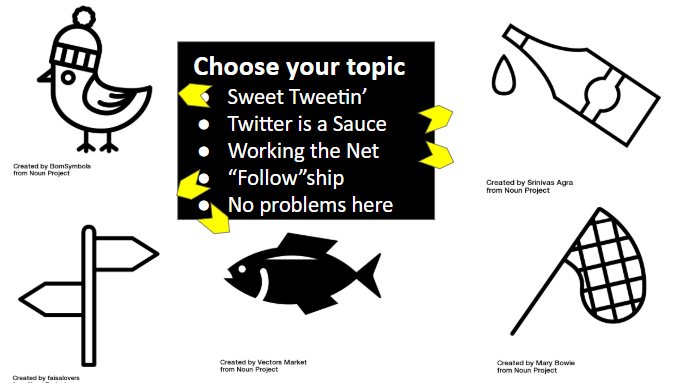
choose your topic: sweet tweetin, twitter is a sauce, working the net, followship, no problems here.

I choose to start with “Twitter is a Sauce”.
You have chosen: Twitter is a sauce

What I mean by that is that if your PLN is a stir fry, then Twitter is the teriyaki. The protein and veggies are friendly, shary people, communities, and organizations. It’s also things like podcasts, blogs, sites, courses, conferences, events and more. Twitter helps them stick together and turns them into something tastier and more fulfilling.

We don’t even need to take my word for it. Here in this post by Sarah Wendorf, as part of her work in the Ontario Extend mOOC, are no less than 18 ways, with awesome examples, how she uses Twitter to make that stir fry for your heart and mind. And many of those ways are not for Sarah’s sole benefit. Most of them offer her own expertise and ideas and access to her PLN in service to others. Saucy!

Okay, we are ready for our next path. I choose to go to “Sweet Tweetin’”
You chose Sweet Tweetin'

The Sweet Tweetin’ section is your basic “what exactly can we do with a tweet” 3 minute tutorial on how twitter works. I tried to find a couple of tweets with a lot going on so that we could break it down and see what can happen. I found this one which includes an original tweet with an image and a link, a quote retweet, tagged people, likes, retweets, a reply. This gives us plenty to look at. You can do a lot with a tweet.

A second busy tweet to look at is this one which included a Twitter moment (which represented a conference presentation that was held ON Twitter), some hashtags, another quote retweet and tagged people:

These were just examples of the things you can do. It didn’t hurt that the tweets themselves were about things I hoped were of interest to the attendees to check out, hopefully serving as an example of Twitter being saucy.

I guess now would be a good time to see what the No Problems Here choice is all about. Is that a herring?
You have chosen: No problems here

I hope we survive this pathway.

You Died. The End.
oops.

Go check out slides 9-11 in the slide deck to see what happened there. It’s just a reminder that Twitter is not always sunshine and lollipops. Let’s go back and try again. “Working the Net” next okay with everyone?
You have chosen: Working the net

Working the ‘net’ is seeing what we can do with our PLNs. What can we get out of it? What can we make it do? For starters, we can ask it for help:

I once asked two people in my PLN directly for some Open Education Slide decks to work with. What resulted was this collection of slide decks from about 30 fabulous people and orgs that advocate for Open Education. There are probably 1000+ slides to work with in there. Nice work, PLN!

I also wanted to show how you can offer access to your PLN to others. It will still benefit you to find out what your PLN can come up with for answers to a question posed by a friend. This one just took a quote retweet:

Look through the replies and follow threads and you’ll see that now McMaster has like 30 awesome books to order for their Teaching & Learning unit and that I am now part of a book club with some awesome folks in Oklahoma.

Okay now we have no choice but to head to “Follow”ship. What’s that?
You have chosen: "Follow"ship

“Follow”ship is a short fellowship in following people, in order to kickstart a PLN, right here and right now. I started by going over a few things that I have found via twitter that I treasure. You can check those out in the slide deck.

you'll find things that you treasure.

There’s nothing left to do now but make our PLNs grow by attacking this twitter list – PLN Kickstart List – with a whole lot of pressing of the “follow” button. The link takes you to the member list, so you can follow the heck out of everyone on the list that you’d like. DO IT!
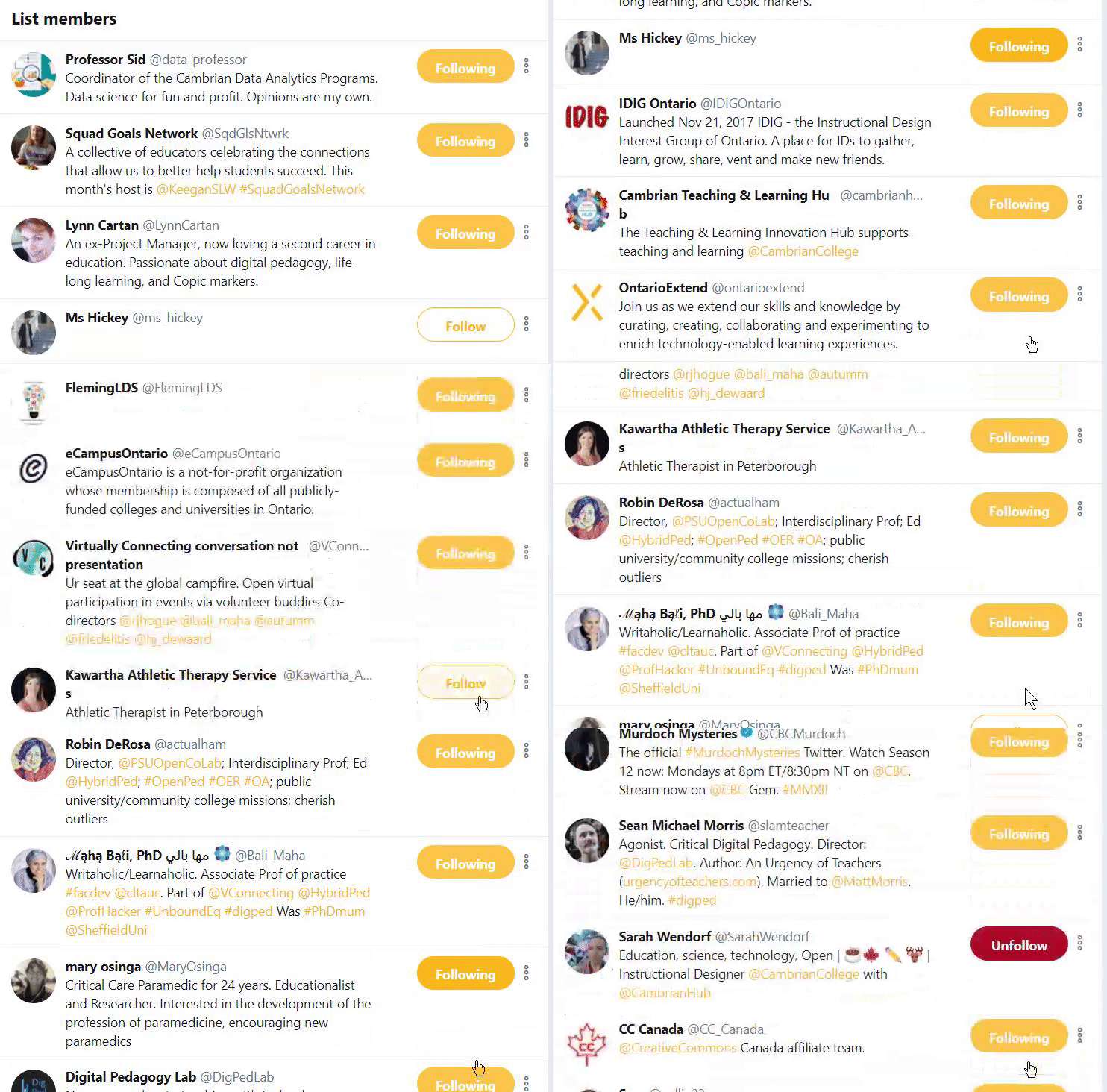
click all the follows that you like

The list includes any of those attending the talk in person that I could collect and anyone mentioned in any of the slides. I hope this list amps up a whole whack of networks. You want on the list, too? Ok! Pop your name in here.

I find that the PLN makes the work that we do less lonely, so I hope this talk and this post can serve to help you make some new connections that will work for all of us. I’m happy to connect with you.

Want to go deeper? Do today’s Daily Extend, today’s involves that same PLN Kickstart List and takes it a step or two further.

featured image credit:”Hatch!” flickr photo by chidorian https://flickr.com/photos/chidorian/173712147 shared under a Creative Commons (BY-SA) license

Reflections on Open Learning ’19

Open Learning ’19 has ended and I’d like to ask everyone to consider writing a blog post as a way to reflect on their experience in the cMOOC over the past few weeks. (Rebecca Clark has already done this, and wonderfully so–check out her post!)

For me, this was my first time serving as Hub Director and that was a pretty daunting task. I’m a pretty good meeting manager and project organizer, but like it’s predecessors, Open Learning ’19 has had many pieces and parts to juggle and is run completely by volunteers. It’s been a challenge to find time to give the cMOOC and the Hub the attention they deserve. But we pulled it off! People came, they learned something, and their networks expanded! At least one person’s education and career may have taken a different path because we were here!

What was new for me this time was taking a lead role in designing the experience. We intentionally pulled in not only established leaders in the field, but the emerging leaders as well. We highlighted new projects and new roles in the realm of open learning. We pared down the experience to what we thought might allow some to make it to the finish line (and some did!). As is common with MOOC experiences, we had folks dropping in and out, but there were some who were there on the first day and are still engaging with the experience in this final week. Any level of participation is valuable and I thank all of you who participated for contributing to the learning experience.

We had fun looking back on the previous iterations of the cMOOC and invited some past participants to rejoin us for interviews, annotations and the reunion Zoom. That was my crazy idea and it turned out to be more fun than even I imagined. Reconnecting in a connected learning experience is a wonderful feeling and I loved hearing about how people took their learning experience from the cMOOC into their work. It lives on through you! I am humbled to know that the Open Learning cMOOC in all its iterations and the Hub have continued to inspire you in the in between times. My hope is that the Hub will continue to do that and I am committed to finding ways to keep it fresh and alive. What struck me about the reflections on past iterations of the cMOOC was the lasting impact that this particular learning experience has had.

One thing you can do to help keep the Hub alive is to continue to use the hashtag #OpenLearningHub when you blog or tweet something that’s relevant to the community we’ve built around all the iterations of the cMOOC. Also consider using #openlearning as well to gain a further reach, but the #OpenLearningHub hashtag will ensure that your voice comes into the Open Learning Hub site for our community to see. This will syndicate your post to the Hub and so it will serve as a way to refresh the content there for all of us. Follow the hashtag to keep up with posts from our community.

I truly look forward to connecting with everyone in the years to come and I’m proud to have played a role in facilitating the Open Learning cMOOC experiences. May the Hub live on through all of us!

And a very special to Gardner Campbell who had the initial idea for the cMOOC and the Hub, encouraged me to move from novice to node to hub director, and hung in there with me through all of this latest iteration. There’s no one I’d rather hang with in my liminal space of learning. Yoda to my Skywalker, you are!

Better late than never…

I hate being on the outside. I hate being left out. I hate participating in something when I feel like I lack foundational knowledge or understanding that could potentially aid me in participating in constructive dialogue – aka I hate not knowing or being unproductive (I am also extremely critical of my personal reflections of myself haha). So, I stepped away from OpenLearning19 this week – not out of anything against the cMOOC in anyway. On the contrary, I have discovered something great in it. Actually, better than great!  To channel Mezirow, I have been transformed. So I needed to think, explore, collect, and then, return to connect and contribute.

So, here I am. After a few weeks to read and Google, I have some conclusions. Actually, they are not conclusions. ‘Conclusion’ entails a sense of finality and it lacks growth potential for my ideas. After a two hour walk in which I gabbed incessantly to the serenity and silence of my husband’s nodding head (he’s a wonderful man), I have positioned myself in the ongoing dialogue about ‘Open.’ Vague… I know. Bear with me.
This blog entry is what I have gathered.

As a PhD student in instructional design and technology, ‘open’ affords me a space to design, develop, and discover the benefits of ‘openness’ in enhancing learning and teaching. David Wiley (Lumen Learning) touched on a more practical approach to open. He argues that change is not going to happen simply by conducting numerous workshops. While useful and educational, the advancement and adoption of open requires hand holding and connecting. It requires breaking down barriers and unlearning assumptions that we have relied on for centuries. We are trying to transform institutions that have thrived and survived in some cases since the 15th century.  “If it isn’t broke, don’t fix it” is their victory song according to Rajiv S. Jiangiani (OPEN: The Philosophy and Practices that are Revolutionizing Education and Science). Institutions are designed to resist new ideas (ironically) (Robert Biswas-Diener, NOBA project). So, how do we shift or disassemble this organizational survival mechanism? In the words of E. Rogers, let’s be the change agents (The Diffusion of Innovations, 2003).

I can be a change agent! The fasted path to adoption is through shared networks. I can’t tell you how many times, I try something new or adopt a new practice because my knowledgeable and trustworthy friends told me it was a great idea and would benefit me. “Well, open is a great idea and you will benefit from it!!!” (It was worth a try…) But, seriously, faculty share and adopt teaching practices etc. based on what their trusted network has told them. On the other hand, I am studying in a discipline that aids in designing or directly designs the framework for learning experiences. I am an architect with more power than I thought possible which is evident from this past week’s video interviews with Autumm Caines and Christine Moskell – both instructional designers doing very different designing and support in the open. All I have to do in my career in higher education is start by showing faculty the promises of open and new connectivist (born from constructivist principles) approaches to learning. Additionally, I am poised to start research. What does the open movement lack in some respect that is the lynchpin in academic society’s standards (which needs to change but that’s another time and blog)? Academics love their empirical research and evidence, so I will be looking into that soon (I’ll keep you updated… promise.)

Also, I channel a bit of Robin DeRosa, who is doing incomparable work at Plymouth University and is a open education bad%$& – I hope I am aloud to say that!? I would not call her radical but to other academics still testing the waters, she is doing some radical things in the realm of open! From class created textbooks to a crowdsourced syllabus. She emphasizes the value of open pedagogy, open faculty development and policy whereby we support and enhance the higher ed system as it changes and transforms in the coming years – and mark my words, it is going to change whether it likes it or not. I am determined to get on board and help in the best way I know how – through my education.

To wrap things up, my life took a disruptive shift a few years back. I was working in insurance wondering how I ended up attached to my ball and chain. It was actually an Avaya call center headset and no, I was not selling you credit card insurance! I was in a cubicle hating everything I was doing. When, all of a sudden, I received notification that my yearly training modules were due (cue giant eye roll). I opened them, completed them, determined that they sucked, and always do. Then, I decided that I had nothing to lose. So, I went to inform my supervisor about the less that adequate quality of training provided (Corporate speak for “suck”). She looked at me and said, “You know what? I agree. But I can’t change it. You can though. Here’s the link for employee funding to return to school in Adult Education to be an instructional designer. You should do it and then apply for an internal job in training and development.” Three years later, I completed the BA part-time while hating my job a little less. I didn’t apply for an internal job. Instead, I left the company because I wanted more. I fell in love with my ability as an instructional designer to not teach or learn but assist in developing teaching and learning – to change how knowledge is delivered in an empowering way. And, so here I am!

Current Minnesota legislation related to open education

Executive summary: There are four bills in front of the Minnesota legislature currently. Three involve poorly-funded mandates; one offers incentives for positive change.

The Bills:

SF130 was introduced 1/14/2019 and is titled “Affordable Textbooks”. This bill defines an affordable textbook as any textbook that costs $40 or less. These could be traditional print textbooks, OER, “or other educational resources intended to be used in place of a traditional textbook.” This means, subscription-based products from mainstream textbook publishers in addition to open-licensed OER. Although reducing textbooks costs is an apparent goal of the bill, it could be used to move from print textbooks to less-expensive digital alternatives while avoiding a shift to OER.

The Bill calls for 15% of courses at state colleges and universities to use “affordable textbooks” by August 31 2021. It does not specify a cap for spending per course, so it is conceivable that a course with multiple textbooks or with a textbook and supplementary texts could still result in student spending in excess of $40.

The issue with this bill is that $40 seems to be an arbitrary number. Does it relate to current student spending? Does it relate to the cost of “other educational resources” the textbook companies are preparing to roll out? And finally, how is the state going to legally require 15% of courses to use “affordable textbooks”?


SF699 was introduced 1/31/2019 and is titled “Z-Degrees”. The bill defines Z-Degree as a zero-textbook-cost associates degree and requires each “college” to “offer the opportunity to earn a Z-Degree”. “College” may mean universities as individual units, or it may mean every college within a university. Z-Degree course offerings must include “at least two distinct [zero-textbook-cost] courses in each transfer curriculum goal area and at least enough credits in each transfer curriculum goal area to complete the transfer curriculum package.”

SF699 specifically includes a requirement that “Each instructor must review and approve open educational resources for use in a course.” It defines OER as OER advocates would expect: “high-quality teaching, learning, and research resources that reside in the public domain or have been released under an intellectual property license that permits their free use and repurposing by others, and may include other resources that are legally available and free of cost to students.” This is a good working definition of OER; the sticking point in this bill seems to be the “Each instructor must review and approve” part. This seems to be a violation of the faculty’s contract and against the spirit of academic freedom. And the appropriation associated with this whole Z-Degree mandate is $2 million spread across two years, for the entire system! That’s probably not enough to pay for the work involved in making a Z-Degree happen in every college in the state, even if everybody was excited to do it and ready to go. And how are administrators going to force faculty to review and “approve” (but not adopt) OER?


SF2214 was introduced 3/7/2019 (its companion HF2426 was introduced 3/13/2019) and is titled “Inclusive Access Pilot Program”. It is a short bill which calls for a pilot program to “address textbook affordability in postsecondary institutions and determine the cost savings for both students and the participating institutions.” Inclusive access is defined as “digital distribution of course material instead of traditional textbooks”. The bill calls for BSU and South Central College to be pilot sites that would “receive incentive funding…for purposes of developing and utilizing inclusive access for all courses offered at the institution, where available.” This sounds very cool at first glance. BSU would get incentives…to do what?

It turns out that “inclusive access” is a sneaky code-word for requiring all students to purchase license keys for a publisher’s digital “walled garden” of educational material (some of which may in fact be open, but it’s all behind the pay-wall). This cost would be assessed as a mandatory course fee. So it would probably be lower than current textbook costs – at least to start. The other sneaky clause in the bill is “for all courses offered at the institution”. Once Pearson achieves a monopoly of all the courses on campus, then it will no longer have to compete on price.


Finally, HF2730 was introduced 3/27/2019, amending MN Statue 2018 section 136F.58 to include incentives for “Open textbook development”. This bill calls for Minnesota State Colleges and Universities to “develop a program to expand the use of open textbooks in college and university courses.” It calls on the system office to “provide opportunities for faculty to identify, review, adapt, author, and adopt open textbooks” and to “develop incentives” to meet those goals.

The system office will (“in coordination with faculty bargaining units”) develop a “program that identifies high-enrollment academic programs and provides faculty within the selected disciplines incentives to jointly adapt or author an open textbook.” The bill is careful to specify, though, that these activities “must be implemented pursuant to faculty collective bargaining agreements that govern academic freedom and textbook choice.” So, it’s a carrot instead of a stick and it will provide faculty with incentives to choose a path that both supports student cost-reduction and respects academic freedom.

How much of a carrot? The bill would allocate $500,000 over two years, which isn’t a bad start. As high-volume programs started quantifying their savings, presumably that number would increase. An incentive ratio of 10% has apparently been discussed (based on success in other states), where a department might receive an incentive payment of 10% of the money they saved students using their new OER. This seems like a good idea, although the system might want to “prime the pump” a bit to move a couple of high-volume programs and get the process started.


Takeaway from the bills:

Academic freedom seems to be challenged when legislation attempts to impose mandates (especially unfunded or poorly-funded ones) in place of incentives. If passed, laws of this type would probably be challenged by faculty unions, with good cause. However, incentives and an appeal for volunteers might get the OER ball rolling on campus.

The Medium is the Message and the Message is the Medium

I really enjoyed this week’s interview with Rob Blair and hearing about his course Democratic Erosion. It is a brilliant idea to use a networked course structure with this particular course topic!

Hearing about this course reminded me of Marshall McLuhan’s idea that “the medium is the message.” Open learning is all about developing, interacting and learning within a network. McLuhan believed that the medium is more important than the message, however, I would say you can no longer separate the message from the medium. In today’s world, messages come in all different digital formats such as websites, blogs, Twitter, email and digitally born books and journals. These things are so intertwined with our lives that we are constantly both consuming and creating. Dr. Blair’s Democratic Erosion course is both medium and message, intertwined and indivisible. Technology has literally become part of how we live and interact

From a librarian’s point of view Blair and his colleagues have created a course that exemplifies the ACRL Framework idea of Information Creation as a Process. I also was excited to hear Dr. Blair as he discussed the posts as living documents that can be edited and updated as students developed their points of view on complicated topics. This reflects another ACRL Framework idea of Research as Inquiry. We want students to be curious and to challenge ideas, including their own, and become lifelong learners who participate in the democratic process. Scholarship is a conversation (yes, another Framework idea!) and this course exemplifies this idea, as well as celebrates many of the ideas of open learning.

#OpenLearning19 Required Blogging?

In the resources for this past week, there were mentions of required blogging. I am very much in favor of blogging, but I am not sure if I would like to be forced to do it.

Traffic sign turn rightFirst, it’s not everyone’s taste. Since at least Mak, S. F. J., Williams, R. & Mackness, J. (2010), we know that Blogs and Forums are different. And exactly because I myself prefer the (more asynchronous) blogs over the (more synchronous) forums, I empathize with learners who have the opposite learning style, erm, preference.

Furthermore, my problem is to come up with an idea on demand. I like it when I encounter something remarkable and I can sit down and reflect on it. But I don’t want to search for something remarkable to write about. These are two very different modes of operation of the mind.

So I wonder if the requirement may put students off blogging, such that they won’t continue blogging after the course is over. In other contexts, ‘open’ connotates two ways of ‘free’: free of charge and without obligation or, as Suber said, free of most restrictions. Yes, I know that open does not equal free, but I am uncomfortable with the combination of openness and force. In connectivism, openness is combined with autonomy, diversity and interactivity, instead.

The network is the deliverable