Tag Archives: liberal education

Associative trails in the post-notecard age

memex

From Life Magazine, Nov. 11, 1945

Like other scientists involved in producing weapons of mass destruction for WWII, Vannevar Bush eventually issued a clarion call to his colleagues to create “pacific instruments,” namely machines capable of collecting “the inherited knowledge of the ages.” This week I read his famous July 1945 essay, “As We May Think” and immediately recognized his memex as a proto-computer with the ability to create associative trails of information. Unlike the atomic bomb, which Bush oversaw, the memex’s purpose was constructive: by enabling scientists to select, annotate, and associate bits of information from myriad sources, the machine would allow them “to grow in the wisdom of [human] race experience” and “wield that great record [of human knowledge] for his [man’s] true good.” I confess I had to reread the final paragraphs several times to grasp Bush’s meaning; he abruptly shifts from “we” (a pronoun encompassing him and his fellow scientists) to “he” (which references Man or mankind—as in the phrase, “Presumably man’s spirit should be elevated . . . “). Yet, for all his visionary ideas about the future, Bush’s optimism that July was clearly measured. Allied troops had just recently liberated the death camps and he undoubtedly knew more about the genocide than the general public. As director of the Manhattan Project, he also knew that Little Boy was even at that moment being readied for use against Japan. The US was still very much at war. Would mankind “perish in conflict” or “live healthily” ever after?

I found it difficult to read “As We May Think” while questions about our nation’s future are swirling. I live in a blue dot surrounded by a swath of red, an established refugee resettlement community in a historically WASP locale, a college town set in a proud but declining agricultural region. Open learning is central to who I am and what I do here, but many of my neighbors want to close our borders, reject freedom of conscience, and deride long-established scientific and humanistic knowledge. What to do at such a moment? I turn inevitably to my students.

This semester I am teaching Intro to Public History, a survey of the major branches of the field: historic preservation, oral history, museum exhibit design, living history, archives, and so forth. Over the years, I have added a lot of digital content, as well, and once again I am requiring students to create their own websites or portfolios (shoutout to UMW’s Domain of One’s Own for inspiration) as a way to not only acquire new skills but to think carefully about curating their own digital identities. The assignment intersects with Bush’s essay in interesting ways. Besides posting several research projects, they must reflect on the digital traces they have already left behind, the FB likes and Instagram posts, the Amazon purchases and texts and sexts and tweets and all manner of bits and bytes that linger in databases everywhere. The same machines that allow ‘we’ scholars to make associative trails for purposes that serve the public good are also used to data-mine for private profit. There is indeed “a new profession of trailblazers,” as Bush called them, “those who find delight in the task of establishing useful trails through the enormous mass of the common record.” Young people care a great deal about privacy and their personal brands, but they often lack the information or tools they need to protect themselves.

So many new tools exist now. The goal of this week’s openlearninghub exercise was to consider innovative ways of locating, selecting, and processing information. Many years ago when I was dissertating, I relied on two ordinary shoeboxes to hold the hundreds of notecards I needed for my research. The project, a study of cultural identity in a 19thC company town, required me to keep track of thousands of individuals and the million factoids I had gathered about them from census records, parish records, wage records, probate inventories, and oral histories. I also used a relational database called Paradox, which I loaded on a dinosaur of a portable computer, and two file cabinets full of folders containing Xeroxes and pages of longhand notes. But the shoeboxes with their alphabetical dividers were the heart and soul of my “philosophical genealogies.” If I had had a memex, they would have been my code book. Once, my partner-now-husband saw me laying out cards on a table as I struggled to link members of several Dougherty families. He said, “You know, that’s how the Nazis kept track of the Jews. Notecards. I wonder what they would have done with computers.” I think about my notecards a lot these days. The days of notecards are long gone.

notes

Blank notecards with my laptop. Two ways of collecting and associating info.

Parlez-vous open learning?

Way back when I was in my twenties, I traveled to Quebec with some friends. I felt so sophisticated, so grown-up as I tried to use my high-school-plus-one-semester-of-college French language skills. I could order (safely) from a menu; navigate hotel check-in; count money out for a purchase; and interact cordialement with people I met. Of course, it was an illusion–that heady feeling of fluency. I was not then nor have I ever been fluent in French. I wasn’t even proficient. But I tried and it felt good to push myself that way.

parlezvous

So it is with open learning. Over the years I have acquired some of the vocabulary, grammar, and idioms needed to converse in this language, yet I know I am far from proficient.

My goal in joining #OpenLearning17 is simply to become more conversant. At the moment, I have a Twitter account that I use frequently to connect with #twitterstorians, #publichistorians, #genedadministrators (ok, there’s not really a hashtag for that yet, no one wants to admit to being one I guess), and #civicengagement folks as well as a few others. I routinely incorporate digital humanities projects into my classes, and I have a blog that I started one day when I was wondering about my personal brand, whatever that is. Like many academics, I often walk around composing blog posts in my head, but by the time I get in front of my computer, *poof*. Hopefully, this cMOOC will help me find the right words.

How about you? Parlez-vous open learning?

Toward Open and Liberal Learning?

Reading “Fifty Shades of Open” by Jeffrey Pomerantz and Robin Peek in First Monday http://firstmonday.org/article/view/6360/5460 one considers the parallel between the growth of fan fiction and the growth of *open* across the array of meanings the word carries.  It is a tempting if baffling parallel.  Wondering how to grasp a meaning of *open,* I thought of questions for Open Learning ’17.  What do the principles and practices of open learning share with liberal education and undergraduate general education—teaching, learning, and assessment in practice right now?  What utility in bringing together liberal education practitioners with open learning practitioners?  The Faculty Collaboratives project at AAC&U http://www.aacu.org/faculty has been supporting and nurturing communities of practice among educators for liberal and general education.  Why?  We want to offer the best possible college education to all students, no matter their program or type of institution they attend.  There is a focused and principled goal for the project.  We’re building networks and infrastructure for educators across states and state systems so that they can in turn do their best work in meeting and reaching all students.  We want to emphasize the learning and success of the large numbers of undergraduate students who have the most to benefit from higher education.  Students who have not been served well by public education are first in my mind and in the minds of many colleagues. Equity in student success is a great goal. That is the story I offered Gardner Campbell in the interview at http://www.gardnercampbell.net/blog1/?p=2638. I hope students will benefit if we do a better job of collaborating as educators across communities within and among states and state systems. As I see it, the experiment of Open Learning ‘17 will give us a chance to answer the questions above.  I confess I want to find stronger ties than I am seeing right now.  It is true that information literacy is one of the outcomes of the Liberal Education and America’s Promise or LEAP initiative http://www.aacu.org/leap.  Will we find richer points of convergence?


Quads as Symbols of Liberal Learning

We recently ended Springboard, a series of thirteen days in June and July that are designed to welcome freshmen to campus and provide a key part of their orientation programming. Organized by our Orientation Office in conjunction with Admissions, the advising centers, the academic colleges, and my unit, University Programs, it affords my colleagues and me an opportunity to talk directly to students and their parents about academic expectations here and the value of a liberal education. I only get ten minutes, so I try to make it count by focusing on a few “mental images” as takeaways.

Here’s what I said:

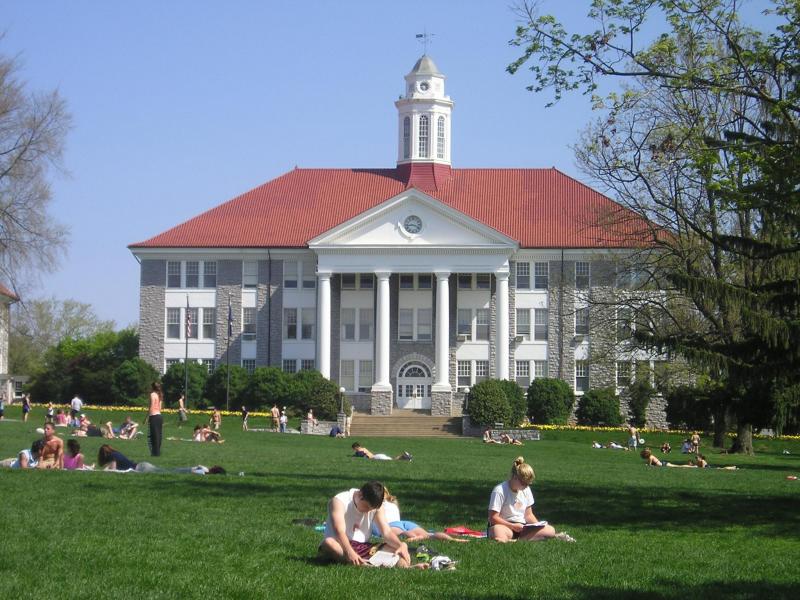
“Welcome, class of 2019! I’m honored to be here representing the faculty. To give you a sense of scale: there are more than 960 FT instructional faculty here and more than 400 part-time instructors. It’s a big place! And a rich, vibrant academic community. My goal this morning is for you to understand what an academic community is. If you’ll humor me for just a minute, I’d like you picture our beautiful Quad. Go ahead, close your eyes. See the broad expanse of lawn. The bluestone buildings on all four sides (cuz it’s a quadrangle). They house dormitories, classrooms, computer labs, and offices. Once upon a time, the only dining hall was there, the library, too. Now picture other quads you know. Maybe UVa’s Grounds, designed by Thomas Jefferson. My own alma mater, the University of Delaware, has two quadrangles. Think: Harvard yard, Oxford, Hogwarts. Quads are everywhere in the landscape of American higher education because they are deeply symbolic spaces. Tracing back to the medieval period, they are echoes of the great European cloisters and universities, living and learning communities where groups of scholars came together in the spirit of contemplation, study, and research.”

aerv107

Architect’s conjectural drawing of the quad in 1908. Then, the fourth side was left open following UVAs example in order to signify a welcoming community appropriate for a democracy. Of course it wasn’t really open: only white women could attend then. But that’s another blog post.

“You’re here today because you’ve chosen to join our academic community. Chosen is the operative word. You are not actually required to be here! There are no laws requiring Americans to attend college. No truant officers will show up at your parent’s door if you skip classes for a few weeks. There are no state mandated SOL tests and no single set of subjects that everyone must take. For the first time in your lives, YOU are the sole person responsible for your education.”

“Because you have voluntarily chosen to enroll here, the faculty have high expectations for you. It’s not like high school, even if you have dual enrollment or AP credit, trust me. For one thing, you were ALL tops in your high school classes. We received about 26,000 applications to produce a freshman cohort of about 4300. So congratulations. But now you’ll have to step up your game. For another thing, this is a university. That word has meaning, too–it’s not a synonym for college. By definition a university is a place that grants graduate degrees—we create new knowledge here. That’s why we call ourselves professors–the faculty profess expertise in their research fields; we are scholars as well as dedicated teachers. And we expect you to join us in doing research. Ok, maybe not freshman year, but certainly when you’re in those 300- and 400-level seminars. Our undergraduates are studying everything from nanotechnology to genocide in Bosnia. A university also offers study abroad experiences, internships, and service-learning projects. To succeed, you’ll want be active not passive learners.”

modquad

The Quad today.

“In choosing to join this academic community, you have chosen to acquire a liberal education, not job training or a piece of paper. I’m talking now about the stuff that prepares you to be an educated and enlightened citizen, like it says in JMU’s mission statement. Like the Quad, this kind of self-reflective, analytical education has been a hallmark of American colleges and universities since the colonial era. It prepares you to be an effective participant in a free society–and that’s why you can’t get this education in many parts of the world today. Now, here’s another thought exercise for you: it’s 1769; picture a short, skinny, knobby-kneed seventeen-year old boy leaving his home in rural Virginia and traveling by carriage all the way to far off, exotic New Jersey. Talk about culture shock! The boy was James Madison and like some of you he didn’t know exactly what he wanted to be when he grew up. At that time, the College of New Jersey (now Princeton) was known for producing Presbyterian ministers. (Apparently, William and Mary was a party school then.) Fortunately for us, he didn’t follow that path. But he did acquire a liberal education, one that enabled him to become one of the most original political thinkers in the world. JMU provides the same kind of liberal arts and sciences curriculum Madison knew, though can rest easy knowing we’ve updated it for the needs of the 21st century. We call it General Education: The Human Community, and it’s a vital part of your degree, a whopping one-third of it, in fact. It’s that important.”

“Despite what you hear in the media, public opinion research tells us a liberal education is also the best preparation for long-term career success you can get. Here’s a shocking statistic: by age 39, the average American with a BA or BS degree will have held between 10-14 different jobs. You can’t know what those jobs will be. None of us knows what jobs lie ahead, not even employers. In a January 2015, researchers interviewed more than 400 employers across all sectors. Do you know what they said they look for in hiring new employees? A little more than 60% said they valued ‘broad, comparative knowledge’ and ‘cross-cutting skills’ like writing and critical thinking over narrow technical competence, which they intend to teach you themselves. So think about the value of your entire degree. As we like to say here, your major will help you get your first job, but a liberal education equips you for a lifetime of employment.”

james_madison1

Students studying and relaxing on the Quad in front of Wilson Hall.

“But I know you aren’t thinking about the workplace today! You’re ready to meet your Orientation Peer Advisors and get your JAC cards. Just do this one thing for me: when you leave Wilson Hall today, take a good look at that Quad again and remember what it symbolizes–Your academic community!”