Registering allows us to better track metrics on downloads. We believe this is especially important since this project is partially funded with public dollars. We will never sell, give away, or otherwise distribute your information.
As far as I can tell there are no open licenses attached to the collection. You can find on the registration page the long set of license agreements, with boilerplate lawyer fee language (for fun if you view source on the license you can see it was written in MS Word) that is much more clear if a Creative Commons license was used instead; it’s more or less the same result:
Your exercise of the Licensed Rights is
expressly made subject to the following conditions.
Attribution.
If You Share the Licensed Material (including in modified form),
You must:
retain the following if it is supplied by the LICENSOR with the
Licensed Material:
identification of MarbleStreetStudio.com as the creator(s) of the
Licensed Material;
a copyright notice;
a notice that refers to this License by the City of Albuquerque;
a notice that refers to the disclaimer of warranties;
a URI or hyperlink to the Licensed Material to the extent
reasonably practicable;
indicate if You modified the Licensed Material and retain an
indication of any previous modifications; and
indicate the Licensed Material is licensed under this License, and
include the text of, or the URI or hyperlink to, this License.
You may satisfy the conditions in Section III(a)(1) in
any reasonable manner based on the medium, means, and context in which
You Share the Licensed Material. For example, it may be reasonable to
satisfy the conditions by providing a URI or hyperlink to a resource that
includes the required information.
If requested by the LICENSOR, You must remove any of the
information required by Section III(a)(1)(A) to
the extent reasonably practicable.
Share Alike.
In addition to the conditions in
Section III(a), if You Share Adapted Material You
produce, the following conditions also apply.
You must include the text of, or the URI or hyperlink to, the
Adapter’s License You apply. You may satisfy this condition in any
reasonable manner based on the medium, means, and context in which You
Share Adapted Material.
You may not offer or impose any additional or different terms or
conditions on, or apply any Effective Technological Measures to, Adapted
Material that restrict exercise of the rights granted under the Adapter’s
License You apply.
As far as I can tell there is no API so the collection can be integrated into other apps or other parts of the information ecosystem. The database is a small, unconnected island. It’s a pretty island. It bears no indication (from viewing source) that it is anything but a custom designed database.
The photos are really really good, do not get me wrong:
But the only metadata visible is an image file name and a list of tags. You get way more data in flickr- this is just a bit of what flickr provides for the image I used at the top of this post:
Got metadata? Flickr does.
Why would the city of Albuquerque not participate in a commons, say by adding their images to the Flickr Commons? Or working with their libraries, make the collection part of the Digital Public Library of America?
I am not critical of the project. I am definitely not critical of the media produced. And if I was able to get a big money grant to produce media, I would love the opportunity.
I am critical of harping over this idea of free being virtuous in terms of cost of access. By not participating in a larger ecosystem of media, by not using standard infrastructures for data management, by not deploying open licenses in use by billions of pieces of other media, it’s a huge opportunity loss.
Top / Featured Image: Found this photo by searching mediachain for Albuquerque (after misspelling it a few times)- the source of the image is in flickr, so I used my own preferred attribution tool to give credit got flickr photo by jghil https://flickr.com/photos/jghil/4239029954 shared under a Creative Commons (BY-NC-ND) license.
Admittedly, not running my attribution through Mediachain means I am not adding to the chain, so here is their attribution code, just for the blocks.
The post “Free(ish) Images, Not Open. For 300,000 Bones” was originally squeezed out of the bottom of an old rusted tube of toothpaste at CogDogBlog (http://cogdogblog.com/2016/11/free-not-open/) on November 19, 2016.
In which this tired blogger fails to summarize a conference experience, and gives up before even trying…
With clocks flipping in some corners of the world, last night I’m just home from a week in Virginia for the 2016 Open Education Conference. That’s it’s 13th iteration, maybe my fourth.
Here is the usual conference after feeling, sniping slightly at the challenge of the conference format, of schedules a bit jammed with sessions, wondering “is there a better way to do this?” It seems hard to figure out how at a three day event, I could manage to miss people I knew were there.
Were it not for text messages, I would have missed seeing my friend/colleague Alisa Cooper from Maricopa, and over lunch I got to meet one of her faculty colleagues from Glendale Community College. But in three days of conferencing, I managed to miss meeting for first time Mark Morvant
And the presentation of information that might be done other ways… useful? Do we have enough space for conversation? In one session, the ever gracious Gail Morong brought this up in a session David Wiley was present, even offering to give up her presentation slot. Is the idea of this balance at conferences elusive?
At the same time, the feeling of presence in person, the genuine interactions, the stuff that happens in the interstices or larger gaps of the schedule, the late night conversations, all seem incredibly enriching. I enjoyed many rich hall conversations, during scheduled sessions, with folks like Ken Bauer, Laura Gogia, Jim Luke, Lee Skallerup-Bessette, seemingly always in the rocking chairs. And a very memorable one on Friday with Kate Bowles.
Thus the highs of the conference experience (the time with people) tend to average out, or more the negatives of the usual format.
Less a summary, no, not one at all I drain the brain of semi random, semi chronological memories.
I should include the trip to University of Mary Washington, the day before Open Ed, at the generous invitation from Jess Strommel to be on a Town Hall panel on “Ethical Online Learning” (there is an archive somewhere out there) along with Sean Michael-Morris, Kate Bowles, and Liz Losh.
I’ve not been back to UMW since 2013, and it was my first visit to the gorgeous Convergence Center that was just braking ground when I left UMW in 2012. Beyond meeting the current team at DTLT, I was eager to visit Martha Burtis, and I got to sit on her Digital Identity class. There is always so much good energy from UMW students, I miss that.
The big prize was getting some morning walk time with Kate- this was the first time we met in person. I had only learned the week before that she was coming to UMW and Open Ed, I made that assumptive mistake of guessing she would video in from Australia.
I will surrender before starting to do justice to summarizing Gardner Campbell’s opening keynote, featuring a piece of opening video art including clips of Bob Dylan, as a Nobel badged literacy genius, dealing with the relentless questions of the press. A misunderstood artist, to whom the media sought insight. I will say again, that Gardner is maybe the only speaker I actually enjoy being read to. If you want more, see David Kernohan’s notes (how the heck does David do that?).
While the keynotes were not streamed / recorded / archived, that does not stop someone like Robin DeRosa for grabbing a periscoped one. That’s how this stuff works — people, not systems.
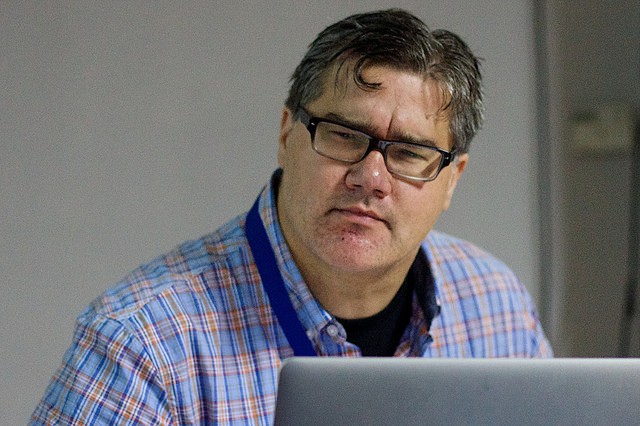
I also learned at this confirmation there is a transformation of many ed-tech practitioners to a similar “look” (not sure how this will work for female colleagues):
One of these is Colin Madland, the other is Ben Harwood. Or Brad Payne. Or…
Watch your hair, you might be next.
And there was music in the air Thursday night… or in the lobby of the Hilton Hotel (I bet they are wondering about their decision to let a bunch of ed tech bring in amps and guitars and drums..)
It is worth noting that the “annual” musical jam that Jim refers to really goes back to the brilliance of Scott Leslie’s conference planning in 2012, when the jam took place on a boat floating around Vancouver.
I think the same is true with students and learning. Alive matters. Alive gets us the real learning, not the “picture of the learning”. But for learning to be alive, somebody has to be actively creating something. We have to be part of a live experience. To me, the core of open learning is being in that space where things and ideas are created. The best space for that is for both instructors and students to create, share, and publish their own work. Simply reading or viewing the flawless, peer-reviewed, polished, perfected work of some publisher is like listening to an album in public. It becomes background noise. If directed, we can attend a small part of it, maybe. But mostly, we it has no affect on us. On the other hand, reading, viewing, and listening to each others’ creations in the same time and space as they’re being created engages us. It even inspires us to create ourselves. The flaws don’t matter. The creating does.
The music “jamming” works as a metaphor, but it’s not just the people with instruments. Many there joined that aliveness not by being just passive listeners, it was just being present together that I bet will cement the memories, even those in the bar playing Jenga and others just sitting in the lobby, tapping toes or dancing.
And do not believe Daniel Lynds when he says he “only knows three chords.” I spotted at least four. And the dude has an intense guitar face with a musical presence that says, “I am more than creating sound.”
And seeing super talented friends like David Kernohan and Vivien Rolfe play/sing can bring up the familiar “imposter syndrome” if you spend time with those two, they do so much to encourage everyone.
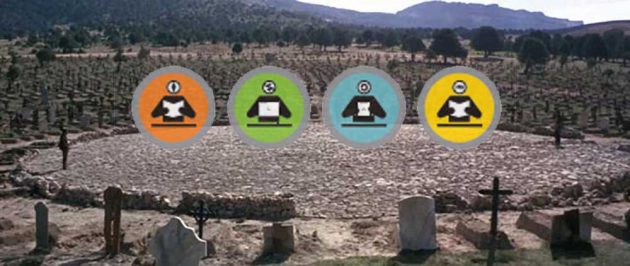
Blame me. This was a response to one of our Creative Commons Certification twitter activities that ended up seeing Robin DeRosa’s photos of her in a CC cape. I dared her to bring her costume, and dredged out my left overs from Western DS106 — if you do not recognize mine… well I do not blame you. But think of me as The Man With No Attribution, who brings justice to the wild frontier in the Spaghetti Ed Tech classic “The Open Licensed, Fair Used, and the Copyrighted.”
Thanks Robin, for being game to be goofy with me, and as well to Rajiv Jhangiani for his anti open washing outfit
I was on site buddy for two Virtually Connecting sessions (we set an ambitious record for the number of sessions) on Friday, the first with David Kernohan and Vivien Rolfe
And one right after with Karen Cangialosi, Samantha Veneruso, and the always frenetic Chuck Pearson (note to self, do not conflate with some NBA player, his twitter handle is @Shorterpearson).
I think I met Karen at talk I did at Keene State College (she plays a great blues harmonica by the way) and enjoyed meeting Samantha. I the session we found a common Maryland connection- Karen went to a high school near where I did in suburban Baltimore, and Samantha teaches in Montgomery County.
My take away– OERs, open education, open textbooks are virtuous, worthy efforts, but are almost a veneer of the reality of higher education for students like Chloe and Nina, and many more, who are sold a dream of education and left short by the false hopes of financial aid.
This one is sitting heavy still. Get the book, everyone needs to read this book
Sigh. I said I would try not to get detailed, and I did. And I left so much out. So much.
I’ve said this a few times, but I go back to my first ed tech conferences I went to in 1990s. I was green as a leaf. At these events, I had little way of knowing people ahead of time. I had no mobile phone to stare at (my Motorola flip phone made calls and let me play Snake). I did not even carry a laptop. Meeting people meant awkward name tag glancing. The social aspects were both intimidating and, well, so much less than now.
For all of its problems, the abuse, the likely failing as a business, twitter provides such a catalyst for the conference experience. We come knowing much more about each other, professionally and often personally, and amplifying it more by the shared in-person experience, and back out again to the digital, and back again. As a social layer, as an information layer, as a human layer, twitter + conference is a fine combination.
All in all… the conference experience still leaves me wanting… more. Yeah, it’s the people.
Since 2003 Brian and I have done enough presentations together that we cannot remember them all, but it’s always something we can do without getting all scripted. But that does not mean it’s not planned. I can remember last year we had not much planned in advance, and the idea in 2015 was jelled with help from Nancy White on the long drive back from a long day. Nancy helped us turn our ideas maybe 180 degrees.
Mainly, she helped us try to step out of the perspective of North American perspectives on openness, and make it more of a question than an answer. Openness was, and is, one of the pillars of this project- all the work participants do in our activities are done in places the world can see, and we hope to have participants experience this in a way that will have them consider doing the same when they do their own project implementations.
But that does not mean we want to assume than an assertion than open is good will resonate (a nod to Catherine Cronin). Talking about Openness with a capital O may not mean much. 5 Rs? And what do we know of the culture of sharing, or re-purposing here? We felt we had to go maybe smaller O and relate to the experiences they were just starting to have in our face to face sessions.
The idea we came up with was rather meta, and real. In front of our audience, we would be having this late night conversation of “What can we tell them?” played out. This is one of those techniques Nancy introduced to the group called “Private Conversation in Public”
This year, because we love our local La Choza Taco stand, and had been there 2 nights before, we made it Late One Night at Tacos La Choza I recorded audio too to go along with the slides.
Like last year, Brian and I were able to assemble the night before the slides in Google Docs. It works well when we are sitting at the same table, each workin on different parts of the slide deck.
The plan was during our talk, if one person said “pass the cilantro” that means “slow down” (we try to watch our fast talking for the same of our Spanish Speaking audience, some of them getting simultaneous translations via headphones) and “I’ll have another taco” means “advance the slides”.
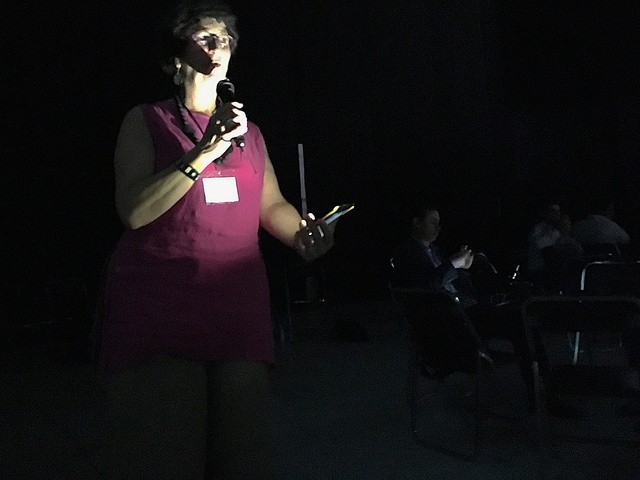
We had them dim the lights, and Nancy introduced us with a spotlight from her phone…
Start reflecting from our own experiences in openness, mine with True Stories of Open Sharing. But we question ourselves if that kind of story really would mean anything here. Brian then talks about his early experiences with UBC’s Jon Beasley-Murray’s Murder, Mayhem Madness Wikipedia project, conjecturing that being a project about a Latin American author might have resonance.
We talk as though we have not convinced each other.
So we start talking about the small bits of open sharing we saw in our work here at UDG. Now in 2015, we did this in Thursday after 3 full days, and we had examples. In this version, we had only one day to draw upon, so we also used examples from the previous year.
We talk about their early exposure to twitter, and how our hashtag activity is visualized with Martin Hawksey’s Twitter TAGS. And how we managed to see our tag trending that day in Mexico (e.g. showing them there is attention from more than those in the room)
Then we go back to the past, to our photo in 2003 when we met in Vancouver, along with D’Arcy Norman, noting there was no twitter then, how our openness was rooted in our blogs. Brian talks about his internship in Barcelona, where he was expected to work on something he had little experience. By writing about this in his blog, he got ideas from other colleagues. Ironically, it was a resource suggestion from Tannis Morgan (who leads this project) that helped Brian run with the project. My example of blogging and external contacts influences, was how my writing on just half an idea for a project got amplified and propelled by a comment from Stephen Downes. The idea here is to demonstrate how if we do not pretend to have answers, but ask questions, that others will assist and influence us.
We move towards the project with the ever present feeling among these faculty, who will earn a “diploma” (like a certificate) for this project, is that They Will Be Evaluated. We describe and show how the reports for this project are openly shared in a site we call Comparte (“Share”). We show them examples of open web resources / media created by last year’s participants… with open meaning they are available now as ideas than can be studied, and maybe emulated.
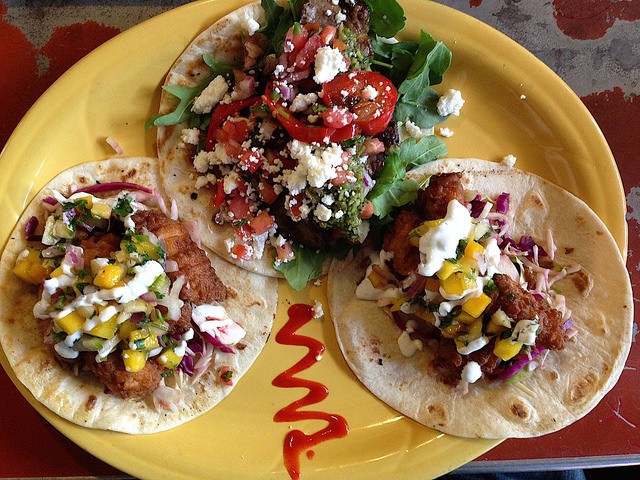
Then we close with the photo of the taco shown at the top of this post. Because tacos.
It’s still hard to know how these faculty take these ideas. But this is a long project, they work together intensively for a week, then form small 3 person mutual support groups as well as access an online space. For 8 weeks starting in late August, they will have a an online experience with us where they are starting to build and put into play their project implementation plans.
So we do not expect them to embrace openness because we say its important. We want them to build up a series of small open experiences, incorporate that into their projects, and hopefully then learn about the value of open through their own practice.
The variety, mixing of ingredients, and maybe even the messiness of tacos might be a useful and tasty metaphor after all…
Top / Featured Image: an open taco from our favorite stand in Guadalajara (La Choza) sampled maybe the night before this presentation. The photo is my photo of a tuna taco, a flickr photo https://flickr.com/photos/cogdog/27050136383 shared under a Creative Commons (BY) license
The post “#UDGAgora: Open as in Taco” was originally rescued from the bottom of a stangant pond at CogDogBlog (http://cogdogblog.com/2016/06/udgagora-open-as-in-taco/) on June 20, 2016.
This kind of small act of near random #ds106 connection will not increase enrollments, will not “fix” education, will not improve institutional metrics… yet I just cannot let it slip by without a small “wow”.
And the ironic thing is that the tweet in which I saw it came into my view about 5 minutes before I had to jump into a video call to Cape Breton University by invitation of Grant Potter. I was asked to say some encouraging things about openness to a faculty group there.
While I am still musing on the takeaway from Catherine Cronin’s OER16 keynote caution about “amazing stories” not being enough to convince people to share openly… I did so anyway because I do believe we have a case to make about shifting teaching to a place where the audience is more than the teacher giving out grades.
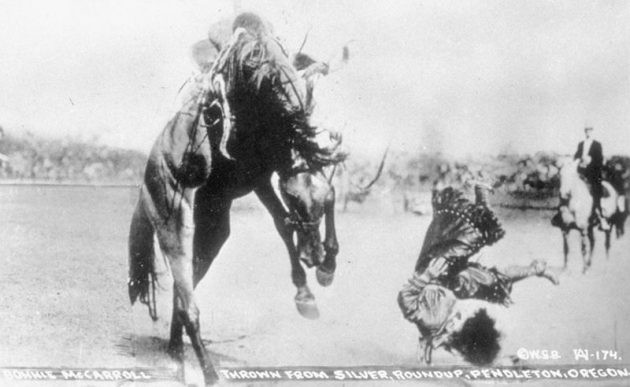
But let’s rewind back to a #ds106 Daily Create from January 25, 2016, when I was still casting most of them in a western theme. In consideration of feedback I heard about westerns being such a male dominated genre, I had been looking to find female western figures, but in fiction, history. I cannot remember the exact search path, but I was rather jaw dropped in reading about an early 20th century rodeo bronco riding star named Bonnie McCaroll:
Bonnie McCarroll, born Mary Ellen “Dot” Treadwell (1897 – September 29, 1929), was a champion rodeo performer and bronc rider most remembered for her death at the Pendleton Round-up in Pendleton, Oregon. She also excelled in steer riding, bulldogging, and automobile jumping.
In 1915, her first year of rodeo competition, McCarroll attracted national attention from a photograph taken of her being thrown from the horse named “Silver” at the Pendleton Round-Up. In her career, she performed before kings, queens, such dignitaries as U.S. President Calvin Coolidge, while he was vacationing in the Black Hills of South Dakota in 1927, and before countless rodeo fans worldwide. After her death, rodeo officials instituted safety regulations and eliminated bronc riding as a women’s sport.
Ann is a bronze sculpture artist from Bridgeport Texas who specializes in works depicting cowgirls (see her web site at http://annayresbronzes.com/).
It’s not a total fluke, I would guess Ann does some regular searches on the figures she uses in her art, but still, here we go again, with an unexpected connection, however small, generated because Ron shared his art in the open.
It would not be possible without an open web.
Keep that in mind was other mega entities are praised for “eating the internet“.
Thanks Ann for finding out little corner of the web.
A screenshot of the sculpture “Bonnie McCarroll 1915 Pendleton Round-Up” by bronze artist Ann Ayres, from her web site http://annayresbronzes.com/
The post “The Small Random Things That Openness Affords” was originally emerged from the primordial ooze and first walked on land at CogDogBlog (http://cogdogblog.com/2016/04/openness-affords/) on April 27, 2016.
When I hear folks in my stream sharing stuff for Open Education Week, my inner cynic wonders what they do the rest of the year. Or speculate a world where we do not have to draw attention in this way to Openness.
I get it. The whole idea is to raise awareness, and most of the people I hang put with are truly Year Round Open Education people- the week is for a broader swath of people. I am not criticizing the week. Ok?
And as open gets washed and wrapped around commercial products, we do and should do, develop our own definition, rather than abiding by someone elses. It takes time and experience.
So I think of it as that light being always on, all night long, heck all day long.
I am not saying that everything open needs to go on for ever, but in a lot of Certain Open Courses That Usually Start with an X, once the last item on the syllabus / schedule passes on the calendar, the tent goes down and the lights are turned off. Do people really hang around their past Coursera/Udacity/EdX MOOCs? Why would they?
The Open Stuff that I am interested in, is not just that anyone can walk through the door, as there are often ONLY IFs. They can walk through the door ONLY IF they create an account and login. They can walk through the door ONLY IF they are in certain parts of the world (geographic limits on media). Openness is not just a door.
And even if the door is open, what good is it if you walk in the door, and no one is there? That’s the Field of Dreams approach of Putting it On the Web and Calling it Done.
Okay, so I am not taking this post in the direction I thought I was in the beginning. That happens.
Rather than trying to say what open is / isn’t, I’m talking about the kinds I personally think are important.
The kinds of things that carry it’s own momentum above, beyond, outside the “course” or even the people who launched it. The ones where people participate in that maybe you do not even know about. That do so sometimes without you even knowing about it.
Of course, in my case I am taking about DS106. I am a proud Cult Member.
ds106 poster by Jim Groom http://bavatuesdays.com/theyre-here-2/I think Martha Burtis made this? And yes, Stephen, we are a cult.I made this one, the faces are Tim Owens, Jim Groom, and Martha Burtis
If folks are spontaneously creating posters, songs, GIFs, videos to celebrate your Open Thing, and it’s not any kind of assignment, you’ve done well.
But this allegiance/affinity thing is not at all limited to ds106. I’ve had a personal theory that you are most rooted/connected to the first cMOOC you experienced a mind-blowing, connecting-around-the-world experience. Others had it with CLMOOC. ETMOOC. MOOCMOOC. The various rhizo14,15,16 gardens.
It’s almost a tribal thing, and sometimes we playfully tease each other
Really we are much more together, in an affinity of “not being like all that other crap.”
And a question becomes, in what ways do you design your open experiences to allow for the kind of serendipity you do not anticipate? Do you leave room/space for that? Because serendipity, the unintended things that happen are, to me, the sources of Great Potential Energy of Goodness – this does not usually happen when you have a strict structural objective compliant design where people are there to collect a certificate or a badge.
There is a lovely undertow of people playfully riffing on ideas and creations; but that is not limited to DS106. I’ve seen it in CLMOOC, rhizoXX (see recent example from Simon Ensor)– this is stuff you cannot plan for, all you can do is spread some fertilizer, sunshine, water, and a few seeds (to use the metaphor).
There is no boundary to it.
I thought of this recently in watching activity in the #ds106 hashtag in twitter. The lovely thing in this space is, that quite often, you do not always know who is there with what class, or on their own. The boundaries of a “course” or “class” are completely blurred and smeared.
In the last weeks, I notice a lot of daily create tweets with the tag #diglitclass. I thought it might be the group from CUDenver, but that’s a PD class and they sort of have a tag.
So I asked… and when you ask, often you get an answer.
Now I know more. There is a class there in Digital Literacy using part of ds106, and we have no idea why, how. They did not need to ask permission to use the Daily Create.
This is a porch light being on, the door being open, and people freelt coming and going from inside and outside.
This is open.
Have nice week.
Top / Featured Image: The metaphor I sought for this post (I don’t write until I have one and an image) was the Motel 6 ad line “We’ll leave the light on for you” (for some reason I thought it included “porch”, so my metaphor is “wrong”?). But I was hoping for an image of an outdoor porch light on at night.
A Google Images / Licensed for Reuse search for “porch light” was dismal. There are musical references, and about 3 rows down all you get are porches. Compfight too was slim. Then I thought, “I have a porch light and I bet I have taken photos of it” — the obvious of search your own photos. And BOOM! a perfect image I did not even envision, this from a box of switch plate covers at a thrift store near me, with the “Porch Leave on Label”. I did not even see this one in my mind; that’s what I love about digging for metaphor images.
The post “Open is The Porch Light Being On (and more)” was originally pulled like taffy through a needle’s eye at CogDogBlog (http://cogdogblog.com/2016/03/open-is-the-porch-light-being-on-and-more/) on March 11, 2016.
If the web was designed for you, then you might never enjoy the Museum of Endangered Sounds. But because much of the web is designed by us, we get gems like this that are weird, quirky, open to all and has a personality of it’s own.
This site exists because someone like Charles wants it to exist.
Right at the intro (below the exhibits) we get jagged pixelate font, and the fact that the creator of the site has (and publishes) his own AOL address? Priceless.
Brendan’s description does it better than I could do, and says a lot about the spirit of the Open Web.
I launched the site in January of 2012 as a way to preserve the sounds made famous by my favorite old technologies and electronics equipment. For instance, the textured rattle and hum of a VHS tape being sucked into the womb of a 1983 JVC HR-7100 VCR. As you probably know, it’s a wonderfully complex sound, subtle yet unfiltered. But, as streaming playback becomes more common in the US, and as people in developing nations like Canada and the UK get brought up to DVD players, it’s likely that the world will have seen and heard the last of older machines like the HR-7100. And as new products come to market, we stand to lose much more than VCRs.
Imagine a world where we never again hear the symphonic startup of a Windows 95 machine. Imagine generations of children unacquainted with the chattering of angels lodged deep within the recesses of an old cathode ray tube TV. And when the entire world has adopted devices with sleek, silent touch interfaces, where will we turn for the sound of fingers striking QWERTY keypads? Tell me that. And tell me: Who will play my GameBoy when I’m gone?
These questions and more led me to the undertaking that is The Museum Of Endangered Sounds.
My ten-year plan is to complete the data collection phase by the year 2015, and spend the next seven years developing the proper markup language to reinterpret the sounds as a binary composition.
If you don’t understand my passion and the significance of my work, you probably never will. But if you do, then you’ve come to the right place.
Oh my, “Imagine a world where we never again hear the symphonic startup of a Windows 95 machine.” Imagine, indeed.
The site does what it says, you click the icons and hear the sounds of old technology. They just loop and loop and loop. What is fun is that you can click multiple ones and now the web page is some kind of bizarre instrument.
My best surprise was when i went to add it to my pinboard, it was already there!
The Web Designed by Business Executives would never have room for Charles, nor for you, nor me to put our personality out there.
(Yes I did click the link, Charles does have eight gerbils).
The post “The Open Web Makes Possible a Museum of Endangered Sounds” was originally slapped on the butt by a cigar smoking doctor yelling “It’s a post!” at CogDogBlog (http://cogdogblog.com/2016/02/endangered-web/) on February 9, 2016.
The western landscape is full of emptiness, vast stretches of drab land, interrupted by deep canyons or sheer mountains, and infrequent water. My reasons for recently watching The Painted Desert was largely because it was set in an area close to where I live. I had it queued on Amazon Prime; a lesser quality version is available on YouTube.
It’s hardly a great movie, and in many ways left me puzzled (or more “Meh”), a lot to things that seemed missing or inconsistent. But that said, if you cannot find something of interest to write about, well…
Western pardners Jeff and Cash find a baby boy in an otherwise deserted emigrants’ camp, and clash over which is to be “father.” They are still bitterly feuding years later when they own adjacent ranches. Bill, the foundling whom Cash has raised to young manhood, wants to end the feud and extends an olive branch toward Jeff, who now has a lovely daughter. But during a mining venture, the bitterness escalates. Is Bill to be set against his own adoptive father?
Sound (and not)
I noted it was an old movie (1931) and frankly in the first few minutes, I was wondering if it was a silent movie. Nothing is said as Jeff and Cash come across an abandoned wagon. I almost expect Chaplin gesticulations and cue cards.
Actually the only sound seems to be the spoken lines and what was recorded on the set. There is no music. There are parts where between dialogue is a ghostly static, no wind blowing, or ambient sounds.
One might chalk this up to being an old movie, but somewhere I read someone mentioning earlier movies that did much better with audio.
Two Notes and Thats It?
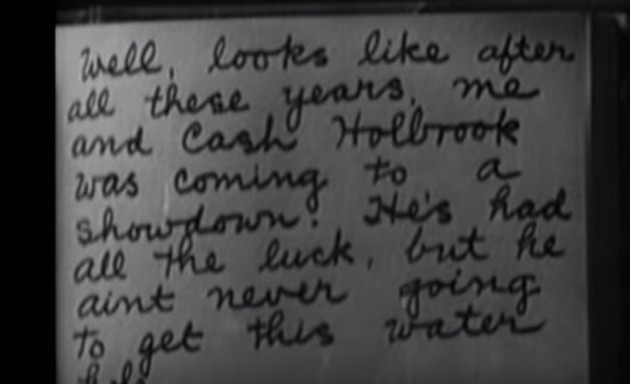
The movie opens (1:05) and I think there is one more scene (9:05) where a notebook with handwriting is used to fill in the plot.
The notebook is used t indicate the passage of time at 9:05
It feels like it was an idea that just got dropped. Or maybe after the gap in time as brought to the present, it was not necessary? It feels like a rickety bridge built over a plot gap.
Gaps in Character Development
Since this is the part of #western106 that we think about characters, I found most of the ones in this movie stiff, thin, or just not built enough for me to care or be interested in.
The movie is built on this conflict between Jeff and Cash, apparently they traveled together to the West, apparently with a joint plan to work together (never hinted at). The whole scene where they find the baby feels fill of gaps too.
They come up to a wagon, hear a baby crying, they take him, and are riding off in like 4 minutes. It’s left to wonder what happened at that site, they did not even investigate. The timing feels wrong. This is a hinge for the characters in the movie, their fighting over Bill in their lives (the grown man from the baby).
They have some comedic moments with the baby, and then there seems to be no comedy in the rest of the movie.
Then they have this big blow up near the water hole, that just seems to come out of nowhere. Up to this point there was nothing to indicate these were not best buddies, and now they are viscously bickering (over whether to stay at the water hole?, and Cash rides off with the baby as a shield.
Then we get a note, and a return to the water hole. Because the lighting is exactly the same, there’s not much sense of time passage except for there are a lot fo buildings around the watering hole, and Jeff is there with a young lady. Somehow we have to figure out it is her daughter. The mother? maybe I was not paying full attention, but how these two people came to live there? We just jumped 20 years.
In her first scene, Mary Ellen Cameron (played by Helen Twelvetrees seems like a rootin’ tootin’ wester gal, she pulls out her shotgun ready to defend her Dad’s land, but a few minutes later she is more or less pushed aside from the action by Brett, and the rest of the movie, she’s more of a eyelash bashing bimbo. Brett makes a big move on her, for some reason she takes up with Bill; there is no lead up to that as a romance. It just sort of happens out of the blue).
The Gable Effect and Boy oh Boyd
Clark Gable as Rance Brett
This movie seems to be most well known for being the first talking movie role for Clark Gable, and is said to be the role that rocketed his career. His is the character that seems to have the most oomph and feel to it, and the most western grizzled cowboy type. Jeff and Cash seem to speak more flatly.
I lost track of where I read it, Gable had no horse riding experience before this movie.
The Brett character does work for being a man of mystery, he’s “from Montana” on his way to New Mexico, but for what? He’s got this affection for Jeff’s daughter Mary Ellen. He makes a strong flirting move early, but then he is never that bold later. This is important because it creates the tension with Bill (the grown found baby)
I was not even sure who the actor was til I looked it up, but Gable does have a strong screen presence.
The bigger role in the movie was William Boyd playing Bill Holbrook (wondering if Holbrook as chosen for the name of the town closest to the Painted Desert?). His character is potentially the most interesting, because he turns agains Cash you raise him and made efforts to try and broker piece with Cash’s old nemesis, Jeff. Why Bill wants this is not clear.
The mystical watering hole (made up I think) is a key element, as well as the presence of mine-able minerals. There are a few scenes out in the landscape, but it does not feel as much of a presence as the films of John Ford.
They seem to be in a really remote location; Jeff’s refusal to let Cash water his cattle a the watering hole requires a 27 mile re-route, but for being remote, they sure seem to be very close to a populated town (which I do not think is named).
There is the complete mine set build and destroyed. Apparently some crew were injured during the blasts done for that scene. Oops.
The Unexpected
For a western this movie is missing the tropes of Really Bad Guys, bank robberies, gunfights, fistfights, jumping from trains, and dealings with Indians.
In the scene where Jeff and daughter get ready, they do the classic putting their ear to the ground. This is where it should turn to a marauding band of Indians, but surprise! It’s cattle.
Then we have this rising tension of Cash bringing his cattle in, but as a suprirse there is a whooping band of horsemen who drive the cattle away. The sounds they are making sound like Indian war cries, but ti turns out tis just Bill and (??) we have no idea who else helped him.
No Indians appear in this movie. No Mexicans either. It’s a White and White movie.
Really the movie is just this long lived (and little explained) animosity between the men in the beginning who found a baby. It’s almost more of a family drama, just set in the Painted Desert.
There’s Probably More
I lost some interest and attention over the last 1/3 of the movie, and maybe even noticed the credits rolling before I knew it was over.
The gaps and things that feel missing from this movie seem to have more to do with the behind the scenes actions of the movie studios and production companies. From one of the reviewers on IMDb, titled “It’s Not All There”
The Painted Desert was one of the last features to be produced by Pathé in 1930 before being taken over by RKO, and one of the first to be released by the emerging RKO-Pathé Distributing Corporation. After its initial release it was put back on the shelf, supposedly never to be seen again. During this time four key action sequences were removed to be used as stock footage in later RKO films, among them the 1938 re-make also titled The Painted Desert. In 1955 the RKO library was sold to C&C Television Corporation for TV syndication, primarily on CBS affiliated stations, and both versions of The Painted Desert were in the package. 35MM source material for these 16mm television prints was missing all of the deleted footage, so that what remained, and all that viewers have been able to see for the last fifty years, was a lot of talk, and practically no action. The sequences which are missing are most of the cattle stampede at the beginning of the film, a wagon hi-jacking and subsequent stampede into the canyon mid-way into the film, an attempted, but unsuccessful wagon hi-jacking soon afterwards, and the big mine explosion and resultant landslide that destroys the mining camp further on. (Two very impressive shots from this last sequence can be found in Republic’s Red River Valley (1936).) Frustratingly, the results of these events are shown, and much talked about, but the events themselves are nowhere to be seen. The version shown on Turner Classic Movies, though of superior visual quality, having been derived from the surviving original 35MM material, is still missing these key sequences, though no mention is made of it on the air.
It makes sense now that it’s not even clear what the “movie” is as it can get picked over and re-arranged by movie studios. It even gives some pause to think all that happens to get that movie on the screen, and it has as much to do with the business as the writing, directing, etc.
Not a great western, but still found a few things worth looking into.
I am just all the time appreciating IMDb more and more. It looks like any other web site, but when you peek under the corners, there is a whole raft of things it is doing with data. Like the Connections section where I note that The Road to Perdition makes a reference to this movie.
Let’s start first with credits. Specifically movie credits. Arguably, the website my wife, Katie, goes to most often is the International Movie Database (IMDB) website. When we watch a movie, 20 minutes into the film, without fail, she will whip out her phone and pull up the IMDB page for the movie.
Most recently, we were at the movie watching Star Wars: The Force Awakens (I promise, no spoilers). A scene comes on with the General Hux character. She thinks she’s seen him somewhere so she’s searching on IMDB. A-ha! Domhnail Gleeson. He was in a Black Mirror episode, she tells me. My facial-name recognition is about as good as a goldfish, so I have no idea what she’s talking about, but she goes on to explain the exact episode that he was in.
And suddenly we have pulled this information together as network; something in which we can relate to and empathize with based off of our previous relationship with other texts. Arguably, the number one value to the user in the social network is this: a way to organize and interact with their network which is made up of these disparate connections that have taken place over time.
So those in the film industry, including actors, gather credits and over time these credits start to build up a collective body of work. I can interact with these credits and try to put together my own interpretation of who this actor is and how they have developed over time based on different variables. Box office smasher or flop? Lead role or supporting? Who was the producer? Was it an independent film? Is this actor more dramatic or comedic? These are all a bit of judgements on my part, as the interpreter, because, ultimately a credit is a credit is a credit. The credit is fairly neutral.
It’s like being a web archeologist. I am gently dusting off the fine dust on this page with a soft brush, and there it is- the first time this great site went on the web, it was on a server at Cardiff University in Wales:
The first web version of the database went live on the servers at Cardiff University in Wales. There is a fun bit of e-mail dating back to those days between web interface author, Rob Hartill, and Col Needham, both impressed when the web interface got 100 accesses in a single day. In recent years, the IMDb website has been serving over 2.5 billion accesses from over 57 million visitors every month.
Imagine that, another huge internet innovation birthed in higher education. Back when it really was an internet frontier, the Wild Wild Web.
Top / Featured Image: Screen capture from The Painted Desert (1931) found on YouTube – this is the early scene where Rance Brett (right, Clark Gable) meets Jeff Cameron (left, J. Farrell MacDonald)
Imagine your university was going to close for a week in the 1st month of the semester because the UCI Road World Championships was overtaking your city. Residential students could stay in their residence halls, but classrooms were to be closed and traveling to campus would be extremely difficult for non-residential students. Next, imagine you are charged with considering how you might turn that situation into one or more learning experience. The open Web to the rescue, #amiright?
The Great VCU Bike Race Book (#vcubrb) was borne of this opportunity. The Great #vcubrb is a unique Connected Learning experience at Virginia Commonwealth University that will take place during the Fall 2015 semester. There are three purposes for the #vcubrb. 1) To provide a purposeful, enjoyable learning experience during the Bike Race week, especially for residential students who would otherwise not have any academic work to occupy them. 2) To give students an opportunity to participate in an innovative online course that aligns with the VCU Quality Enhancement Plan’s goals of integrative learning by means of digital fluency. 3) To provide a unique faculty development experience that will advance VCU faculty’s involvement in distinctive online learning.
My hunch is the “#amiright” in the abstract meant Jon Becker wrote the proposal, and we missed Jon and of course Gardner Campbell who were unable to attend the conference- leaving Tom to represent the ALTLab, Amy as one of the faculty who taught a course, and me who remotely worked on the web site.
After two days of sessions and some conference grumbling about “too much open textbook” stuff, Amy and Tom were keen to go with something different… and literally we came up with the idea on Thursday over some street tacos from a truck behind the Vancouver Art Gallery.
We each had our different roles in the project, but felt a 3 way slide deck walk through was not tasty. How could we do it more conversational? If you overly generalize presentations, the person in front comes in with a pre-planned stack of stuff; the audience listens or tweets, and maybe there are some questions at the end, or just polite clapping.
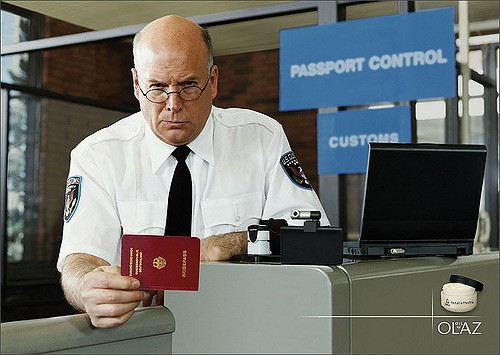
With us being three Americans recently crossing the border for the conference, the customs desk experience made think of a different modality.
What if we said to the audience, rather than us coming in with our set of presentation content, what if we asked for a volunteer to come u0 and ask us a series of questions as if they were the customs/presentation agent? Just to make sure this did not flopped, I pre-enlisted a willing (Canadian) volunteer…
Grant Potter will always play along. I sent some suggested questions.
Who are you people?
What is this Bike race thing? What is “UCI”? (Tom can answer)
How did you get involved?
Why is a university even doing this?
What kinds of courses were created? What was it like for faculty (Amy’s response key)
What do you have to show for this?
What was the experience like?
What happened for the students?
What is this book thing? Why are we talking about books?
We might have done 2, but it was enough to set the discussion in motion. No slides. No script. Just Tom, Amy, and I conversing about this project we were part of, as we had the day before outside eating tacos.
Just for reference, as I have really said nothing about the project…
The Great VCU Bike Race Book – this is a holder now for a few bits of project parts, but ultimately will be “the book” (open, but not a textbook!)
UNIV 291 Courses – a piece I worked on as gateway for information about the courses. Great graphic art work on the jerseys by VCU’s Emma Gauthier (blogged here)
Anthropology of the Crowd — this is Amy’s course site, a tremendous body of work by her students. Her summary there on the front is the kind of project recap we dream off- it’s reflective, full of examples of student work, and lots of media.
FAQ this is Tom’s work, and much of his sarcastic wit got toned down, but still left with great lines like:
There you go; a pile of web links- no slides, no audio recording, not even a photo of us yacking on stage.
It was as great as the tacos.
Stay tuned, as we move early next year into producing the “book” (again, not a textbook 😉
Top / Featured Image Credit: You should envy those street truck tacos! flickr photo by cogdogblog http://flickr.com/photos/cogdog/22863843910 shared under a Creative Commons (BY) license
The second of three sessions my name was listed on at Open Ed 2015 was Splots and Darkweb Plots. It might not take a lot of guessing to know that this was co-presented with Brian Lamb.
It is affirming a year later to have a good handful of SPLOTs in the wild, meaning people other than us using them. The prep for this talk got me, way overdue, moving the later changes to the github repos (TRU Writer) and (TRU Collector) and finally adding some documentation.
I was happy to meet David Wright there who had managed to set up a version of the writing SPLOT before it had an installation instructions
Been playing with @cogdog & @brlamb TRUWriter all morning. Great tool. Easy to install. Up and running.
This has me pumped to return to the SPLOT home base and maybe pick up some of the half ideas that never got built out last year (example).
Stay tuned to the Smoothest Portable Learning Open Technologies or Simplest Possible Lucid Online Tools or Simplest Possible Lexical Outstanding Timesavers or Super Perceptive Learning Online Touchstones…. at splot.ca
The post “SPLOT on Open Ed 2015” was originally pulled charred and crispy from a smoky charred oven at CogDogBlog (http://cogdogblog.com/2015/11/splot-on-open-ed-2015/) on November 22, 2015.
Much as he may disavow my assertion (ask him about the one in Flagstaff a few years ago), Brian Lamb and I getting together for presenting is always a peak experience, usually peaking soon before it happens.
We’ve done much individually and together on the topic or a while, so I was not worried that we had nary a plan before we went to Mexico.
There was also no plan by Thursday of the first week, and we were slated to do it the next day. We had talked/speculate at we might not want to start with the assumptions on attitudes and awareness of open sharing, re-use that we know from our usual North American audiences.
It was on the ride back from the CUAAD campus in a car with Nancy White, that her typical magical force happened:
Of course what she said seems to have faded, but it really gelled the idea- that rather we try to explain the ideas of openness, that it becomes more of a questioning our our own assumptions; and that we look to use small examples if things that the participants had done that week that demonstrate its spirit in action (I may have actually been dozing on the ride home, but Brian got the spark).
He banged out an outline that night as we sat on the veranda at Villa Ganz.
And that was the setting for a bit of drama inn our session;; we literal play acted for the audience “twelve hours ago in a dark hotel lobby”. We acted like we were trying to organize the very presentation we were doing. I would do a bit of overview of my usual stuff (True Stories of Open Sharing) and Brian talks some about one of his favorite examples, the Jon Beasley Murray Murder Mayhem Madness Wikipedia writing story.
We in fact talk about these as if we were conversing. Then we stop and say to each other “I don’t think this will work for this audience”.
And then we break into a series of vignettes of examples we saw that weak, things openly created and shared by participants, informal connectivity, how the open internet participated in the activities that week. Plus some serious addressing of the concerns people described for us, unclear local support, how to integrate technology not readily available, and the looming issue of being evaluated.
Then we flash back to our own stories of how we first connected in 2003, of finding support from remote colleagues, even flashing the old photo of us with D’Arcy Norman in Vancouver at 2004 (oh they loved the old photo!)
And we return to images of what we saw that week, how every time we looked at our participants, the way the were nearly always working collaboratively, laughing, showing their work. The question we want them to leave with is how can we sustain or develop this same sense of being together we had face to face when we move to the online sessions.
I don’t want to gloat much, but the energy in the room was strong when we moved to a conversational mode, even with us doing this in English. Does the spirit of openness come across even when not all the words do? I’d like to think so.
It was a joy to put this together- Brian and I both co-assembled the images as a Google Docs presentation thing, and in the morning, I downloaded it as Powerpoint (in case of internet hiccups) to project. Both of them are embedded below (we used media and stories from each week of the activities, to showcase people who were in the room).
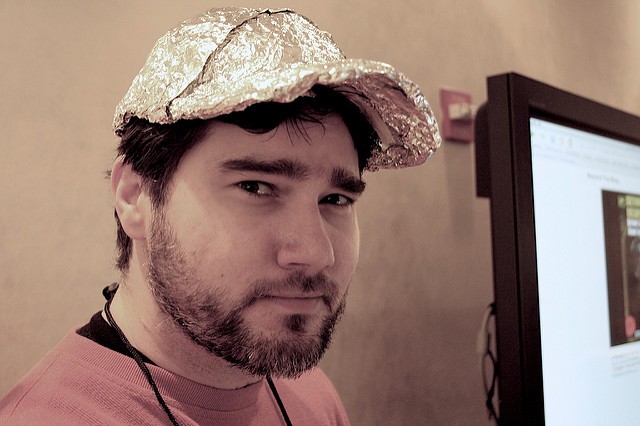
It’s hard to top working with Brian, it’s sheer excitement every time we plot something off kilter. My favorite mode of presenting has a bit of theatrics to it, and Brian is always willing to play (or provide the foil hats)