Tag Archives: openlearning17

When Free Beer Leaves Me Cold: Declaring Interest in #OpenLearning17

I’m super excited that some of my favorite Virginia educators have gotten together to do a cMOOC! #OpenLearning17 started today and I’m so thrilled to follow along and learn with a great community. The syllabus says this week is for introductions, blogs, and working with a connected learning coach.  There is also a great reading all about the meaning of “open” which was enlightening to the history of the word. To this end the article starts with the word “free” as defined by Richard Stallman for the Free Software Definition, distinguishing the difference between “free” as in “free speech” not as in “free beer”. “Free”, in the sense that will eventually grow into “Open”, is focused more on liberation than lack of price. So, besides lacking a price, “free” as defined by Stallman also includes the ability to see and change the program itself – also the ability to redistribute changed versions of the program. It seems to me that in this way the program is used by the person instead of the person being used by the program. It also seems that this encourages community as conversations need to arise around this kind of usage.

I am actually struggling with some “free beer” kind of software (at least I think it is free beer) in my life right now so I thought I’d talk about it as my introduction to the group.

I’ll be the first to admit I’m not the best at email management. Our institution has a size limit on faculty and staff inboxes that is like 20mb or something. I’m always archiving stuff off because I’m getting yelled at for not having enough space in my mailbox. To make more room one of the first things that I do is sort by size and archive off the messages that are the largest. Usually these are messages that have large attachments.

A few months ago it seemed to really start filling up quick. The thing was I would do my little trick of sorting by size and I started finding these messages from one particular professor that I was working with that had no attachment – often they were just a sentence or two of text. I checked to see if perhaps there was an image in the signature line that was taking up a bunch of room but I didn’t see anything like that. I thought it was a fluke, archived the messages, and moved on.

The thing was it kept happening and it was getting worse. The first few times I found these messages they were maybe 500kb but then after a week I was finding that they were 1mb – then 2mb – and always from the same professor. What was going on?

I’d had enough and I knew there was something that I couldn’t see in the background of those emails. I asked our Instructional Designer Jim Kerr what he thought and we started a back and forth of trying to deduct what was going on. Was it only in replies? Was it every email that professor sent me? It did not seem to be happening when the professor sent from his phone… Well eventually we pulled up the source code for the emails and the cause became abundantly clear – there was about 11,000 lines of junk code in each of those emails. I don’t read or write code but one word was sticking out all over the place; Grammarly.

Grammarly is a piece of “free” software that is supposed to help you write better. In real time it corrects spelling and grammar errors in all of your text. You can install it as browser plug-in so that you don’t even have to go to a website – wherever you write text on the web it is there.

Grammarly says it is the “free grammar checker” but I believe this is free as in beer not free as in speech. I’m new to the open/free movement and new to Grammarly so let me know if I got this wrong. I don’t see anywhere that I can get to their code to tweak it or to see what exactly it is doing or why it is ending up in the background of very simple emails and bloating them up. Any talk of community on their site applies to those looking to talk about grammar issues not to talk about the software, how it functions, or how users can change it directly. Grammarly is free but there is a paid tier and the volume licensing also has a cost associated to it. So, I suppose it is like free cheap beer – if you want the stuff that tastes good you have to pay.

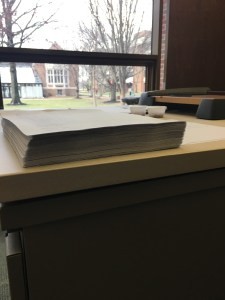
I printed the code that was behind the email just so that I could demonstrate how much was actually going on behind the scenes. Mind you this is double sided.

Printed code behind an email message that was one sentence long. This is double sided.

After going through all of this the professor immediately removed Grammarly from his computer – he said his email box was filling every day and no one could figure out why. But it also got Jim and I thinking about how Grammarly works. It is not entirely on your computer – much of the computing process is in the cloud – it needs the internet to function. So, it seems that it is basically a keylogger. Though it is not covert (I mean you install the thing) it is recording every keystroke and sending it to their servers to check for grammar and spelling issues. It does seem that they are encrypting and such but now we are wondering if there are implications for FERPA in an educational setting. And besides having some program record and send my every keystroke is a little creepy to me. Especially, If I don’t know what is going on in the background.

To be honest, I’m not a coder and even if Grammarly did make their source code available I couldn’t make much of it. I think that there might even be security issues if it were that open. Honestly, a big reason why I’m writing this as a part of my introduction for #OpenLearning17 is because I’m trying to better understand the implications from others that might know better than me. I’m wondering if our concerns about FERPA are warranted and if anyone has any clue how the junk code got into the emails. Any feedback would be great but if not, if this is too far outside the interest of #OpenLearning17, that is okay too. Hoping that this post can still act as a way of saying hi and giving folks some idea of the type of things that I’m thinking about.

Looking forward to working with everyone in #OpenLearning17 and can’t wait to see where this takes us.
Greetings from the #OpenLearning17 Connected Learning Coach

This week marks the opening of Open Learning: A Connectivist MOOC for Faculty Collaboratives, a 15-week course that aims to “design and provide a helpful and stimulating learning experience for all participants that results in measurable improvement in the use of digital affordances and sustainable professional development connections across Virginia and other areas.”

For the uninitiated, faculty collaboratives are part of the American Association of Colleges & University (AACU) LEAP initiative.  Since 2005, LEAP (Liberal Education & America’s Promise) has promoted college learning that involves high-impact educational practices and authentic assessments; faculty collaboratives support LEAP success by creating large-scale, sustainable networks of resources meant to support faculty development on LEAP-related principles, practices, & outcomes.  The #OpenLearning17 MOOC represents a partnership between AACU and the State Council for Higher Education of Virginia (SCHEV) and is the faculty collaborative experience for Virginia that seeks to enhance digital literacy and leadership among the faculty of institutions of higher education in Virginia and beyond.

Hello, I am Laura Gogia, your Connected Learning Coach for the #OpenLearning17 Course.

giphy-4
Wait, what?

More explanation may be needed :).  Here are the obvious questions that come to mind.

Question: WHAT IS CONNECTED LEARNING & WHAT DOES IT HAVE TO DO WITH A CONNECTIVIST MOOC?

If you participate in #openlearning17, you will be working to enhance your ability to make connections in and across digital platforms, building visible networks of ideas, people, and personal/professional resources over time.  It is one example of a connected learning experience.

Connected learning is a progressive educational approach (think Dewey) contextualized for the digital world. The National Writing Project does a great job of providing case studies and examples, Mimi Ito and colleagues’ agenda for connected learning research and instructional design goes into a bit more detail, and I’ve written a white paper on how connected learning was executed at Virginia Commonwealth University.  If you read through all of these things, you’ll see that the purpose of connected learning is to create inclusive, creative, social, authentic learning environments meant to help students recognize, strategically reflect on, and forge new connections between people, contexts, ideas, and personal experiences. Although connected learning does not have to be executed in open digital environments, to do so opens the door to an entirely different level of access to and opportunity for authentic audiences, creative resources, and personal learning network development.

john-dewey-o

Connected Learning = Dewey in the digital world.


Question: AS A LEARNER, HOW DO I ENGAGE IN CONNECTED LEARNING?

As I mentioned above, connected learning is really a form of experiential learning, so we can think about it in terms of Kolb’s experiential learning cycle.  I’ve  written about it in more detail elsewhere. However, to cut to the chase, connected learners deepen their understanding by making connections:

  • with other people (social learning)
  • across their own thought trajectory, over time (reflective learning)
  • across disciplines and contexts (interdisciplinary and cross-contextual)
  • through different types of expression (multimodal; visual/audio/kinesthetic/etc)

Digital platforms allow us to makes those connections explicit via hyperlinks, embedded images, audio, and video which brings us to the final question…

Question: WHAT IS A CONNECTED LEARNING COACH?

Short answer: I am and this is not the first time I have done this; in fact, for more details, you can check out this WCET blog post. During this course – usually in the form of blog comments or tweets or infographics– I will be asking you to consider how you can use the affordances of the web to enhance your communication and learning.

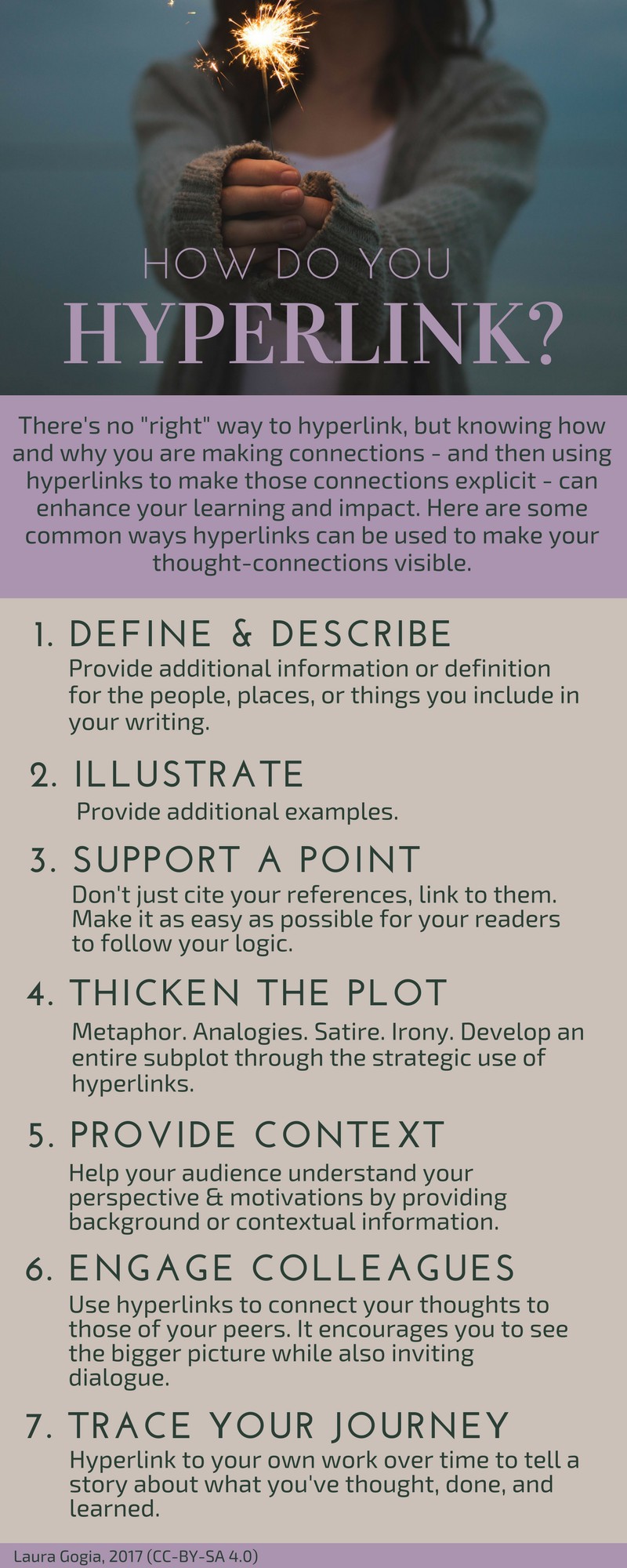
For example, I might ask you to think about how a hyperlink – one form of a digital affordance – might make your thinking more explicit, increase your communicative impact, and enhance your own learning.  If you click through the hyperlinks in this blog post, you will see that I made connections between my current thinking and:

  • the course website & AACU website
  • my past work
  • other references, and
  • other forms of expression (hint: the gifs)

In doing so, I not only demonstrated a understanding of audience (e.g. I provided context and additional resources for them), but also connected this current activity with my other scholarly work.  I reconfirmed my purpose and position.  I also put a lot of thought into what gifs would express what was going on in my head…which made me think about what was actually going on in my head more than I would have otherwise.

giphy-5
Connections

Digital spaces – particularly public digital spaces – allow you to do certain things that you cannot do on paper or in a closed classroom space. Of course, the reverse can be true as well…and we can reflect on that too. It is my HOPE, my genuine hope, that you will join me in exploring the digital nature of #OpenLearning2017 with curiosity as a truly unusual learning space.

Thanks – you’ll see me around 🙂

Some Open Questions for #OpenLearning17

Reading Time: 2 minutes

They say when one door closes, another opens (or a window, maybe). But we don’t usually talk about how sometimes opening a particular door might actually close another. For the same people, or different ones.


Open/Shut flickr photo by sarae shared under a Creative Commons ( BY-ND ) license

I’m really looking forward to #openlearning17, with a bunch of really awesome people discussing different dimensions of open learning…

I’m particularly interested in asking questions about open for whom, by whom, for what purpose? Can we think about issues like access, and recognize how just being “open” does not mean we are necessarily making something accessible for others? Just by being “free” (as in gratis, zero cost to the user) does not mean everyone has equal access to it? I want to ask about the privilege of open, and what our responsibilities are when we have the privilege of open… how can we think critically about the different approaches of open learning, from OERs to open scholarship to open pedagogical practices…and these aren’t issues no one has talked about before, and I’m particularly influenced by the work of sava singh, Robin DeRosa and Catherine Cronin and others on this…

Could a social justice orientation to openness occasionally mean being closed to a privileged group in order to create openness for marginal groups? Why do we, and why should “we” care about advocating for openness for marginal groups? What are the most respectful ways to do that as allies, and what’s the role of the semi-privileged open educator who lies at the borders/intersections?

Looking forward to some deep discussions. inshallah

On a more practical note, check out Creative Commons new “one-click attribution” tool in beta

Also, do you know about cogdog’s Flickr CC attribution helper bookmarklet? That’s how easy it is to do attribution for CC Flickr images on your blog, as I’ve done above… it’s possibly my favorite tool EVER. Now if only I could get my students to use it 🙂

Hello there #openlearning17

Hello!

I am participating in the class to find some more awesome “faculty development” ideas. Just the #openlearning17 course itself is a good opportunity I can share with faculty here. I need those. I am an instructional designer these last ten years and a high school English teacher the 10 years prior. I love working with people.

While I am looking for good ideas, I also have a couple to share that you might be able to use in some way. So, I’ll do that.


The first is a “reflective writing” challenge that began at Yavapai College in Arizona. Faculty were asked to write 25 sentences a week about teaching and learning for nine weeks on the open web. They did, and so did faculty at other colleges. The link here has more description and links to all the writings. It is still very successful.

Another was to build a group of videos created by faculty about teaching. The vision was a wall of short videos that anyone could pick and choose from and maybe learn something from. There was also the advantage of getting faculty to create video content which was new to many of them. So they not only shared what they do, but learned something new in the process. There are links to the videos created by a few schools there too.

We had tried to get faculty to give us “tours” of their courses and that worked pretty well. I think we did have about 10 one time but some disappeared from faculty YouTube channels and we did not pursue getting them back. I don’t know why. But the idea was good and after a few brave faculty shared their online courses, a few more did.

The first year we did the open house the classes were totally open. Now it looks like college credentials are needed to access them. But the idea of an “Open House” worked really well. http://www.telswebletter.com/openhouse/

If you have any questions about any of those things I’d be happy to answer questions if you have them.

Virginia’s Faculty Collaboratives Project

I am excited to work on the AAC&U’s Faculty Collaboratives project. The project is being implemented at the state level. Half a dozen states were in the first cohort, which began last year. Virginia is in the second cohort, which means we have benefited by learning from the experiences of the first cohort.

The nominal goal of the Faculty Collaboratives project is for each state group to develop a collection of faculty development resources to increase awareness of how to enhance the effectiveness of teaching and learning, especially in the liberal arts & sciences. These resources will be based on the findings of learning science over the last few decades–findings of which I suspect most rank & file faculty are unaware. I don’t know about you, but learning science was not part of my graduate program. AAC&U has conducted a number of initiatives in this area, including the two I’m most familiar with: LEAP and VALUE. The challenge is to get these resources into the consciousness of faculty.

Gardner Campbell, who is leading the Virginia initiative, expresses the challenge this way: How can we help students (and faculty) see general education requirements as more than checkboxes on the road to the student’s real education (e.g. in the major)? How can we help students and faculty see general education as more than just a set of hurdles to be gotten past? How can we help students and faculty see general education as a foundational part of their undergraduate studies as well as lifetime learning?  In short, how can we do what we’ve always valued, only better.

What approach are we taking in Virginia? We decided early on to use open educational practices as the model for our approach. Virginia has a vibrant open education community, so we have both resources and interest to draw from. David Wiley describes what we’re planning as rethinking general education requirements as if the Internet existed.

Open education can be pursued from a variety of angles, including open pedagogy, open access, open educational resources (OER), and more. There is no universally accepted definition of open education, which allows a diversity of approaches to be tried. It’s probably best to think of open education as a philosophy of teaching and learning, a set of practices, rather than a specific technique or set of skills. One can try some, but not all practices, and that’s fine. If this sounds imprecise, we will be exploring these concepts in more detail soon.

Our project will operate at several levels.

  • We want to create an online platform to showcase a set of teaching resources and practices.
  • We want to make the resource organic and sustainable so that the platform doesn’t die when the project is over.
  • We want to model what we’re presenting, using open educational practices.
  • We want to assess whether the platform makes a difference in faculty teaching practice and effectiveness.

Not too ambitious, huh? Beginning later this month (January 2017), we will conduct an open online course to explore open educational practices. The idea is to give interested faculty the opportunity to learn by doing. The course is designed for anyone who would like to learn more about open education, regardless of your background and experience. Everyone is welcome!

The course will be organized by topic. If you are only interested in one or two topics, you can simply participate those weeks.   Of course, you’ll get far more out of it if you participate in the whole course. If you have tried taking a MOOC (e.g. Coursera, Udacity) before, you will find our course very different. It will be based on the Constructivist MOOC model developed by George Siemans and Stephen Downs and exemplified by DS 106. For additional information on the course and how to participate, check out the project hub at http://openlearninghub.net. I hope to see you there.

Day 1

This is the first day of creating a blog. I wonder many times what I would write. I have reflected on would my ideas be worthy to spark conversation, challenge current ideologies, and etc. My hope, as I venture out to participate in the endeavors of OpenLearning, that I can offer different perspective on the field instructional design from the points of accreditation, career development for faculty, career develop for academic support staff, and course development.