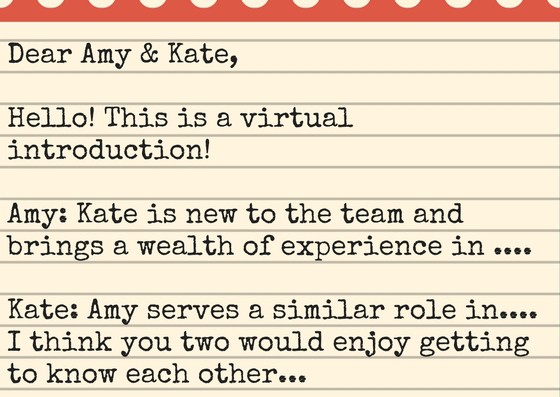
As the new Associate Director at Virginia Commonwealth University’s Grace E. Harris Leadership Institute (GEHLI), I’ve been getting a lot of virtual introductions that sound like these recently. Spend enough time in higher education, and you will send and receive these things so often that you stop thinking about what they really are, which is a basic form of digital networking.
With the growth of behemoth (horrible) professional (superficial) networking platforms, “networking” in the context of digital platforms has gotten a bad name. In fact, if you read enough Forbes.com, you’ll see that the “soft skills” business gurus want you to stop networking and start connecting. To be completely honest, I do not like Forbes.com (or the terms soft skills, guru, business…or anyone who writes about networking but doesn’t really know what it means), but if you read the article I’ve hyperlinked, you’ll find some truth in the fluff: Networks consist of connections. Therefore, effective networks are made up of effective connections. Effective connections are those which make sense, that work, that are mutually beneficial.
Think this through for a moment: We can create networks of people, ideas, and resources. We forge connections through actions like introducing, conversing, sharing, receiving, co-creating. Our digital connections automatically leave digital trails of emails, tweets, hyperlinks, blog post comments. Don’t worry, I’ll unpack that over time. It’s only the first day of #OpenLearning17.
However, tonight, I have my own virtual invitation to extend and my own a digital connection to forge.
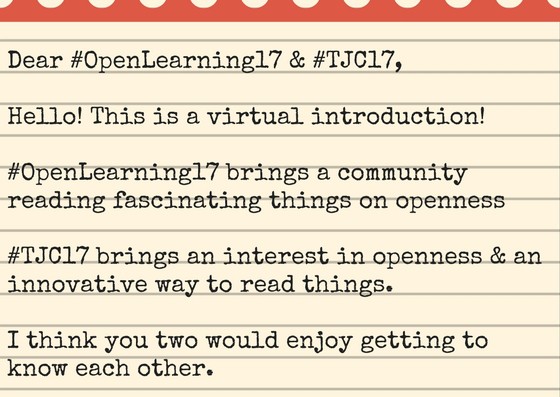
This week, #openlearning17 – an open SCHEV/AACU faculty collaborative experience (I talk more about it here) – is reading a great article called 50 Shades of Open by Jeffery Pomerantz and Robin Peek. It’s so great that Gardner Campbell, the #openlearning17 hub director, thought it might benefit from some special treatment…something akin to the type of reading we did in the Twitter Journal Club (TJC) I founded several years ago.
Some background. TJC was my first real experiment in Twitter-based pedagogy. I was a graduate student who, like all graduate students, was struggling to read everything in the world. When I wasn’t trying to read everything in the world, I was practicing my tweeting by live-tweeting conferences, webinars, presentations, etc (not because I was a graduate student – I did that because I am Laura).
One day, my two worlds collided. I came across an article written by two scholars I knew to be on Twitter, so I began to live-tweet their article as I read it, mentioning their Twitter handles in each tweet so that they would see it. They responded, riveted (so they said) by what this graduate student might make of their writing. Others joined in. Suddenly we were having a Twitter-party-cum-question-answer-session with the article’s authors. It was magical. It had to be repeated.
Out of this emerged a monthly gathering (which sadly has grown dormant over the past year as many of us were completing and defending our dissertations and finding jobs and so forth). But also a website, a peer-reviewed journal article, and an unusual approach to reading scholarly articles.
From the TJC website:
Twitter Journal Club is an open learning experience on Twitter (originally aggregated around the hashtag #tjc15) in which participants read a previously agreed upon article at a scheduled time, live-tweeting as they go. We are now going into our second calendar year and will be working under the hashtag #tjc16…and now #TJC17. The articles – which must be openly available either through pre-print or open access – are recommended by participants via Google Doc and read in order of recommendation.Articles tend to be recently published articles from Open Education/Education Technology/Digital Literacy/Networked or Connecting Learning fields. Article authors are invited to join the conversation via direct invitation.
There is no mandate to read the article in advance (although there is also no mandate to prevent participants from reading in advance). The journal club convenes formally for one hour and while conversations can occur for however long as desired, this hour is archived and published via Storify so that participants can read the transcript if they desireThere are no pre-arranged talking points or questions for the discussion. It just IS.


