All posts by @GoogleGuacamole

Second-Guessing

This tweet.

Too much emotional intelligence increases stress because if you focus too much on the feelings of others, you second-guess yourself into oblivion.  You become paralyzed in your choices.

This reminds me of a guest speaker I was listening to the other day. She said women spend too much time second-guessing themselves in the workplace.  “Was my tone okay?” “Did I say the right thing at the right time?” She argues that men do none of this second-guessing, and that it is a waste of time.

In my head – not out loud, unfortunately – I argued that there is a place for second-guessing; self-reflection is a form of second-guessing. Self-reflection is how we learn.

Moderation.  Too much of a good thing is a bad thing.  Always.

Therapy

I was listening to a successful, high-powered woman executive speak at a luncheon the other day.  Someone asked her about the best thing she ever did for personal development (not to be confused with “taking-a-bath-to-relax” self-care or strictly professional development) and she said “start going to a counselor; if things aren’t going well in your professional life or if you want to make it to the next level, you seek the counsel of a mentor, someone you trust.  Why should your personal life be any different?”

Amen, sister.  I love my therapist.  I’ve been seeing the same one off and on for about seven years now…never more than several months in a row, because eventually I get uncomfortable with my first world problems…but then I always go back, because life. No one holds up a reflective mirror quite as well as my therapist (she’s the professional, after all).  Furthermore, I take more personal risks –  speak my mind, own my mistakes, do things that I might otherwise be kind of scary – because I know she is there to help me pick up the pieces when it all goes wrong.  In that respect, she is probably the best teacher I’ve ever had.  It’s a privilege to go to a therapist – there are cultural, classist, gendered things built into everything I’ve just typed.  One of these days I’d like to sit down with someone who prays and goes to church, someone who meditates and goes to yoga, and someone who journals/blogs and goes to therapy…and look at the similarities and differences.

Getting back on the horse

It’s been forever since I last blogged. There have been things – presentations, projects, parties, and other life events…so many things that I could have blogged about but did not.  Ironically, my excuse is not that I’ve been too busy.  Sometimes I haven’t had the heart, sometimes I’ve been waiting to decide how my blog will fit into my evolving personal and professional identity.

Today, I decided that life is too short to wait. Life is a f—ingly interesting learning experience, and if I don’t start jotting some of these things down, I feel like I’m going to forget how interesting things really are.  I’d hate to look back when I’m 80 and think that I spent most days bored.

So. Inspired by Jon Becker (as always), I’m going to try this whole #365 thing…but not twitter, not photos… I’m going to try blogging everyday. Nothing too time consuming. Just a little note for later, entirely for me.

Day 1

Last night I went to a goodbye party for a neighbor who is moving to Atlanta.  Another neighbor was talking about a recent work trip.  His work is somewhat delicate & international, so I won’t go into details here, but suffice to say he was talking about how much he admired his boss, who had spent the entire trip walking that fine line of disagreeing with his boss in a way that would reassure the individuals with whom they were meeting while not directly saying his boss was wrong – because that wouldn’t be good either.  It was a brilliant navigation of understanding social and organizational culture, managing self, and influencing perception.  It was a game, but one that took tremendous skill, discipline, and confidence.

If I’m going to get anywhere in any sort of organization,  I’m going to have to learn how to play that sort of game. It doubly pisses me off: because I have to admit that I’m not good at this sort of thing (weakness, dammit) and because part of me would love to stay the way I am – just another loose cannon. Being a loose cannon is great, but it might be nice to have something else in the back pocket, to pull out when the situation arises. As my husband says, playing the game is a form of #adulting – get on with it. It’s time to stop refusing to play the game and learn how to play it well.


Featured Picture: Maarten van den Heuvel, unsplash.com

Laying Out My Pieces

A quick thought on an Easter morning – When did we stop asking questions? Or did we ever start?

I was in the doctor’s office the other day for a routine check-up. The nurse, who was going through the standard screening questions, said: “And you don’t smoke or drink alcohol.” I responded, “Well, I don’t smoke but I do drink alcohol.” And she said: “Ok, occasional alcohol,” and went on with her screening…statements?

Why didn’t she stop to say, “Can you tell me about your drinking?” What if I were a heavy drinker…maybe even worried about it?  She gave me absolutely no space to share any of that with her.

Similar problem with a colleague.  We have only known each other for four months, but she assumes she knows me, when in reality she knows far less than anyone who follows my blog or Twitter activity.  She doesn’t know the story behind why I believe in collaborative learning.  She doesn’t know that I already have really vivid experiences with self-reflection, the fluidity of identity, and the impact of institutional structures and processes on self-expression and -advocacy. Rather, she assumes that she needs to teach me these things because I am “new.”  I’m not new; I’m an adult, therefore I am not new. I have a history which needs to be reconciled with her experience and our shared space. However, that can only be done if I am allowed to speak about my past experiences.  I need the space to lay out my pieces if I am going to make this integration happen.

Therein lies the importance of asking questions/giving space.

The obvious response is that I should speak up and tell people what I need.  However, the nuanced response is that power hierarchies are real, self-advocacy is not always clear-cut, and thoughtful approaches are needed to identify and then get precisely what you need.

In medical contexts, screening questions are meant to screen. Really there is no excuse for the nurse’s actions. The patient does not necessarily know that they have a problem (hence the need to screen), and shouldn’t be expected to feel comfortable bringing them up especially when a medical professional has already chosen the “correct” answer on their behalf.  I’m still kicking myself for not providing feedback.  I had a lot of reasons (none of them really good enough, I guess) for not wanting to be an ass about it, especially since I don’t actually have a drinking problem (I screen myself).


In terms of work, people higher in the organizational chart need to ask more questions, they need to give more space to the people below them on the org chart.  I will learn how to insert myself even where there are no spaces for me to do so.  When I figure out how to do this, I will let you know.  But for now, a gentle reminder for everyone with power:

Stop.  Think.  Ask questions. Make space.  It’s not only your job, it’s the right thing to do.  It’s also really smart.

Featured Image by: Glen Carrie, http://www.unsplash.com

End of another era

Approximately seven years ago, I left a rapidly growing medical practice for an uncertain future. I didn’t have a plan.  Come to find out, I didn’t have much of an idea about my core identity either, because what I had was so integrated with my profession. The year(s) after I left medicine was (were) very dark, but they provided me with all the opportunities to hit rock bottom, to make mistakes, to ask for help, and to be brave in a Paul Simon, Cool, Cool River  kind of way.

How many times have I blogged about how difficult it is when someone asks me about leaving medicine?  I can think of three separate post and a handful of tweets, but there have probably been more. I haven’t liked it very much. The comments about my questionable work ethic,  my presumed student debt and the disappointment to my family, the rumors that I must be addicted to drugs or alcohol or guilty of extreme malpractice — I’ve heard them all.  All of those things would flash through my head – along with a healthy dose of self-hatred (for not being able to stick with it, to prevent burnout, to advocate for myself better) – every time some stranger would casually ask me why I left medicine…and then walk away after a minute or two leaving me to re-play my answer in my head over and over and over again.  I never answered well.

Things changed last week during my MBTI certification.  In one day five different clusters of people walked up to me and asked me why I had left medicine (it’s a long story on why they knew I was a physician in the first place – even when I don’t include it in my intro, it invariably comes up. It’s such a large part of my perspective on life that it always does).  I have no idea what made this day different. Maybe it was the intensity of the experience, the fact that they were all genuinely curious. Maybe I truly am done with feeling victimized by others’ assumptions.  I don’t know.  But I finally got my answer in place in a way that doesn’t leave me torn up after I’m done giving it.

Today hasn’t been the greatest day.  It wasn’t the worst, but I’ve moved on to my next hangup, -the next professional hurdle I need to move past.  I’ll save that for another day, but I want to take a moment to celebrate this victory for what it is. I deserve this.

So.  My two minutes on why I am no longer a physician.

Why I Am No Longer A Physician

By Laura Gogia

Three reasons.

  1.  A lack of resources.  I went to work in an underserved, isolated region straight out of residency training. I was the only gynecologist, the only female surgeon, the only surgeon who was also the mother of tiny babies.  I worked in a hospital culture rife with sexism, sexual harassment, bullies, mediocrity, and general dysfunction.  I had no mentors, no peers, no backup, no help, no call coverage, no vacations, no strategies for dealing with desperately poor, uneducated, holistically unhealthy populations. I was all in, but I was unprepared.
  2. A lack of opportunity. A lack of peers means a lack of professional development. Medicine is easy enough to keep up on via conferences and reading; surgical skills require practice and interdisciplinary training.  I refused to place my patients at risk for the sake of my learning curve.  My surgical skills were out of date in three years and that was unacceptable to me.
  3. I wanted something different.  I love people and their stories but I am not built to engage with so many people in intensely important (sacred, even) one-on-one scenarios everyday, nor am I built to work the same, limited number of diagnostic algorithms day in and day out. To be happy, I need more freedom, more quiet time, and more creativity than the proper practice of medicine allows.

There.  That’s the whole story.  It’s actually quite simple and logical. It’s also entirely forgivable…maybe even brave and very smart.  And I can say it without wanting to cry or throw up after I’m done.

On to the next challenge.

Featured Image by Chad Madden, http://www.unsplash.com

I am officially MBTI certified

A couple of weeks ago, I met my former advisor at a campus coffee shop.  It had been a while since we had caught up and the conversation went as these things usually do. He updated me on his research plans and I told him all about my new job.  Things were going well and with minimal angst until I brought up the upcoming MBTI training:

Me: They’re sending me to learn how to give the Myers Briggs.

Him: Really?

Me: I need your reassurance that i’m not going to get dumber by getting certified in MBTI testing.

Him: You’re the one with the doctorate in research and evaluation. 

Me: What if they brainwash me?

(Anxious silence)

Him: You’ll probably be okay.

(Anxious silence)

Him: Just don’t get brainwashed.

My transition from institutional research to leadership development has not been gentle.I had to hit the ground running, reading everything from Forbes to Harvard Business Review while also developing reading lists, proposing conferences, and creating sessions. Three months in, and I’m still trying to make sense of the field of leadership development. I’m not a fan of what I interpret as a organizational development, adult education, and social/developmental psychology melange interpreted through a cloudy and unchallenged business lens and served up with a side of fluff.

For me the struggle against business-lite is real, and I don’t think that I am alone.  For as many business executives and executive coaches swarming around glossy and well-marketed personal assessments, there are as many academic researchers who challenge their efficacy and use.

As I wrote in a previous blog post, I have not had the best consumer experience with the MBTI.  However, it is a fairly non-negotiable part of my job. I was not asked to get certified; I was told.  Therefore, I needed to be okay with this experience.  I focused on the fact that my experience with the MBTI had been as an uneducated consumer.  I recognized that I really didn’t know anything about the MBTI.  Finally, I shut up, opened my mind, and drove up to a Courtyard Marriot in Northern Virginia to figure out what I was missing.

I’m only going to say this once, so listen up.

I was not wrong about my previous experiences. Furthermore, given that many people experience the MBTI similarly to the ways I did, the concerns I listed in my previous post are valid.  However, I was wrong about the MBTI.

I have taken the MBTI several times, usually in a classroom setting, without initial coaching (e.g. how to take the test), contextualization (e.g. specific purpose of the test), or follow-up counseling (e.g. how to interpret and use the results).   In other words, it was given to me inappropriately. In fact, the Myers Briggs Foundation would say it was given to me unethically.  While anyone with a master’s degree in counseling or similar can order and distribute tests and reports, relatively few people are certified or have received specific training in how to interpret and use the tests.  In other words, lots of people give these tests and plenty of them are doing it wrong.

I am certified in MBTI coaching and facilitation and I have a few things to say.

MBTI has a theoretical framework. MBTI is based on Carl Jung‘s theory of personality type.  Jung wrote that individuals are born with innate preferences for how they focus their energy (introversion or extroversion); take in information (sensing or intuition); and make decisions (thinking or feeling). How individuals express these preferences will be shaped over time through culture, parental expectations, life experiences, etc.

After Jung published his work in the 1920s his American contemporary, Katherine Cook Briggs began to adapt it into an inventory of questions that could be used to help people identify their preferences. Among other things, she and her daughter, Isabel Briggs Myers, added an additional axis to Jung’s theory related to how individuals choose to orient themselves to the world (judging or perceiving).

MBTI has changed over the years. The questions are constantly tested and refined. If you took an MBTI in the early 1990s and found it to be gendered, you are not wrong.  It was revised in 1998. Recent evidence suggests it is there is no longer a gender bias present.

MBTI has some advantages over other personal assessments. Results given through Myers Briggs are positively framed.  There are no wrong answers.  Every type has its own special strengths and weaknesses. The inventory provides insight into healthy normal human behavior – not pathology.  The positive nature of the Myers Briggs works for marriage counseling.  It works for team building. It works for personal growth.  As an academic, I like the Big Five, which is more commonly used in academic research than the MBTI. Go ahead and call me an introverted, curious, antagonistic (but conscientious) neurotic, because I can take it. However, imagine sitting with your work group and being told you are an antagonistic neurotic.  Like I said, it works for me, but it doesn’t work for most…even other antagonistic neurotics.  The positive nature of the MBTI works in practitioner-based scenarios.

MBTI appears to be reliable and valid. Trained skeptic that I am, I looked at sample sizes, populations, reliability, validity.  The number of types in any population (e.g. introverts and extroverts) is relatively stable over gender, race, ethnicity, country, language, age, employment status, marital status, socioeconomic status, etc.  The Myers Briggs foundation (and independent evaluators) routinely implement reliability (split test and test-retest) testing.  They routinely check validity through reliability and correlational studies (other tests, career choices, factor analysis, etc.).  There is a ridiculous amount of data. I am comfortable saying that MBTI appears to be reliable and valid FOR THE TYPE OF ASSESSMENT THAT IT IS.

So, let’s get to that.

MBTI is a type tool, not a trait tool.  It indicates that you have a preference for introversion or extroversion; concrete versus abstract thinking; logical/systemic vs instance-centric decisions; early-bird versus just-in-time organization. It does not measure “how much” of something you have. It does not measure how good you are at something.  It doesn’t even measure what you usually do in the world. It is about your innate preference. When your assessment returns with something like “you have a very clear preference for introversion” it means just that: You are clear on your preference. You know that you prefer introversion.  It does not mean you are a “strong introvert.”

MBTI is a self-report inventory. Mindset is critical. In my previous post, I mentioned how I used to change my answers to suit whatever person I wanted to be the day I took the test. Yes. A high school student can game the test, which is why it is essential to provide appropriate instructions when you facilitate a Myers Briggs assessment.  You are supposed to take it as if you were in a perfect world and could always do things the way you want to do them. When you look at a word pair, choose the one that seems easiest, more natural. The idea is to cast off your roles and others’ expectations. When you don’t do that, you aren’t really getting to your innate preferences. If you don’t want to get to your innate preferences, you won’t.  The individual taking the test has to be fully cooperative, have full buy-in, have some knowledge of themselves or this thing won’t work.

Appropriate post-assessment counseling is essential. Which brings me to my point: sometimes it is hard to cast off cultural, community, familial, or even personal expectations. Sometimes we don’t know the difference between them and our innate preferences.  Conflicts such as these (between innate preferences and cultural expectations) will often show up in Myers Briggs results. Someone who knows how to interpret the results can see the conflict.  What a wonderful opportunity for self discovery.

So let’s talk about post-assessment counseling.

This is a facilitated self assessment. The client decides their type.  The test does not label you. The Myers Briggs Foundation is clear on this. When facilitating the MBTI, a certified coach must go through the following steps, in this order:

  • Have the client take the test but not see the score.
  • Describe the dichotomies (I vs. E; S vs. N; T vs. F; J vs. P) to the client and have them hypothesize their type.  This is an interactive activity, lots of questions and counseling (First hypothesis)
  • Review the assessment results with the client (Second hypothesis)
  • If the client took Form Q (includes information on personality facets), review these results with the client(third hypothesis).
  • Given all these data points, the client decides their own type.

Facilitation can be oriented in different ways.  The type of things your coach does with these results will depend on the context in which the inventory was given.  There are dozens of contexts; I’ll discuss three.

Team building.  Sometimes teams will take the MBTI together and a coach will be hired to facilitate team building around the results.  In these cases, the focus may be on the team personality type rather than personal types.  Discussions and facilitated activities might focus on how the team tends to process information or make decisions; how other teams or supervisors might perceive them; how certain members might dominate or be dominated through in certain group norms or behaviors; how to appreciate or communicate with other team members.

Relationship dynamics. Some of the therapists I know will ask couples to take the MBTI so that they might begin to develop a language for talking to each other and understanding their differences.  I completely get this now, but I’ll need to go into a little more detail to prove it.  When you receive your four letter type (mine is ‘INTJ,’ you can google it if you like), you also receive a dominant, auxiliary, tertiary, and infantile traits. Dominant is exactly what it sounds like.  Auxiliary supports the dominant. Tertiary and infantile are much less well developed, although in times of extreme stress the infant will often jump into the driver seat.  You know those times when you say “I have no idea what happened to me – that was so uncharacteristic…it’s like I went crazy”?  Your infant was in the driver seat.  I can explain it to anyone who wants the detail, but suffice to say, there is a formula. When my husband and I reviewed each other’s Myers Briggs identified stress reactions, there was such a huge A-HA! moment. We can now identify each other’s craziness as a stress reaction rather than straight up craziness.  This can only be good for our relationship.

Personal growth. As I said in my last post, Myers Briggs is a starting point, not an end point. The questions that emerged for me as I studied these traits were deep and uncomfortable.  I questioned the source of my empathy and emotional intelligence.  I questioned my choice in practicing and then leaving medicine.  I questioned my relationship with my parents, my husband, my friends. I sweated through every shirt I took with me to Northern Virginia.  I had a tension headache every day by 12 noon.  I worked hard this week.  However, it was worth it. I came away with a better understanding of what has happened up to this point in my life.  I forgave my parents, my partners, and even myself a little.  I let some things go and I celebrated others. I got some closure and some confidence. I am and will always be more than my MBTI, but this silly little facilitated self assessment challenged me – it asked the hard questions and I worked just as hard to answer them. It was good. Really really good.

Bottom line: Maybe I’m brainwashed, but I’m also stronger and smarter than I was a week ago. I highly recommend taking the Myers Briggs, but only if you are going to do it right.  Get a purpose. Get a coach.  Get ready to do the work.

Featured Image is my own.


The conclusions to a struggle with personal assessments, specifically the MBTI

For most of the upcoming week I will be holed up in a mid-priced suburban extended stay hotel becoming certified in Myers-Briggs Personality (MBTI) testing and – as is typical of everything I do – I am feeling quite conflicted about this.

When I heard that I would be engaging in MBTI coaching as part of my work, my knee jerk reaction was something similar to what was written in this Huffington Post article. Like the author, I am highly skeptical of the MBTI. My high school administered these assessments almost yearly and I overhauled my personality assessment to suit whatever vulnerabilities were secretly ruling my day. Did I need to feel pretty and feminine? I’d dress myself up as a feeling extrovert.  Giving in to my sarcastic side? Judging introvert. Pretending to be a creative free spirit? Intuitive perceiver.  I’ve officially been them all.

Furthermore, like the author of this Harvard Business Review article, I am concerned about the harm – potential and realized – of the MBTI box. When I take the test as honestly as I can, I am a very strong INTJ.  It’s the rarest type for women and in my more vulnerable moments, this knowledge only reinforces (or somehow excuses in a very illogical complicated sort of way) how awkward I feel in gendered social spaces like bridal showers or “ladies nights.”   I know from personal experience that boxes can be very limiting when you apply them to yourself or others because I do it.  I do it just like everyone else does it all the time.

Finally, despite the fact that I seem to put a lot of stock in the power of categories and labels (I am a “J” after all), I would like to think I am more than my MBTI label. I have functioned successfully in dozens of diverse contexts that require me to learn how to act against any sort of type. The Myers Briggs folk like to equate their assessment results to handedness. Yeah, well, when necessary I can be ambidextrous.  Surgical instruments are right-handed. I was hit on the wrist with the back of a scalpel until I could cut suture, clamp vessels, and tie knots as quickly and accurately as the right handed residents. In life our preferences don’t necessarily mean anything; we learn what we have to learn.

That being said, refusing to engage with MBTI or writing it off as idiotic is not a viable option for me. Therefore, I need to find a way to come to terms with it.

I started by reaching out to my network.  I know therapists.  The therapists I know have mixed feelings on the MBTI.  Some discount it entirely for reasons similar to the ones I’ve listed above.  However, others talk about how it offers a vocabulary to those who have none for talking about their preferences or behavior.  The MBTI gives them a place to start in understanding themselves and their relationships with others. Furthermore, this place is positively framed. According to one therapist with whom I spoke, many people blame themselves for what they see as personality shortcomings.  MBTI takes away some of the perceptions of pathology, negativity, or less-ness so that the real work and understanding can begin.

Then I put on my researcher hat.  While observing a MBTI group coaching session, I put aside my own objections and observed what was happening around the room.  I saw some evidence of participants feeling validated.  Many expressed delight, stating that they felt heard and understood, some “for the first time.” I heard participants describing their workflows to each other, picking up terms and phrases from the MBTI assessment manual to communicate with one another more effectively.  I saw people with completely different workflow preferences working to negotiate an action plan that suited both of them (a negotiation mediated through words they had learned from the MBTI). I heard people say “Hey! I wonder if that’s why so-and-so does that…” as if light bulbs had just gone off in their head. I heard the beginnings of curiosity, that if properly coaxed, could lead to something a lot more interesting than MBTI.

Finally, I reached inside. Recently I took the conflict dynamics profile (CDP) as an observer of another leadership development program.  If you aren’t familiar, it’s probably exactly what you think it is. The assessment offers a series of statements regarding how you might act or interact in times of conflict and you provide a score for how frequently you think you engage in that specific behavior. The scores add up and provide you with a profile that tells you how often you use active-constructive responses (e.g. creating solutions, reaching out to resolve conflict, expressing your emotions honestly, taking the perspectives of others); passive-constructive responses (e.g. reflective thinking, delay responding when triggered, adapting to reality); active-destructive responses (e.g. demeaning others, retaliating, winning at all costs, displaying anger); and passive-destructive responses (e.g. avoiding, yielding, hiding emotions, self-criticism).

Overall, my results were good.  I am nothing if not active in any conflict. After years in and out of cognitive behavioral therapy (I keep going back because it works for me), I’ve got my active-constructive responses nailed firmly in place. However, I need to work on the passive-constructive responses, particularly delaying my response when triggered and adapting to reality when things don’t go my way.

This weekend, I had to drive my kids and my mother-in-law up to Pittsburgh for a bridal shower.  I’ve already mentioned that bridal showers aren’t really my scene; I have a lot of internal stuff going on as well as all the normal stuff that happens with in-laws, weddings, and really long drives. Things happened.  I got triggered.  And you know what happened after that?  Without even thinking about it, I grabbed on tight to my conflict dynamics profile.  Even as I was boiling away in some crazy blend of self-loathing and resentment, a part of me was excited by a perceived growth opportunity.  I forced myself to try walking away and I taking my time, because nothing with the other parties is going to change in minutes or even hours (delaying response).  I forced myself to stop focusing on what happened and start focusing on how to negotiate happiness with the current reality (adapting).  I came up with a plan, made it happen, and ultimately ended up in a better place than I would have if things had gone as originally planned.  It wasn’t pretty, nor was it automatic, but it was still perfect.  And I got it done because the stupid conflict dynamics profile gave me some vocabulary and a framework for a personal growth plan…something simple enough that I could grab onto it in the moment, without a therapist or coach present, under pressure, and in Pittsburgh, Pennsylvania.

My conclusion:

  1. Personal assessments are a starting place, not an end point, for self awareness and reflective practice.  I have a pretty solid foundation of skills and strategies for self awareness and reflective practice. The MBTI is not for me, because I don’t need  a starting place for understanding myself and my relationships with others. I’m more of an intermediate player. Obvious statement: Not everyone has been as lucky or privileged as I have been. Not everyone has had my past experiences. Quite a few adults can actually use a MBTI. The key is to make sure that people understand them as a starting place and then carry through with developing the curiosity about others that MBTIs trigger.
  2. Some personal assessments will be more useful to an individual than others. An obvious point of course, but a useful reminder to leadership coaches who pass these things out like they are cotton candy.  Maybe there is a place for personalization. Maybe there is a place for sitting down with participants first, finding out where they are in their personal development and goals, and making a tailored plan. Maybe that will make those personal assessments even more effective.
  3. Personal assessments without proper pre- and post-assessment counseling can be a waste of time (at the least) or harmful (at worst). I stand by this statement as I stand by all my knee jerk reactions I listed at the beginning of this post.  I was not all the way wrong.
  4. The best way for me to push forward my own agenda of points 1 through 3 is to get started. Damn it, Laura, stop dragging your feet, take the training, and use it to help you build some kick ass sessions.

Time to pack.

Featured Image: Andy Beales, unsplash.com

New job, new narrative

Starting a new job has its challenges, one of which is introducing yourself and getting to know your work colleagues.  I attended my first faculty meeting several weeks ago.  I didn’t know anyone in the room except for my boss, so she introduced me, I smiled and waved, and the meeting went on. It was a fairly typical new employee experience.

Then the inevitable (for me, at least) occurred: when I am introduced as a former physician to a group, there is often at least one person who approaches me after the meeting to ask for one sentence on why I would leave a medical practice.  One sentence.  I know they don’t want more, because they ask while we are exiting a room, or entering an elevator, or waiting in the food line at a reception. Within one sentence of my explanation, they wander off, usually after shaking their head (as in “what a waste”) or making a comment about student debt.

These situations really bothers me, mostly because of the assumption that questions about my decision to leave medicine can be answered simply, and that they are appropriate for small talk with a very new acquaintance.  The fact that it makes me so angry has led me to conclude that there is more to my reaction than frustration at rudeness.  When I get angry, it is almost always because I am feeling vulnerable. I know this about myself.

New jobs – new work colleagues, new duties, new workspaces – are opportunities for reinvention: to tell different parts of your past, dress and behave differently, and learn from past mistakes, to be a different sort of work colleague.  As I ease into my new role, I find that I have kept my workflows and office decor. Blogging, whiteboards, and interchangeable/temporary gallery-style photos (although this time with a theme and a color palette) are undeniably me, no matter what.

Nevertheless, I changed my wardrobe. Gone are the Old Navy student duds and in their place is Talbot’s entire deeply discounted winter line (God help me if my mother reads this, since I once told her that I would *never* like anything from Talbots, but yes, it happened. Shh.).

More important, I’m in the process of changing my work narrative…and I think that is why being surprised in the hallway outside the faculty meeting with superficial questioning about my past made me so angry. Despite all the years and reflective blog posts, I have yet to figure out how to talk about what happened when I was practicing medicine.  I don’t know how to encapsulate the professional and personal isolation and the systemic sexism and the challenging patient population and the burn out… Not in one minute with a stranger while navigating a crowded space.  Not when I’m trying my hardest to make a fresh start without completely wiping the slate clean. I do not know how to handle this situation.

However, I am getting something else right.

When I started in my new position, a position in which I design and teach leadership development for faculty and the community – I made the intentional decision to prioritize self-care and work life balance. I had my reasons.  First, I’ve never been anything than a workaholic.  Second, I’ve experienced burn out before and left one career, so I’m concerned about leaving another. Third, I really should model what I am teaching.

Also, I want to change who I am at work.  I want a different story.

I have worked for and with many people across fields and disciplines. My favorite leaders – the ones I admire and would like to emulate – have been calmly competence, or at least they have been really good at giving that appearance.  They are efficient.  They do not take their stress out on their subordinates. They delegate well, provide ample feedback and growth opportunities, and give credit where it is due. I don’t mean that in terms of handing out gift cards, I mean that as caring about and respecting their employees. These leaders also seem to take care of themselves – they eat, they look good, they exercise, they read, they get haircuts, and if they need to go to the doctor, then by golly they make an appointment and they go.  I presume they do these things because it sustains them and makes them better at their jobs. This is the type of supervisor I want to be. I want to be sustainable as well as excellent.

As such, I have made an intentional decision to engage in self-care.  I eat lunch – often at my desk, but quietly and at rest.  I meet with friends on campus for peer coaching and networking.  I consistently leave work for home (almost) on time.  I rarely bring work home at night and limit my weekend work to no more than several hours on Sunday (if that).  I make and keep doctors appointments. I get hair cuts.  I sleep. I exercise, but not if it gets in the way of sleep.  Sleep comes first.

Self-care, specifically leaving the work on the desk at 5pm, has not been easy. There has been a lot of anxiety around not getting all of my tasks done as soon as they emerge. Given that I am supervising a large program evaluation, creating a communication plan, pitching several new programs, creating and teaching new sessions for existing programs, and orchestrating widespread infrastructure updates…*none* of these things were ever going to get done on a dime anyhow. But not giving in to the impulse to work nonstop has taken discipline, and a constant reminder to myself that there is time, the world will not end, the work can and should wait for me to recharge.

In being more disciplined, I have learned to let go.  I was working hard on a presentation last night…granted, I worked until 10 pm, but then I stopped and went to bed rather than work on it through til this morning.  It got the work done.  It was fine.  Furthermore, I have been delegating to student workers.  Granted, I have to correct some of their work, but I am teaching them about coding and database organization even as they do the detail work for me so that I can focus on data analysis. I have asked and received more help from my family around the house – they help me do tasks I once did all by myself, because I need time to unwind just as much as anyone else does.

Self-care takes discipline, but I have also seen results.  I am more efficient.  I feel more grounded, engaged, resilient in my work than I ever have.

Engaging in self-care has not been easy, but it is also beginning to make a difference in my narrative.  It’s too early to say if I will ever achieve calm competence, but today, someone from my workplace announced to a large group of people that I had inspired her to try harder in her own quest for work-life balance.  Apparently, I “leave the office on time almost every night” and I still get an extraordinary amount of work done. Apparently, that’s something to behold.

New job.  I’m changing the narrative.

Featured image by Ellie Pritts, CC-O

Peer Coaching: The Basics

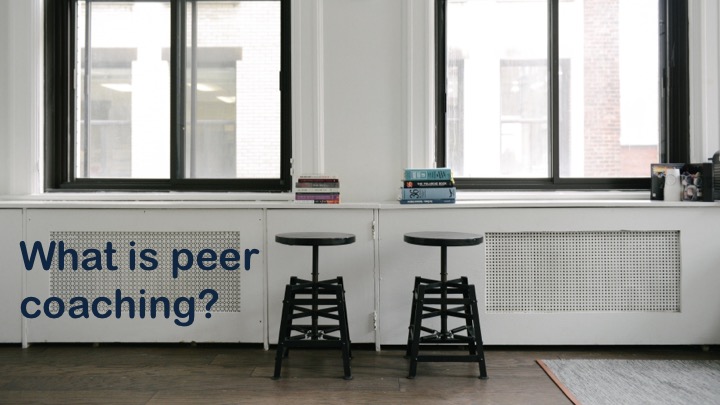
Last week I was responsible for introducing a faculty group to the concept of peer coaching.  Most in the room had heard of it but few had participated in any sort of formalized peer coaching experience and no one could define peer coaching or differentiate it from other forms of coaching, mentoring, or training.

Click to view slideshow.

What is Peer Coaching?

Peer coaching is a confidential, mutually beneficial relationship through which two professional colleagues reflect on current practices, learn new concepts and share ideas, and solve work related problems…TOGETHER.

Peer coaching is characterized by certain key behaviors.  First, peer coaches function within a formalized structure: They meet at scheduled intervals for a specific period of time (usually devoting 15-30 minutes to each peer); work through explicit goals or problems; focus on action-oriented conversation; and identify next steps or means for accountability before the end of each session.

Second, they engage in active listening. Active listening requires the listener to think through what is being said. Does it make sense? What are the implications related to the specified goals or desired outcomes? What sorts of patterns of thinking or behavior are present?

Third, when peer coaches are actively listening, they take a curious stance.  This means that when things don’t make sense to the listener (based on their understanding of the situation or their past experience), they ask the speaker to clarify until it makes sense to both of them. “Can you help me understand?” allows the listener to find out more without putting the speaker on the defensive with a bunch of “Why did you do that?” questions. When being curious, it behooves the speaker to remember that whatever is being said needs to make sense from the context of the speaker and not necessarily the context of the listener.  Empathy and openness to new perspectives is key to success.

Finally, peer coaches become reflective mirrors for the speaker, paraphrasing what the speaker has said so that both can be sure that they are hearing the same things.  When peer coaches reflect the speaker’s thoughts back to them, these thoughts become external and concrete.  The speaker can engage with their own conclusions more critically and effectively, often finding their own solutions with very little original input from the listener.

Peer Coaching Is Not:

  • Peer coaching is not mentoring. It differs from traditional mentoring relationships in terms of power dynamics. Since peers work on things together, peer coaching is rarely an exercise in advising or guiding. There is much less modeling and much more give-and-take in peer coaching than in mentoring.


  • Peer coaching is not chatting with a friend. It differs from a conversation with a friend in terms of structure.  Peer coaches stick to schedules and explicit goals with much less whining, joking, and moving off topic, and much more active listening, receptiveness to feedback, reflecting, and problem solving. Most importantly, structured peer coaching events are action-oriented and always end with “next steps” to ensure accountability.
  • Peer coaching is not sharing of technical expertise. Peer coaching does not focus on the same type of content as a technical tutorial; this is not teaching a co-worker about the agency database; this is about professional and personal development.
  • Peer coaching is not mental health counseling. Oftentimes, peer coaching is personal development, which means conversations often wander into emotional realms. For example, peer coaches often provide feedback on things like interpersonal communication and impact of homelife on work life (and vice versa). However, if a partner’s concerns seem to require more or different sorts of feedback than their peer coach feels comfortable providing (or if they are taking over more than their share of the conversation…remember, this is a mutually beneficial activity), then the peer coach needs to speak up and suggest professional counseling and the speaker needs to be open to accepting that feedback.

Peer Coaching Topics

The leadership development literature suggests that peer coaching can be helpful at any point in the career arc. Early professionals who engage in peer coaching tend to develop higher levels of confidence in their professional identity and organizational and disciplinary knowledge while also building the foundations of the professional network that will sustain them throughout their career. Mid-career professionals often use their peer coaching relationships to facilitate re-evaluation and growth.  Finally, late-career professionals can engage each other around the self-reflection required to develop their legacy and transition away from their career.

Activity

After definitions were provided, session participants took a moment to consider a question or concern they might want to address in a peer coaching context.  Once they had a topic in mind, they paired off and took turns discussing it with their peer coach. After 15 minutes each, the partners provided each other with feedback before reporting out to the group.

Feedback

Overall, the session was well-received.  These particular participants did not seem to have any difficulties engaging in active listening or taking a reflective or curious stance. However, they voiced surprise about several different aspects of their peer coaching experience.

  • Their experiences and problems are not entirely unique. Because participants were randomly paired, they spoke with peer coaches from very different units within the organization.  Many were pleasantly surprised to find out that their peers from other parts of the organization had had similar experiences or were facing similar problems – it added a sense of validation (and relief) to the process.
  • The efficiency of the process. Others were surprised they were able to identify a goal or problem and work their way towards a concrete action plan in a 15 minute session. They credited their results to the intentional focus and active listening of the peer coaching experience.

Ultimately, many session participants – none of whom identified as engaging in peer coaching activities at the beginning of the session –  recognized that they were already *almost* engaging in peer coaching with work colleagues or friends… often over lunches, coffee dates, or afternoon walking breaks. We discussed how, with just a little bit of tweaking (usually around the integration of next steps or accountability into the discussion), they could take those conversations to the next level.

For more information on peer coaching, check out

Use Your Staff Meeting for Peer to Peer Coaching

Honing Your Skills as a Peer Coach

Peer Coaching Guidelines

Featured image by Unsplash contributor, Annie Spratt (CC-0). Slide images by Unsplash contributors, Breather (CC-o).


Connecting Spaces

This afternoon, the steering committee for #openlearning17, a AACU Faculty Collaboratives Experience, met to discuss what has gone well with the experience thus far and what we can do to improve.  Several of us mentioned how thought-provoking and mind-binding the Twitter discussions have been, but others have made a request: specifically, those who have been attending Twitter discussions regularly want a little time to get to know each other.

To that end, let’s carve out a little time.

One of the more interesting things about connecting with people in virtual spaces is the knowledge that they could be doing all sorts of physical things in all sorts of physical places while they are holding that conversation with you. While I take pride in the fact that my online personality is very much the same as my face-to-face personality (maybe a little more confident, but I’m working on that), I’ve hosted Twitter chats from airplanes, airports, the attic, a Lincoln Town Car, a hotel bar (while ducking to avoid a bar brawl), taxis, offices (mine and others), my car, on my phone, in my doctor’s office, at the Hair Cuttery, and on four different continents.

What I’ve come to appreciate over the years is that physical context matters to our online interactions, as much as anything that is going on in our head while we are chatting.  And knowing the physical environment of those with whom we chat helps us get to know them.  It makes them more real.  It makes us more comfortable. Therefore, I propose the following:

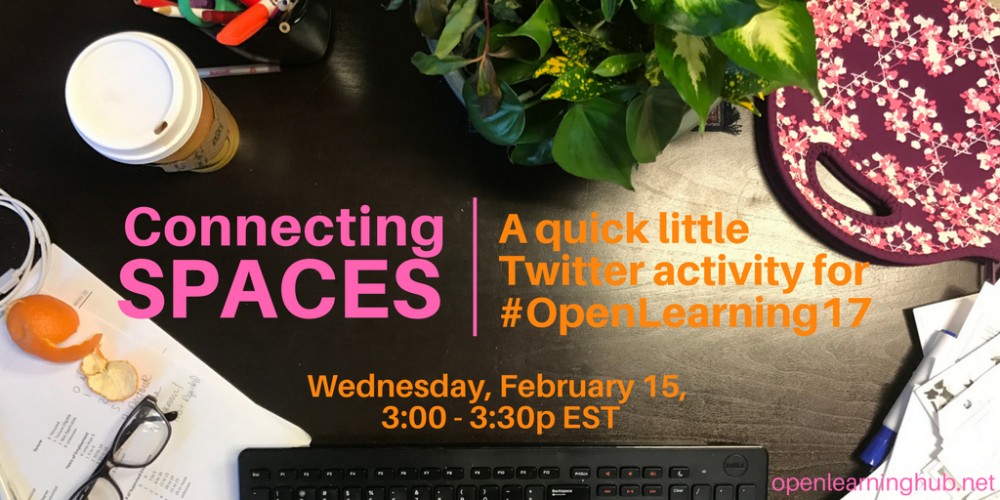
an invitation to connecting spaces: a quick little twitter activity for #openlearning17, wednesday February 15 from 3:00 to 3:30 pm eastern standard time. The invitation is placed on the background of an office desk, with glasses, an orange peel, some papers, a coffee cup and a plant.

That’s my office desk, by the way.  I bring my lunch because I prefer simple lunches and don’t like to waste valuable time going out.  I buy a large cup of coffee (a splash of milk) as a personal incentive to leave the seat warmer in my car every morning. I love seat warmers. I have to take off my glasses when I read because I’m months away from needing bifocals, and I’m trying to keep a dish garden alive, because one would think that an adult old enough to consider bifocals might be able to maintain a plant.  Also, I am building a database and working hard to develop coding schema that make sense and are entirely sustainable (all those papers).  I’ve been on the job for a month.  It’s not like I’m applying any pressure on myself at all.

On Wednesday, February 15, 2017 at 3:00pm EST, I will be hosting a quick little Twitter activity called Connecting Spaces.  Come. Chat however feels comfortable, but it might be interesting if we share a little about our physical spaces.  Where are you?  Why are you there?  Why or why not do you like to engage in Twitter chats in this space?

Taking a picture of your space, or better yet, a quick video would be a great way to introduce yourself.

Regardless, I hope to see you there.