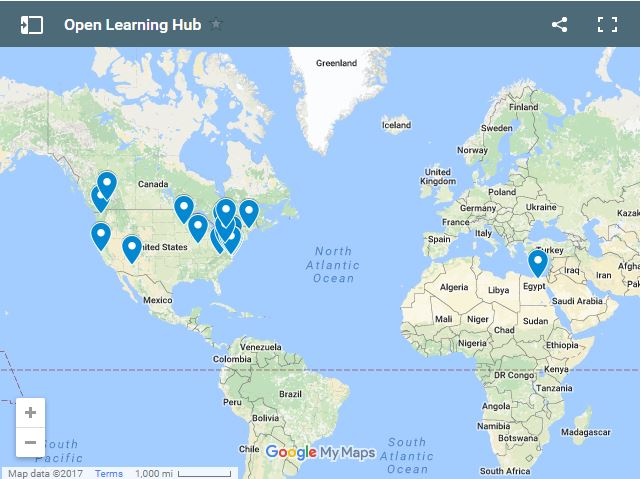
Opening the page for #openlearning17…

This blog’s initial reasons for existing are contingent and instrumental. Its purpose will evolve over time, undoubtedly, but for the moment, it is primarily intended as a tool for participating in the Open Learning 17 cMOOC.

Currently on sabbatical, I have spent a great deal of time thinking about teaching, learning, education. I am hopeful that these reflections will help me better support my students’ learning and allow me to empower and equip them — and myself — for living and working in the twenty-first century. Despite cultural and political forces to the contrary, I am hopeful than openness — open exchange, open access, clarity about power relationships, verifiable accuracy in the public record, freedom of connection, freedom of speech, open-mindedness — will provide humanity with the tools it needs to better understand our universe, to help us build more effective, more helpful, more constructive and more sustainable societies across the planet that allow all human beings, indeed, the biosphere as a whole, to survive in diversity and to thrive.

Open learning, connected learning, collaborative learning, critical learning are all part of what I hope will be an emergent paradigm that points toward increasingly collaborative, satisfying, peaceful and sustainable human cultures. It is not an exaggeration to say that I believe that the long-term survival of Homo sapiens sapiens and of all sentient species depends on a radical shift that must include changes in dominant notions of education and learning.

-rrdaniel2

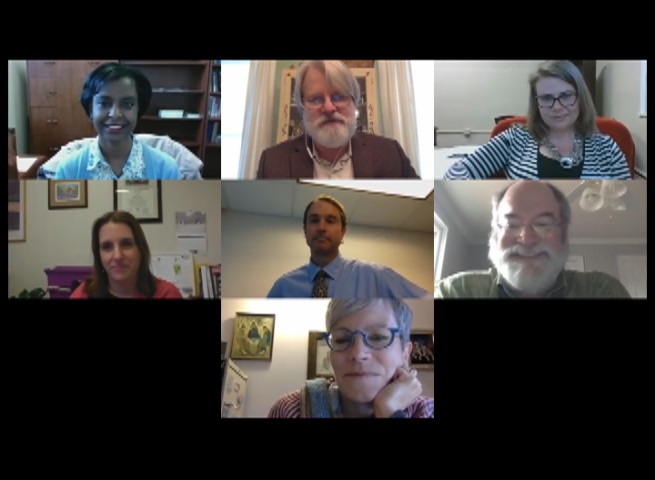
Virginia’s Faculty Collaboratives Steering Committee Welcomes You To Open Learning ’17

For many weeks, Virginia’s Faculty Collaboratives Steering Committee has planned our connectivist MOOC, “Open Learning ’17,” and worked to get ready for launch week. To find out a little more about who we are and why we’re excited to be part of this expedition, please click on the image below.

It’s a cliche to say this is all a work in progress, but it’s also true–and we look forward to what we will all build together. Welcome!

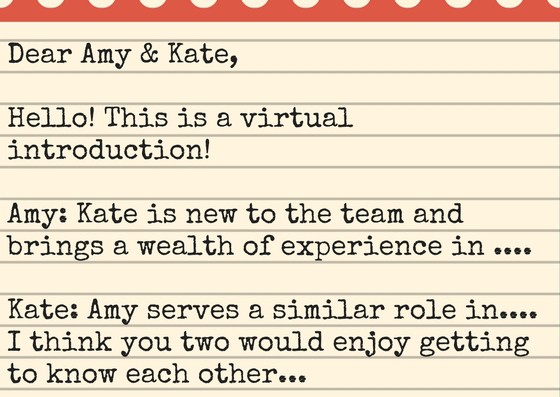
A Virtual Introduction

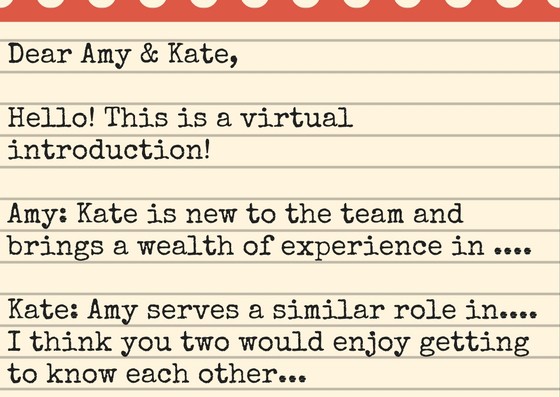
dear-i-want-to-introduce-you-to-laura-gogio-gehlis-new-associate-director-she-is-new-to-the-team-and-brings-a-wealth-of-experience-in-research-evaluation-and-adult-learning-laura-kasey-formerly

As the new Associate Director at Virginia Commonwealth University’s Grace E. Harris Leadership Institute (GEHLI), I’ve been getting a lot of virtual introductions that sound like these recently. Spend enough time in higher education,  and you will send and receive these things so often that you stop thinking about what they really are, which is a basic form of digital networking.

With the growth of behemoth (horrible) professional (superficial) networking platforms, “networking” in the context of digital platforms has gotten a bad name.  In fact, if you read enough Forbes.com, you’ll see that the “soft skills” business gurus want you to stop networking and start connecting. To be completely honest, I do not like Forbes.com (or the terms soft skills, guru, business…or anyone who writes about networking but doesn’t really know what it means),  but if you read the article I’ve hyperlinked, you’ll find some truth in the fluff: Networks consist of connections. Therefore, effective networks are made up of effective connections. Effective connections are those which make sense, that work, that are mutually  beneficial.

Think this through for a moment: We can create networks of people, ideas, and resources. We forge connections through actions like introducing, conversing, sharing, receiving, co-creating. Our digital connections automatically leave digital trails of emails, tweets, hyperlinks, blog post comments. Don’t worry, I’ll unpack that over time. It’s only the first day of #OpenLearning17.

However, tonight, I have my own virtual invitation to extend and my own a digital connection to forge.
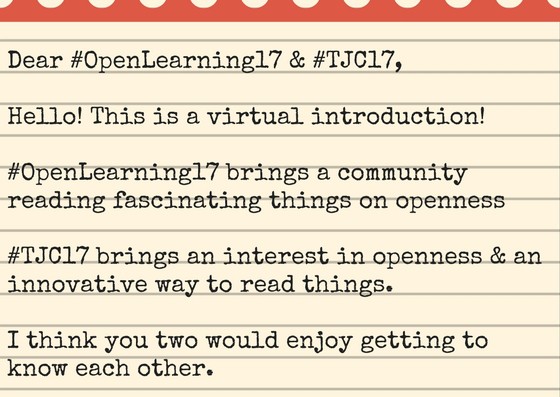
dear-i-want-to-introduce-you-to-laura-gogio-gehlis-new-associate-director-she-is-new-to-the-team-and-brings-a-wealth-of-experience-in-research-evaluation-and-adult-learning-laura-kasey-formerly

This week, #openlearning17 – an open SCHEV/AACU faculty collaborative experience (I talk more about it here) – is reading a great article called 50 Shades of Open by Jeffery Pomerantz and Robin Peek.  It’s so great that Gardner Campbell, the #openlearning17 hub director, thought it might benefit from some special treatment…something akin to the type of reading we did in the Twitter Journal Club (TJC) I founded several years ago.

Some background.  TJC was my first real experiment in Twitter-based pedagogy.  I was a graduate student who, like all graduate students, was struggling to read everything in the world. When I wasn’t trying to read everything in the world, I was practicing my tweeting by live-tweeting conferences, webinars, presentations, etc (not because I was a graduate student – I did that because I am Laura).

One day, my two worlds collided.  I came across an article written by two scholars I knew to be on Twitter, so I began to live-tweet their article as I read it, mentioning their Twitter handles in each tweet so that they would see it.  They responded, riveted (so they said) by what this graduate student might make of their writing.  Others joined in. Suddenly we were having a Twitter-party-cum-question-answer-session with the article’s authors.  It was magical.  It had to be repeated.

Out of this emerged a monthly gathering (which sadly has grown dormant over the past year as many of us were completing and defending our dissertations and finding jobs and so forth). But also  a website, a peer-reviewed journal article, and an unusual approach to reading scholarly articles.

From the TJC website:

Twitter Journal Club is an open learning experience on Twitter (originally aggregated around the hashtag #tjc15) in which participants read a previously agreed upon article at a scheduled time, live-tweeting as they go.  We are now going into our second calendar year and will be working under the hashtag #tjc16…and now #TJC17. The articles – which must be openly available either through pre-print or open access – are recommended by participants via Google Doc and read in order of recommendation.

Articles tend to be recently published articles from Open Education/Education Technology/Digital Literacy/Networked or Connecting Learning fields.  Article authors are invited to join the conversation via direct invitation.

There is no mandate to read the article in advance (although there is also no mandate to prevent participants from reading in advance).  The journal club convenes formally for one hour and while conversations can occur for however long as desired, this hour is archived and published via Storify so that participants can read the transcript if they desire
There are no pre-arranged talking points or questions for the discussion.  It just IS.
As I wrote in Hybrid Pedagogy, the TJC approach doesn’t result in the same sort of outcomes as a typical journal club.  You don’t delve deep into the article as much as spring forth from it.  There is a celebratory buzz around these events, not a somber or studious hum.  TJC sparks conversations and if you come away with one or two nuggets, a list of difficult to answer questions, a bazillionty more references to check out, and you STILL NEED TO READ THE ENTIRE ARTICLE…well then you have been #TJC’ed.
Gardner and I are dusting off the #TJC..now #TJC17 hashtag and rousing the community for a reunion because we think #openlearning17 and #TJC17 might have some fun together around this article.  I’ll be sending out the word (you’ll see it…in all my Twitter glory for those of you who have never seen it before), but you who have gotten to the end of this post will hear it first.
twitter-journal-club-tjc17

Hello #OpenLearning17

I’m excited to join the party at Open Learning: A Connectivist MOOC for Faculty Collaboratives. While I’ve been blogging for the last couple of years at Digital Pedagogy @ Austin College, I’ve inexplicably put off writing and speaking in a space that is truly my own, in a voice that is truly my own. The hypocrisy of it, to be honest, is that I encourage my faculty colleagues and our students to claim their own online domains, to think and write and work in public, to blog and to create in an open connected network. Even though I wasn’t really doing it myself!

For whatever reason, the chance to be a part of this course has broken through my inertia and resistance. Especially after hearing Gardner Campbell’s recent keynote at the OU Academic Tech Expo, and catching his interviews with Laura Gogia, I felt that now was “the acceptable time” to make the leap. I’m grateful that you guys have opened the course to those of us beyond your fair state of Virginia.

Looking forward to learning with all of you…and welcoming any advice and suggestions for shaping up this here blog and website!


Trying not to kill my mind

Since fear is the mind killer, I am trying to have some courage.  My mind needs all the help it can get these days.  My fear in joining the Open Learning 17 faculty collaborative isn’t really about writing poorly or having nothing to say that anyone else wants to read (although I have those fears too); but more a fear that I won’t be able to keep up! Fear of being too busy.  But Laura Vanderkam recently reminded us that it isn’t about the quantity of time we have, but about how we set our priorities.  I am setting out this semester to facilitate an Open Pedagogy Learning Community at Keene State College where I work- but I have a lot to learn!   It seems like a good idea for me to take advantage of as many learning opportunities as I can, so here I am.

A Tentative Toe Dip: #OpenLearning17

I just found out about #OpenLearning17: A Connectivist MOOC for Faculty Collaboratives. Since I’m already on a quest to learn more about open education as I revise one of my primary courses, I figured I’d give it a whirl. To be quite honest, I have no idea what a faculty collaborative is :). It sounds […]

The post A Tentative Toe Dip: #OpenLearning17 appeared first on Camille Freeman.

The network is the deliverable