When I got to college, I discovered there was a thing called intellectual history. Part of intellectual history, I also learned, was intellectual lineage: not just idea leading to idea, but thinker leading to thinker. Groups of writers interacting synchronously and asynchronously. Influences, meetings, letters, fallings-out, all of it.
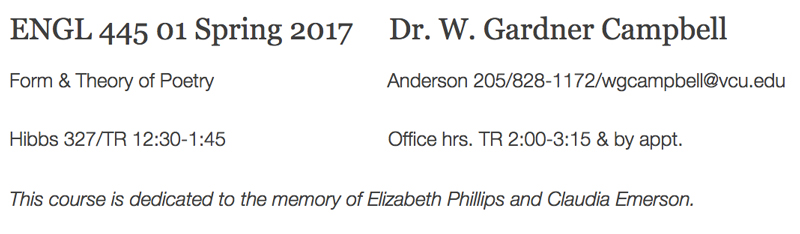
This semester, it occurred to me that I might at least signal to my students that I come from someplace too, intellectually speaking. More precisely, I come from someones. I feel a great cloud of witnesses around me as I teach and as I learn. Those witnesses are intellectual parents, intellectual siblings, and in some cases, even intellectual heirs. These are the people whose work has shaped me, and who have shaped my work. In the most intimate cases, these are people with whom I’ve broken bread. People with whom I’ve fought, and cried. People who’ve believed in me when I didn’t believe in myself, people who’ve encouraged me, people who’ve intervened at key moments. People who are with me as I think and write and teach and learn.
I have always felt that the courses I design and lead, at their best, do not deliver content so much as they mingle souls, as John Donne said letters do. My students sometimes hear a few of my stories, but somehow I wanted to communicate something in a more ceremonial way. So I came up with the idea of putting a dedication on my syllabi. My wish is that students will see how precious our time together may be, and how one day we may find we have changed each other’s lives. I want them to see that courses of study are books, but not just books; assignments, but not just assignments; credit hours, but not just credit hours. I want them to understand that a course of study is more relational than transactional. I want them to understand some of the gratitude I feel.
And I’ll confess it: I want to send a letter of sorts, a communication, perhaps even an eldritch communication in some cases, to the teachers and mentors and colleagues who have sustained me and honored me with their faith and hope and love.
So this semester, my poetry course and my film course both have dedications. The words are small and may well be overlooked, even though I did explain them on the first day of class. In the end, the words may mean little to anyone but me. But I have written them, even as those I honor have helped to write and teach and love me into being. And I am content.
So in December I used Bronwyn Hegarty’s Attributes of Open Pedagogy, along with several other documents to develop a page to use in conversation with faculty about open pedagogy. Last week, I had the opportunity to share it with a small group, and it worked really well in terms of focusing the discussion and talking … Continue reading Reflections on Generosity of Spirit: Barriers to working in the open
We’re back in familiar territory for me on this one, though it’s less on my mind at a community college. Our faculty aren’t the ones doing a lot of the publishing, but we certainly benefit from others publishing OA.
One of the main places my mind goes when I consider OA and this ideal future of all OA research, is finding it. Probably because I’m a librarian, right? As I mentioned in my “Are We There Yet?” post, one of the concepts I sometimes try to emphasize to students is that searching for any kind of depth of purpose is a lot more challenging. Google can provide a very good answer or two very quickly. It’s not good at exhaustively searching and providing every relevant thing to you. You start scrolling down or paging through your Google results and pretty quickly you see the pages aren’t all that helpful. Google wants to have fantastic precision, not recall. Library databases are looking for great recall. They are also much more limited in the resources they provide to the user. They provide facets and filters and controlled vocabulary to help you search more powerfully.
My point is that I think the database layer of library resources will still have a purpose even if all of the content itself is OA. My hope would be that it’s a whole lot cheaper. But I think the tools and added functionality will probably still be of value in assisting the finding of the OA things. Unless someone out of the goodness of their heart wants to create a free version that works really well… But I think in this case, actually paying someone is a better idea in terms of reliability. That’s often the snag with open, free content.
In addition, I think publishers would argue that they add value to the published content through editing, marketing, etc. You can take issue with that and disagree, but I think that would be the publisher counterpoint.
As an E-Resources Librarian, another place my mind goes is… what about the usage data? I wouldn’t need it to determine cost effectiveness if the content is all OA, but I would certainly still want to understand the usage of resources by Germanna students in particular. What are their research habits and how can we better serve them? We use the usage information we get from our databases to help inform us in that. I don’t know how we would get that information otherwise, unless we kept a search layer from our vendors at the least.
And that’s the end of my scattered thoughts about OA.
Our spring break is just around the corner, and as we reach the middle of the semester I am thinking about how things have been going so far with our efforts to bring awareness to the value of Open Education at Keene State College. Jenny Darrow (@gobman) and I have spent many hours this semester immersed in planning and in wonderful conversations about how we can raise awareness about the value of Open Education to our campus. We’ve worked hard identifying and trying to motivate faculty who would be early adopters, excited to rise to the challenge of doing something new. Our faculty Open Pedagogy Learning Community has been humming along with great discussions emerging from that group. We have also put energy into numerous conversations and emails with administrators. (The admin reaction sometimes feels like high enthusiasm and sometimes feels like ‘pat-on-the-head’ support. Perhaps they just haven’t taken us seriously enough to be hostile yet says my cynical self!) But the way our work has been developing this semester has shown us that the students might just be the drivers of this Open Ed bus, the real ambassadors. A New England snowstorm ‘flipped’ the order of our first few guest speakers, and shifted my thinking about what we were doing.
If one of the important tenets of Open Pedagogy is that it is student-driven, then why shouldn’t an Open Education movement itself be student-driven?
compliancesigns.com
The first speakers in our open education speaker series were students: Andrew Rikard, from Davidson College, and Erika Bullock, from Georgetown University. Their visit started with a conversation with our OPLC faculty, and I have to say that the dialogue that emerged, really blew my mind. Our faculty were riveted as the students talked about what it meant to them to take ownership of their learning. (This phrase- ‘students take ownership of their learning’ -really sunk in so much more deeply for me even though I had heard it and thought about it many, many times before).
Erika and Andrew spoke earnestly to professors of their fears about questioning faculty authority, an authority for which they have great respect, and they very much did not want to appear disrespectful or challenging. But they hoped that faculty would “respect the authority of students in their own experiences”. Faculty looked students in the eyes and spoke earnestly about their fear of being perceived as ‘not doing their job’. Students told of feeling uncomfortable with a professor when they ‘don’t know what you want’. We all wondered, how do we make it feel like ownership, not a burden? Erika and Andrew went even further to suggest that students themselves could decide whether Open is really the best path to learning for them. “What is my vision for myself?” “Do I enjoy being a collaborator and sharing?” Faculty pondered “How do we (if we can) increase student intrinsic motivation?”
Erika and Andrew suggested that faculty should be very transparent with students about what they are doing in order to convey a sense of ‘we are all in this together’. When Erika told us about a faculty member that shared her life story in the first class that ended with “…and this is why I am here, why I am teaching this”, it was extraordinarily moving for her. At one point Andrew said, “I got to watch somebody who I thought knew everything, learn.” And Erika said, “I was deconstructing my definition of a student”. Erika also spoke eloquently about her experiences with Open Pedagogy as academic and co-curricular collaboration (a topic for a whole other post). I think there was something particularly powerful for our faculty to hear these kinds of statements directly from the mouths of students. It was also brought up that many of these ideas about student ownership and connected learning aren’t necessarily new, but that they weren’t easy or possible when many of us started teaching, but now technology and domain spaces are making so much more of this possible now. There were so many other amazing moments in this conversation (like how ‘scientists cultivate frustration’); I wish I could have written them all down, but I was too transfixed.
This exchange really got me thinking that Open Pedagogy faculty ‘development’ might be most effectively achieved by having students do the ‘training’.
The presentation, (Trust, Power and Agency) that Andrew and Erika gave later was (without planning it this way) mostly to a student audience, and we ended with a rich roundtable discussion with Andrew, Erika, KSC students and visiting students from Plymouth State University. That discussion moved even further into student engagement- how students should be influencing college policies, designing courses and making curriculum decisions. I wish I would have also periscoped that conversation with students from four different institutions. So much great stuff – take a look at the #KSCollab twitter feed from Feb 24 for some of it.
We originally scheduled Robin DeRosa to be our first speaker in the KSC Open Ed speaker series. Of course, we wanted to begin with a big splash and get everyone fired up and who better than @actualham? But due to the weather, Robin followed Andrew and Erika. And, our OPLC faculty were already fired up by the students! And then, when it came time for Robin’s talk, apparently all of our advertising that said, ‘make sure you bring students too’- resulted in an unexpected 75-80% of the audience being students, and the rest faculty (we counted a single administrator).
But the talented and audacious @actualham (and Robin is surely ready to kill me with all of my adjective use lately, but this one really works here and I love the alliteration), instantaneously transformed her presentation, Putting the Public back in Public Education, for a mostly student audience. And I mean instantaneously. I think she had about 3 minutes to think about it. (She IS a genius among geniuses and anyone who thinks I am just another ‘over-the-top actualham fan’, will mark my words some day).
What was particularly great, was that Robin got the students fired up, not mainly about textbook costs (although they certainly cared about that too), but about the Open Pedagogy! They were excited about learning in a different way, and especially in learning beyond their class.
One student, after the talk, even asked Robin where she can get her own e-port. She was psyched about the idea of having her own domain space where she could create there, without some faculty member requiring it for a course. Now that’s student empowerment. The consequences of Robin’s presentation are still incubating, but I am already sensing a significant shift in my own students who attended.
Perhaps Adrienne Rich’s (another woman ahead of her time) 1977 call to students to Claim their Education (HT Mark Long), is finally emerging, about 40 years later.
This is a post that has been meaning to be written for years. It is the first in a series, I hope, chronicling the development and implementation of an #Open Introduction to Literature Course. The thinking behind this series has been rolling around in my brain for a while, and I hope to pull it … Continue reading Working in the Open- Part 1 of a Series
It happened just last Tuesday, and I’ve been reeling ever since.
I was talking with a student during an office visit. The topic of blogging came up. I’m not sure exactly how we got there, but I brought out one of my touchstones, the great “Dackolupatoni” experiment undertaken by a student at Virginia Tech just after a visit to the class by our Distinguished Innovator in Residence, Jon Udell. I could explain all that to you, but I’d really rather you just go read the student’s post (miraculously, several years later, it’s still there–thank you, VT). In a marvelously recursive description of her learning, the student blogged about, and thus enacted, her new understanding of the web’s peculiar, thrilling potential to be both noun and verb. The blog post was about the web, and because it was a blog post to the web, it also became webby itself. It webbed itself. “Dackolpatoni” thus became a small, potent, magically self-enacting instance of the very thing the student had just learned. It became, in Jon Udell’s wonderful metaphor, an “awakened grain of sand.”
The memory thrills me now now less than the experience did then. To have a student, all on her own, craft such an elegant proof of concept! There were several other electric moments in that class, but this one immediately defined a moment that continues to resonate, ever more plangently, throughout the sounding connections of this resonant web. The student’s post is as powerful a demonstration I can imagine of Jerome Bruner’s definition of understanding: “going beyond the information given.” And the going-beyond has now transcended its local context. It has gone beyond its own going beyond! The bright moment continues to expand its sphere of illumination. And the bright moment continues to light my path. So fragile and exquisite a moment, to have proven so remarkably enduring. But of course that was the reason for the student’s experiment to begin with. And the spark that became incandescent was the student’s realization that there were grounds for making that experiment. She became aware of a question to ask.
It was indeed a thrill for me, and remains so, to have been present in the moments leading up to, and away from, that particular moment. I wasn’t there for the moment of the writing, of course. I read that post after the class, after it had been written, after it had already begun to do its work. But reading it, afterwards, as it began to web, I saw something like the red shift that indicates the universe is expanding. I did not see the leap, but I saw the leaping. Spooky action at a distance. The web was the instrumentation that revealed that action, even as it inspired it and made it possible.
Thrilling as that “Dackolupatoni” experience was, it was not a new thrill for me. My experience with the Web has always been one of uncanny connections and near-mystical properties. I know they’re not really mystical properties, really I do, but I continue to marvel at, and seek to emulate and propagate, the conditions and protocols and dreams underlying the technical architecture that makes these properties possible. When I became an administrator at the University of Mary Washington, right about the time there was enormous energy around the idea of “Web 2.0,” I was fortunate to be able to gather a team that was ready and able to help faculty, staff, and students to find and make those uncanny, web-energized connections in their own work. Marvels tumbled out, and the sense of uncanny energies and possibilities seemed to increase with near-exponential intensity and frequency. Those webs kept growing, too–not that everyone understood or welcomed or even acknowledged these miracles in plain sight.
All of which brings me back to last Tuesday, and the student in my office. I had just told her the “Dackolupatoni” story as a way of describing the energy and linking I hoped students could discover (and craft, and experience) in the blogging we were doing for class. I told her about awakening grains of sand. She looked at me, paused, and thought. Then she said something like, “That’s a really interesting metaphor. I’d never thought about the Web that way. Posting something to the Web always seemed to me like sending a message into vast, dark, and empty interstellar space.” And all at once I could see, with newfound clarity, what I’ve been trying to share for years, even when I felt discouraged and baffled by aggressive and sometimes hostile resistance to the very idea of connected learning.
I see with renewed clarity that a core element of what I would call digital literacy, perhaps the core element, is understanding the possibilities the Web holds out to us for awakening grains of sand, of “Dackolupatoni” experiments that have the weird and transformative properties of demonstrating how giving airy nothings a local habitation and a name can make us more at home, and much less alone, within the apparent infinities of our own consciousness. How human agency can scale, not by dwarfing and even consuming those around us, but by equipping us to recognize, and on this platform to demonstrate, the possibility of becoming what Donne describes as “books lying open to each other,” in an environment in which it is possible, in Parker Palmer’s beautiful phrase, “to know as we are known.” Like language. Like love.
A story of two students, then, each of whom taught me crucial things. A story to help explain why “connected learning” is for me not only an aspiration, but pretty close to a redundancy. A story of how permissionless linking generates both spam and the music of the spheres. I hardly know what to say.
29 degrees and not much wind at all … and I got out a little early. I could hear talk and laughter from one early-party group this “Unofficial Saint Patrick’s Day.”
Imagining having funding. Imagining organizing (!yes, I think crazy thoughts on bike rides) the Urbana-Champaign node of OER innovations. The technology and its development have reached a tipping point of accessibility and affordability. We don’t have to wait at the doors of the Big Publishers for well-honed interactive resources. (We *do* have to resist the urge to focus on the early adopters and neglect that honing part in pursuit of What’s The Latest and Greatest.)
I’m imagining teaming up with Pixo and/or our own folks. Our App Development course started with educational apps for our faculty as the ‘recommended projects’ — can we take them to the next level? The folks at Landmark School and The NEw Community School — we could cooperate to design mobile apps that included visual-kinesthetic engagement all the way through college math.
Doors have been opened to innovative approaches to make math requirements less of a barrier. Many schools have re-designed their math courses entirely (think the Carnegie Pathways and — trying to build concepts rather than procedures, and tackling some of the formidable affective issues students face. THey’re using online learning… but they don’t really understand the actual, cognitive learning issues that many of the students who come in significantly under ‘college level’ face… and they don’t understand just how many of these folks are out there, underachieving. Let’s get a team together to make math accessible…and OPEN… and now, back to my regularly scheduled program. What with this online stuff, students want to be DONE on Friday, so it’s not a ‘dead’ day… *Eight* industrious souls here, before 9:00 a.m….full of questions…
The gist of this week’s readings and viewings to me is that there is a movement to take formal learning and open it up. By open it up, I mean a few different things:
Connect formal learning in the classroom to activities and community outside of the classroom
Create opportunities in the classroom for students to explore what interests them
Connect students with other students and other people in general who share interests
Deconstruct and recreate what education looks like now that we have tools like the internet, which removes limitations that existed before
There are a lot of good-feels behind these things, so I felt pretty positive about it all. It also feels impossible or maybe too rosy. In the big picture, I wonder if this isn’t a reaction against all of the structure that has crept into education. I hope we don’t just react against structure without taking into account ways in which it might still be a useful component. My dad likes to say “don’t take down the fence until you know why it was put there in the first place.” He has a lot of sayings that still float around in my head. So, hopefully, folks who are spearheading this are not completely rejecting structured learning as inherently bad for learning.
Something that comes to mind about all of this in terms of libraries, is actually related to public libraries. Public libraries have more of the community space role and our local Central Rappahannock Regional Library does this well. The public library becomes the space where like-minded people can gather to pursue an interest. One of the problems with pursuing our interests with a group is where to do it. Not all activities pursued together can be pursued entirely online. Public libraries often provide space, and sometimes the resources. I know CRRL has a group that plays European games regularly. They also have a knitting group, book club, card playing group, etc. They help facilitate bringing people together in the community who wouldn’t necessarily know each other otherwise, and that often includes young people.
However, I wonder about the motivation to make such group connections happen. I suppose the thought would be that if you are interested enough you’d take the risk and put yourself out there in the community. But I wonder how many are really willing ultimately to do that. It is risky. I think of how we generally separate ourselves even from our physical neighbors and don’t necessarily even want to get to know them. Let me also add that when I moved into my house last year I intentionally interacted with my neighbors on multiple occasions because I want to reverse that trend at least for me personally. This was an intentional decision, though, as my inclination would be to keep to myself.
Perhaps that’s where the formal education in some form comes into play. The instructor can become the facilitator for such connections and the boost of confidence needed. The student wouldn’t alone in taking the risk as others in the class take the same risk.
This all still feels a bit vague and up in the theory clouds, but I can see the potential positive impact of bringing it down to earth.
Bryan at the UMW Faculty Academy, 2005. Note the aura, even then.
I should have done this Saturday, but Monday will have to do. Thanks, Bryan Alexander, for directing our week of digital literacy at Open Learning ’17. I met Bryan in January, 2004, in San Diego, at a conference of the National Learning Infrastructure Initiative, the predecessor organization to the EDUCAUSE Learning Initiative. I was so inspired by Bryan’s closing talk on mobile learning that I rushed the stage afterward and secured a follow-up conversation at a local burger emporium, where I met yet another Br*an for the first time–a story for another post.
Since that time, I have been very fortunate to know Bryan as a colleague, a mentor, a teacher, and a friend. The moral is clear: be a fanboy–not that I need any encouragement.
At the end of the #OpenLearning17 week of digital literacy, hosted and herded and directed with aplomb, panache, alacrity, and insight by Bryan Alexander, I have a few thoughts on conceptual frameworks: their necessity, and why they are all too often neglected or waved away as “conceptual, not practical.”
I’ll start with a story from my experience as a teacher, one that I think many teachers have had. Because I believe that sustained, focused engagement with a text builds powers of attention, observation, and analysis that will generalize to other spheres of intellectual, social, and civic engagement, I ask my English students to write at length on a particular text, topic, etc. Because I have to give them some idea of the scope of investigation and extent of focused engagement I imagine, I will assign a page length or a word-count equivalent. That’s how a “ten page term paper” ends up being required for a class, though I don’t use those words so much anymore, as the writing is usually to the web, not to paper, and likely to be multimodal, and should NOT resemble the book-report-with-affected-authoritatively-stilted voice that students typically use in “term papers.”
I put a great deal of thought into how I describe the assignment, how I scaffold the learning experience preceding the due date, and how I explain the purpose of the assignment. I don’t assume that any single aspect of the assignment is magic, but I also don’t assume that an assignment without some specifications will automatically liberate learning. I try to balance formal requirements with a strong encouragement toward creativity, exploration, and an essayistic disposition. (I remind students that “essay” comes from the French word for “attempt.”)
You can, perhaps, sense where this is going.
The first questions, and often the most persistent questions, are about length or word count. What if it’s nine pages (or equivalent word count)? Even more heartbreaking are the questions about whether it’s okay to do eleven pages when the syllabus says ten. And so forth. Why these questions? Why the even more frequently heartbreaking questions about how many times one must blog, or post to a discussion forum, and whether one can “make up” two weeks of missed blogging by posting four times as frequently for a week or two?
My idea today is that the problem is the lack of a conceptual framework–or worse, the lack of expecting or inquiring about a conceptual framework. That is, I have one, but many of my students don’t, and they’ve learned not to expect one, inquire about one, or to build one for themselves, at least with regard to their education. Many of them find it difficult to recognize a conceptual framework when they see one, or when I try to explain one to them. School has scarred their insight.
But as heartbreaking as it is when my students focus on word count instead of why words matter, it’s even more heartbreaking–and damaging–when it happens within the university itself.
Conceptual frameworks are not things to do. Conceptual frameworks are tools for understanding, tools to think with. But it appears that we have represented education to our students and ourselves as merely, or largely, things to do. Practical things. Competencies, lists of courses, one bolus after another of “content” to be delivered–and if the content can be pushed in faster, you’ll graduate all the sooner.
Certainly one must do things. But unless the conceptual frameworks are always in view, unless they inform every thing one does, one inevitably ends up with “on time trains” that go nowhere. Or as Will Richardson put it in a recent essay, one ends up trying “to do the wrong thing right”:
One of the things I’ve come to realize in my many discussions with educators from around the globe is that there are a number of practices in our current systems of schooling that “unsettle” us, primarily because they don’t comport with what Seymour Papert calls our “stock of intuitive, empathic, common sense knowledge about learning.” But what’s also notable about those practices is that we rarely want to discuss them aloud, content instead to let them hover silently in the background of our work. We know, as I suggested a few weeks ago, that in many cases, these practices are attempting to do “the wrong thing right” rather than “do the right thing” in the first place. But we carry on regardless.
The Framework offered here is called a framework intentionally because it is based on a cluster of interconnected core concepts, with flexible options for implementation, rather than on a set of standards or learning outcomes, or any prescriptive enumeration of skills. At the heart of this Framework are conceptual understandings that organize many other concepts and ideas about information, research, and scholarship into a coherent whole.
I know many who try to present a similar “cluster of interconnected core concepts” in our conversations about digital literacy, or education generally, but again and again I find that these efforts are obscured or smothered by a rush to “a set of standards, or learning outcomes … or prescriptive enumeration of skills” that fill our discourse, our meetings, our curricula, and worst of all, the way we present “student success” to our students and ourselves.
One big reason Open Learning ’17’s syllabus began with readings from 1945, 1962, and 1974 is that these readings are rich in conceptual frameworks, rich in ideas, rich in clusters of interconnected core concepts. If at time the readings become oblique, or indirect, or even difficult to follow, it’s not because the writers–these dreamers who imagine human ingenuity might end up being beneficial–are confused. It’s because every conceptual framework must resist the weird entropy that reduces interconnected core concepts–one might even say networked core concepts–into mere methodologies, prescriptions, to-do lists. Ten-page papers, with padding and repetition so we can all stop thinking and go home. Or so we can editorialize, argue about current hot topics, and make free, widely available versions of bad things.
Without robust conceptual frameworks, we can’t even recognize wicked problems, much less begin to work on them. And if we call rationales for easily scaled, easily managed, cheap approaches to complexity and human capacity “conceptual frameworks” or even “ideas,” then we have sold our birthrights for a mess of pottage.
I know we can do better, but I don’t know if we will.