
Tag Archives: openlearning
First Test Post for OpenLearning
Testing to see if categories really work with blog posts.
Learn to edit Wikipedia
Join me at the Western Institute for Social Research (WISR) in Berkeley, California, next Monday, January 15th at 6 pm
Learn to edit Wikipedia!
Bring your laptop and we will all sign into the online course and discuss the eventual creation of a WISR Wikipedia page.
Click on the flyer to enroll or download the flyer below.

Download pdf: Wikipedia_course_flyer pdf
My first professional post!
Hi! I’m a librarian at Saginaw Valley State University in Michigan. We are just delving into the practice of open educational resources, so I hope I learn a lot from this course.
I am the Electronic Resources Librarian here and have been at this library for almost 12 years. So working with open resources and learning is probably a natural fit for my position. I have a special interest in open education and am a member of the Michigan Academic Libraries Association interest group on this topic.
I’m looking forward to this course and hopefully interacting with some of you.
Beth M. Johns, MLIS
https://www.linkedin.com/in/bethmjohns/
An end to the beginning: Open Learning ’17

Photo by Alan Levine
Open Learning ’17‘s last official event was yesterday, as Susan Albertine, Beverly Covington, Steve Greenlaw, Amy Nelson, and I reflected on the experience from multiple perspectives. Today’s the last day of the Open Learning ’17 “week,” however, and I offer one more thought while class is still (barely) in session.
I always imagined the Open Learning ’17 experience as a course of study. To me it was an opportunity for a community to form around a series of readings, videoconferences, blog posts, tweets, and the like. Each week would take up a new topic, but all along the way there would be a crescendo, a building, learnings that would be more than a mere accumulation. We would get to something like “all the opens, connected,” or at least a first approximation thereof.
This goal could have been built into the design more conspicuously and much more effectively. My bad. Looking back, I think we should have used each Friday’s Twitter chat to connect the current week with the preceding weeks. It’s entirely possible that not enough people were plugged in to every week, consistently, to make such a chat work, On the other hand, it’s possible that such a Twitter chat would have sent a strong signal that the course of study should connect, and not simply be an occasion for a la carte involvement when one’s favorite topic was scheduled.
All of that said, each week was full of individual excellences, and I am grateful to all the directors-of-the-week (and sometimes weekS) for their imagination and dedication: Bryan Alexander, Stephanie Blackmon, Sue Erickson and Maha Bali, Amy Nelson and Shelli Fowler, Steve Greenlaw, and Laura Gogia . I deeply appreciate the time and energy contributed by everyone who took part in the videoconferences, especially Bret Eynon and Randy Bass. I’m grateful to the steering committee for their support and their wise counsel throughout the experience. And while it is no doubt a little dangerous to single anyone out, I feel I must in this instance give the MVP Award to Amy Nelson, who was all-in throughout the experience, and who represented most fully the kind of learning and participation I had imagined at the outset.
Thanks as well to AAC&U’s Susan Albertine for trusting us and cheering us on, despite or perhaps because of our persistently idiosyncratic approach. Thanks also to Beverly Covington for her patient and enthusiastic support on the state level as SCHEV’s liaison to the Faculty Collaboratives project.
And of course, a huge thank you to all the participants in Open Learning ’17, who blogged, tweeted, and gave of their time, expertise, and hearts. Your contributions convinced me the idea could work, and did work, and might work again. I’m grateful.
I don’t know where we’ll go from here. I know we plan to curate the resources generated during the semester so folks can consult specific elements very readily. We have a number of extraordinary videoconferences and interviews recorded. We have some truly inspiring and occasionally even jaw-dropping blog posts that stand as beautiful essays in our anthology of learning. We have some great Twitter chats Storified. We have several connected learning infographics and other coaching materials from our connected learning coach, Laura Gogia. These resources will live on, connected to the hub site, as long as the hub site exists.
I hope the site will continue to buzz and whir over the summer. And I hope that one day this course of study, or something akin to it, will bring us together again.
I’m sure I’ll have more to say as I continue to reflect on the experience. I should probably write a post to explain, if only from my perspective, the design of the learning experience. I should also write more about what I think was most successful and what I found most disappointing, and why.
For now, though, I’ll leave the week with another quotation from Lichtenberg’s Waste Books. My previous blog post featured a quotation from this astonishing work, a quotation that I think is one of the most urgent and important things I’ve ever posted to Gardner Writes. Maybe it’ll take a while to sink in. Be that as it may, this quotation is no less urgent and important. The words speak powerfully, if perhaps a little obliquely, to the journey of Open Learning ’17, and to at least some of what I hope this first voyage will carry into the future.
The peasant who believes the moon is no bigger than a plough wheel never reflects that at a distance of a few miles a whole church appears only as a white speck but the moon on the contrary seems always to be the same size: what prevents him from connecting these ideas, which are all presented to him distinctly? In his ordinary life he does in fact connect ideas and perhaps does so by more artificial connections than these. This reflection should make the philosopher pay heed: perhaps in some of the connections he makes he is still a peasant. We think early in life but we do not know we are thinking, any more than we know we are growing or digesting; many ordinary people never do discover it. Close observations of external things easily leads back to the point of observations, ourselves, and conversely he who is for once wholly aware of himself easily proceeds from that to observing the things around him. Be attentive, feel nothing in vain, measure and compare: this is the whole law of philosophy.
Notebook A, entry 35, in Georg Christoph Lichtenberg, The Waste Books, ed. R. J. Hollingdale. Penguin Books, 1990, rpt. New York Review Books, 2000, p. 12.
The Waste Books, Teaching, and Learning
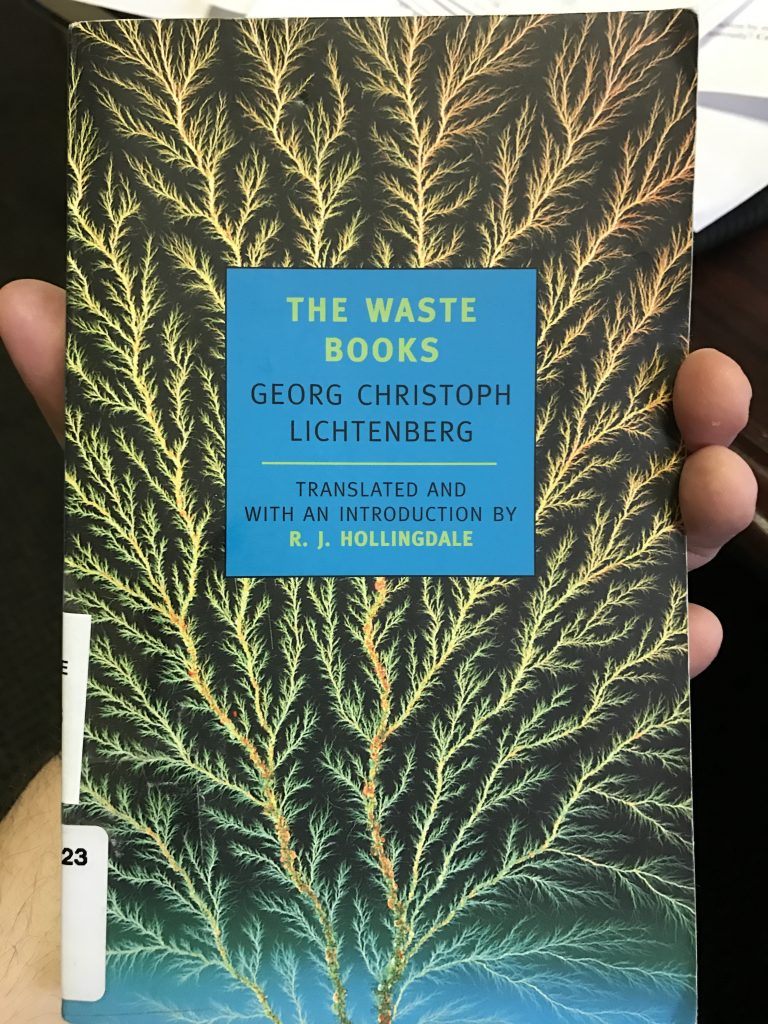
Gjertrud Schnackenberg’s extraordinary and heartbreaking Heavenly Questions, in particular the section called “Sublimaze,” has led me to a new author–new to me, anyway: Georg Christoph Lichtenberg. Much more to say about Lichtenberg, and the associative trail I followed when he appeared (not rhizomatic, and not predictable either), but no time to say it just now. Yet I do want to copy, and share, a Lichtenberg observation I read just last night in that lovely space just before sleep. It has made quite an impression on me. Perhaps you will find it illuminating, too.
From Notebook C, entry 26, in The Waste Books, translated and with an Introduction by R. J. Hollingdale (Penguin, 1990, rpt. New York Review Books, 2000), pp. 36-37:
Herrr Capitaine-Lieutenant von Hammerstein was much in favor of instruction with apparatus. The principal argument he always put forward was that it could only be a good thing to achieve one’s objective as quickly as possible. That was virtually the only argument he had. But since the investigation of a subject, the effort involved in understanding it, is calculated to teach us to know it better from several sides and to attach it most readily to our system of thought, for people who have the ability a drawing is certainly to be preferred to a model. An increase in knowledge acquired too quickly and with too little participation on one’s own part is not very fruitful: erudition can produce foliage without bearing fruit. There are a great many shallow heads who are astonishingly knowledgeable. What we have to discover for ourselves leaves behind in our mind a pathway that can also be used on another occasion.
More Questions Than Answers (about Open Ped)
Now that the Keene State spring 2017 semester Open Education speaker series and Open Pedagogy Learning Community have come to an end, I wanted to write a wrap-up post. I know I can’t capture everything that I have been thinking for a whole semester in this blog post, but I will try to hit some main points. The presentations were fabulous. And I wrote about our first few speakers in my Student Drivers post. I think the best part about having Open Ed guest stars on campus was all of the informal conversations, interactions and meals that allowed us to dig into some deeper discussions.
Meanwhile, the Open Ed world has been on fire with tweets and blog posts and hangouts and such where there has been much discussion aimed at trying to answer the question- ‘What is Open Pedagogy’? See Maha Bali’s excellent curation of posts on Open Pedagogy.
Well I’ve been facilitating an Open Pedagogy Learning Community at Keene State where we set out with that question- and like I always tell my students, the best investigations end up generating more questions, not answers:
- Do you have to use or create OER for it to ‘count’ as Open Pedagogy? (we actually discussed this back in January/February before David Wiley’s controversial post).
- Who gets to decide what Open Pedagogy is?
- Isn’t just calling it Open Practices better?
- What is Open anyway?
- What counts as OER?
- What is ‘content’ for that matter? Is it anything that is ‘captured’ (written or recorded)?
- Once anyone posts something online, is it “captured”? And therefore copyrightable? And therefore you could put a CC license on it? And therefore it could become the stuff of Open Pedagogy?
And also meanwhile the students in my two different biology courses starting tweeting at each other and sharing ideas and articles and hashtags- they opened up the edges of their classes and nobody asked them to- Is that Open Pedagogy? Shrug.
And then Jim Groom writes about choosing ‘awesome’ over open, and I think “Yeah!” And then Maha reminds us…once again…about privilege (oh yeah.)
Then, Martha Burtis comes to campus and says:
“We can’t say that our questions are only pedagogical- they have to be technical and pedagogical.”
This realization smacks me upside the head. I like learning about tools, but I have always thought the point was for them to be easy to learn and use, for people like me that are not experts at coding and stuff.
But Martha emphasizes to us that the ‘appification’ of the internet – has enabled students and others not to learn the technical. That those ‘apps’ control how people interact with and learn from the internet, the web. The people that control THAT are controlling nearly everything. Like Google and Facebook and Amazon. (Duh Karen!).
Google can say “Oh, it’s the algorithm, it’s not our fault” (when a search returns a bunch of racist results on a topic), and this deception is widely swallowed by those of us not in the know. Damn. There is an activist agenda to this. We have a responsibility to learn the technical aspects of the web; to create spaces, and algorithms and apps or whatever that are cognizant of diversity, inclusion, social justice and the rest of the pedagogical principles that we espouse so boldly when we talk about our teaching practices, our pedagogy. Students (and others) need to not just learn technical skills, but the IMPLICATIONS of those technical skills. We need to push back on the idea that is it ok to say “I’m not technically savvy”.
“I want us to realize that the web is not something that is happening to us, but rather it is something we are creating.” From Beyond Websites, by Martha Burtis
So more questions:
- Who makes the web?
- Who could/should be making the web?
- What is a domain? Who needs to own one?
- Who owns your data?
- What does your institution do with its data?
- Why is a non-institutional, non-vendor-built space so critical?
- If students take part in making the web, using their own domains, in the context of being guided by professors using educational/social justice principles, is this Open Pedagogy?
If you’re not sure that these are important questions, you don’t need to look much further than the biting wisdom of Audrey Watters whose ability to cut straight to the educational technology chase is uncanny. If you haven’t read her ‘Why a Domain of One’s Own matters (to the future of knowledge)’ and ‘Education Technology’s Completely Over’, read them now.
Last summer, I wrote this:
“For those of us that believe that our job is to help students become agents that can transform the society we live in, not just replicate it, the potential of Open Ed was like breathing fresh air…”
Open HAS to be political. Anything that is potentially transformative is political. I wouldn’t have put as much energy into learning about and participating in the Open Ed movement if it wasn’t. And make no mistake, it is a movement. I recruited faculty into our KSC Open Pedagogy Learning Community by emphasizing the political power and potential of Open. And I said:
“Practitioners of Open Pedagogy actively critique and confront the industrial and corporate approach of co-opting and packaging ‘teaching technology’ to turn students into consumers. Instead, they utilize the as web a place for uncontrolled discovery, creativity and analysis, and as a venue for dialogue with the wider public.”
So Bonnie Stewart’s recent post about her Keene State talk gets me thinking even further about the politics of Open, and Open as activism.
Bonnie pointed to some complicated relationships between digital identity and digital citizenship. In her talk, she said “[Digital] citizenship means we need to think about what we open up to the public. Our empires today are not all nation-states. Empires are places that we bring our students into when we ask them to engage online. And identity is the price of admission.”
There is so much to say about the importance of helping students think about how they shape their digital identity and the complexities between media literacy and digital identity. And this reminds me of Maha Bali’s Fake News: Not Your Main Problem where she says-
“The solution isn’t going to be by focusing on promoting digital literacies to combat fake news. It’s got to be about nurturing cross-cultural learning attitudes and skills that help make our knee-jerk reactions to news in general more socially just and empathetic.”
- Is ‘nurturing cross-cultural learning…’ a central tenet of Open Pedagogy (or should it be)?
Then Bonnie says in her post,
“Digital identity isn’t just the wrong lens for figuring out digital scholarship, or encouraging participatory engagement in learning. It’s actually the wrong lens for building towards any vision of digital citizenship that makes for a liveable, decent digital social sphere to inhabit.”
So I am thinking that maybe she means the narcissistic, isolated ways that some people build their ‘digital identities’? (maybe she doesn’t, so I apologize for any incorrect interpretation). But if the focus is solely on the created digital self, then this likely works counter to building a social movement.
And more questions,
- Are domains about identity? (Are wikis better than blogs for community building?)
- Is Open Pedagogy about guiding that process of digital identity development towards building a social movement that is about connection, compassion, authenticity and addressing global issues?
- Does it start with students seeing the potential of using the web to be helpful to someone else?
@karencang (2/2) share my blog because I'd like my posts to serve a purpose beyond a grade. It would be amazing if something I wrote helped someone.
— Elizabeth McGurk (@berserkmcgurk) April 12, 2017
Faculty and New Media Literacies

Photo by Gardner Campbell
Last week in Open Learning ’17 we began our work with Randy Bass and Bret Eynon’s book Open and Integrative: Designing Liberal Education for the New Digital Ecosystem, published in 2016 by the AAC&U. As with other things we’ve read in our openly networked course of study, we’ve been busy annotating the book with Hypothes.is. And as I was reading along and making my annotations, I found that my colleague Amy Nelson (also on the Open Learning ’17 Steering Committee) had very succinctly annotated a passage that had given me pause as well.
First, the passage from Open and Integrative:
Connected learning previews the new ecosystem where learners move easily between formal and informal contexts, connect knowledge and lived experience, and deepen learning through engagement with others. (19)
Then, Amy’s note:
Would like to see faculty incorporated into this ecosystem more explicitly. They also need to be more nimble and able to negotiate across these domains.
Exactly. The more I thought about it, the more it seemed to me that Week 10 (topic: participatory cultures) and Weeks 11-13 (topic: liberal learning and the new digital ecosystem) of Open Learning ’17 needed to be introduced to one other, so to speak. Perhaps the juxtaposition already suggested this idea to me, but it really was Amy’s comment that helped me connect the dots.
When Bass and Eynon write about digital ecosystems, they sometimes mean the open Web and various affordances on the Web. Most of the time, however, they lean more toward “learning technologies” like eportfolios, analytics, simulations, etc. that schools build for learners, a very different kind of ecosystem that the one made possible by the Web itself. (One could also argue that ecosystems our students live in when not in school are not about the open Web either, an argument that deserves its own post, and one I will address obliquely below.) Why does this difference matter? Obviously, the word “ecosystem” implies something more than the dominance of one or two species. The word suggests something holistic, comprehensive, a system that includes of many interdependent parts in a larger network.
I’d argue that the turning point for civilization was not so much digital computing as networked digital computing. I had a small habitrail on my individual computer back in the 1980s, but it wasn’t an ecosystem. It was more along the lines of a “productivity suite.” Suites on the Mac were more interesting and truly interconnected than they were on the PC, but we’re still talking about the walled garden of an individual computer. Exciting, you bet, but not an ecosystem.
An ecosystem is complexly connected. An ecosystem supports emergent phenomena. An ecosystem is “deeply intertwingled,” to borrow Ted Nelson’s plangent phrase.
An ecosystem gives and gathers life
To and from all its members.
An ecosystem is genuinely and thoroughly participatory.
No one is only a creator.
No one is only a consumer.
So as I thought some more about Amy’s comment, I began to understand that one of my ongoing nodes of discontent with the status quo has to do with how, all too often, faculty do not themselves have the knowledge, skills, or dispositions to be members of the participatory cultures supported by the open Web. (They may also lack the knowledge, skills, or dispositions to be members of the participatory cultures supported by the contemporary university, given that the contemporary university is more likely a “multiversity,” as Clark Kerr observed half a century ago–but that’s also another post.) During a very stimulating and lovely conversation with Randy and Bret about their book, I could nevetheless hear the conversation drifting toward the opportunities and skills we would help students to enjoy and acquire. At one point toward the end of the conversation, I asked Randy Bass about the relationship between the digital ecosystems inside and outside the university. While stressing the need for “porous boundaries” between those two ecosystems, Randy articulated a laudable goal for schools trying to think about such boundaries. Randy asked schools
to think about how you’re empowering people inside a university by helping them learn how to connect outside the university, how to build networks, how to negotiate networks, how to protect themselves, how to leverage resources that they don’t yet control, how to make use of intellectual tools in combination with what might their own … facility in these digital environments for the kind of, what we could call in the Jesuit tradition, the kind of “interior freedom” that we’re trying to help students achieve…..
And as I listened to Randy and agreed with him, I couldn’t help wondering whether faculty might be a bit complacent about their own abilities in this regard. Do our faculty know how to connect outside the university, especially in the kinds of participatory cultures Jenkins describes? Do faculty know how to build and negotiate effective, mind-expanding online networks that cross institutional boundaries–or that aren’t defined by institutional boundaries at all? Do faculty know how to leverage resources they don’t control? Do faculty know how to use intellectual tools in digital environments that have little or nothing to do with school? For that matter, do faculty have the kind of “interior freedom” Randy advocates, within these new digital ecosystems?
And a little voice in my head spoke again: why do we assume we can maintain our professional lives free of these new literacies and at the same time convey wisdom to students about their lives and literacies?
In his 2006 white paper “Confronting the Challenges of Participatory Culture: Media Education for the 21st Century,” Henry Jenkins sounds an urgent call to action:
The social production of meaning is more than individual interpretation multiplied; it represents a qualitative difference in the ways we make sense of cultural experience, and in that sense, it represents a profound change in how we understand literacy. In such a world, youth need skills for working within social networks, for pooling knowledge within a collective intelligence, for negotiating across cultural differences that shape the governing assumptions in different communities, and for reconciling conflicting bits of data to form a coherent picture of the world around them.
We must integrate these new knowledge cultures into our schools, not only through group work but also through long-distance collaborations across different learning communities.Students should discover what it is like to contribute their own expertise to a process that involves many intelligences, a process they encounter readily in their participation in fan discussion lists or blogging. Indeed, this disparate collaboration may be the most radical element of new literacies: they enable collaboration and knowledge-sharing with large-scale communities that may never personally interact. Schools are currently still training autonomous problem-solvers, whereas as students enter the workplace, they are increasingly being asked to work in teams, drawing on different sets of expertise, and collaborating to solve problems.
Youth need those skills, now more than ever. The question then becomes whether faculty themselves have these skills in ways that can be modeled and thus meaningfully incorporated in their own pedagogies (and in their own scholarly networks as well–why not?).
These skills are not just ‘information” skills, narrowly considered. They are new media literacies.
I’ve copied Jenkins’ 2006 skill taxonomy below, with some comments. With the caveat that I do not think knowledge, skills, and dispositions can be divided, my question remains: to what extent do you have and model these skills for your students? To what extent do your colleagues have and model these skills for their students? As we consider Jenkins’ list, we may well agree that there’s a profound gap between what we say students should know and what we ourselves can, or are willing, to do as we participate in this new digital ecosystem.
As I argued in “My Computer Romance“:
We live in 2007. Faculty complaints are real and serious. In lives full of teaching, advising, reading, marking papers, writing, presenting at conferences, publishing—more demands each year—faculty do not have the time to learn these new literacies. Based on their past experience, faculty fear that whatever they do learn will likely be obsolete within a few years. If faculty are successful in learning these new forms of reading and writing and in working within them, their achievements are often not valued in the tenure and promotion process. And if faculty incorporate these new literacies into their teaching, they still may not understand how to evaluate student work within these literacies. I hear these complaints from my faculty colleagues, faculty at other U.S. colleges and universities (from liberal arts to research institutions), and faculty around the world. These are valid complaints. They must be addressed, especially by administrators who can align institutional resources to bring relief and opportunities to those faculty ready to engage with these tools. All faculty who are ready deserve a place where they too can enjoy a computer romance.
Yet faculty must move forward before the professional infrastructure is completely hospitable. Faculty can no longer afford to wait. We faculty live in 2007, and we all must be ready. These technologies are not going away. Their promise is enormous and only beginning to be realized. They are essential components of every aspect of our lives, and we owe it to ourselves and our students not only to understand them but to delight in them, to learn within them, and to share those delighted experiences of learning with our students. Only when our students see our own learning blossoming within a computer romance will they listen to us when we tell them to use these tools more wisely themselves.
Lives of curiosity, creativity, and discovery within this new digital realm await us all if we are prepared to calm our fears, share our ideas (whether or not they’re “half-baked”), and remember the excitement that called us to this place, this vocation. The computers are us. The world is our wiki.
Yes, it’s now seven years later. There may have been some incremental progress in some areas, but I fear there have been many more steps back than forward. Perhaps it is not too late to turn that around. I hope not.
And with that, here’s Jenkins’ list, with my comments in italics.
Play
— the capacity to experiment with one’s surroundings as a form of problem-solving
This specific form of new-media play is likely foreign to many faculty, even in their private lives. Will a generational transition address this gap, or will faculty culture continue to penalize play in favor of other, more aggressively career-focused kinds of professional activity?
Performance
— the ability to adopt alternative identities for the purpose of improvisation and discovery
I suspect many faculty would be baffled as to why this skill might be desirable or important.
Simulation
— the ability to interpret and construct dynamic models of real-world processes
Perhaps less of a skill gap here, though these models are usually contained within specific course or institutional boundaries.
Appropriation
— the ability to meaningfully sample and remix media content
The word “appropriation” probably isn’t the best word for this skill anymore, but the ability is still relevant and important. To take one very small example: how many faculty do you know who’ve created an animated gif, or experimented with an image macro?
Multitasking
— the ability to scan one’s environment and shift focus as needed to salient details.
I’d say this ability badly needs another name, as much research suggests human beings are fooling themselves if they imagine they’re good multitaskers. That said, there is what I’d call a “gestalt” or “gist” or “sizing-up” ability–that ‘scanning one’s environment’ Jenkins describes–that is important, especially in networked cultures.
Distributed Cognition
— the ability to interact meaningfully with tools that expand mental capacities
This ability is perhaps the most vital of all, especially in new-media online participatory cultures. Any mind-expanding or intellect-augmenting technology vastly broadens one’s intellectual and personal horizons. School itself should be such a tool. Books certainly have been, for centuries. To what extent do faculty experience online participatory cultures and new-media literacies as mind-expanding?
Collective Intelligence
— the ability to pool knowledge and compare notes with others toward a common goal
This is certainly the goal of a scholarly community, though it’s not always clear what goals are truly held in common, and I wonder to what extent academia is a genuinely participatory culture in the contemporary “multiversity.”
Judgment
— the ability to evaluate the reliability and credibility of different information sources
This ability is probably the most familiar and putatively widespread among faculty in the contemporary university, though the Sokal Hoax does give one pause in this regard.
Transmedia Navigation
— the ability to follow the flow of stories and information across multiple modalities
I think most faculty wouldn’t know where to start with this ability, though they might plead that they’re not film scholars, art history scholars, writing teachers, musicians, etc. Yet not being able to follow the flow of stories and information across multiple modalities does seem to be missing a considerable opportunity in the new digital ecosystem.
Networking
— the ability to search for, synthesize, and disseminate information
Faculty can do this in older ways, but it’s not clear to me to what extent the new media landscape has altered more conventional practices or abilities. In particulate, I wonder if faculty routinely disseminate scholarly information outside peer circles.
Negotiation
— the ability to travel across diverse communities, discerning and respecting multiple perspectives, and grasping and following alternative norms.
Faculty are often skeptical about faculty in other disciplines, a very short hop across communities with fairly limited intellectual diversity. Are faculty willing to take on the diverse communities and alternative norms of Twitter? of Wikipedia? of Reddit?
well lit rabbit holes
Noon I ducked down to our local “Maker Space,” which has open hours ’til 1:00. I’ve been going there for years whenever something’s weird with whatever version of my dynamo hub light I’m trying to get rolling.
Long story short: the person who knows how to take gadgets apart & put ’em together was coming for the 1:00 thing, which seems to be an open Python and things like that session. Facilitator is a person who teaches Python to people in Information Science grad students who are “non-STEM,” and, she says, often phobic about math as soon as it turns into “x=” something so she has found other ways. It was interesting to hear conversations among people in the University community.
It also took ’til 4:00 to figure it all out and get it back together and get it charged and… now I have to find the right thingy to put it on the bike, and no I didn’t so much as *touch* the tech project.
This a.m. I discover a tweet talking about David Wiley of Lumen Learning’s latest blog which talks about people using “open” in ways that aren’t open enough…we need those 5Rs… oh, and the comments are closed. Nothing ironic there, is there? The comments and tweets on blogs about that blog make me realize again what a tight-knit group these guys are (lots of insider references). (My opinion: if you’re going to want a certain definition for a term, then don’t give the term a name like “open.” Hello? It already has a ton of meanings and interpretations. Name it after somebody, maybe… )
It’s time to do some courage-seeking …


Podcasts R Us
https://www.insidehighered.com/audio/2017/03/22/pulse-app-algebra is 24 minutes about a guy and an algebra app that he says is the first on the planet like it — you get to drag and drop things to solve algebra equations. (Start at 18:30 and you can be spared the l-a-b-o-r-i-o-u-s background… ) I share his mystification about the underuse of the media (like me, he thinks Khan Academy is a dronefest) but … actually, doesn’t the “Dragon” algebra software pretty much do that?
I also share his appreciation for the visual-kinesthetic fluency aspect of algebra, and his disdain for teaching students the whole “add 3 to both sides of the equation” — and then stopping there, when they’re doing everything by hand, one step at a time. I do wonder how much understanding gets lost if people just jump to “move it over and change the sign” too quickly — but it’s a wonder, not an assumption. Could be that it really does cut the cognitive load without cutting the understanding… or it could be that it turns into a process like changing a mixed number into an improper fraction — motor memory, but often without a *clue* as to what the numbers mean. I wonder if it helps with understanding the importance of that equals sign thing…
Wonder if he’s ever stumbled on the OER community and the idea that sharing the code, etc. could mean better things could evolve…
Time to get out of rabbit holes and back to Camtasia.

