Category Archives: Virginia Group

Virginia Faculty Collaborative Group

Digital Presence: A Scheduled Chat with Ken Bauer’s Students

Tomorrow, Lee Skallerup and I will be speaking to Ken Bauer’s #iTec Digital Identity course, a five day bootcamp on digital identity for undergraduate students at Tecnológico de Monterrey on…you guessed it – digital identity.  Ken has put together a stunning lineup – Dave Cormier, Bonnie Stewart, Alan Levine, Amy Burvall, and Autumm Caines – and that’s just on the first half of the week.

I’ve heard all of those people speak expertly on digital identity, to the point that I feel a bit superfluous.  However, in the spirit of not giving into imposter syndrome, I’ve devoted a bit of time to thinking about what I can bring to the conversation that is special and uniquely my own.

I started by brainstorming on Twitter with 5 thoughts on my approach to digital identity and when I started that list, it became clear to me fairly quickly that I had a problem with the title of this course.

 I don’t like to talk about digital identity, because it creates an unnatural divide between digital and other forms of identity.  Digital identity is no different than the multiple identities we carry through the day – e.g. our parenting identity, professional identity, peer identities.

Personally, I’ve been working hard over the last five years to consolidate those identities into a balanced, holistic approach to being an authentic human…so to separate out my ‘digital identity’ and talk about it for minutes on end just doesn’t seem to jibe with the rest of my life mission.

I am myself. I am myself in digital spaces.  I am myself in the grocery store, in my living room, in my work cubicle.  Because my digital experience is so completely integrated into my physical activities, I am my digital self at the very same time that I am waiting in the grocery store line, and in my living room, and in my work cubicle. In fact, I workout early in the mornings to exercise videos stored on my google drive. I can be doing one-legged burpees when I see a Twitter notification pop up in the corner of the screen. Therefore, I am my digital self even as I am very much also my physical self. The distinction is meaningless to me.

I prefer to talk about digital presence.

Presence is closely related to but different from identity.  Identity is who you are; presence is how you behave. How you present yourself.  How you engage with the space and others in it.

Digital presence. All of the speakers Ken has lined up are brilliant on digital presence, but I can speak specifically to what it means to behave as a learner in a digital space.

My primary goal as a blogger and tweeter is to learn.  I am a constructionist at heart; Seymour Papert writes that thinking is made sharper – refined – when it is made concrete. Write a thought down and it becomes less abstract while also becoming something that is available for self reflection and social commentary.  I write to make things concrete.  I write in digital public spaces to gain access to social commentary.

I blog and tweet to create a record. We learn by studying our own trails (and the trails of others).  In 1945, Vannevar Bush called these associative trails. Sure, I could  trace my trails through journals and scrapbooks, but I write in digital, public spaces so that I can have access to hyperlinks, tags, filters, multimodal forms of expression.  I write in these spaces to have access to digital affordances. The ability to rearrange posts and create serendipitous juxtapositions is magical, happy learning.

Finally, I blog and tweet to be a part of something larger than myself.  I have written over and over again on personal learning networks (so has Dave Cormier, probably a little more famously) so I’m not going to belabor the point now.  But as I have said before (and so has Howard Rheingold), the key to learning in and on the open web is making oneself useful. There are different ways to make oneself useful. Being a learner is not just about the cognitive stuff; yes, on Twitter I have been known to help people learn their epistemological frameworks and others have helped me learn to code SQL sequences (all true, documentable stories). However, meaningful learning is often emotional.  It feels scary sometimes.  Isolating.  Confusing. Lonely.  I make myself useful by making myself available in digital spaces.  I help people and they help me as best as we all can, because we are human: humans being humans in digital spaces. 

Digital presence as an opportunity to create, record, and share – that’s what I’m going to talk about tomorrow.


Quads as Symbols of Liberal Learning

We recently ended Springboard, a series of thirteen days in June and July that are designed to welcome freshmen to campus and provide a key part of their orientation programming. Organized by our Orientation Office in conjunction with Admissions, the advising centers, the academic colleges, and my unit, University Programs, it affords my colleagues and me an opportunity to talk directly to students and their parents about academic expectations here and the value of a liberal education. I only get ten minutes, so I try to make it count by focusing on a few “mental images” as takeaways.

Here’s what I said:

“Welcome, class of 2019! I’m honored to be here representing the faculty. To give you a sense of scale: there are more than 960 FT instructional faculty here and more than 400 part-time instructors. It’s a big place! And a rich, vibrant academic community. My goal this morning is for you to understand what an academic community is. If you’ll humor me for just a minute, I’d like you picture our beautiful Quad. Go ahead, close your eyes. See the broad expanse of lawn. The bluestone buildings on all four sides (cuz it’s a quadrangle). They house dormitories, classrooms, computer labs, and offices. Once upon a time, the only dining hall was there, the library, too. Now picture other quads you know. Maybe UVa’s Grounds, designed by Thomas Jefferson. My own alma mater, the University of Delaware, has two quadrangles. Think: Harvard yard, Oxford, Hogwarts. Quads are everywhere in the landscape of American higher education because they are deeply symbolic spaces. Tracing back to the medieval period, they are echoes of the great European cloisters and universities, living and learning communities where groups of scholars came together in the spirit of contemplation, study, and research.”

aerv107

Architect’s conjectural drawing of the quad in 1908. Then, the fourth side was left open following UVAs example in order to signify a welcoming community appropriate for a democracy. Of course it wasn’t really open: only white women could attend then. But that’s another blog post.

“You’re here today because you’ve chosen to join our academic community. Chosen is the operative word. You are not actually required to be here! There are no laws requiring Americans to attend college. No truant officers will show up at your parent’s door if you skip classes for a few weeks. There are no state mandated SOL tests and no single set of subjects that everyone must take. For the first time in your lives, YOU are the sole person responsible for your education.”

“Because you have voluntarily chosen to enroll here, the faculty have high expectations for you. It’s not like high school, even if you have dual enrollment or AP credit, trust me. For one thing, you were ALL tops in your high school classes. We received about 26,000 applications to produce a freshman cohort of about 4300. So congratulations. But now you’ll have to step up your game. For another thing, this is a university. That word has meaning, too–it’s not a synonym for college. By definition a university is a place that grants graduate degrees—we create new knowledge here. That’s why we call ourselves professors–the faculty profess expertise in their research fields; we are scholars as well as dedicated teachers. And we expect you to join us in doing research. Ok, maybe not freshman year, but certainly when you’re in those 300- and 400-level seminars. Our undergraduates are studying everything from nanotechnology to genocide in Bosnia. A university also offers study abroad experiences, internships, and service-learning projects. To succeed, you’ll want be active not passive learners.”

modquad

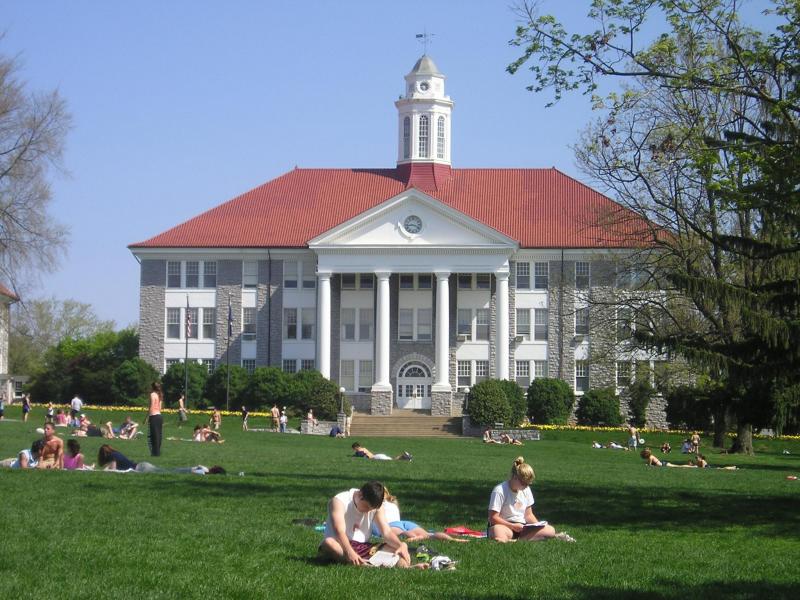
The Quad today.

“In choosing to join this academic community, you have chosen to acquire a liberal education, not job training or a piece of paper. I’m talking now about the stuff that prepares you to be an educated and enlightened citizen, like it says in JMU’s mission statement. Like the Quad, this kind of self-reflective, analytical education has been a hallmark of American colleges and universities since the colonial era. It prepares you to be an effective participant in a free society–and that’s why you can’t get this education in many parts of the world today. Now, here’s another thought exercise for you: it’s 1769; picture a short, skinny, knobby-kneed seventeen-year old boy leaving his home in rural Virginia and traveling by carriage all the way to far off, exotic New Jersey. Talk about culture shock! The boy was James Madison and like some of you he didn’t know exactly what he wanted to be when he grew up. At that time, the College of New Jersey (now Princeton) was known for producing Presbyterian ministers. (Apparently, William and Mary was a party school then.) Fortunately for us, he didn’t follow that path. But he did acquire a liberal education, one that enabled him to become one of the most original political thinkers in the world. JMU provides the same kind of liberal arts and sciences curriculum Madison knew, though can rest easy knowing we’ve updated it for the needs of the 21st century. We call it General Education: The Human Community, and it’s a vital part of your degree, a whopping one-third of it, in fact. It’s that important.”

“Despite what you hear in the media, public opinion research tells us a liberal education is also the best preparation for long-term career success you can get. Here’s a shocking statistic: by age 39, the average American with a BA or BS degree will have held between 10-14 different jobs. You can’t know what those jobs will be. None of us knows what jobs lie ahead, not even employers. In a January 2015, researchers interviewed more than 400 employers across all sectors. Do you know what they said they look for in hiring new employees? A little more than 60% said they valued ‘broad, comparative knowledge’ and ‘cross-cutting skills’ like writing and critical thinking over narrow technical competence, which they intend to teach you themselves. So think about the value of your entire degree. As we like to say here, your major will help you get your first job, but a liberal education equips you for a lifetime of employment.”

james_madison1

Students studying and relaxing on the Quad in front of Wilson Hall.

“But I know you aren’t thinking about the workplace today! You’re ready to meet your Orientation Peer Advisors and get your JAC cards. Just do this one thing for me: when you leave Wilson Hall today, take a good look at that Quad again and remember what it symbolizes–Your academic community!”