Category Archives: Virginia Group

Virginia Faculty Collaborative Group

Stories as a Way of Being

This morning at #OpenEd16, I presented as part of a panel on “Floating on a Sea of Data: Why Higher Ed Needs #SoNAR. I was a last minute addition, joining  Kate Bowles, Kristen Eshleman, Bonnie Stewart, Dave Cormier, and Amy Collier when another panelist became unavailable.  The position was offered to me as an opportunity related to my recent collaboration with Kristen on using Sensemaker. “Yes” was the obvious answer, even I had never heard of #SoNAR and my formal experience in narrative inquiry was fairly scant.

I sat quietly in the first planning session listening to the others. As they spoke, I looked for holes in their expertise (there were none) and ways in which I was different from them (there were plenty), as a means to understand how I might best contribute.

At first, I couldn’t find an answer, but around the same time a friend of mine sent me a collection of vignettes and journal entries that he had written in the aftermath of an life-altering event.  More than any philosophical conversation, his work reminded me of the power of stories as a way of being in the world: a way of remembering, understanding, and healing.

In reading his stories, I remembered that I had written my own in the year after I left medical practice, a collection of ten essays that I felt captured the essence of my medical education and practice experience. And as I considered his stories and how they related to mine, I realized what I could contribute to the conversation at #OpenEd16: a story of my own, one that might be as powerful for the audience as my friend’s had been for me.

Today I shared the tenth story of my collection in a Peroscoped conference session and in front of a packed audience. The aim was to set the stage for Kate, Kristen, Bonnie, Dave, and Amy to discuss the need to harness narrative inquiry for systemic change. However, this was also an opportunity for me to be more open and honest about who I am. It was an opportunity to be brave.

Only one other person had ever read these stories before today.  Sharing this part of my life with other people in ways that are complicated, half-written, and raw has never been a priority for me, in part because I have been afraid that people would not understand. Even the “good” stories seemed too risky to share. Maybe I wouldn’t be believed. Maybe I would be accused of being arrogant if I showed myself in too good a light. Maybe people would find bad things in my story where I had originally thought there was good.

Today, I made a decision to trust the OpenEd community.  When you asked if you could Periscope the session, I said yes because I trusted you to take care of me if things went wrong. You have supported me through my dissertation, professional trials, and bouts of self-doubt and despair. You are my professional family, and this conference is my home. If I were going to share these things anywhere, it would be at OpenEd, with you.

The sharing was not easy. If you watch the video, you’ll hear that I almost stopped before I started.  You’ll hear how slow I was because it was hard to get the words out.  You’ll hear me speed up as you laughed and responded in ways that made things easier. You’ll hear me finish, grieving all over again at the end of the story, but satisfied that I had said everything that needed to be said.

I am so grateful to all of you.

—

Transcript

Stories are a way of being in the world, with other people. I am here to offer an example.  As many of you know, I used to be a gynecologist practicing alone in a small remote hospital in Virginia.  For a lot of reasons, I burned out and left medical practice.  But in the year after that happened, I wrote down ten stories that I felt captured the essence of my experience as a medical student, resident, and physician.  I wrote down these stories so that I could remember, try to understand what had happened, and to begin to heal.

This is Chapter 10 pretty much as I wrote it five years ago.

My last four months were some of the busiest of my career, but I had looked up from the work just long enough to notice that it was springtime in the countryside. I was counting down the days by this point.  On the tenth day before my last, I was enjoying my pre-dawn commute through the country when I saw Andy’s (pseudonym) text come across my phone: “Laura. Please tell me you are already here.”

Andy was a former chiropractor, now rural ER doc, and my only friend in the Emergency Department. I immediately picked up speed and called him back. A woman in labor with her second child was lying in the trauma bay. I only had to observe one set of contractions to know she was moving from latent to active labor right before my eyes.

Active labor is notoriously unpredictable in second babies. It could take thirty minutes, two hours, or stall out altogether. My little rural hospital did not technically offer obstetrical care so it had minimal obstetrical equipment available for me to use. In this particular case, the lack of equipment it put me in a very tight spot. I was a trained and board certified obstetrician as well as a gynecologist and could be held accountable regardless of access to equipment; I had to make the decision on whether to transport her to another hospital and risk her delivering en route or keep her at this hospital, which was unprepared for a laboring woman who wasn’t in act of giving birth.

I will be honest: I cannot remember what this woman looked like or what her name was, but I remember every part of her story.  Her midwife, whom she loved, was over an hour away in the city. The diversion to my hospital had been about policy, not about her choice. And I could feel this: This woman felt very much alone.

I knew the roads between my town and the city well. I knew the woods, the deep isolation, the very spotty cell service. I knew there would be no help for us if we got in trouble along the way. But as I felt the rhythm of her labor, my instincts told me that we could make it if we left immediately with the right sort of drivers.  The woman and I considered the options briefly. We made the decision together, as best as we knew how.

I walked out of the trauma bay to eyeball the drivers, because I was only going to try this if I thought they would drive with a special sort of passion. One was a tall skinny kid with two large earrings. The other was only slightly older, with a serious neck tattoo.  In other words, they looked perfect to me.  I literally held my hands over my heart as I asked them to drive me and the woman as fast as they could.

There was something hypnotic about that ride. Without access to drugs or monitors there was nothing doctor-like for me to do. I had nothing to offer but myself and the confidence of another woman who had given birth before. The woman and I sat in silence, holding hands, her eyes closed. The drivers rarely used the sirens as they moved over the empty roads. The rush of the wind and the rocking motion of the rig only heightened the feeling of acceptance that wrapped me up together with this woman. I watched the sun rise over the tiny fields that marked the edges of the forest.

With a definite air of victory, the drivers turned on the sirens as we burst onto the city’s morning traffic.  The sun was fully up. The woman sensed the change and opened her eyes between contractions, which were now only one minute apart. I smiled and looked down at her, announcing – only when I was absolutely sure – that this baby would be born in the hospital. I asked her if the baby had a name. She looked at me but only had time to smile before another contraction began.

Reaching Labor and Delivery was anticlimactic. The midwife met us at the elevator doors. We transferred the woman to the hospital bed, stopped for fresh linens and coffee, and like all good EMTs, slipped away unnoticed.

The drivers sat up front, and I rode home alone in the back of the rig, ripping a Styrofoam cup into bits on the cold, vibrating metal floor.  My phone buzzed in my pocket and it was a text from the midwife. She had wanted me to know of the delivery – a baby girl. Baby Serenity had been born 20 minutes after we had arrived at the hospital. Both mom and baby were fine.

The rig rattled enough that the drivers in the front couldn’t hear me so I let myself l cry and laugh and cry a little more. The baby’s name was Serenity and she had done her job. I had just traversed the riskiest scenario that I ever would in my medical career and it had never occurred to me to be afraid. It had been an ending and a beginning, both simple and good, a true journey through the woods that the woman and I had both gotten through.

An exercise in simple data visualization

Data visualization.  It’s a buzzword we hear frequently, usually in connection to other buzzwords like big data, business intelligence, dashboards, and accountability.  However, data visualization doesn’t have to be a buzzword.  As a concept, it can be quite simple: it is the act of collecting information and displaying it in ways that illuminate while allowing for informed decision making.  Data visualization does not have to be fancy to be effective; in fact, simple is often better. Even the simplest forms of data visualization can drive conversation and change.

slide02
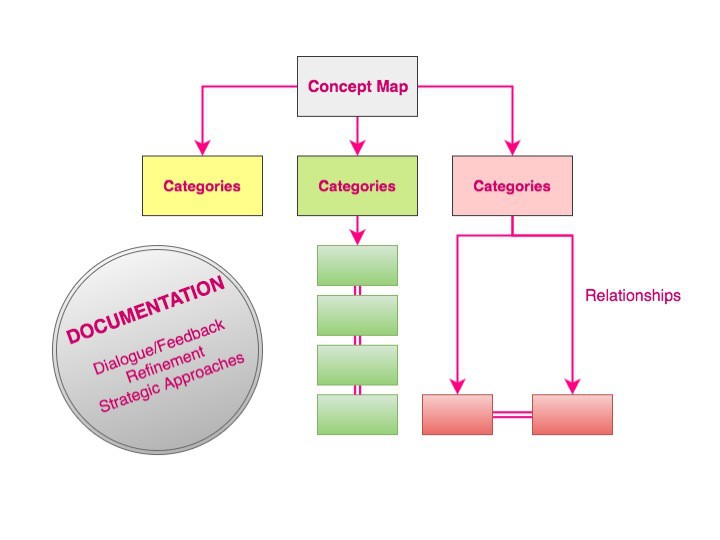
A concept map.

A concept map is a form of data viz that educational researchers have shown since the 1970s to be an effective way to help people grasp complex concepts. According to the research, concept maps work in several ways.

  • First, concept maps encourage us to organize pieces of information into categories – which in turn allows us to move to a more abstract level of thinking.
  • Second, they make thinking visible or concrete – which makes the thinking less fuzzy to the person who is trying to think it.
  • Third, concept maps themselves act as “meeting posts:” places that allow other people to meet our thinking where we are, facilitating conversation and potential collaboration.
  • Finally, concept maps allow us to maintain a record over time, so that we can reflect on where we were, where we are, and where we might want to go in the future.

And the best thing about concept mapping is that it can be adapted to be useful in many contexts for facilitating discussion and enabling change.

Let’s work through an example in which we use a simple form of data visualization – concept mapping – to reflect on and discuss our behaviors in digital spaces as a potential form of professional development.

slide05

1.Take ten seconds to write down as many answers to this question as possible.  Where do you go when you are online?  Which platforms, digital spaces, applications – anything you do online – personal or professional.

Go ahead. I’ll wait.

My guess is that you had no problems writing down a handful – search engines, email accounts, entertainment services like Netflix and Spotify, social media (Facebook, maybe Twitter, Instagram).  The creatives among you may have some video, music, photo, or graphic design applications on the list – things that help you remix or create things.

2.Circle the ones you use for work or your professional development. 

slide06

3. Identify five ways that you used those digital platforms or spaces.  What sorts of activities were you engaging in? What was your purpose in being there?

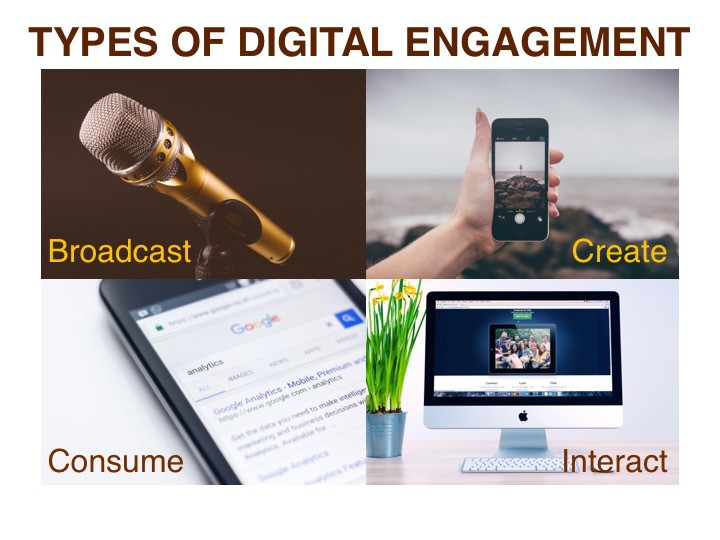
Generally speaking, when people get on the Internet, much of what they do  can be described through four categories of engagement.  These are not necessarily mutually exclusive or a comprehensive list, but they are a way to begin to think about and talk about what you do on the web.

  •  Broadcasting.  People express their ideas and information with no real intention of dialogue, per se.  Broadcasting is about getting one’s ideas out there for someone else’s consumption.
  • So obviously if there are some people broadcasting, there are others who are consuming. We consume when we don’t have the intention of giving a lot of feedback – we consume information when we search databases or search engines.  We consume entertainment when we watch Netflix. When we buy things on Amazon.
  • However, sometimes people can actively participate or interact and provide feedback – we consume when we buy on Amazon, but we are participating or interacting when we opt to leave a review.  We are consuming when we read a Wikipedia entry, we are interacting or participating when we make edits.  We interact when we engage in dialogue on Facebook or Twitter; we are contributing to a larger narrative.
  • Finally, sometimes we use the web to create, and I’m thinking about all the web applications that allow us to make things. Making videos, music playlists, picture mashups, editing software, photo albums.

slide07

Like I said, these activities aren’t mutually exclusive – sometimes we make things collaboratively, for example.  And certainly they can be used in a sequential fashion – in fact, I’m going to give you an example of that in a minute.  But I find that these categories can be useful when we are talking about what we are doing on the Internet.

4. So, now that we have a little bit of a vocabulary how can we leverage these spaces and our behaviors to advance our professional development?   I want you to take a moment to choose how you are going to frame this question for your own purposes.  Are you going to think about your students’ professional development?  Your team’s?  Your own?  All of those would work for the activity that’s coming up – pick the one that interests you the most.

There are plenty of answers to that question, but the one I’d like for us to consider is the idea of a personal learning network, which is a form of strategic digital engagement that fosters, learning, sharing, and professional networking in ways that potentially transcends institutions, geography, and traditional power hierarchies.

So, how do professional learning networks work? I’m going to offer a personal example.

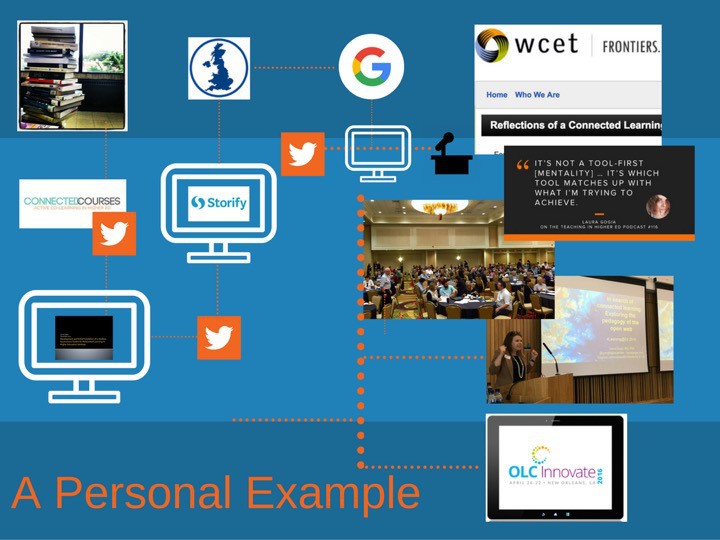
5. As I tell this story, I want you to look for the digital spaces, the types of digital engagement, and how things fit together. 

slide10

In the fall of 2014, as part of my graduate fellowship, I participated in a massively open online course (MOOC) on faculty development and connected learning. Through my Twitter interactions related to that course, I became recognized in within the connected learning community as someone who researched connected learning as part of my dissertation work.  Around that same time, I was developing and presenting a mock prospectus for a dissertation preparation course.  I posted my mock prospectus slides on slide sharing platform and then embedded that presentation in a blog post in which I described my research proposal. I advertised my blog post on Twitter using the MOOC hashtag and asked the people from the course to take a look and offer feedback.

As they commented and asked me questions on Twitter, I noticed some themes across their responses.  I aggregated their tweets on Storify, which is a storytelling digital platform, and embedded the product into a blog post in which I suggested potential areas for research collaborations based on the questions they were asking.  I advertised that post on Twitter, using the MOOC hashtag. Several scholars expressed in interest in collaborating in different areas.  For the next 18 months I worked several research collaborations through combinations of Google Hangouts, Docs, and Google Plus.  This work led to conference proposals and publications at an international level. The combinations of online and conference presentations led to keynote and plenary addresses, guest blogging assignments, panels and podcast invitations, and  consulting work.

Can you identify two or three digital platforms and types of engagement from that story?

So I am not trying to suggest that everyone needs to develop a professional learning network as complex as my own, but what I am arguing is that there can be benefits from approaching digital engagement intentionally.  

How can we optimize what we do online the same way we tend to think about optimizing our activities offline? 

slide11

The answer is to

slide12

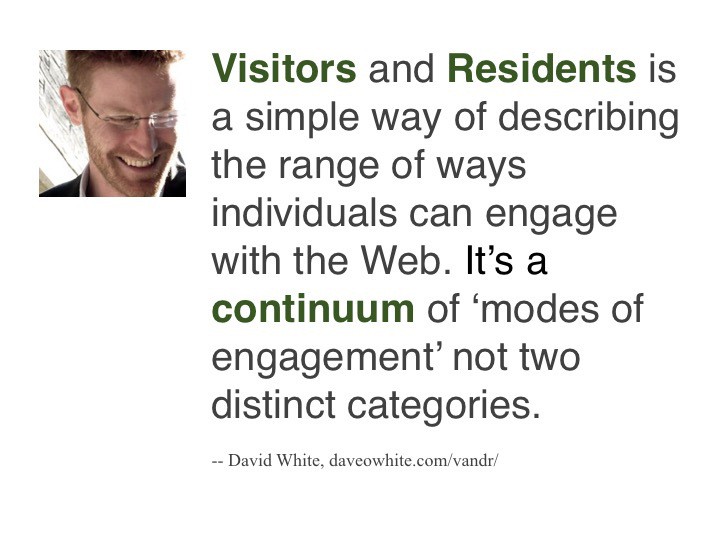
In terms of digital engagement, the V&R scholars developed a mapping exercise that aims to help people talk about their online activity in terms of being digital visitors and residents.  In David White’s words,

slide13So they describe a spectrum of engagement anchored on both ends by visitor activity, which tends to perceive digital platforms as tools.  When we act as visitors, we tend to be goal oriented – we get in and get out without leaving too much of a digital footprint.
On the other side of the spectrum, when we acts as digital residents, we tend to think of the digital in terms of a space that we inhabit along with other people.  Activity tends to be more extended and less goal driven.  When we act as residents, we are there to build a presence or an identity.

slide15

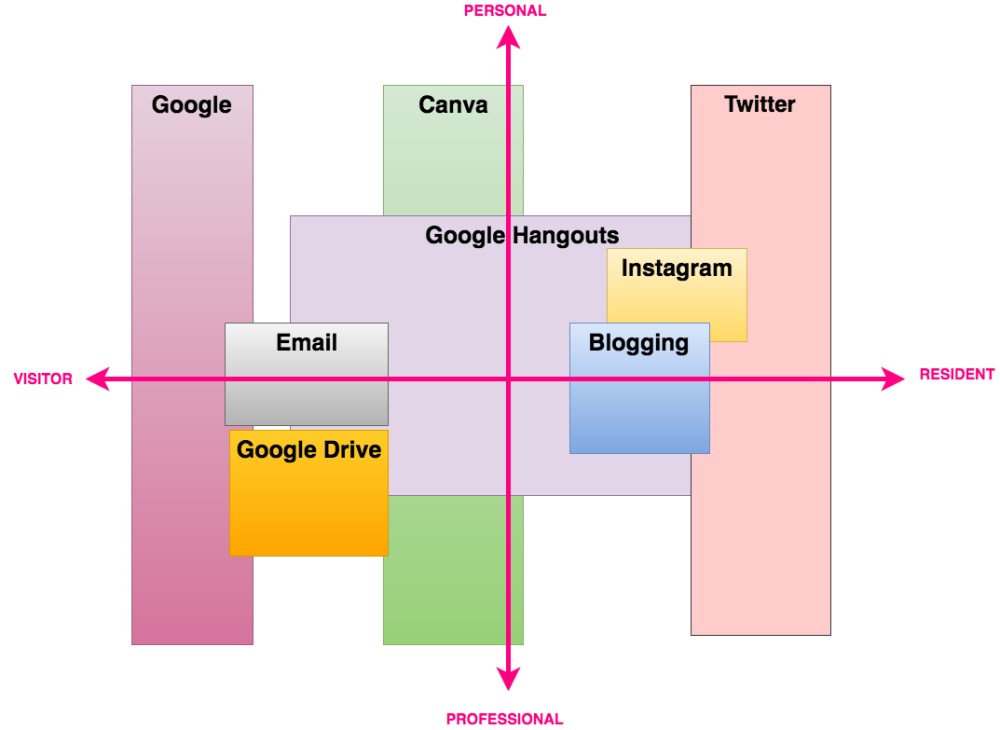
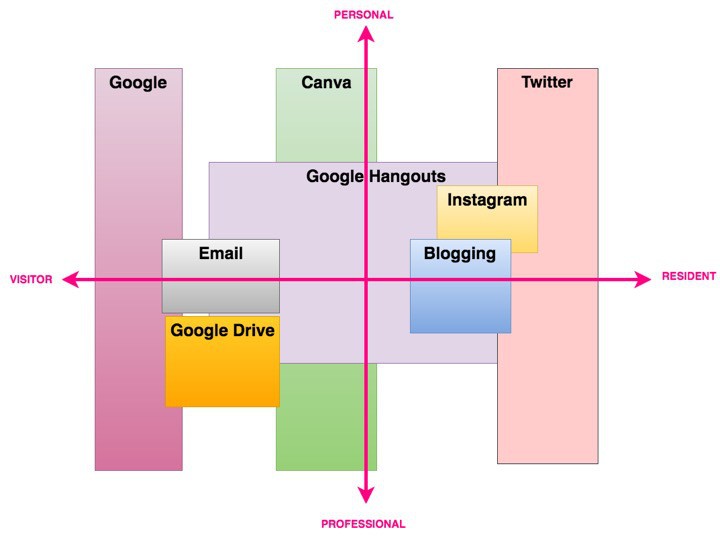
This is a simplified version of my V&R map. I’ve identified my primary digital platforms.  There are two axes – the first is the Visitor and Resident axes, which we’ve discussed.  In my case I tend to use things like Google search engines in very goal-oriented sorts of ways and I tend to hang out on Twitter – that’s where my community is.

The other axis is personal and professional use – sometimes you’ll see this listed as “institutional.”  It’s useful because many people tend to have dual lives in the digital world – in fact you might have one email account up here and a different one down here. But you’ll see that I am not particularly dualistic. I have a lot of overlap – and that’s actually the sort of observation that could lead to discussion on strategy and intentionality, right?

6.  Take a moment to draw your own map.  It doesn’t have to be comprehensive. You already have a list of platforms to work with.

7.  Talk it over with a partner. Consider these things as places to start:

slide17slide18slide19And when we finish, let’s think about exactly what we did.
  • We made a concept map – a form of data visualization – that anyone could have made regardless of discipline, professional context, technology, or other resources.
  • We reflected on behaviors and potentially attitudes and belief systems and shared those – in a concrete way with another person.  In this case, we talked about digital activity, but it could have been on anything.  If we  were in a professional development setting, we could have established some goals around that as well as set some plans.
  • We used active/experiential learning in order to do all of it – an approach consistent with best practices of adult learning.

slide20


Granularities of the Open Dissertation

Next week, the 13th annual Open Education Conference will be hosted in my hometown. This is an exciting time for me; in academic circles we talk about how certain conferences bring out all of “our people.”  For me, #opened16 is that conference. You are my people and I hope you consider me one of your’s.

Although the conference is firmly within my geographic community (and as such I have already been made responsible for bringing “my people” to the community’s beer and tacos), I am participating in this conference from a distinct position of in-betweeness.  My presentations make my point for me.

On Thursday I will be joining the inestimable Kate Bowles, Kristen Eshleman, Bonnie Stewart, Dave Cormier, and Amy Collier and potentially others for a panel discussion on the place of narrative inquiry in the context of open education.  This is a story of my now and future: I am working with Kristen on a project that combines data visualization and narrative inquiry to capture the complexity of experience and drive systems-level change. More and more my work involves data visualization in some way…not always in the sense of business intelligence or institutional reporting, but always in the sense of capturing a story and displaying it in a way that is intentional, interpretable, and useful towards a greater purpose.

On Friday, I will be joining the equally inestimable Jon Becker, Bonnie Stewart (again!), Alec Couros, and potentially others for a panel – workshop on the open dissertation.  This presentation represents my past: I completed a version of the open dissertation in February, 2016 with the support of Jon (my chair) and Alec (a committee member) and the entire open education community.

I want to take a minute to discuss the open dissertation and the origins of this panel discussion.  In reality, it is all Bonnie Stewart’s fault.

The discussion started in February or March of this year.  I had just successfully defended my dissertation – the research for which was situated in data visualization and open pedagogy – but when people call my dissertation “open,” they are really talking about how I executed the process and published the product.

Over the year of active reading, writing, and researching, I lived online. I blogged and tweeted openly throughout my dissertation process – a simple search will provide you with iterations of proposals, theories, models, and slides. There was the horrible writers block – After months, I cleared it in one day of pounding out four or five blog posts – one point after another in the most epic display of literature synthesis I think I will ever be capable of achieving.  Jon live tweeted his readings of my drafts. I invited Lee Skallerup and Valerie Holton into my defense hearing specifically to live tweet.  Between them, Alec, Jon, and the entire opened community, my defense turned out to be an international goodwill party I will remember for the rest of my life. Then I published my dissertation under a CC license and created a website for it, complete with open educational resources for teachers and students.

Mine was an open dissertation.

A week after my defense, Maha Bali wrote a ProfHacker post about the open dissertation, arguing that it represented a spectrum of activity – not a specific thing. She began to explicate the spectrum, offering Bonnie (Stewart)’s livestreamed dissertation and my live tweeted defense as examples.  Bonnie and I both commented on the post, pointing out some of the granularities of the process that lends it to personalization…open can be open in about a million different ways. Bonnie suggested the panel.

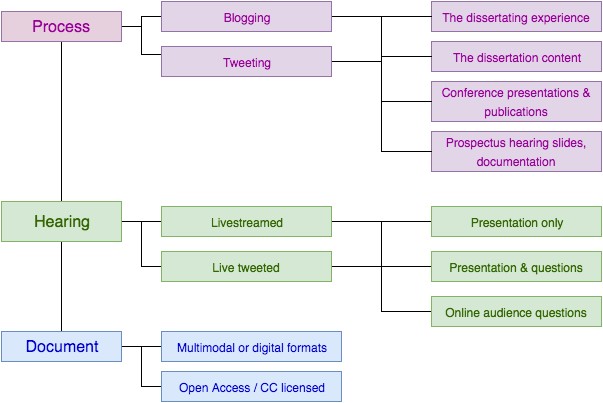
The panel discussion at #opened16 is meant to discuss some of those granularities and to examine some of the benefits, pitfalls, and institutional barriers that exist in exercising your right (and I do believe it’s a right) to an open dissertation. I was trying to map out the “spectrum” – after all, that’s my part in the panel presentation – but I’m not sure it’s a spectrum at all.  In reality, it’s more like a flowchart with decisions to be made all along the way.

Here’s a first pass* at understanding the granularities of the open dissertation.

granularities-of-open


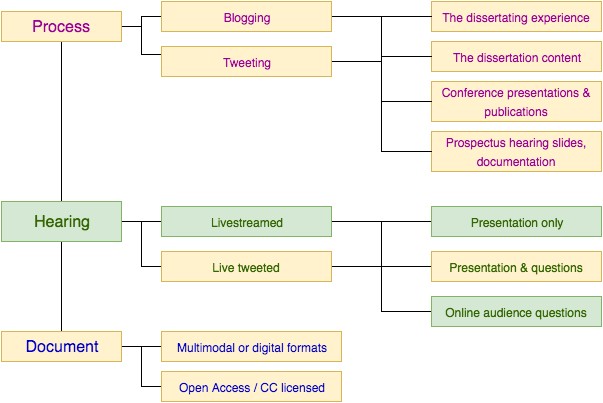
Now here are the “open” choices I made – in yellow.

lauras-open


See how that works? I have a lot of yellow boxes on my organizational chart – but how would that translate to a spectrum in comparison to someone else’s yellow boxes?  Are all yellow boxes considered “equal”?  What’s open and more open?  Quite frankly, I don’t care. People should do what’s right for them.  However, I do like the idea of a chart.  I am, after all, the data visualization person.  I want to be able to pick my boxes and talk to you about your’s.

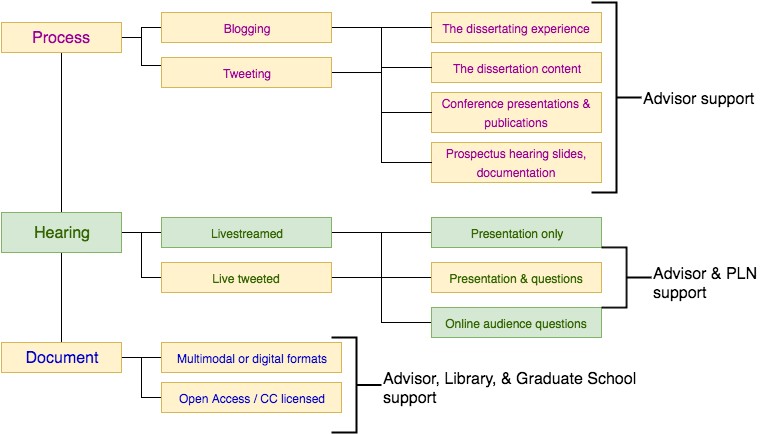
However, this next part is important, too. If I go back into my diagram and identify the institutional structures that needed to be in place for me to do what I did…

lauras-open-with-institutional-supports

Then you’ll see how much of this depended on Jon’s support. Consider that.

And come to the session – help add to the org chart.*  Even as I get ready to publish this post, I see some glaring absences. So come, help fill it out because that’s a very open education type thing to do🙂.  It should be fun.


My Digital Resident & Visitor Map

I’m putting together a session for college and community leaders on digital platforms and professional development. It’s a short session – I only have 30 minutes.   Additionally, there are pre-set criteria for the session that essentially boil down to requiring an experiential adult learning experience. In short, I need to offer a taste of something larger and compelling, but that is also discreet, active, and meaningful on its own.

I’m struggling.  Thirty minutes is not a long time.

However, I often find that all goodness starts with completing a Visitors and Residents Mapping Exercise.  The digital visitor/resident model was introduced by David White, Donna Lanclos, and colleagues in 2011.  The model represents a spectrum of behaviors (visitors to residents) as compared to the older and now debunked digital natives narrative, which focuses on discrete groups of people.

When acting as digital visitors, people consider digital platforms as tools. Their behavior tends to be goal oriented.  They limit their time online to what is required to achieve their goals and tend to get offline without leaving much of a digital trace or identity. In contrast, digital residents perceive digital platforms as spaces more than tools: spaces that can be linked together and inhabited along with other people.  They tend to spend more time on the platform, leaving artifacts and developing identities within those spaces.

resident_visitor
A simplified version of my digital map, as of October 2016

This is my digital map. It shows how someone can be a digital resident and visitor at the same time both within and across platforms.  It shows that I tend to mix my personal and professional use of digital platforms.  It shows Google Hangouts as a significant area of context collapse; I use it as a tool to be sure, but it is also a space where I talk to my friends about their families, conduct research meetings, and give guest lectures…sometimes back-to-back, sometimes in the same hangout.  I have literally had girlfriend chats that shifted into business meetings that shifted back into girlfriend chats – changes signified through the on air button. Another interesting overlap occurs at blogging, instagram, and twitter.  I use these platforms differently, but my followers significantly overlap.  Instagram is kind of like my B side.

I like my map.  Now I just need to jump from this to a micro-presentation.

A Post-IT Post

A post-IT post before I leave Newark.

During my  panel presentation at #WCET16 this AM, I heard some colleagues slip into tech-first talk, despite the fact I had been espousing a pedagogy-first perspective (and they had been nodding vigorously) for almost an hour. To make matters worse, some of them would start sentences with pedagogy and end with tech; the tools-first paradigm is THAT ingrained in these people.  So, in my final moments, I pulled out my VCU example:

Desire to facilitate Connected Learning –> let’s try blogging and tweeting to promote connected learning –> let’s assess for connected learning.  EVERYTHING, is done and considered in the context of the pedagogy, connected learning.  I defined the terms, of course. I offered an example of a specific course (Collaborative Curiosity – you know it :)). Administrators around the room were nodding and smiling…it really is a great course design. So intentional.  People were drawn in by the course but some of them actually got my point: Connected Learning first, blogging/tweeting second.

Then a vendor in the room stood up and asked me if we had ever considered using his product (some sort of gated discussion forum…whatever) to promote student safety, security, and FERPA in Collaborative Curiosity.

giphy-3

I just kinda looked at him for a second and said “No.  I explained our pedagogical approach.  We needed a public forum to promote dialogue beyond the classroom. The walled garden might be fine for some pedagogical goals, but it was not consistent with our agenda, and it would have been a horrible pedagogical choice.”

Then I firmly shut down his FERPA talk and my friend the moderator shut me down before I really got going on the vendor.  It was probably for the best.

There were some smart people in that room. I’m really hoping that exchange drove home my point. Pedagogy first.  Tools second. Otherwise you do stupid shit like letting tech get in the way of your pedagogy because a vendor told you to.


The Problem with the EduSocMedia Lit: A presentation for WCET 2016

Tomorrow, Laura Pasquini, Ron Hannaford, and I will be presenting at the WCET Annual Meeting on methods, practices, and implications of Social Media Research. This came about because Ron, Director of Distance Learning at Biola University, was inspired to coordinate a panel to address the fact that higher education institutions need empirical data to direct and support faculty use of social media in classrooms.  He and Laura Pasquini had already worked together in the context of educational technology; Ron and I shared several heated discussions on the principles and practice of digital pedagogy at Online Learning Consortium’s Innovate Conference in April.

Although Laura, Ron, and I champion online learning, we bring very different perspectives to the table – perspectives that are fueled by our respective professional positions, educational backgrounds, and philosophical approaches. I can’t speak for them here, but I can provide you with some of my own ideas on the subject.

In titling our presentation “Social Media Research: Methods, Practices, & Implications,” I think we are dangerously close to missing the entire point.  We need to step back from a conversation of tools and technology to consider the big picture of the pedagogies we aim to develop and the nature of story we hope to describe. 

Let me back up. Over the summer, I worked with Laura Pasquini and Jessica Knott on a systematic literature review on the educational use of social media in higher education.  Laura P. and Jessica have been working on this for a little over a year, collecting and examining different aspects of the literature; I was brought in this summer specifically to help examine the research methods and study designs found within. It was a massive project, and as I’ve written previously I read over 500 articles, many of them twice.

Based on a preliminary analysis, two types of study dominate the edusocmedia research landscape: the quantitative survey and the action research/single site case study (represented here as a single entity because they almost always consisted of the same thing: descriptive pieces written by a practitioner who had developed and implemented something in their own classroom). Regardless of the study design, a large number of studies focus on either use or perceptions of social media (in general or for learning) by students, faculty, and/or administration.

I find this unfortunate, or, at the very least, unfinished.

In reviewing the edusocmedia at the depth that I did, I found a striking absence of experimental designs. I believe this is the point some of my colleagues would like to drive home and then change. In the U.S., we tend to privilege the wisdom of experiments, or at least well designed quasi-experimental designs, over other forms of research.  Many of my colleagues are looking for more (quasi)experiments involving structured cohorts and systematic approaches to interventions – at the tool level.  What impact does classroom Twitter have on the test score of group A versus group B? How does use of Facebook in that class increase student engagement (via validated instrument) in this group versus that? Does Twitter impact critical thinking more than the Facebook when implemented sequentially or simultaneously?

Or similar.

This is where I tend to veer away from some of my colleagues.  I like (quasi)experimental designs – I really do – and I find the lack of (quasi)experimental designs in the literature problematic.  However, I do not consider them the gold standard, because I believe in a balanced relationship between (quality) experimental and (quality) nonexperimental, (quality) qualitative and (quality) quantitative work.

I believe in a richly woven (and quality) story.  I believe it is a mistake to hold a discussion about the need for more (quasi) experimental designs in edusocmedia literature without situating it in a larger critique of the literature, including the questions we ask, the outcomes we seek, and the quality of the work we produce.

This is why I’m on the panel.

Let’s talk about quality of the literature for a moment. Systematically speaking, the edusocmedia research has a quality problem. To be clear, I don’t think it’s isolated to edusocmedia or even educational technology.  Furthermore, there are some beautiful articles out there. I am speaking at a general level.

Sampling. Surveys are frequently given to convenience sample populations. Qualitative work often involves extremely small sample sizes.  I am trained in qualitative research; I understand and live by terms such as snowballing, saturation, in-depth case studies and similar.  However, a one-time “focus group” of less than five students (without additional data) does not seem like the basis for a publication.

Research questions.  As previously mentioned, we tend to focus on perceptions and current use of social media among students, faculty, and administrators.  These are important questions; their answers lay a foundation for work on access, systems level change, and considerations for pedagogical scaffolding. However, I believe the literature is saturated in these areas and offer a relatively solid picture over the last decade on a fairly international scale (one exception is South America, but I’m unsure whether this is related to a lack of published research or a lack of research published in English). I am not suggesting you should not do your own needs analysis when necessary; I’m suggesting that you do not publish it unless it is remarkably different than what has already been published.

Unfortunately, given the consistently low number of article citations noted via Google Scholar, I wonder if we are reading the literature at any depth prior to publishing our work.  #Edusocmedia literature seems to be the thing that everyone writes but nobody reads…or cites.

Study designs and collection. We tend to fall back on a nonexperimental descriptive design by default. How many designs could be strengthened by the use of a pre-/post intervention survey rather than the use of an end-of-course evaluation? In terms of qualitative research – this is where my heart just plain hurts. Qualitative research requires knowledge and skills, just as quantitative work does.  There are definitions and standards to uphold.  There are indicators of rigor to follow. As a group of scholars, we need to raise our understanding and skill level in qualitative research.

Analysis and Reporting.  Transparency and replicability. Reported research is not actually research unless enough information is provided so that a reader to repeat the process. Methods sections.  Explanations of how data were analyzed – qualitative and quantitative.  This is essential.  As a group of scholars, we need to take our own research seriously. We need to identify our study designs correctly and report our data analysis methods (not just our course designs) with enough detail that others can replicate our work.

The Big Picture

I am concerned about improving the quality of what we do.  However, I am also concerned about building a compelling, cohesive body of literature that is as comprehensive as possible. In other words, we – as a body of scholars –  not only need to have a talk about how we do research, but why we do research.

We need to rethink our research questions, moving beyond use and perception of social media; however, we also need to move beyond social media. 

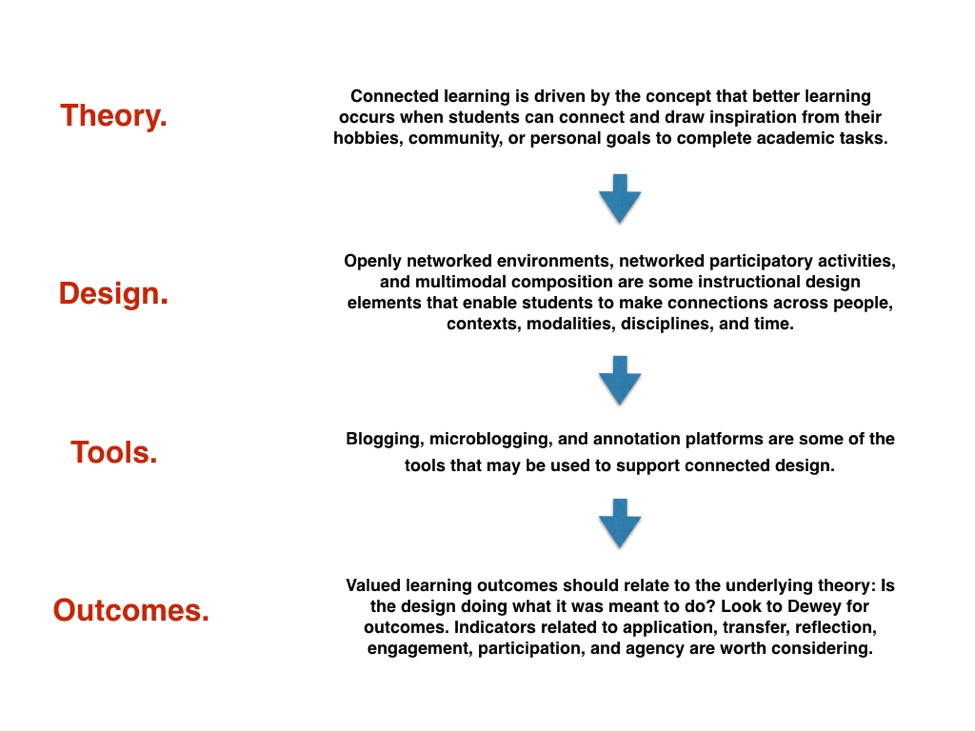
Social media is a collection of tools.  It is not a pedagogy. To show you what I mean, I’ve pulled a graphic from one of my other posts to serve as an illustration. Worldview. Pedagogy. Practice. Tool. Assessments.  Worldview and pedagogical assumptions drive the use of tools, such as social media.  To research and discuss social media without the broader context of philosophy and pedagogy is – at best – a waste of time and – at worst – harmful to collective knowledge. If we limit our research to the level of the tool (e.g. do students perceive a specific social media tool to be an effective learning tool?), we risk turning that tool into a pedagogical “black box:” We will have failed to analyze what makes that particular tool effective…and why.

picture1

When we situate ourselves entirely in specific forms of social media, we risk irrelevance, particularly if we are publishing in traditional journals that might take a year or more to see the light of publication. 

Tools change quickly – when faculty choose them, they are often doing so at the whim of administration (I’m thinking about learning management systems or clickers in particular) or the social media industry (Twitter, Facebook. They have a history of making significant changes and not once did they consult me about how it might impact my students or classroom).

I applaud the #edusocmedia field for exploring how students perceive the use of Pinterest (for example) in different disciplines and contexts.  However, it is just as important to ask what pedagogical actions Pinterest facilitates (collaborative resource curation…maybe?) and how those actions impact student learning (enhancing students’ ability to critique information sources…maybe?).  If we can elevate the discussion of tools to how they function (e.g. curation, collaboration, hyperlinks, multimodal creativity) rather than what they are, then our work will likely stay more relevant for longer periods of time.

Selfies & avatars as a form of reflection

Recently, I’ve spent much time and energy  discussing the pedagogical merits of blogging: a practice that supports skills such as social networking; providing and receiving feedback; developing a sense of audience; and creating a searchable, filterable, organizable record of thinking and growth over time. Alan Levine talks about this last benefit all the time – he can trace his learning for decades through his blog.  That’s wicked cool.

I’ve been blogging for about 5 years. It’s really interesting to look at how my practice has changed over time.  I had some better stories back then, but I’m better at telling them now. More balanced. I’m growing into my blogging and it shows.

However, a couple of nights ago I was searching through old folders on my PC. I was looking for an image that I needed to edit and submit for an upcoming publication. While I was searching (and cursing my lack of organization in the last days of my dissertation phase) I happened across a folder of old avatar pics, some of them as many as five or six years old.  My doctoral program was full of opportunities to establish a digital presence. Blogging, tweeting, and Google Plus were required in one class or another, LinkedIn was often encouraged by the faculty, Skype came in handy, and Instagram wasn’t much of a stretch. Furthermore, I presented at plenty of professional conferences and was interviewed for articles.. all of these required pictures or avatars.

Oh, the avatars. The selfies.

Selfies are somewhat controversial among the general population.  Some people have embraced them as opportunities to document, empower, or entertain.  Others see them as an alarming trend towards collective narcissism and self-involvement.  Since I tend to be the photographer of the family, I see them as the only real visual record of my existence in this world (seriously – and I’m not the only one with this problem).

When I look through the avatar folder, I see my graduate school story unfold as clearly as it does in this blog.  In fact, flipping through selfies might be a more visceral experience than clicking through blog posts, because the pictures were taken in a moment rather than composed over hours, days, or weeks.  When I look at these pictures, I see more than age changes (although there are plenty of those). I see a growing understanding of social media (that first picture on LinkedIn? really? I was a hot mess). I see signs belonging within academic communities (the Howard Rheingold impression). I see confidence in a professional role (never been more in my element than in that picture with my glasses on the top of my head). I see landmark occasions (graduation). I see my kids. I see some pretty significant depression this summer (the third and second to last pictures… I wince a little when I see them and recovery (what a difference a couple months can make).  I see me. The avatars help me lay it all out. They aren’t about self-absorption as much as sharing and recording, just like blogging.

userpic_4297251_54c1303e5deb34a3217a13e04e60fa5d
LinkedIn – 2012.
photo-3
Twitter – 2012.
photo-4
LinkedIn – 2013.
screen-shot-2016-10-06-at-10-17-09-pm
WordPress – 2013
userpic_4297251_9c9e64d049c3492dbb9a63f0c8e514a6
Academia.edu – 2014
screen-shot-2016-10-06-at-10-13-11-pm
Twitter -2014/15
screen-shot-2016-10-06-at-10-13-01-pm
Conferences, Articles – 2015
screen-shot-2016-10-06-at-10-08-57-pm
Instagram – 2015
screen-shot-2016-10-06-at-10-08-44-pm
Twitter – 2015
screen-shot-2016-10-06-at-10-08-36-pm
Twitter – 2015
screen-shot-2016-10-06-at-10-13-26-pm
Google, Presentations – 2016
screen-shot-2016-10-06-at-10-07-54-pm
Twitter – 2016 (Graduation)
screen-shot-2016-10-06-at-10-07-02-pm
Twitter – 2016
screen-shot-2016-10-06-at-10-06-36-pm
Twitter – 2016
screen-shot-2016-10-06-at-10-06-05-pm
Instagram – 2016
screen-shot-2016-10-06-at-10-05-33-pm
Twitter – Today (Literally).


Coding and the Adult Learner

I have done a significant amount of coursework in adult learning. I’ve read the canon. I’ve taught classes to other educators on adult learning.  I’ve published a chapter.

Furthermore, I’ve been accused of being an adult learner. In the first year of my doctoral program, a random faculty member stopped me in the hallway to shake me by the shoulders and say emphatically: “YOU (shake) are the ultimate adult learner! WE (shake) are WATCHING (shake) your EVERY MOVE (shake shake). I can’t WAIT to see WHAT YOU DO (shhhhaaakkkkeeeee)!”

So, I am an adult educator and learner, blah blah blah. When I tweeted this today –

it had special meaning to me, but it was not intended to be particularly insightful to the casual reader. Every adult educator knows that adults learn better with ‘just in time’ learning and in ‘need to know’ situations. At some level, most adults have to want to learn what they are learning, they have to need to learn whatever it is that they are learning, or they aren’t learning it. Period.

Granted, I’ve never been the average adult. I tend to be curious about everything and capable of learning a lot…well…almost everything.  I’ll start learning something before I’m actually legitimately interested in it and without particular need (at least what the average adult would designate as need).  That being said, I have a profoundly big blind spot in terms of computer programming and auto repair.

Before I go on, I acknowledge that these are exceedingly useful areas of study, particularly for a woman who hangs out in EdTech circles and who does, in fact, drive automobiles.  I also acknowledge that I’ve had ample opportunity to learn a little about both.  When I was working as a graduate fellow at ALT Lab, there were people eager to teach JavaScript and similar. They literally came to my office door offering to teach me. Also my husband fixes cars for fun. He knows how to make my car horn blow by pushing a button on a laptop. If I wanted a lesson in basic auto repair all I had (have) to do is open the kitchen door and go outside.

Unfortunately, I have actively and repeatedly turned down invitations to learn anything related to coding and auto repair.  Other than how to change my font size in html, I know (actually, now that should be ‘knew’) nothing.

I’ve spent significant time reflecting on my unusual and striking lack of interest.  There’s some deeply ingrained gender bias-type things involved that I’m not sure I’ve fully unpacked, even now. Computers and cars don’t play a role in how I see myself, my work, my past experience, or future goals.  Also, I’ve always been in situations where the potential  teachers are men…the lack of female role models hasn’t helped whatever gender things are going on in my head.  In related news, I hate being wrong in front of anyone, but particularly men (it goes back to my medical days where I worked alone in environments of blatant and not-so-blatant sexual harassment and sexism) and when you mix all this together, I have to say it:

I am Laura Gogia MD PhD, and I am intimidated by networked computers and servers and mainframes and software installation and people who know what these things are. Also cars and mechanics, but that’s a different blog post.

About a month ago I was told I would be learning how to code for my job. It was really quite unexpected. In fact, if I had known I would need to learn these things there’s a decent chance I might have turned the job down or not applied for it in the first place, because  of the bolded statement I just made.

QUERY: Having to learn things unexpectedly is the norm for my work.  I’m good at it.  So how come coding felt so different?

ANSWER: This is the first time ever that I have very real, deeply-held personal barriers to what it was I was being asked to learn.

Learning to code has been a pain in the ass. I have been angry – really angry – at myself, at my current the situation, at my previous education, at my previous workplaces. My anger has been exacerbated by and exacerbating for the grief I felt over moving beyond my phd. I have been depressed – really depressed. I have wanted to give up and walk away.

I am willing to bet that this is the way many adults feel when they try to learn something new, particularly when they are told they have to learn it for work.  Finally, I am getting a taste of what it’s like to be a real everyday adult learner.  

I tend to get emotional about things, but I also always have a strategy.  Like I said, I know the adult ed literature.  I know that motivation is everything, so I grabbed onto every personal reason to learn coding that I could find: keep my job, develop a skillset for the resume, be a model for my kids, develop my brain in new and interesting ways.  The reason didn’t matter, as long as it worked in the moment.

I also knew that expertise begets interest begets expertise. The better I get at something, the more interesting it becomes, the more internally motivated I am, the better I will get. Just. Keep. Working. Things. Will. Happen. It’s my mantra for everything.  Most of the time it works.

This time, it’s working. I’m going to be fine.

But what else is important? The teacher.  To have someone you can trust, who gives a little space for you to be angry or depressed or frustrated or wrong or just plain weird – this is important. So big collective thanks to all the teachers out there who make this happen for adult learners everyday.  You are really important too. Good job.  And thank you.


LEGO Critique Deux: CITY Fun in the Park Set (This time it’s PERSONAL!)

Last year, in an effort to “walk the walk”, I reviewed the LEGO Robie House. I find myself teaching the LEGO FSEM again this fall, and figured: well, let’s walk again. This time, I picked a set I was super excited about, the CITY Fun in the Park set. It’s a pretty small set, considering …

Continue reading »

Reflections on (Im)perfection

When I talk about blogging with students (or faculty) who are just starting to blog, someone almost always asks “how do I know what’s good enough to share?”

It’s a great question. I ask it of myself almost every single time I sit down to write a post. It seems to me that the question reveals two separate but related types of uncertainty:

  1. “What if I’m wrong?”
  2. “What if my audience doesn’t like it?”

This post is about the first uncertainty: the fear of being wrong or otherwise imperfect.

Despite all the educational texts and scholars who reassure us that we learn through mistakes and grow through conflict, I have a major, lifelong problem with a fear of being imperfect. For what it’s worth medical training does not help those with natural tendencies; in fact, it makes it much worse.  Learning in the open, specifically blogging, has been one way for me to hack away at the conditioning just a bit.

I blog, therefore I reveal my imperfections.  Often.  In public.

This morning Lee Skallerup and I spoke with Ken Bauer’s class on digital identity, just like I threatened to in my last post.  Lee was great.  I was absolutely horrible.   I couldn’t make eye contact with the camera to save my life.  I know this because I watched the video later this afternoon.  It was a distracting amount of a lack of eye contact. It was subpar. It was definitely imperfect.

My impulse, of course, was to rip myself to shreds. I had a parent’s night at my daughter’s school tonight.  My husband stayed home to watch the kids  and as I drove alone  to the school I started the ritualistic self-pugilism.  It may sound overly dramatic to call it self-pugilism but no – no one will ever be as hard on Laura Gogia as I am on myself.

However, as I pulled up to the school I said to myself: You’ve had a migraine for the last four days. You still have a migraine. Your head hurts like hell. You’re exhausted and ragged and you didn’t do great today but don’t you think it’s time you gave yourself a break?

Giving yourself a break.  It’s impossible under some circumstances to do your best, let alone be perfect.  Everyone deserves a break, even you.  Even me.

Perfection comes through practice – from trying and failing and picking yourself up and trying again.  I didn’t do great today but I could learn from the effort.  Migraine or no, I’ve gotten into a bad habit of not making eye contact with the camera during video conferences.  Friends have been mentioning it since April.  It’s a lazy move – I’m an introvert. I write better than I speak, and when I have to think and speak at the same time it’s easier for me to focus (or maybe I just enjoy it more) if I crawl back into myself and pretend no one else is there. I talked it over with my family (I showed them parts of the video) and we decided that I should tape a picture of them next to the camera lens and talk to that the next time I do a video conference – for a little while, just to get me back into the habit of actually TRYING to present well.

There’s a meaning to this brief, rough blog post – because, like I said today, I never hit the publish button unless I think at least one person out there might find something in it useful. I (you) can get better, but first comes

  1. screwing up
  2. giving my(your)self a break when I (you) screw up.
  3. take what I (you) can from the experience and strategize.
  4. get better.

We all have to learn that.  Blog to find out how to blog. Only then will you know what’s worth sharing.