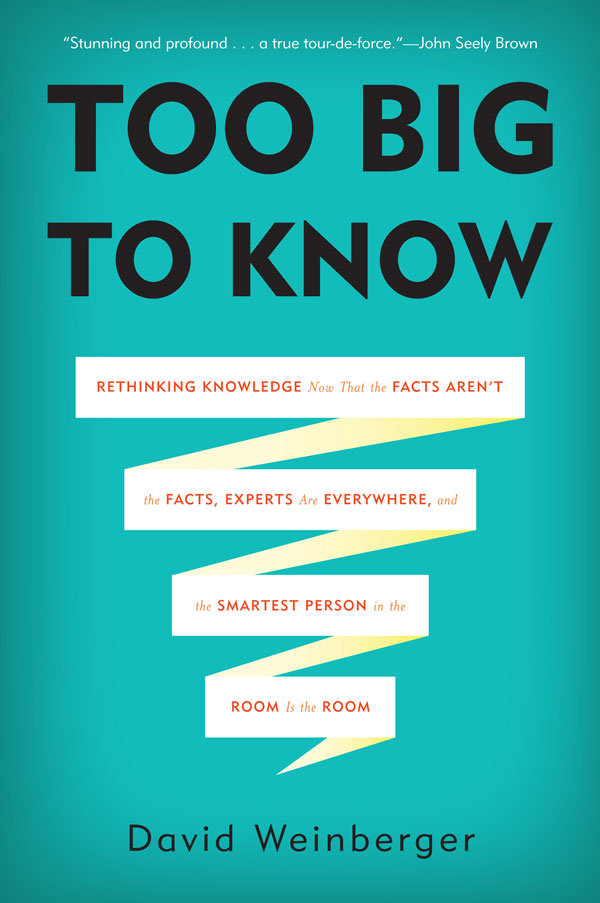
Too Big to Know: Monday Morning Live Tweet Class with David Weinberger

Too Big To Know

Greetings Open Learners!

We have a late-breaking, serendipitous opportunity tomorrow morning to talk about David Weinberger’s book, Too Big To Know on Twitter. Weinberger, a philosopher and technologist who writes about the effects of the internet on human relationships, is currently a senior researcher at Harvard’s  Berkman Center. In light of current discussions about the nature of facts and their alternatives, the book’s subtitle — “Rethinking Knowledge
Now that the Facts aren’t the Facts,
Experts are Everywhere, and
the Smartest Person in the Room
is the Room.”   — is especially compelling.

Dr. Weinberger will be Skyping into Tom Ewing‘s undergraduate course on Data in Social Context at Virginia Tech  to talk about Too Big To Know with Tom and his students.

I will be live tweeting the conversation tomorrow (Monday) from 10:10 to 11:00 am EST. If you’re familiar with the book or Weinberger’s work please join us. And if you aren’t please join us anyway!  You can follow along and send questions and thoughts to #Openlearning17 and #Faccollab.

Followers of #gedivt — I will try to flag you all as well, but the best bet would be to check #OpenLearning17

Twitter Handles: Data in Social Context: @DiSCVT ;David Weinberger: @dweinberger ; Tom Ewing: @EThomasEwing

Associative Trails, Connectivity, Networks, Rhizomes, Learning

[703 words]

As is my wont, I’m throwing together a bunch of semantically charged bits, following an an only partially conscious, mostly intuitive process, a kind of ADHD fluttermind effect that arises from neural activity in my brain. To nail down some of these flighty connections and intuitions, it is my intent to explore it further here and, as much as possible, to make the gist of my “associative trail” meaningful for others.

Part of the way that I’m thinking about this is old-school analogy. I know that brains work through a complex mechanism of dynamic networks. We still don’t know exactly how consciousness and thinking arise from large numbers of interconnected neurons stimulating each other in certain ways, but that seems to be how our brains — our mind-generators — work. Connections that are dynamically managed and networks that collectively produce a certain minimal cognitive functions, collaborating and connecting with other networks to produce more complex cognitive functions, iterated and reiterated dynamically, scaling up until we have those effects or results or entities that we identify as “thought,” “learning” and “mind.”

Learning takes place by making new connections, by building networks of meaning, by noting and reiterating the way in which certain stimuli produce a kind of “pow!” that is impactful and meaningful. If, in my analogy, individual human beings function as if they were neurons, what they do, then, is respond to stimuli. Once a stimulus reaches a certain level, the person/neuron unit acts in a way that stimulate one or more others in network. Or perhaps nodes or concepts within that unit’s mind interact with other nodes or concepts or other bits and pieces. Over time, connections are forged, then strengthened or pruned, leading to a dynamic but reasonably stable set of learning.

What I’m trying to suggest is that there may be ways in which learning is both individual, but also collective. There may be ways in which this whole process of associative trails build significant patterns over time, patterns that represent the dynamic but stable results of collaborative learning. Individual learning, intuitions and associative trails count. But they are all the more impactful when they connect to others. It is for this reason that tools that facilitate collaborative learning over time — from traditional scholarship, for example, to online learning communities and web-based annotation tools like Hypothe.is — have deep and resonant value. They help construct layers that may ultimately result in more complex, more meaningful, more impactful learning. I guess the question to ask is how one goes about pruning those associative trails or those connections that are not helpful or productive. How does one choose or discern? A difficult question.

Another way to think of it is as a kind of learning ecosystem. Each part of that system can function individually, but the true beauty of the ecosystem is the way in which everything is interconnected in a kind of dynamic but generally stable system of interchange, mutual benefit, exchange, stimulus and reaction. I think of the vast mycorrhizal networks, loosely connected with tree root systems that help regulate forests, for example. (One suggestive video to watch on this topic is Susan Simard’s TED Talk on “How Trees Talk to Each Other.”) This way of thinking about it — seeing analogies and correspondences between neural networks, mycorrhizal networks, communication networks, networks of learners — resonates in significant ways with Gilles Deleuze and Félix Guattari’s  Mille Plateaux (Paris: Éditions de Minuit, 1980) [A Thousand Plateaus, trans. Brian Massumi (Minneapolis: U of Minnesota, 1987)].

If we are growing complex, multilayered, interconnecting and interpenetrating ecosystems of thought, of learning, of mind, my earlier difficult question can be rephrased to wonder what mechanisms regulate the complex system? What dynamic will select the strong and meaningful connections for building resiliency? What processes will target the connections that are destined to be pruned because they do not contribute usefully to the long-term survival of the complex system?

Is there, in fact, a way in which learning, technology and connection are weaving themselves together for the construction of some greater entity? (Teilhard de Chardin’s noosphere?) Is this thread of thinking simply a delusion? The answer to those questions merit further thought. I’d be interested to hear other perspectives on these random musings.

Associative Trails Around DigCiz, Fake News, and Microtargeting

Microtargeting: A Digital Citizen’s Perspective

I started writing this post about fake news and microtargeting a few days ago and then I was reminded that #OpenLearning17 was talking about Vannevar Bush’s As We May Think this week. I began to see connections between how they might relate. It made this post even longer but I think it was worth it.

Some background if you don’t know: Bush’s article was written in 1945 as the war was ending. He was the Director of Scientific Research and Development during this time so he was all about applying science in warfare. In the article he is envisioning where scientists will put their energies as the war is ending.

Now, as peace approaches, one asks where they [scientists] will find objectives worthy of their best.

The article focuses on the connections we make when we build knowledge. How we associate past discoveries with current ones and tie things together. Bush advocates using technology to track the connections that we make in this process to extend memory for better reflection on those connections. Many credit this article with predicting the Internet.

He uses this term “associative trails” to describe indexing knowledge based on connections that we define. He thinks this is more powerful than typical kinds of indexing like sorting by number or alphabetizing. But I note that this is a much more personalized kind of indexing.

He is advocating for metacognition, that is, realizing what you are thinking and where your trails lie so you can better understand what you are researching, yes, but more importantly your own thought processes. What I am wondering about is what happens when you get the technology part but you leave out the metacognitive part? Bush does not seem to consider this option but I think this is often the world that we live in today.

When I start thinking about fake news and microtargeting I have to ask what if a person does not have access to their associative trails? What if they don’t even realize they are leaving a trail? What if they think that their trail is not so important? What if someone’s trail could be bought and sold? What does the record of all our connections say about us and can it be used in ways that might be exploitive?

I’m not a data scientist. I’m not a journalist. I’m not a librarian.

I am a technologist. I am an educator. I am a person. A person who lives some of her life on the web. I want to say a lot of her life on the web…. But “a lot” is a relative term.

Often it is journalists and librarians that tackle the fake news topic. I think that both of these groups add an important perspective to the conversation but I also think that there is the perspective of a digital citizen and those that advocate for such concepts; the perspective of someone using the web as a place of expression, a place to learn, and to be heard and to listen to others.

What is microtargeting?

When I bring the idea of microtargeting up I’ll start with something like “well you know they track a lot of your data from the internet to try to influence you” and most often, before I can continue, I hear “oh yes of course I know that”. Then there is the inevitable story of shopping for an item on one site and then continuing to see ads for it on other sites. But that is rather mild and not really what concerns me.

I’m not just talking about the machine realizing that you were looking at a product on another site or that you clicked on something from your email, that is cookies and web beacons, that is rudimentary stuff.

I’m talking about gathering thousands of data points, combining them, and analyzing them. Everything from shopping history to facebook likes and what church you attend can be gathered and combined with traditional demographics to create a “personalized experience” meant to influence you with emotional and psychological messaging.

The big story around microtargeting right now has to do with a little company called Cambridge Analytica (CA) in London. They are the big story because they’ve had well known wins with customers like the Brexit Leave and Donald Trump campaigns.  

In this eleven minute video during the Concordia Summit their CEO Alexander Nix explains how they work. In the video Nix explains that demographic and geographic information is child’s play. That the idea of all people from one demographic getting the same message: “all women because of their gender, all African Americans because of their race, all old people because of their age” is ridiculous. That those things are of course important but they are only part of the picture; that psychographics are a much more complete picture because then you are targeting for personality.

The big shocker where people feel a little creeped out is when they learn that CA uses those silly little facebook quizzes (you know the ones that you click the “connect to facebook” button on before you are allowed to take them) to profile your personality. What! Those quizzes are not just there for free for you to have fun with… as they say: if the service is free consider that you might be the product.

As we may forget

CA is not the only one doing this; they are just the popular story right now and the quizzing is only part of things. For me the big part is that connection to facebook which can give the owner of the quiz (be it CA or some other company) access to all of your account information, your likes, your posts, and often much of your friend’s information. Of course, much of your personal and consumer data can be purchased so throw that into the mix. Imagine aligning all of this data for a person. It is a lot. Often people don’t even realize what they are giving away.

You authorize the connection so that you can take the quiz or play the game or whatever and then it is over for you – you have had your fun and you move on. But the app still has that connection to your account and will continue to unless you go in and specifically delete it. This means that it can continue to gather data. Apps will vary of course and I can’t speak for any specific one but I know that all of you are reading the terms of service of each app before you connect it – right?

In this case the user is continuing to make associative trails on facebook through friending and liking. However, they are not using those trails for metacognition. They are not using technology to extend their memory so that they may better reflect on the connections that they are making. Instead they plow forward forgetting many of the connections and the fact that they have authorized someone/thing else access and track their connection trails. The trails are being harvested by an outside entity and the user, more than likely, has no idea who that entity is – did I mention that they could change the terms of service, the name of, or the nature of the app at any moment?

But how much can someone really do with all that data?

I have seen the data scientist folks that I follow sort of look at the CA story a little sideways and it seems every day there is a new article downplaying the impact CA had on the Trump and Brexit campaigns. Interestingly though not too many saying that the idea behind this, using big data and psychographics to personalize experiences, is invalid. Just that CA might be more hype than pay off.

This much more comprehensive story about the origins of CA in Motherboard states that Cambridge is not releasing any empirical evidence on how much or how little they are affecting the outcomes of campaigns. And though CA is more than happy to tout their wins as proof of their effectiveness I’ve yet to see anything about their losses which is a classic vendor ploy.

In this recent Bloomberg article, The Math Babe, Cathy O’Neil points out that what Trump was doing during the campaign is not uncommon and that the Hillary campaign was also doing it. Also, that U.S. companies have for decades been tracking personality. O’Neil points out that “To be sure, there’s plenty to be appalled at in this story…. It is just not specific to Trump”.  She states that Hillary had access to more data than Trump because she had access to Obama’s archive of data from the previous elections. 

But then I think about Bush. As We May Think considers information storage and to be sure the amount of data is important. However, I think the real meat is in the connections. It is here that I have a hunch that having the right context or being able to see the right connections could be more powerful than having more data – well at least if we are talking about the difference between a lot of data and a whole heck of a lot data. Did I mention that I am not a data scientist?

Paul Olivier Dehaye has written about how CA was targeting “low information voters” for the Trump campaign. This article hypothesizes that CA used data (citing CA’s claim to have 5000 data points for every adult American) to specifically look for voters who had a low “need for cognition” for microtarged political advertising. These are the type of folks who would be more likely to not dig too deep or question stories that were presented to them. These folks are not doing a lot of metacognition. I don’t blame them for this, but I’ll get to that in a bit.

What is real and how can we tell?

As I remember it, when the term fake news first started being thrown around during the campaign it was largely being used to define sites that were not run by major news organizations or even particular journalists but rather individuals who knew how to buy a domain name, hosting, and throw up a WordPress site but who were only interested in click revenu. They would come up with crazy stories and even crazier headlines just to get people to click. As these started to be called out as “fake news” some began to create lists of these sites and place parody and satire sites alongside of them.

But then it got more challenging with accusations that major news sources were in fact fake news and that we could tap into “alternative facts” to get to the truth.

Journalists receive training to be sensitive to bias and context and to not let it interfere with their reporting, so they should be more prepared to consider context and fight against bias, especially their own. However, you will never be able to completely remove bias and context; much of it can be hidden and not realized till later. It is here that education is asked to step in and create critical citizens who will hold journalists responsible for what they report and it is here that we see the calls for greater digital and information literacy in regards to fake news.

Fake news, microtargeting, and digital citizenship

Bush envisioned people using technology to extend their memory to be more metacognitive about the connections they were making while they were building knowledge. These seem like rather “high cognition” kind of folks to me but what about those “low cognition” kind of people that Dehaye thinks CA could be after? Who are they?

I mean I’ll admit that I’m guilty myself. I don’t read every terms of service for every new app I download. I have forgotten that I’d given access to some app only later to find it hanging out in my facebook or accessing the geolocation of my phone. But I think that it is really some of the most vulnerable among us that are at risk here.  

What if you work 40/50 hours a week and care for children, parents, or grandparents? What if you have a disability or illness to manage? What if you grew up surrounded by technology and this kind of technology usage is your normal? Do you have time to build all of those literacies? 

Building critical literacies around information and digital technologies takes time. It requires more than just a list of which websites are fake, which are satire, and which are backed by trained journalists. It requires more than a diagram of which news sources lean in which direction politically.

You need the ability to critically look for the nuance of things that could be off. For instance a .com.co is different than a .com. Kin Lane talks about “domain literacy” for which goes much deeper than this basic understanding of domains but I hope you see what I mean. We need to read the article and then ask is it really reporting first hand or are they reporting on reporting as Mike Caulfield points out when he calls for the first step in fact checking to not be evaluating the source but rather determining who the source is!

Once you determine the true source you need to evaluate it – who wrote this, what are their political leanings, are they being backed by other influences (like money) somewhere? You should click on the article’s links and/or look at its sources and read those articles to get context before you make a definitive decision about it’s worth. All of this takes access, and knowledge, and constant practice.

Maha Bali writes about how fake news is not our real problem. She points out how fake news is good for critical thinking and states that we need more than just a cognitive approach; what we really need is cross-cultural dialog, learning, and skills. This is where education and community need to step up to the plate.

It seems like a lot and for me it is a call for better general and liberal education. I think the first step may just be in realizing (and getting students to realize) that my internet is different from your internet. Where possible, taking ownership for our own “associative trails” and demanding that ownership when it is kept from us. Finally, simply realizing that there are political forces and companies with lots of your data… which has always been the case but maybe realizing that they are trying to influence you in increasingly intimate ways.

This article (images and words) are CC-BY Autumm Caines
Teachers Guide to Social Media – Part 2

Teachers Guide to Social Media
Creative Commons License
This work is licensed under a Creative Commons Attribution-NonCommercial-NoDerivatives 4.0 International License.

Welcome my dear teacher to the Continuation of our Teacher Guide to Social Networking Series. If you haven’t read the Part one of the series I would request you to have a look on it. 
I suppose up till now all have already seen the troubles caused by social media and the online world. While there are great benefits it’s now more being used in unproductive actually a destructive manner. Ethical Hackers Club has previously posted many articles on Social Media and Cyber Bullying and we have been trying our best to provide solutions for the same.  

So Lets start with Our Part two of the Guide:

When we talk about Social Media how can we forget about privacy? Social media has always kept your privacy at risk. So Let’s start on with the same.

Protecting your privacy on social media:

interacting with studentsThere are several ways you can limit who sees what you post but, although if you are really worried about something getting into the wrong hands, the best idea is to avoid posting it online on any social media. Event greater if you don’t share it over email or any online storage, as once anything is online it can easily be copied and pasted intentionally or by mistake. 

But these are extreme cases, such as something that is embarrassing or something that could get you or someone else in trouble. Learning how to limit audience from posts you share online can help you out with the sensible amount of privacy. 

So before you start using any social media account you should learn about its privacy settings and terms. 
Almost all recognized social accounts have options to limit people who can see what you post. Some even allow you to control the audience for each post the best known among them is Facebook. 


Facebook allows users with options to allow post visible to friends, friends of friends and also it allows the customization of the audience to show it to specific people, group of people or to hide them from the same. although there are some people who make posts public knowing that anyone could see. What we recommend is that you learn about privacy before you post. Visit Ethical Hackers Club’s Cyber Secure School Section to learn more about our programs for schools. 

Socializing with students:

Socializing with students over social media surely isn’t a great idea, but there are few teachers who use the platform to discuss classroom projects, resources for students but what we recommend teachers is that they could start a Facebook page or a group wherein students can access the discussions without having to be friends. 

You are an educator but you too have a personal life and your comforts like common people do. Be in your comfort zone while making social media decisions and do what you feel is good for you. 

There’s a lot more for Teachers to learn here so Stay Connected for our Teachers Guide to Social Media – Part 3.  

…..To be Continued.

For-Profit Involvement in OER – Part 5

 Below is a re-posting from http://developingprofessionalstaff-mpls.blogspot.com/2017/01/for-profit-involvement-in-oer-part-5.html

Wednesday, January 25, 2017

For-Profit Involvement in OER – Part 5

This is a continuation of a discussion from Part 4


In a blog post yesterday, David Wiley said:


“The conversation needs to be larger, the sense of urgency needs to be greater, and the vision and imagination of what’s possible needs to be far, far broader.


PDFs aren’t going to get us there. We need more efforts to provide the benefits of publishers’ “adaptive” systems while honoring and enabling the values of the OER community (e.g., the 5Rs and open pedagogy) and more support of these efforts.


The tl;dr (sic) is this: faculty (who make the decision about what resources will be used by students) love these systems, and with good reason – they can make things better for students and faculty alike. If the OER community doesn’t recognize that and start providing and promoting viable alternatives to publishers’ platforms, the best possible future for OER is being locked down inside a Pearson MyLab playing second fiddle to proprietary content. No 5Rs and no open pedagogy.”


Earlier in the post he said: “And don’t even start trying to explain how the LMS is the answer. Just don’t.”


I responded, ignoring his exhortation: “LMSs properly supported, are very good ‘platforms’ for all kinds of assessment and analytics. And, more importantly, control of the LMSs can remain in the hands of the faculty where it should be, if they choose to exercise that authority. Of course, if faculty are only interested in the easiest way to do things, well, then, they can always pay someone or have someone else pay for the difficult parts of teaching and learning.”


David responded to that by saying- “This is demonstrably false. Just taking the first example that comes to mind, LMSs cannot do Computerized Adaptive Testing no matter how they’re supported.”


I’m not sure where to start. Arguing that we shouldn’t consider LMSs for OER because LMSs can’t do CAT is a problem for at least two reasons: First, CAT is usually not OER in practice, today. But, secondly, LMSs can indeed to CAT if you want to use them for that.


David then went on to propose that I read what he’d written about LMSs and CMSs and OLNs back in 2009. I generally agree with what he wrote in 2009. Faculty adoption of all of the interactive, collaborative, student centered features of an LMS is a slow and extremely tedious process. We wrote about that in our book chapter and 2014 HLC Conference Best Paper describing such an initiative. David would do well, I think, to consider the work of one of his colleagues at BYU, Charles Graham, who we reference in our work. Graham, et al. point out that implementing a hybrid or blended system in an institution requires a whole lot more than was considered by David and Mott in their 2009 paper.
David clearly understood that there are a whole host of issues to consider as faculty change the very nature of how they do what they do. David’s approach regarding the task of transforming the way faculty approach how they interact with students in the teaching and learning process was not to show faculty how to do it. Instead, he created a for-profit company where OER is housed in an LMS that is connected to the institution’s LMS via LTI. The advantage to faculty is that they don’t need to learn how to install OER in their LMS courses and learn how to use the new, interactive, collaborative, student centered, wider community connected features of their LMS, or learn how to manage the analytics that are available with all current generation LMSs. The advantage to David is he gets to have a for-profit company that charges the students of those faculty who don’t want to learn how to do all of that difficult ‘platform stuff.’ Sure the students save money compared to what they would pay if they bought the books from proprietary publishers, but the faculty stay ignorant about how to really manage learning using a learning management system. Ignorant faculty are good for profit making.

One for the hippie hub

You better think (think)
Think about what you’re trying to do to me
Think (think, think)
Let your mind go, let yourself be free

Think by Aretha Franklin and Ted White

Our “flower child hub director, Gardner” sent a nice message reminding me to do some OpenLearning17 blogging, so here goes.

When I went back to look at Vannevar Bush’s “As We May Think” a few days ago, I was happy to see a few annotations from some former ds106ers, from when I tried to get them on the annotation train. We also used the article back when we did The Internet Course, and I did a primitive Cmap breakdown of some of my thoughts and reactions to it.

One of the things that struck me about it was Bush’s background. He founded defense contractor behemoth Raytheon, headed the Office of Scientific Research and Development during WWII, and was instrumental in the creation of the National Science Foundation. He was pretty much the embodiment of the military-industrial complex in his day. But as windham notes in annotation, Bush’s “humanitarian optimism” inspired both the essay and the many minds behind the development of the Internet.

He recognized that there is something more important than the money to be made – humanity over profit. I imagine that might have been obvious in the wake of WWII, but it has long since been forgotten in military-industrial complex, and it no longer seems to matter to the powers that be in information technology. The Web was meant to connect people, in Berners-Lee’s view, rather than to disrupt them. A way to let your mind grow and let yourself be free.

People walking around everyday
Playing games, taking score
Trying to make other people lose their minds
Ah, be careful you don’t lose yours, oh

It can be hard to maintain that sense of humanitarian optimism in this age of disruption, creative destruction, and weaponized information. When I looked up the lyrics to Aretha’s song, the third line above stood out to me – the definition of gaslighting. That’s quite the opposite of informing, isn’t it? The tool that Bush envisioned and humankind built is not being used to connect people, or to organize information, or to help us think better, but quite the opposite. This has to do with the social, political, economic and technological environment we have created and the way information is generated and distributed within it.

If we work to understand the hows and whys of information creation and flow, what I would call information literacy, then presumably we will be better able to review our shady present. That would elevate my spirit. Until then, there’s always Aretha:

Notes and Trails

I’m still processing this week’s #openlearning17 webinar, “‘As We May Think’, Annotation, and Liberal Learning: A Conversation with Hypothess.is’ Jon Udell and Jeremy Dean.” And I find myself wanting to use the very practices and ideas that were discussed therein, annotating the conversation and creating my own knowledge structure by connecting ideas and concepts in a trail that makes sense to me. I guess I could use a video annotator that I’m familiar with, such as Classroom Salon, or perhaps produce a transcript that could itself be annotated with Hypothes.is  But in the interests of time, I’ll forego those options and write up just a few thoughts.

There are lots of possible places to start, but let’s go with Jon Udell’s observation about the “sea change” that occurs when we annotate a document and are able to extract the nuggets relevant to our inquiry…a phrase, a sentence, a number in a table, a cell in a spreadsheet, etc. With annotation, you have a resource that is more granular than the document as a whole, a resource that has its own URL (like a document or an entire webpage). Not only does this nugget have its own URL, but it can be tagged to become part of a larger path or group of related items.

Why is this such a game-changer (to shift our change metaphors)? Perhaps because now we can get a more accurate representation, in the exterior public space of the Web, of the kind of connections being forged in the inquirer’s brain. My thinking is not primarily a matter of linking texts and documents as such, but of connecting ideas and concepts and discrete pieces of data. And Hypothes.is provides some of the “architectural glue” for holding the structure together. I hadn’t really thought previously about Hypothes.is as an “infrastructure” that goes beyond just creating marginalia on a single digital text (which might be the “digital facelift” understanding of it, to use Clay Shirky’s phrase). So it’s not just the annotation itself, but this “annotation infrastructure,” the way that the associated link and tags can be combined and recombined, that is so powerful.

And, it seems that this interplay between what’s taking place in an inquirer’s brain and what’s being represented in the open space of the Web is another theme running through the conversation. In discussing the nature of a “tag,” Gardner Campbell posited a juxtaposition between the tag as (i) a shared conceptual marker (thus public and open), and (ii) the tag in an individuals’s associative trail, which is meaningful in the network of that person’s brain. Later, in a related observation, he spoke of two ways to think about associative trails (which, it seems, is what a tag fundamentally is). First, they are connections that thinkers make and want to share as part of a record of activity and a larger effort to make those kinds of links another layer of meaning (again, the public/open sense). Second, tags are a kind of context by which we can understand where ideas come from in the first place. A well chosen tag prompts us to think about our own thinking, to reflect upon how it is that one idea is connected to another in our own minds. Here Gardner laments the difficulty of getting students to engage in this metacognition, or in focusing on anything beyond what they perceive an instructor to prescribe and expect and to have already created for them.

But to become more aware of the web of connections and associations that exists in one’s brain is to realize that this web is made up not only of explicitly conceptual links, but also largely unconscious links generated by our lived experience, which may seem irrelevant to the investigation or study at hand, but which provide a rich context for thinking about how we think. Creative ideas and insights may well emerge from these seemingly unrelated associations in our minds. So as well, to learn from another person is to discover something of the web inside that person’s mind.

This is to say that as we seek to build knowledge by accessing resources and creating connections on the web, the resources available to us are not just texts and other documents but people. Learning involves engaging with others on a human level. Jon Udell, I believe, used the phrase “context is a service we provide each other.” I’m still puzzling out what this means, but I’m guessing that it refers to the ideal of accessing and processing information, not in an abstract and depersonalized manner, but within the context of other learners and practitioners in “trust networks.” And that’s the difference between reading “As We May Think” on my own, and working through it in this community, this network of fellow learners.

Are We There Yet?

abstract-air-backdrop-1755967_1280

First off, I’ve had yet another library school connection. I’m not sure which class I read this article in, but somewhere along the line in one of my classes we were assigned this article. At the time I remember being impressed that someone would have such a good sense of the future of information, though a lot of the mechanics ended up being more sophisticated than he thought they’d be what with the Internet and the advances in computing. I’m a science-fiction reader, and I’m often similarly impressed with what older science fiction authors get right about the future. Of course, they often also get it wrong. I don’t know whether to be amused or upset that male science fiction authors of the 50s and 60s could not imagine a future in which women were not housewives (see Fahrenheit 451 and Do Androids Dream of Electric Sheep?).

I named this post “Are We There Yet?” because it seems to be that the seamless access of information and ease of annotation is lagging. As Bush notes, we have gotten very good at storing information and taking less and less space to store it cheaply. However, access and annotation are still regular snags. Search algorithms have a long way to go for research purposes. When I teach students how to use the library, knowing that they will be frustrated by the ever-present clunkiness of databases, I try to get them to see that the purpose of their searching is different. In a Google search, often the first web page or two will do the trick. Who ever scrolls to the bottom of a Google search results page? Who goes on to the next page? More likely you’d rerun the search with different words. The idea is that a web page or two will meet the need for information. Research for scholarly purposes ideally involves a more exhaustive search, and Google doesn’t handle that well. They prioritize precision over recall. A library database prioritizes recall over precision. As of yet having both done well isn’t possible. So, while the information is out there, still in traditional article form for the most part, it’s not simple to retrieve effectively.

Besides access is annotation. The research indicates that students still prefer print books, and the ease of annotating is often cited as a reason for that preference. Digital versions of annotation tools exist, but they are still awkward and limited. They also vary based on which e-reader software/hardware is being used. I feel there is a long way to go toward making annotations and links between data easy to achieve in the digital realm. Ultimately, while students prefer print, libraries generally see students use e-books more than print books. I don’t think this means the students were misleading us when they said they prefer print. I think convenience wins over preference and the student at home that wants to use information from a book for an assignment is going to use the book they can access immediately.

My musings are mainly concrete and concerning the technology we deal with right now. I’m aware that all of this assumes a scholarly communication environment that has perhaps stagnated, and some of the “but this is the way it’s always been done” needs to be challenged. My impression is that the challenges are happening – the movement behind this course is one example – but they haven’t hit a critical mass yet or gained full support from academia. When I reach the end of my career, 40 years from now perhaps, it will be interesting to see what has changed and what has stayed the same.

The network is the deliverable