Open Note Databases & the Promise of the Memex

Vannevar Bush’s Memex

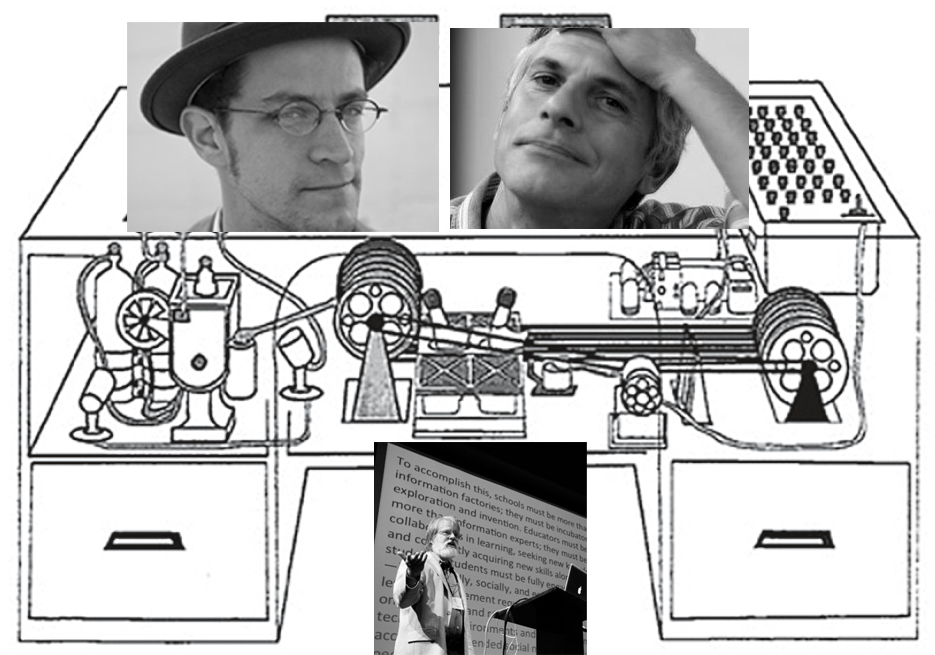
In 1945, Vannevar Bush wrote a now famous piece for The Atlantic called “As We May Think.” In it, he proposed the development of a machine called the Memex. This desk shaped machine would be able to display printed and handwritten texts and would be able to record notes made with a special stylus. The machine would be able to record meta-data noting connections between various sources and all of this information could be stored on removable cards.

The Memex served as inspiration in the development of the modern personal computer. Hundreds of articles in the 1990s pointed to the invention of the World Wide Web as the culmination of Bush’s vision, and those comparisons have continued into the new millennium with the modern Internet. But while the stylus-touch interfaces of modern tablets and the proliferation of online media do fulfill much of Bush’s technological vision, the key underlying epistemic concept put forth by Bush has been largely neglected.

The rapid sharing of ideas was an obvious use of the Memex, but Bush proposed that the educational value of the tool would be the ability to retrace the thought processes and connective strands that others had made through the ever growing sea of data. Bush said, “The inheritance from the master becomes, not only his additions to the world’s record, but for his disciples the entire scaffolding by which they were erected.” While academia is slowly moving towards open access models of publication, this deeper level of sharing the cognitive “scaffolding” of our theories has received far less consideration.

On Wednesday, Jeremy Dean and Jon Udell of Hypothes.is joined with Gardner Campbell as part of #openlearning17 to discuss how web annotation is allowing us to record and retrace our thoughts as we move from one website to the next. The collective pooling of reading notes, along with the ability to retrace the steps of an individual go a long way to fulfilling the epistemological vision of Bush’s Memex.

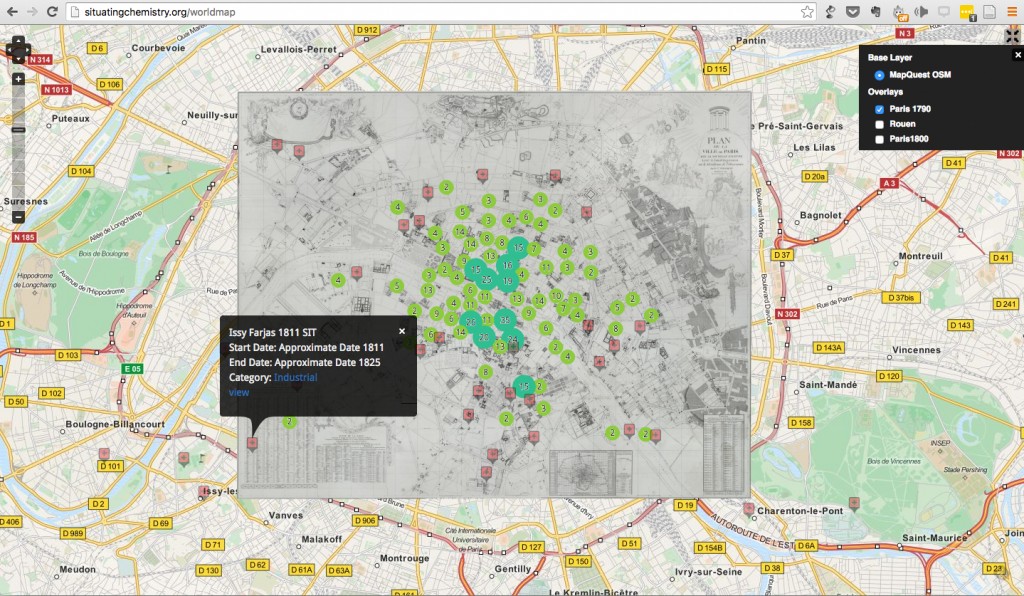
Here though I want to propose a different kind of database as an alternative and complimentary implementation of Bush’s vision. I have been working on an open note database called Situating Chemistry for a couple of years now. The concept is that researchers interested in the history of chemistry (don’t laugh, we exist) can come together to share a wide variety of notes. In addition to reading notes, the system can be used to create a profile of a historical person to record biographical notes compiled from both archival and secondary sources. These people can then be linked to each other to show familial, business, educational or any other type of relationship. Users can also record notes on the places that chemistry was done. A record can be created for a paritcular factory site, a university lab or lecture hall, or the site of an important conference. These sites can be linked back to the people who used them and mapped. Here we see a map from the 18th century of Paris with clustered pins representing the sites in our database:

A screen shot of the world map in the Situating Chemistry database featuring data about 18th century Paris

In addition to people and places, users can use the system to record notes on organizations, events, courses, sources, objects, collections, processes, and theories. The key is that researchers can use the database to take notes on any facet of their studies and then connect that facet to both its particular context and the broader population of notes within the system. Users can choose to put a password on their records, but the default and usual practice is to leave the note sets open to all users so that we can extend each others’ individual records and pool our collective research.

Designing an Open-Notes Database

Web-based databases of historical people like the Prosopography of Anglo-Saxon England (PASE) and the Prosopography of the Byzantine World were produced as conclusive publications of completed research. As such, the developers could accommodate, truncate, or omit problematic pieces of data. Published databases can also choose data visualizations that best highlight key records or insights. Researchers with Stanford’s Mapping the Republic of Letters, put together this beautiful dashboard to explore the correspondence of Enlightenment thinkers.

Screenshot of the Republic of Letters Visualization dashboard

Unlike these published databases, an open note system is designed to accommodate active note taking. Rather than structuring database fields to best present the data already collected, Situating Chemistry was built to be flexible. Because a researcher will more often than not have incomplete data, the only required field is the title of the record. The fields to record dates of birth and death can be partially filled out when only a year or year and month are known. They can also be marked approximate to indicate ambiguity in the historical record. Similarly, visualizations are employed to bring the researcher’s attention to interesting data and suggest new pathways for research.

Within any prosopographical project, the amount of biographical information available for the research subjects can vary widely. One project in Situating Chemistry focuses on the students of the noted Scottish professor William Cullen (1710-1790). In 1756, fifty-nine students attended Cullen’s chemistry course at the University of Edinburgh. Amongst them was George Fordyce (1736-1802) of Aberdeen who would go on to earn his medical degree from Edinburgh and become a lecturer of chemistry and medicine in London. Although there is no monograph length biography of Fordyce, he has entries in the Dictionary of National Biography and the Dictionary of Scientific Biography and is a relatively well-documented individual.

The other fifty-eight attendees of the course are less known. We know from Cullen’s notes that Robert Cumming was from Edinburgh, that John Richardson was from Northumberland, and that Henry Dunston was from some unspecified part of England. More surprisingly, at least two of the attendees were from Virginia—Thomas Clayton and James Taylor—and one was from Antigua—Christopher Hodge. Clayton, Fordyce, and eight other students would go on to earn their MDs from Edinburgh.

In designing Situating Chemistry database we wanted to ensure that we could capture structured, machine-readable data on someone like George Fordyce, or for that matter William Cullen. Additionally, we also wanted to be able to create records for people like Henry Dunston, for whom we had only a name and relationships of interest, in this case that he was a student in Cullen’s chemistry course, in Edinburgh, in 1756, with these other people, and he was from England.

Screen shot of the Situating Chemistry Database depicting the fields available for recording data about a person

The record for any individual can be linked to other individuals in several different ways. In addition to familial relations, we also have structured fields to collect information on instructor-student relationships and correspondents. There is also a somewhat generic person-to-person connection field that offers a list of relationships that can be expanded when needed. We designed the database such that every individual is the subject of their own record. A field denoting that a person was active in chemistry is automatically checked for every new record, but can be deactivated for familial relations, business partners, and others who are of interest but were not actively ‘doing’ chemistry even in the broadest definition.

In addition to linking a person to other individuals within the system, a person can also be linked to many other kinds of data. The database was initially conceived of as a way to catalogue sites of chemistry. We thus started the database with a table to collect information on apothecary shops, lecture halls, pharmaceutical manufactories, bleach fields, labs, etc. For a given site, the latitude and longitude of the site along with a modern address can be recorded along with information about the ownership and financial history of the site, the chemical activities associated with it, the organizational history, related images, documents, sources, etc. For each individual in the system, we display the sites that they owned and operated and also those additional sites that they were associated with.

After developing tables for the sites and people involved in chemistry, we developed further tables for chemical substances collections, courses, documents, events, images, letters, objects, organizations, primary and secondary sources, processes and techniques of chemistry, and archival and museum repositories. Any two records can be connected with an extensible series of subject-predicate-object relationships. For example a given individual could be a member of an organization or might have studied a particular chemical substance or been a practitioner of a particular process or technique of chemistry. Every record, whether it be for a person or any other type of data, can and should be sourced by linking it to primary and/or secondary sources. For the system as a whole then, we have tables for more than a dozen types of information and hundreds of structured data fields, all strung together into a relational web of information.

Interoperability & Extensibility

In its first conception, the Situating Chemistry database was thought of as a single table for sites with about a dozen fields. However, this variety of tables and fields grew organically through discussion of the research questions and practices that we, as historians of chemistry, conduct. The goal for the project was not to publish a completed set of sites or records, but rather to facilitate active research. A researcher could enter the data that they were collecting for a research project to organize and analyze the information, and they could take the database with them into the archives to continue to collect information. Researchers can access their records and add new records to Situating Chemistry from a laptop, tablet, or even a phone.

To accommodate both offline note-taking and the rapid upload of external data sets, the database has also been designed so that users can upload CSV files (excel-type tables). Any data in the system can in turn be downloaded as a CSV or in other structured formats including XML, RDF, and JSON. Because Situating Chemistry was designed as a research tool rather than a data-publication, the goal of the database is to allow users to both enter and access whatever fields and records sets they consider interesting. Several visualizations including tables, graphs, and a timeline are built into the system. The user can also extract whatever structured data they want to pull from the system, so that she can also generate her own visualizations using tools like Tableau or programming languages like Python and R.

The schema of the database is not specific to our current project, nor to the period 1760-1840. It could be readily adapted for use by other historians of chemistry (and alchemy) and historians of other sciences.  If you were to dump out the 5000 records that we have input into the system, you could convert the project into a Sites of Archeology database and record the digs of the 19th and 20th century.  You could just as easily record the observatories, telescopes, and astronomers of the 16th and 17th centuries or plot the biological specimens collected by Linnaeus’s correspondents.

While we certainly hope that our database will be used by and be useful to historians of chemistry, the real point of the project is to enable the collaborative epistemology proposed by Vannevar Bush.  History and humanities more generally are dominated by the single-author article and monograph, so a system built to pool research notes may seem counterintuitive. However, we need to remember that the point of these publications is to share our knowledge. If we all share our coffee stained notebooks, idiosyncratic excel files, and shoeboxes full of notecards, we can engage in deeper and more nuanced studies in the history of chemistry and science more broadly. Without sacrificing traditional academic products, we can collectively populate searchable, interlinked reference guides that will accelerate research and model our methodologies for the generations to come.

Please visit our site to learn more about the project and let me know if you would like to set up an account or get a copy of the code.

More open in the press…

… My ed tech buddy at the U of I sent this to me:  Top Fears Shutting the Door on Open Education  from campustechnology.com  .

Surprise 1:   In this context, concerns about “accessibility” have nothing to do with ADA and everything to do with “if it’s on the web, that website might go bell up or delete that file!” kinds of fears.   (If it’s *open* you can retain… make it open!)  … and faculty are more worried about this than students (though IMHO … faculty are wise).

SUrprise 2:   This statement about the overglorification of “failure ” from a Rolin Moe whose session I missed at the Open Ed conference:

“‘When we think about the failure ethos, it’s almost entirely perpetuated by successful white males, who can look back on their personal struggles, quote-unquote ‘struggles,’ and think about the triumphs they had,’ said Moe.

…  Forcing students who may already be marginalized to fail publicly in some way — as in publishing their writing on a public blog where they can be trolled — may simply be cruel.”

I really appreciated the honest discussion of the ups and downs of “have the students put their writing online,”  especially since so much discussion of OER stops at “free textbooks.”

… but I’ve set today as deadline for Getting The Application Ready.   Now, I had six students here by 8:30 — unusual for a Thursday — but the folks who are here early w/ no classes … are a little more independent, hence the time to type this up between questions and mouse cords taking students down… no injuries….

Teachers Guide to Social Media – Part 1

Teachers Guide 1
Creative Commons License
This work is licensed under a Creative Commons Attribution-NonCommercial-ShareAlike 4.0 International License.

Social media has become the most import part of our daily life. As of January 2017, more than about three-fourth of Indian adults were using some form of social media, and almost 9 out of 10 were present on facebook, according to EHC’s survey. There’s no doubt almost 96% of your students are using Social media account be it a middle school or a higher grade.


Social media has made it easy for Teachers to stay connected with their students in order to enhance their network of contacts, engage in important discussions, extend their own learning and even provide a platform for class projects, and also to keep them informed, so almost 40% of educators & Teachers are too found on some or the other social media both for personal and professional use.
While for personal use educators do have a personal life, families, friends and interests just like everyone else does.

Proper Use:

But Educators in India also have great responsibilities as they don’t only act as Teachers but are also mentors of India culture and society. And so increases their responsibilities and concerns to think twice about how they use social media.
shivam

  • What is relevant to post? 
  • Who should you interact with? 
  • Should you “friend,” “follow” or make your posts open to your students? 
  • And what about parents and colleagues? 
  • Are there particular posts to avoid? 
  • And how can you control who has access to what you post? 
Social media services and apps can be used as educational tools, but there are serious issues to consider counting privacy, relevant content, security and also your comfort level with the apps and services.

A Teacher must be a good learner:

Find out what tools currently your students are crazy about ( new trends develop frequently) and try them out. You might find them useful, or maybe not. But having an open mind about what your students are using and recommending not only opens you up to new extents but shows that you respect your students and care about what is important to them.
There’s never the specific answer for the question regarding the use of social media, but there are serious issues that you need to think about and, possibly, discuss with parents, students, and colleagues. 
One thing we can say for sure is that social media is nothing to be afraid of. We’re not saying it’s for everyone, but we are saying that it’s a powerful tool and with great powers come great responsibilities. 

Our series of Teachers Guide to Social Media is designed to provide a framework for thinking about how to make the best use social media. 

…..To be Continued.

Is the Internet Your Griot?

“His excursions may be more enjoyable if he can reacquire the privilege of forgetting the manifold things he does not need to have immediately at hand, with some assurance that he can find them again if they prove important.” —from “As We May Think” by Vannevar Bush

The time is upon us! We can offload innumerable amounts of data onto our technological devices. Don’t bother remembering that phone number; just pull it up on your cell phone. Or…wait for it…just give your cell phone a voice command and tell it whom to call—and bask in the fanciness of your own pants. As I read Vannevar Bush’s work, however, I began to wonder—what are the “manifold things” we do not “need to have immediately at hand”? What happens when technology fails? Can we trust our technology? Can we trust ourselves to record those manifold things accurately? And as we each toss our contributions into/onto the intricate web, will our quest to find the right questions to access that information turn into a veritable search for the Holy Grail?

I keep thinking about context. Technology does permit us to forget and find again, but sometimes what we find is divorced from its context. We know that the web can hold the stories, and even hold the contextual aspects of the stories, but knowing the right questions to ask to access that information may be a bit tricky for some.

Last weekend, I attended an amazing event called “Building a Vocal Community,” a workshop led by Dr. Ysaye M. Barnwell (some may know her from the group Sweet Honey in the Rock). During the workshop, she discussed the importance of griots—the historians, story keepers, story tellers, and so much more.

As I consider the “manifold things” we have given to the internet, and the possibility to feel both immensely connected and terrifyingly disconnected on the web, I also consider how we find and contextualize the things that “prove important” (to quote Vannevar Bush). It leads me to ask quite simply, and with no intent to disempower the position, is the internet your griot?

“As We May Think,” Annotation, and Liberal Learning: a conversation with Hypothesi.is’ Jon Udell and Jeremy Dean

Our Faculty Collaboratives Open Learning ’17 cMOOC is in its second week! Today I had the great pleasure of speaking with two leaders at Hypothes.is: Jeremy Dean (Director of Education) and Jon Udell (Director, Integrations). Our topic was Vannevar Bush’s epochal “As We May Think,” especially as seen through the lenses of online annotation and liberal learning. Click on the image below to experience our conversation.


As you’ll hear, Bush’s phrase “associative trails” appropriately wound its way throughout the conversation. I encouraged Jon and Jeremy to reflect on robust resource linking across collaborating minds as well as the more idiosyncratic and sometimes apparently “random” associative trails that are forged within our individual brains. I had probably registered this distinction myself in one of my many earlier passes through this endlessly fascinating essay, but today the distinction became newly vivid for me, and helped me understand areas of connection and disjunction within the essay itself.

Since a classic blog-based distributed conversation brought us together many years ago, I have interacted with Jon on numerous occasions. Some of his own associative trails have grown familiar (and dear, I must say) to me, but he’s always full of surprises, too, and I remain consistently challenged and stimulated by his ongoing work with the Web as a platform for co-constructed knowledge. I have been fortunate to spend more time with Jeremy lately, learning of his literary and musical background, and learning much more about his work with educators who are adopting Hypothes.is in their teaching as a way of helping students learn to scaffold and extend their own learning. It’s fascinating to see two people who are quite distinctive in background and personality nevertheless strongly united in their commitment to building a better world out of deeper, more thoughtful, more educated, and more robust human interaction.

I’m confident you’ll detect my own enduring concerns and commitments here as well. As I reflect on today’s conversation, I can see how my own work, and perhaps my personality as well, are situated almost at the meeting point between Jeremy and Jon. I hope that middle-ness helped to elicit the uniqueness, and the tremendous connections, these two thinkers brought to bear today. My thanks to both of them. I hope we can do this again, and soon.

Online courses

So!   IN between applying for a job to help enhance and create math courses… I’m trying to … build a math course!   For our folks who need to prep for the test … or already took the test and need to learn stuff…

We’ve got Modumath, but its online presence is — well, it’s *not* open, but it would be typical of an open effort.   Really great videos have been uploaded and you can go through the videos and answer questions as they play and get instant feedback.

There’s a printable PDF that has the same information in text form, and a self-test with answers.

There’s no adaptability at all.   There isn’t even individual … anything.   All users from a single license go to the same pages.

So!   Our job is to make this more individual.   THe tutorial videos are outstanding, albeit low-tech.   Our plan is to put the videos into modules, and then add our own quizzes.   Here’s where we can be … ADAPTABLE!   and USE BADGES 🙂   And … if it’s to prepare for a test that’s proctored ^3   then … cheating will, as my teachers always said, “only cheat yourself.”  (And there would be stuff for getting you motivated like you find here from MIT about getting you to write a little about your values before you do the stuff).

We can have a plain old “did you get it?” quiz… and then a Thing To Do If You Didn’t Get It that you have to do to take it again, and then … you don’t move on until you pass (though there Always Needs To Be An Alternative because sometimes you do need to move on).

… then, when we’ve built enough things around it, we can make our own modern videos and not have to have a subscription to another product.

Of course, if I do it here, it might be a challenge to make it open… but if I can stay a step ahead on my own — gee, I just *happen* to know about this OER video that will fit, because I already made it! — then…

… so tomorrow in the early hour the plan is to learn what the ‘grunt work’ part is, where we plop the video into the module… happily that’s the kind of task that I can do around working w/ students, unlike programming, which reading up on Lumen Learning made me recognize the potential value of learning.

I did a pretty good job with that Java stuff with the basics, and honestly I think the basics could work for making adaptable activities.   I did the silly integer app , right?   What if I really, honestly *had* focused hours each day for it?   LOL I’d probably get past 60 on my StackOverflow rep!!!   (I’m over 1100 on Canvas..)   I can dream, can’t I?

Happy (Associative) Trails To You, Revisited

Reading “As We May Think” again is like revisiting an old friend, and in this case it prompted me to recall a classroom experience that I had a couple of years ago, during a previous engagement with Vannevar Bush. I developed a new course called “How the Web Works” to teach at Austin College for the summer of 2015 and, grateful for the generosity of openness, I liberally borrowed elements from several existing cMOOCs and created a mashup of “Thought Vectors in Concept Space,” “DS 106,” and “Digital Citizenship” (thanks Gardner, CogDog, and Chris!) Summer enrollment at AC is quite small, and it turns out I had only one student, named Chris. At the same time, I was finishing up another short cMOOC that Christina Hendricks was facilitating, “Teaching with WordPress,” which helped me to think through the process of setting up my course on WP. So much generosity! In that context, I wrote a blog post entitled “Happy (Associative) Trails to You,” describing the pathways Chris and I wound through during one particular class meeting. It’s kinda long, but seemed to pull a lot of things together for me that may be possibly relevant to #openlearning17, so I’m going to reproduce it here on my new site.
————————————————————————————————–

Although #TWP15 has ended its formal run, the network lives on (I hope!), and so I’m going to keep blogging about this WordPress based course, “How the Web Works.” It also occurred to me after today’s class meeting that sometimes it would be a helpful practice to blog about a particular meeting as a reflective exercise, to think out loud, and to capture a bit of what transpired to help clarify my own thinking.

I realized toward the end of our time today that we were on an “associative” trail that was largely serendipitous and unpredictable. An associative trail, for those new to the term, was the phrase Vannevar Bush used to describe a sequence of nodes of information and ideas, one prompting the next, through which one could move in an emergent process of discovery (see his famous 1945 article, “As We May Think,” which foreshadows the development of hypertext). Bush was describing an information retrieval and management system modeled on the way our brains work, namely, by a process of association in moving from one item of consciousness to the next. Just for kicks, you can check out this video by Gardner Campbell demonstrating how he followed an associative trail through the stacks of a library and elsewhere to discover new resources for one of his classes. And here’s a cool account of a serendipitous “distraction trail” by Alan Levine (aka CogDog).

So something analogous to that happened in class today. On a regular basis I’m trying to introduce new knowledge tools for students to incorporate into their learning toolkit, and so today I started out by demonstrating Diigo for social bookmarking and annotation. I discussed how I use my Diigo library and network in my work flow, and then turned our shared screen over to Chris for him to set up his account and to add some relevant bookmarks. As I watched him learn to navigate the basic elements of the application, I had occasion to explain one crucial difference between the free and premium versions of Diigo–the ability to cache weblinks. It’s all well and good to bookmark a resource, but if the link rots or gets broken, you’re out of luck if you don’t have a cached version or a local copy of the resource. Now I didn’t require Chris to get a premium account, but this was an opportunity for a bit of discussion about the impermanence of the web, and I was able to reference a speech given earlier this year by Vincent Cerf, a pioneer developer of basic internet protocols, warning about the possibility of a “digital Dark Age.” (Of course I found the reference almost immediately because I had bookmarked an article about the speech on Diigo.)

From there I described how I use Diigo (and Twitter) networks to discover new resources and to share references with others, and how I also use a service called “If This Then That” (IFTTT) to automatically tweet the title and URL of any resource that I save in my Diigo library. That led to Chris setting up his own free IFTTT account on the spot, and creating his first “recipe,” to automatically tweet the title and URL of new blog posts to his WordPress site. We then launched into a broader discussion of APIs and how applications talk to each other and share information, and why that’s important in an open web environment. I asked Chris if he had any experience with APIs, and he mentioned the Steam gaming distribution platform, on which he is quite active. It seems that on Steam, players can develop “mods” (modifications) to existing games that other players can download and add to their version of the game. But sometimes mods can conflict, and so Steam has developed a way to bundle mods together and determine whether there will be any conflicts among them and with the base game before they are downloaded and installed.

As Chris was demonstrating this by showing me his Steam site, I noticed some of the games that he was in, and we started talking about those. Mostly they were historical immersion role playing games such as Crusader Kings II and Europa Universalis IV. I realized we had an opportunity to open up a whole new space for discussing games and learning, as I recalled two resources dealing specifically with immersive game experiences for learning history at the undergraduate level. First, Reacting to the Past, a classroom simulation experience originating at Barnard College and now used at over 300 colleges and universities in the US and abroad. According to the RTTP website,

Reacting to the Past (RTTP) consists of elaborate games, set in the past, in which students are assigned roles informed by classic texts in the history of ideas. Class sessions are run entirely by students; instructors advise and guide students and grade their oral and written work. It seeks to draw students into the past, promote engagement with big ideas, and improve intellectual and academic skills. Reacting to the Past was honored with the 2004 Theodore Hesburgh Award (TIAA-CREF) for outstanding innovation in higher education.

Secondly, I called to mind an initiative called Play the Past, which operates from a similar conceptual framework but is more oriented toward actual gameplay rather than classroom simulation. PTP is a community of academics and developers pursuing the study of gaming, learning, and cultural heritage:

Collaboratively edited and authored, Play the Past is dedicated to thoughtfully exploring and discussing the intersection of cultural heritage (very broadly defined) and games/meaningful play (equally broadly defined). Play the Past contributors come from a wide variety of backgrounds, domains, perspectives, and motivations (for being interested in both games and cultural heritage) – a fact which is evident in the wide variety of topics we tackle in our posts.

As we looked at the PTP home page, it just so happened that the latest article featured there was an interview with the developers of a World War I immersive simulation game called Verdun (after one of the iconic battles of that war). Turns out that this is one of Chris’s favorite games, he has played it extensively, and has even presented about it at a gaming conference. Interestingly, if you google “Verdun,” the first return is not, as you might have expected, the Wikipedia article on the battle (that’s no. 3), but the page for the game on Steam. So we chatted about how the game places the player inside the experience of WWI and unfolds the futility and senseless of the war as well as historical information about the military strategies and maneuvers, the political dynamics of the conflict, and the cultural and economic contexts in which the war played out.

So now Chris is going to write up a blog post about his experience playing Verdun, complete with a “let’s play” video demonstration documenting his gameplay with commentary. And when the class had started a couple of hours earlier, I had no idea we were going to get here…a completely “emergent” development that we reached by an associative trail. Now it’s not likely that every class will exhibit such a clear sequence of leaps from one idea to the next, but I thought this instance was striking enough to be worth writing about.


As We May Write

I live in a fairly rural town at the start of the Northern Neck of Virginia. Some argue that we’re the “Gateway to the Northern Neck,” as our welcome sign proudly states. Regardless of the term we use, geographically we’re situated at a bend in the Potomac River before it feeds into the Chesapeake Bay. I bring this up because the reason I, and around 70% of people I know, live in King George is that it’s home to Dahlgren, a Naval Surface Warfare Base (from what I’m told the bend in the river makes this spot ideal). I’m not qualified to say this but something tells me that if Dahlgren were to cease to exist, King George would just about be finished, too.

While my dad has since changed career paths, my family was moved to KG in the early 90s when my dad got stationed here. After retiring from the Navy, he worked with government contractors outside the base doing basically the same thing he would have been doing inside base. My dad used to joke that he could never wish for world peace because he’d be out of a job. While reading the beginning of the assigned reading for this week, I had this in mind. While my family is not directly dependent on the base anymore (although I’m sure I could find several ways if I let my mind wander), just about all my friends’ parents, the parents of the kids I babysat, and the spouses of most of my teachers growing up depend on the work from the base in one way or another.

I have often asked the same question Bush poses at the beginning of the text, although admittedly not as thoughtfully and clearly: what are the scientists to do next? While I think the need for war-related research isn’t going away anytime soon, it’s cool to know that people were asking this question almost 75 years ago, the same way I’m asking it now (yay progress). I’m fascinated by where Bush’s mind goes with his answer, so I think I’ll just dive right in. My response will be organized via association, rather than an index, as per his suggestion. 😉 .

I love that Bush explains how ineffective a car would have been to make in Ancient Egypt. I think of all the technology that I’ve thought “oh well, that’s more effort than it’s worth” without thinking of the possibilities it could hold. Often times, the first edition of a tool takes longer and is more difficult to use than using no tool at all (in the example of writing vs typing). However, once we get to later editions we cannot imagine our lives without these tools. I think sometimes it’s difficult to think so long term and remember that what we’re working on now, might be of some use down the road. When I was younger and I tied two rakes to the back of my Barbie Jeep to rake the leaves in the driveway (a project that took twice as long to construct as would have taken to just rake the leaves by hand- and worked about half as well) my dad explained how his job as a mathematician was all about spending more time in order to find the easiest way to do something. The first time around, these tools we spend so much time making are often ineffective in terms of time and resources, but they open the door to making the tasks easier in the future. Since I’m only 22, I can hardly remember a life without internet, but I’m assuming when people first started using it, while there was excitement for the future, there was also a question of if it was worth it.

This way of thinking can be directly applied to much of what we do in terms of incorporating technology into higher education. Although the internet is pretty much used across the board, there are other technological tools that I think professors and universities are slow to adopt. It can be difficult and even seem forced when we try incorporating these new tools, but with time, it might be hard to imagine a college education without them. I think this falls in line with accessibility of ideas.

What I really love about Bush’s vision for the future, is the idea of making things permanent. I think that the concept of permanence is partially what compels us to write and to speak. We have an idea and we want people to have access to that idea. While having an idea is great, if we don’t remember or share this idea, it’s not of too much use. If we never act to make the idea a reality, it’s even less useful. Additionally, if we can store an idea but don’t have any way of getting to it, there’s no real reason for it to be stored. We feel the need to share our ideas and give them some permanence.

Whenever I think of the internet, I think of it as both permanent and temporary. Teens are warned to think before posting as “nothing ever really goes away on the internet” but at the same time, if the internet stopped working one day, most information (regardless of importance) would be lost forever. We currently are saving and sharing our ideas when we write and present our research, when we tweet and post our thoughts, and when we comment our opinions. We have shared our thoughts with the world and they are timestamped so that everyone knows when we had them. But is there a way to improve what we’re currently doing now? How do we file away and share the information in a way for others to easily search and find these thoughts? And by that I mean, how do we share our ideas, our knowledge, and our passion in way that’s easily accessible?

I have no clue, that’s why I’m trying to spend more time reading everyone else’s thoughts rather than writing my own, but I don’t think the answer is super simple, just because something as incredible as the internet exists.

While this article was written almost 75 years ago, with a few tweaks it could read like it was written last week. Although we have the internet now, and almost everything he envisioned for the future seems to already exist, the need for a better way to share information is something we can still work on. Now the problem seems not to be the way the information is organized, but how we make it accessible for others.

Lastly, On a practical note, I can’t help but wish for this idea of the memex exactly as Bush described. I have a series of folders on my laptop labeled “screenshots and such” that I’d conservatively estimate have anywhere from two to three thousand screenshots in them. I’ve spent hours upon hours organizing these screenshots into folders (which could still use quite a bit more organization), so the idea of a device in the future that could organize everything for me sounds exciting. Maybe it’s time for me to get started making my next tool.


The network is the deliverable