Week One Done, Week Two Underway

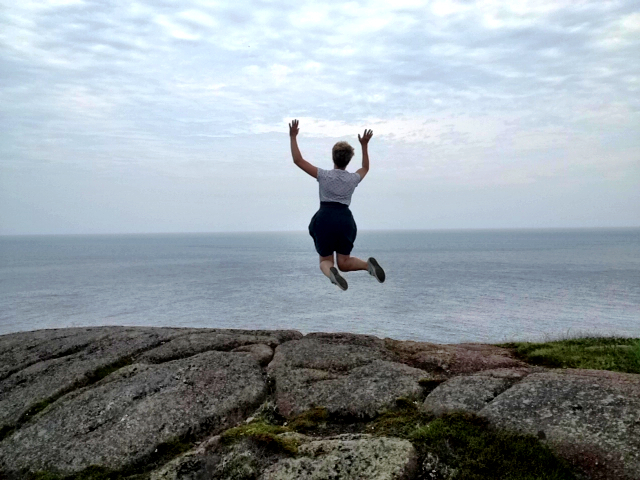
Photo by Dean Shareski https://flic.kr/p/f3MPjW

One week in, and we’re aloft! The first week of Open Learning ’17 featured two Twitter events, lots of fine blogging, and some face-to-face conversations that I hope will bring more people into the network soon.

And before I forget, let me add that it’s not too late to join up! You can easily get up to speed by reading some blogs and the main text for each week. If you’ve been thinking about joining, now’s a great time to get involved. Head to openlearninghub.net and click on “join up” for all the details.

Amy Nelson has already posted a thoughtful piece on week one’s activities. So, what she said. 🙂

I’ll add that the Twitter mixer on Wednesday was very inspiring for me, as the question of “what’s open in your teaching and learning?” began to resonate through contexts ranging from professors, to students, to administrators, and back again. The Storify record of the chat will suggest much of this resonance. I encourage you to take a look. These Storify pages will preserve much of our Twitter activity during the course. I think they’re great resources for conveying the flavor, and the many directions, of near-real-time online conversation. I should also note that folks who accuse me of operating at the 30,000-foot level would have a very strong case to make in this instance, as I held up my end of the mixer from somewhere near that altitude over Nebraska, on my way to the AAC&U conference in San Francisco.

And speaking of the AAC&U conference, Steve Greenlaw and I held our Virginia Faculty Collaboratives flag high in several sessions, as did the Faculty Collaboratives leader and chief egger-on, AAC&U’s Susan Albertine. Susan was very generous in her shout-outs to our work, and joyfully connected us with other Faculty Collaboratives leaders to help us continue to get the word out and grow the network. Steve and I had many conversations with other state leaders along these lines, most notably Faculty Collaboratives folks from Wisconsin, California, Utah, and Texas. Some great ideas emerged, so as we say in the biz, “watch this space.”

I can’t add much to Laura Gogia’s intense and detailed analysis of our Twitter Journal Club event on Friday, except to say that I found the event exceptionally stimulating and exhilarating. I can’t imagine a better end to our first week, or a better first reading than “Fifty Shades of Open,”, or a better networked encounter with that first reading. I am deeply grateful to Laura for jumping in to make this event possible, even though she had only about four days to prepare. If we do indeed make the road by walking, it’s important to have what Christina Engelbart calls “expedition quality” people to walk alongside who’ll help to make that road. Laura’s expedition quality, through and through. Special thanks and a big shout-out to Jeffrey Pomerantz, one of the essay’s authors, whose presence lent special excitement to the event. Jeffrey’s insights in the article were extended into the Twittersphere in our conversation. He was most generous and thoughtful, and we are grateful for his participation. (And Jeffrey, you know you’re welcome to stick around as long as you want–we’re always open.)

Now it’s week two. What’s on the schedule? Glad you asked. This week we’re reading the immortal essay “As We May Think,” written by Vannevar Bush and published just as World War II was ending. Here are four ways to engage with this essay in our networked community:

Synchronous events:

Wednesday, February 1, at noon ET: “Associative Trails, Online Annotation, and ‘As We May Think’”: a webcast with Jeremy Dean, Director of Education, and Jon Udell, Director, Integrations, both of whom work for Hypothes.is, an online annotation platform whose mission is “to enable a conversation around the world’s knowledge.”
In addition to reading “As We May Think” prior to the webcast, consider setting up a Hypothes.is account for yourself and glancing over the annotations that already exist for the Vannevar Bush essay. You might want to make a few annotations yourself, or perhaps reply to some of the ones you find.
For the webcast, we’ll be using the Twitter hashtag #openlearning17 for our backchannel, and for asking questions of Jeremy and Jon. Don’t miss this extraordinary opportunity to engage with two leading representatives of what Vannevar Bush foresaw as networked learning “trailblazers.”

Friday, February 3, noon ET: Twitter Chat on “As We May Think” and Open Learning. 
This Twitter chat will continue our consideration of Bush’s essay, with a particular emphasis on open learning, the goals of our course, and the Faculty Collaboratives project generally. Here we’ll do the “crosswalks” Susan Albertine has encouraged us to do between open learning, mind-liberating education, and the AAC&U’s Liberal Education and America’s Promise initiative. Once again, we’ll use our course’s Twitter hashtag, #openlearning17.

And asynchronously:

**Keep those blogs and tweets coming! This week we encourage special attention to our main reading, “As We May Think,” but as always, we’re interested to know what’s on your mind and heart about anything connected to open learning. Don’t forget that linking to a colleague’s blog post is a great way to strengthen the network! For a beautiful explanation of the power of hyperlinking, look no farther than our own Connected Learning Coach’s hyperlinking infographic.

**Consider also annotating “As We May Think.” There’s a rich conversation there already, but it’s great to add our voices and extend the range of topics to include open learning in particular. Tag your annotations any way you want, but remember to include openlearning17 as one of the tags so we can tally and collect the annotations more easily. It’s all about building the resources together! To get started with online annotation, go to Hypothes.is and sign up for an account. Hypothes.is also has lots of short, effective video tutorials to help get you up and running. And as always, don’t hesitate to reach out to the Open Learning ’17 community for help, too.

Week Two is underway Can you find one or two colleagues who’d add to the conversation? Let ’em in!
The (medium) Hard Work of Open

Long Trail

My what a couple of weeks it’s been….So much anticipation, trepidation, incredulity, outrage, sorrow….resolve…

No, I’m not talking about #OpenLearning17. The course launch last week provided a wonderfully affirming forum for engaging with the forces of enlightenment.  Laura Gogia’s masterful facilitation of a Twitter Journal Club (#TJC17) on Friday brought folks together around a close reading of Jeffrey Pomerantz’ and Robin Peek’s Fifty Shades of Open, and through Twitter magic and generosity Jeffrey Pomerantz was able to participate in the discussion. Some of us even carried the conversation further by annotating it on Hypothes.is . And because the #TJC17was open and coincided with the annual AAC&U conference in San Francisco, conference participants could join the fun and those of us who were not physically in attendance could share in some of the buzz generated by the big gathering.

But locally, last week was a time when I was reminded, rather brutally, that teaching collaboratively and in the open takes time, is messy, and is totally worth it.

First of all, there’s just the time commitment to building out the digital spaces where my courses grow. While I was working on my book last semester I seem to have remembered how cool it is when you get a website tricked out and looking nice, but forgotten just how time consuming it is to:

Create the motherblog, choose a template, add feedwordpress, hook up JetPack, pick out fonts, and colors and other design features, customize the template so it will be easy to update the front end as new content comes in, create a shadow blog for the comments and feed that through an RSS feed on the main site…..

None of that’s hard, but it all takes time. And then you have to get the students hooked up and ready to roll (ah yes, add form to site that they can fill out so you can harvest the URL..)

You see where this is going — there’s lots of set up work to do before the first class session.

And then there are the human factors — they include a couple of outstanding GTAs for the grad course and an editorial team for my undergrad course (two peer-editors, veterans of the course who comment on posts and help identify content to feature in the weekly edition, plus a WordPress savvy grad student who handles a lot of the weekly maintenance).  So that’s really two “teaching teams” for these learner-centered hybrid courses.

And figuring out how we are going to best facilitate learning in the course and establishing a weekly work flow, with time built in for dialogue and troubleshooting, can be pretty messy. We need to figure out which affordances to use for what kinds of interaction (Slack for sure, also a shared Drive folder….e-mail only when smoke signals fail). We all have different strengths and intersecting but not 100% overlapping domains of expertise. Like everyone else, we are busy. And like everyone else we learn by doing. So, the first couple of weeks can be pretty bumpy, as we coordinate our individual tasks with our other time commitments, learn (or remember) some new tricks (how do you get the sleeping dogs to be in the center of the photo in the slider?), and figure out how to best work together to help leverage the students’ contributions into a robust and interesting place that showcases and enables “acts of cognition” (focused either on Soviet History of contemporary pedagogy in higher ed):

And to me, that’s why  working in the open — in a medium where we can all create and engage collaboratively with the content — is not just worth it, but necessary.  I did spend less time on my classes before the 2.0 version of my teaching — I think we are all familiar with that feeling that sometimes it’s just plain easier to do something by yourself or the way you’ve always done it. But I do see real (positive) differences in the way we learn (students, course assistants and instructor) in these networked, open learning spaces. And the takeaways for the students, in the form of the critical thinking, writing and research skills they develop by working on the open web, the insights they gain about the course content and their own learning, as well as the digital portfolio that they create, make the extra time and effort well worth the investment on my part.

In an era of Alt-Facts and gathering storms around the ethical tenets of our democracy, learning together in the open seems especially important. (I know I’m being hyperbolic and I hope I’m wrong about the storm clouds, but I’m still going to throw down behind open pedagogies.)


OPML Is the Alchemy of Following Blogs in an Open Networked Course

This post is meant primarily for participants in the Networked Narratives course I am co-teaching with Mia Zamora, where everyone is publishing in their own blog space. Everything here applies as well for the Open Learning ’17 course led by Gardner Campbell; I’m working on both sites at the same time, so things I do on one cross over.

In terms of staying tuned into news and current interesting information, many people these days rely on social media. For me, that is part of my information flow input, but not only one. Yes, I find many useful things shared by other, but it depends on when I tune in, who I follow, and how deep– it’s pretty much accidental serendipity.

My more primary means is checking regularly maybe 150 different websites, mostly blogs. Do I visit 150 blogs on a regular basis? Heck no.

I make use of the same three letter technology that we had you trip over to connect you blogs, RSS. These feeds can pull the stories from hundreds of sites into one interface where I can scan them like subject lines in my email inbox. Just like there, I can skip stuff that is not important or interesting (that’s why blog post titles matter!).

The Flow of Networked Open Courses (aka a lot of blogs)

In an open networked course, I want to be more confident I am scanning the activity, especially for my students. And even more so as a teacher. One thing I can do is go to the course home page, and see the new posts displayed at the bottom. That’s the full flow of all blogs. In a busy course, it starts as a trickle, then becomes like a garden hose, and eventually a high pressure firehose.

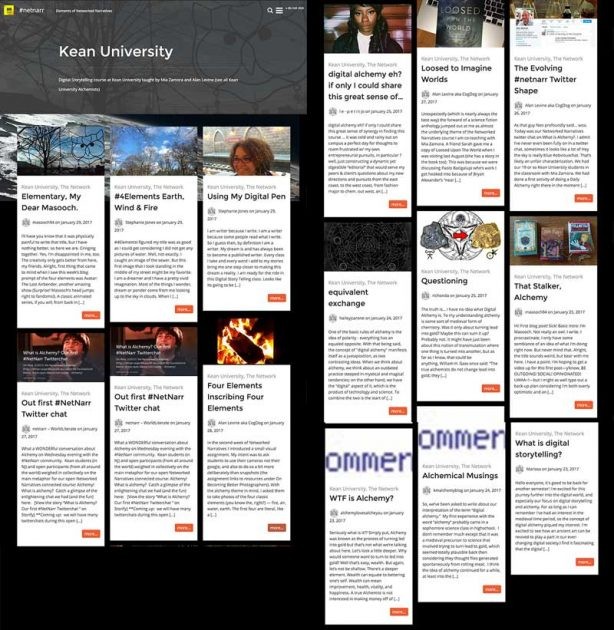
With the way I set up syndicated sites, we can slice the flow; in networked Narratives we have a page for posts just by Open Participants or just ones by the Kean University students.

Screen shot montage of the most recent syndicated posts by Kean students; by now it’s already changed

Hocus Pocus… OPML

So I am going to share you some web alchemy, and a magic potion called OPML. You need not know what that stands for (make something up), nor do you even have to look at it (it’s cryptic XML, don’t look).

If you can understand that an RSS feed represents an updated data file that shows the latest content of one blog, and OPML file is a bundle of links to RSS feeds, it’s like a mega subscription file. It’s like a big folder of — okay, the metaphors are getting in the way.

Let’s just do it.

First we need to get these magical mysterious files. I am going to do this with the interest of following just our Kean blogs, but this could work for all of them or the open ones as well. You will find the same links on all.

From each of these “flow” pages, in the header you will find links to a page that lists all of the blogs that are connected, I call them Notebooks — here is the one for Ken alchemists (see also the one for all blogs or open ones).

Check the four orange buttons

Click the buttons for Blogs OPML and the one for Blog Comments OPML (you should do this on a computer, mobile devices probably will cry when you click on these).

Both links will save files to your computer. Just download them. Do not open them.

To set up yourself to be an OPML Alchemist, you need a tool called an “RSS Reader.” There are a number you can use (Google had a great one, and they killed it, sigh. I’m still in mourning).

I will recommend Feedly, but you could easily use other ones. Feedly is free, go create an account. It will give you something blank. Like twitter, they want to suggest things for you. Do that later. Or never.

But do click (if the right side here is not visible) the Discover and Follow button. Way down at the bottom, is the link you want:

So first import the Blogs OPML file you downloaded. Lights may blink and gears are churning.

On the left side, you will see a link that represents all of the blogs listed in the file. On the right will be some kind of listing of the posts from these blogs, the newest ones first.

Posts from all the blogs in one OPML file. Cool!

The titles in bold are ones I have not read. So the interface can tell you at a glance what is new.

Your first view may be more of a graphic grid layout, different from my screenshot above. That’s my preference; you can change the views by opening the small menu to the right of the title:

If there is a title that looks interesting, clicking it opens it so I can read the blog post right here:

Reading one post…

When a post os open, if you click it’s title, you can then jump over to the blog itself if you prefer reading it there (or if you want to add comments).

You can even use keyboard shortcuts to read through them– j loads the next one and k the previous. You can read through many blogs this way.

As they say on late night TV, “but wait, there is more!”

If you click the OPML feed open on the left, you can see the names of all blogs in the subscription. And if you click a blog, you can now scan all the posts from one blog:

Okay, let’s breathe. With this set up, we can read a whole bunch of blogs in one single interface. When a blog publishes new stuff, it will be updated here (there might be some lag in how often feedly checks for updates).

That’s why I consider this one of the few technologies I can safely say that it saves you time.

Okay, but there is the second OPML file. We use the first to read the posts. The second one contains the activity on the comments to all blog posts (this works for blogs published on WordPress or Blogger only).

That’s right, folks– you can monitor the comment conversations on hundreds (or 10 or 3) blogs in one place. AMAZING! ?

Now import the other OPML file, the blog comments one.

In this case, I see the title of the post that was commented on, as well as the name of the commenter, all in my scan view:

Just flip through them (j and k are your friends), and if you want to respond, click the title and jump out to a blog.

And like above, I can quickly see what the activity looks like on a single blog:

Yes, Writeannabella is getting good activity on her new blog– I can see it in a glance, as well as seeing that there are no comments. At once glance, we can get a sense of the participation level on every blog or the community as a whole.

I cannot say enough how critical this alchemy is to stay in touch with the activity in an open networked course. Yes, it is good for teachers, but it is just as useful for participants to take in all the activity in one place.

Are you ready to do some OPML Alchemy? Fear not the funky acronyms!


Top / Featured Image: A screen shot of a real OPML file for Networked Narratives, edited in Photoshop (inverted, rotated, scaled, blurred) by me shared under CC BY

The post “OPML Is the Alchemy of Following Blogs in an Open Networked Course” was originally slapped on the butt by a cigar smoking doctor yelling “It’s a post!” at CogDogBlog (http://cogdogblog.com/2017/01/opml-is-the-alchemy/) on January 30, 2017.

From the Ground

Photo licensed under Creative Commons Attribution 2.0 Generic license.

I’ve been saying since we began thinking about having an Open Education ‘Initiative’ on our campus- that it has to rise up from the people.  (Those who have known me as an activist for at least three decades wouldn’t be surprised by this.)  For our institution of ‘higher learning’, that means we the faculty and staff.  This past Friday (27 Jan 17) was our first meeting of the KSC Open Pedagogy Learning Community (the OPLC) with 13 attendees.  With no real agenda, just some suggested readings and a question- the rising up from the ground is already happening… below are my notes (in all of their imperfection and incompleteness, apologies to my esteemed colleagues for all inaccuracies).


I like the idea of building a community of learning, blurring the line between student and instructor. Open could be a catalyst to ‘blow the whole system up’

How to get student buy-in for open strategies. How to bring students in, address their worries about grading.

I’m interested in the intersections between open pedagogy and critical pedagogy, how to empower students to take ownership.

I don’t even know enough yet to be cynical like I usually am. 

My students are already using open resources I realized. 

I need to work on having my students make their work public.

I’ve become increasingly aware of a conversation that I didn’t know I was already a part of.  All of my courses are open, my students are writing in the open.

The library could be an incubator for open education efforts.  It could provide a hub to support students.  

I would blow it all up tomorrow if we could.

I’m already familiar with open source software, I’m here to learn more about open education.

Open education offers something new, it is really exciting. 

Having students being part of the process of learning is especially exciting.

No textbook? I was already doing that.

Open would allow us to do education even after we retire. 

How to find that balance between what students need to learn and ‘blowing it all up’.

I know very little about open, I’m here to learn more.

I’m familiar with OER, but I want to learn more about open practices.

Very excited about the idea of students producing the textbook. 

Social justice aspect of critical pedagogy – the connection between open and critical

Is the process more important than the product?  Not about striving for ‘perfection’.

It seems like it is OK for it to be messy and not perfect…the key is action, not perfection.   That the process is part of the learning.  This may be a hard adjustment for me to make.

But this doesn’t mean we don’t know anything.

Building an external community is important, maybe do that first, before you work on creating a textbook with students for example.

The voices of students that are uncomfortable or not there yet, need to be heard too.  How do we get our students to move forward?

Talk about the advantages to them.  Getting jobs.

The balance of privacy and openness.  Development of digital literacies.  Using annotations- private? Public?  Dimension and value of social learning. 

Challenging traditional teaching role expectations.  

Reflect upon and transform structures. 

What does it mean to say that education is inherently an ethical and political act?

We aren’t trying to turn students into something.  We are trying to get our students to turn themselves into something. 

I look for the grappling, the struggling.

Blow up grading. Let’s just all give our students incompletes because learning isn’t done.  #resist

Just start with having students react.  Can’t analyze until after they react. 

We don’t understand where our privacy begins and ends online.

Teach students not to put too much personal information online. 

They are going to be information producers when they leave here in an unsafe space. That’s going to happen to them later.  Have to help students learn how to do it now.

Making students aware of risks and vulnerability. 

Every time you put something online, you attach your own credibility to it.  What do you want that to look like?

Connecting students currently in the class with alums. Helps students to see better where they might go next.

Let’s use some of this time to talk about tools. Syndication tools. Annotation tools

Importance of peer review.  ‘Peer review is like trolling’

When we open students work, we are subjecting them to constant peer review

Some of my students admitted to being trolls and are proud of it. Trolling as an act of rebellion.

I don’t want it to be so open that it’s pointless.  How do we structure open so that’s there is something there?

Have people in this group generate a list of what they are trying

Get everyone in the OPLC to create a blog, have participants write blog posts about their teaching, syndicate their blogs to a main site for the OPLC.

One more meaning of open

This post, and all others with the “openlearning” tag, are part of the #OpenLearning17 cMOOC that is ongoing under the auspices of the AAC&U. However, none of these posts are going be very neat reflections on the week’s events and readings, and I’m limiting myself to a short amount of time to compose them and leave them in an attempt to redevelop a discipline of blog writing. We will see where this takes us.

I was reminded a little more than a year ago of what I’ve always wanted “open” to mean in my classes.

I was getting to know a couple of pretty nifty football players in my physics classes at Tennessee Tech in Fall 2015, and was reveling in getting to further my bit of football nerd with guys who played. I remember thinking that this was going to be a bit of fun the afternoon the football player in my PHYS 2020 section dropped by the office to ask a couple of questions about the first exam and the conversation turned towards the end to his high school teammate who was quarterbacking the Iowa Hawkeyes, which of course brings out the BIG TENNNNNNNNNNNNNN [1] fan in me, because I forever wanna go back to Ohio State, to ol’ Columbus-town. [2]

I’ve always enjoyed the student-athletes in my classes, and always enjoyed the ways they broke the “dumb jock” stereotypes – especially the football players who owned their science coursework, from the elite linebacker slaving over a copy machine in the library to the placekicker owning a physics lab by sheer force of personality to the wide receiver making the mathematics behind classical mechanics look far too easy. I’ve always felt like I understood the double life those athletes have to lead, and that I’d supported them as well as I could.

I believed that until roughly the afternoon of November 8, 2015.

I’d recognized there had been tensions building at Mizzou all fall, and I think I had heard a rumor or two about a graduate student leader organizing action in defense of both grad students and African-Americans. (Naturally, I was more concerned about the graduate students and whether they’d have insurance on their assistantships.) I know I hadn’t heard a lick about what Concerned Student 1950 was, or how that leader was so alienated by his university’s lack of concern about the racism he experienced on a regular basis that he was moved to hunger strike.

And when that alienation drove players on the football team to tell their coach that they didn’t feel like it was time for games, and their coach (and all credit to Gary Pinkel forever for his immediate support) arranged for that picture to demonstrate that he stood with those players, my lone reaction was “I really don’t have a clue, do I?”

So many others have described that disconnect, but I’ve since always thought Bill Connelly described it best when he described his own experience as a student:

There have always been two Missouri campuses, and I’m going to go out on a limb and say that isn’t unique for college towns. There has always been unofficial segregation, and most of it comes by choice. You gravitate toward that with which you are familiar, even (or especially) when in unfamiliar territory. Maybe that means people from your high school. Maybe that means people of your color.

I was lucky. Mizzou attracts a pretty diverse population, in part because of the journalism school. My dorm floor was made up almost equally of students from Kansas City, St. Louis, rural Missouri and Chicago. I came from a small Oklahoma town that had more Native Americans than African Americans, but I was on a floor with quite a few black students. One became my roommate. Others became good friends.

You can find common ground with just about anyone if you try, and we didn’t have to try very hard. But no matter how similar we were in our tastes and preferences — sports, music, TV, girls, whatever — I was randomly exposed to our differences. One friend had regular meetings with an advisor as part of aid he was receiving to be able to attend the school. Another would act differently when we would encounter a black acquaintance on campus.

Little things opened a window into a different world. Things like attending the NPHC Homecoming step show, where you’re suddenly in the vast minority and having an incredible time.

It didn’t take much empathy to realize the experience of any member of any minority population is simply different. It could still be good or mostly good, but it was going to be different, and there was no way around that. And while every black student gets exposed to a white world while attending college, not every white student gets the same experience.

At one point in my life, I was immersed in the recognition of every different culture that made the modern university. You could not possibly attend Ohio State and not be made aware, and – God bless Elizabeth Gross, God bless her priorities steering admissions to the Biophysics Program at Ohio State – I was in a far more diverse environment than most at Ohio State. Students from all around the country, men and women, never as many students of color as Dr. Gross wanted but dang if she didn’t try. And then the international students, and she could have filled a program with students from China or India with the pile of superior applications from those two countries, but she made a point to push the admissions committee to take applicants from every nation seriously, and Pakistan and Saudi Arabia and the Ukraine and Nigeria and I know for a fact I’m not remembering every example. The student who followed me in my graduate lab was from – of course – Iran.

Having the best program – having the best university – meant diversity mattered. It meant we recognized one another’s voices. It meant we recognized how we thought differently, how we engaged differently with the science.

That was an incredible inheritance for me to receive. And then I moved south, first for the postdoc in Birmingham, then for the faculty job in the deepest Deep-South part of Georgia. And although it didn’t happen all at once, my surroundings began to get progressively whiter, and progressively more comfortable. And my understanding of that inheritance started to fade.

Twitter helped some, forced me to pay attention a little bit better. But the Mizzou boycott snapped me to attention. I felt comfortable, and many of my students felt comfortable. But some might be afraid. Some might be desperately so.

I made a point in my next meeting with my classes to say that this was on my heart, and a guy like me might think he understands but he might not have a clue. And what’s more, he might think it’s cool to be seeing a bunch of football players in his class and enjoy a few yuks with them about the game but he really doesn’t understand a thing about their experience, especially when they’re black and he’s white. And I promised – whenever a need was in front of them, and they felt burdened – to be an ear who would listen.

I have kept that promise imperfectly, perhaps even horribly. I jumped jobs within the year, after all. And even as I left one group of football players behind, I entered into a new class at the new place and couldn’t seem to build the connections with those athletes burdened by that double life anywhere near as much as I wanted. Part of the difficulty is simply the age difference. Once I might have that cool young prof who could do no wrong and who everyone wanted to hang out with. Now I have students who are the same age as my own kids, and I’m the same age as their fathers – or even older. Father Time, the saying goes, is undefeated.

But even in this moment of history – especially in this moment of history – we’re still human, together, in a time where the laws are being torn up and rewritten seemingly to inflict maximum pain on the people who aren’t like me, who don’t share my skin tone, who aren’t my gender. It seems to me that even pointing out the age difference is so much useless whining. We need one another, we need to be working together and not against one another.

I care about so much of this open pedagogy movement, so much about making academic resources available freely (“free” as in speech and “free” as in beer), so much about opening my educational practices to empower learners. But – with all respect to Pomerantz and Peek, and all understanding why I should read an article on the “fifty shades of open” – the meaning of “open” that matters most to me is the open relationship I need with my students.

My student’s lives are important. I don’t need to pretend that they are simply in my classroom as automatons and their engagement and effectiveness aren’t influenced by what happens outside the classroom, what happens in their families, what happens in their workplaces – and yes, what happens in Washington, D.C.

I need to create the space that allows my students to be the most open, the most honest, the most free (and “free” as in without restraints, without judgment, without fear). That doesn’t just matter in humanities or arts classes, that matters in the sciences as well. Students need to be affirmed. Students need to know their experience matters.

And I need to continue to commit myself to the willingness to listen, no matter where that listening takes me.

[1] BIG TENNNNNNNNNNNNNN, of course, should always be spelled with fourteen “n”‘s. No real reason.
[2] to the stadium to hear the band, by far the finest in the land

That time when the AACU Virginia FacCollab held a Twitter Journal Club Event

On January 27, 2017, the AACU Virginia Faculty Collaboratives Experience (#OpenLearning17) teamed up with Twitter Journal Club (#TJC17) for a synchronous reading & discussion of Jeffrey Pomerantz & Robin Peek’s 50 Shades of Open.  Through serendipitous networking (thank you, Phil Edwards), author Jeffrey P. discovered the event and made himself available to provide additional background, resources, and insights into the nature of the article and the concept of open (Thank you again, Jeffrey!).

A diverse group participated, tweeting in from Mexico, California, Texas, Washington, New Mexico, Pennsylvania North Carolina, Maryland, and Virginia.  The Virginia institutions of higher education represented during the event included University of Mary Washington, James Madison University, George Mason University, Virginia Commonwealth University, and Virginia Tech. (*Disclaimer: This is not be a comprehensive list, though I can make it comprehensive if you give me a compelling reason to do so.)

Tweets came in from both hashtags, but due to time constraints I’ve focused on only on tweets that included the #TJC17 hashtag.  We were active in this space, tweeting approximately than 300 times in less than an hour.  Many participants were so engaged in the conversation that they continued to talk with each other (and with the hashtag) well after the event was over.  Days later, pieces of the conversation are still being retweeted by people who were not involved in the original conversation.

I’ve lightly organized these tweets (bearing in mind I collected only those from the #TJC17 hashtag) into conversational threads and storified them, here.

Loosely, conversations emerged around the following themes:

  • The stability and evolution of ‘open.’  While some participants focused on the extreme stability of the meaning of open over the years, others focused on how the ever-changing world has led to different and more nuanced uses of the word.  The concept of valuing a thing for what it is versus valuing it for how it can be used…it came up again and again in different ways throughout the conversation.
  • Marveling over all the types of ‘open.’ Many participants hadn’t thought about all the contexts of open before reading this article; they mentioned which ones struck them as particularly interesting or new.
  • Implications of ‘open skies.’ Of those new ways of considering open, the “open skies” conversation took on a life of its own, revealing tensions between hospitality, use, ownership, surveillance, and accessibility.
  • ‘Open’ in terms of accessibility versus use. General agreement that once we take accessibility for granted, our focus turns almost entirely to how we are able to use that which is accessible.  Some participants reminded us that accessibility is still a huge issue for many people.  We must balance our focus on accessibility and use.
  • The source code of pedagogy. In many ways the heart of the conversation. In what started as a reference to open software, some participants wove through the concept of education as ‘made’ and codified…codified in ways that can potentially be shared, remixed, and reused.  We moved past open-as-availability and into the realm of open-as-transparency, allowing for links across theory, practice, and learner’s goals. We moved from valuing-as-is to valuing-as-application.
  • The commons. As part of that conversation, we moved through references to the commons, most notable for the number of outside references that were added to the overall conversation, as people shared their favorite authors and resources with each other.
  • Connecting ‘open’ to liberal education. This conversation is worth reading in whole from the storify. Gardner Campbell asked: “How do you think 50 shades of open connect w ideals of “mind-liberating education,” aka “liberal learning”? The article’s author, Jeffrey Pomerantz, responded: “Short answer? I think openness is not necessary to liberal learning but sure helps. Liberal learning must aim for self-sufficiency in the student. Openness encourages exploration.”
  • The Twitter Journal Club experience (a meta-commentary). Some people watched the stream with an eye for meta-analysis and commented on it at regular intervals. When I say “most people,” I mean mostly me and it was the preliminary work for this post. However, it also included people talking about other activity on the hashtag, their learning experiences, and their physical surroundings.

Participants linked this event to the following entities: 

In terms of my own experience:

For critics who say nothing can be learned in this sort of chaotic, unscaffolded digital environment, I merely point you to the summary and analysis above. For those who were disconcerted by the porn bots sharing our hashtag (yes, #TJC17 must mean something else…to someone), well, to be honest, I loved it.  Absolutely loved it.  We do not own hashtags – hashtags are open or shared resources.  I can’t think of a better way of demonstrating the concept of openly shared resources than academe sharing a hashtag with porn bots.  Furthermore, as I was discussing with Gardner Campbell after the event, the strangeness of such a juxtaposition can be liberating, if you let it be so.

The freewheeling thinking associated with Twitter Journal Club will always be one of my favorite approaches to informal knowledge construction.  I realize that it isn’t for everyone, nor does it fulfill every scholarly need. However, we cannot spend our days approaching scholarly articles in the same way, from the same direction.  We need to mix up scholarly thoughts, challenge them, throw them against the wall, enter into them with our minds open and academic defenses down. Twitter Journal Club offers me – and presumably those of us who keep coming back – that opportunity.  I always emerge feeling rejuvenated, connected, and even more curious than before.  For me, this is what a joyful approach to liberal education looks like.

Featured Image by Jon Eric Marababol


Gratis, Libre, and the Pursuit of Open

What a week to be discussing access and transparency as facets of open! Maybe because of the political events of this first week of a new presidential term, including the attempt to limit access to government funding scientific information, the access and transparency aspects of Pomerantz article “Fifty shades of open” resonated with me especially as I was reading.

In my workshops with faculty, we often begin with what most of us think of as the most impactful facet of open: gratis, or free of cost. This means a great deal to our students at this point and I think it will mean a great deal to our institutions soon as well, but it is a narrow focus to stop there. I have faculty ask if its permissible to employ fair use or to use licensed library resources as a part of their open courses. I tell them yes because I don’t want to limit their ability or motivation to provide a course free of costly materials to their students, and though I often want to add a caveat that its not truly in the spirit of open if they do it that way, I rarely do so. I struggle with how to frame that point without reaching so high into theoretical openness that would cause people to abandon practical openness.

But the article linked above got me thinking about the many ways we use that word, and what it really means in different contexts. We are careful to discuss definitions in our workshops and talk about the rights that we are looking for to make sure the materials we are using are useful in the ways we need them to be, but our focus in the end, is on gratis more than libre.

As Pomerantz points out, “openness breeds more openness” and I think maybe this is the way to frame my caveat about freely accessible and all the other rights that come with something that is open. “Openness is not free [of costs]” he continues. We need our students to become working people who contribute to that “virtuous cycle” of creating knowledge and who see the value in a culture that shares knowledge and learning freely. Without this part of an open education, I’m not sure if open can really be sustainable. As the saying goes, “freedom isn’t free.”

Openness, Connection, Scholarship, Knowledge Development, Learning

[1152 words]

I’m still pondering the relationship between openness and connection. There are significant ways in which the two concepts align well with each other in the domain of learning, even if they do not overlap semantically. That is, open learning is generally going to be characterized by a relative ease of connection in many forms. Connecting new information or concepts to previous learning. Facility of connecting reflective insights to hard data, or old writing to new writing through easy access to stores of data or to the archive. Connections between learners in different regions or different time zones. Connection and collaboration over great distances.

There are also significant ways in which one can also see some tension or opposition. One of those lies in the disciplinary rules for knowledge development and in the parameters and institutions that have evolved for verification and control of that intellectual work. Let me offer a brief historical sketch. As humanist intellectual traditions emerged from the Renaissance and evolved through the Enlightenment, the development of ideas, the formulation and verification of models was a relatively open process. Anyone who felt qualified and able to do so could contribute to the enterprise, which was constructed around sharing information, theories and arguments through print media, mostly books. Those media were “accessible” more widely than manuscripts and personal letters and notes had been. However, that “openness” was quite relative. Very few persons, almost exclusively men, could afford to make the steep climb toward access to that free exchange of ideas. One had to be literate and one had to have the resources to buy or borrow books, assemble a personal library or be in a position to access someone else’s personal library; additionally, one needed leisure time to read and reflect; finally, one needed a modicum of social-intellectual reputation to publish or the support and influence of an influential patron or a printer. Generally speaking, there was no such profession as “scholar” or “researcher.” One could, however, be an erudite writer, like Voltaire or Samuel Johnson and live by one’s pen and by one’s reputation. In the eighteenth century, writers often survived thanks to patronage, but increasingly over the course of the nineteenth century, writers were able to earn a living directly from their writing. That said, even with growing access in the nineteenth and early twentieth century to literacy, coupled with the power of publishing one’s thoughts, theories or research, only those with a certain education and a certain socio-economic standing had access to books and to the “connected” conversation of the erudite.

In the nineteenth and twentieth centuries, knowledge production, teaching and learning evolved significantly. The influence of religion in education (and as a moral authority) waned somewhat and secular education gained significant in infuence. At the same time, thinkers increasing channeled critical inquiry and publishing into disciplinary channels. Areas of knowledge that that had previously been pursued and developed by amateurs and by men of leisure and intellectual inclination came to be formalized as history, philosophy, mathematics, physics. Openness continued to exist in the form of a relatively accessible channels of publication and distribution, school and public libraries and through increasingly rapid personal communication. To assure the validity and reliability of information and conclusions developed within those increasingly well-defined areas of knowledge, persons (mostly men) who recognized each other as experts inthe domain applied rules and criteria to the relatively open discussion of hypotheses, methods, experiments, reflections and conclusions. Over time, scholars and arbiters of publication further clarified and formalized those rules and criteria. The authority of postsecondary institutions rose and the production of knowledge under their aegis came to be highly regularized. Disciplines and disciplinary academic publications (journals and presses) structured , validated and assured the quality of knowledge production and knowledge dissemination. By the late twentieth century, though, it seems to me that that pendulum had swung a bit far in the direction of verification and control (especially control). Disciplinary structure overshadowed much of learning and it influenced even the relative standing and level of power of sectors within universities.

What is more, discipline-focused publication became an industry unto itself. The very profitability of that enterprise spurred the rise of aggressively for-profit institutions (publishers, disseminators), who took advantage of the publish-or-perish incentives of academia to harness both relatively inexpensive peer-review labor and large streams of unpaid-for content. Institutional dependence on peer-reviewed publication to evaluate scholars and academics’ need to appear in print (or to bolster their h-index or other metrics) as a demonstration of “productivity” undergird that economic model. Organizations like Elsevier (“Empowering Knowledge / Knowledge Uncovered“) depend on essentially free academic labor and content, on the one hand, and, on the other, scholars’ need to consult scholarly publication, some of which is available only in exchange for a costly (in some cases, exorbitant) subscription or per-use fee.

There is a paradox here. On the one hand, intellectual work and the production of knowledge is far more democratic and more widely shared in the twenty-first century than it was in the 1750s. Additionally, modalities of communication have arisen that make the sharing of ideas and communication almost instantaneous. The internet has greatly facilitated connection and shared understandings among scholars. There is greater openness and greater communication. On the other hand, there has been a significant trend moving knowledge production in the direction of closure and restriction. The rise of disciplines and the enforcement of disciplinary standards in academic publishing has, in large measure, discouraged cognitive exchange and erected barriers to communication between disciplines. There are countertrends, of course, but the gist of the evolution has been toward ostensible “rigor” in the the genre and style of writing in peer-reviewed journals and a restrictive monodisciplinary focus of particular journals. Additionally, the economic model that makes access to journals extremely costly restricts functional openness.

Reaction to copyright and DRM restrictions and constraints and high fees led to various openness or open access movements, statements or trends, like the BOAI, Creative Commons and SPARC and various open science initiatives. If there is a liberation in these efforts at openness, it is not only relief from high-cost access to scholarly work, but it is also in the way in which open online scholarship has rekindled connection across disciplinary lines. Digital humanities, for example, often blends over into statistics or information science or data visualization. The work of sociologists and literary theorists may appear in close contact, inviting comparison. Biologists, geologists and anthropologists may offer converging perspectives on issues like climate change in a single scholarly piece. There are ways in which “open” also invites “connection.”

There will always be a tension between the insistence of some on disciplinary rigor and discipline-specific doctrine and the refusal of other scholars and learners to be contained within a single well-defined box. It is this latter, the pulling together of openness and connection in digitally mediated learning that gives me hope and motivation.

#openlearning17

-rrdaniel2


The network is the deliverable