Tag Archives: openlearning

A day late…

I didn’t get around to making a post happen for #openlearning17 week 2 before it ended, but I did participate in our cMOOC in few (low-profile, lurker-y) ways.

A lot of people seemed to have previously read or heard of Vannavar Bush’s “As We May Think,” but this was my first exposure to it somehow (I swear I really did go to library school!). As my professional focus has shifted more toward scholarly communication over the last year, I was glad to have been introduced to such a foundational piece. Even more, I’m glad to be reading it for the first time as a part of a group of people who can really help me understand the context and application to scholarly communication now. Since I’m a day late, I’ll add just a few reflections, for brevity, in .gif format.

On reading Bush’s article and this blog post which really helped me think about what associative trails mean now (#meta-metacognition):

image

On reading this twitter exchange on note-taking (or rather, note-making!) as a research methodology:

image

And, on reading all the other tweets in Friday’s twitter chat and blog posts on the openlearning hub network that really illuminated this topic for me:

image

Trails of wonder, rigorously explored.

On our way to Solsbury Hill, 2003

This week, Open Learning ’17 turns to Doug Engelbart’s “Augmenting Human Intellect: A Conceptual Framework”–but I want to write a few words about “As We May Think,” first.

One of the great things about a learning experience undertaken with others is the way familiar texts reveal new layers of meaning and implication. This time around with “As We May Think,” an essay I’ve read maybe twenty times or more, I was particularly struck the multiple meanings of Vannevar Bush’s idea of “associative trails.” Some of these trails we make deliberately, the way we construct an argument, but also the way we build a curriculum, organize a course of study, or even write a story. Bush envisions a time when such trails, with all the context (or “scaffolding”) that’s part of the story of the trail-blazing, will help good ideas come into being more frequently:

When the user is building a trail, he names it, inserts the name in his code book, and taps it out on his keyboard. Before him are the two items to be joined, projected onto adjacent viewing positions. At the bottom of each there are a number of blank code spaces, and a pointer is set to indicate one of these on each item. The user taps a single key, and the items are permanently joined. In each code space appears the code word. Out of view, but also in the code space, is inserted a set of dots for photocell viewing; and on each item these dots by their positions designate the index number of the other item.

Thereafter, at any time, when one of these items is in view, the other can be instantly recalled merely by tapping a button below the corresponding code space. Moreover, when numerous items have been thus joined together to form a trail, they can be reviewed in turn, rapidly or slowly, by deflecting a lever like that used for turning the pages of a book. It is exactly as though the physical items had been gathered together from widely separated sources and bound together to form a new book. It is more than this, for any item can be joined into numerous trails.

This process, amplified considerably across the Web, is very much what Jon Udell describes during our conversation last week, in a powerful demonstration of Hypothes.is as both an individual and a crowdsourced Memex.

I think it’s fair to say that we believe expertise will result in more interesting and fruitful trails, some of them so interesting and fruitful that the trails themselves become objects of study. The Memex also gives us a better opportunity to study both results and process, and to study in particular those associative trail-makers who are particularly ingenious and conceptually powerful in their ability to build new ideas and implementations out of new combinations. This power of juxtaposition and connection drives the primary modes of discovery Steven Johnson analyzes in Where Good Ideas Come From, and it also underlies Jon Udell’s idea of “manufactured serendipity” that’s taken up as “designed serendipity” by Michael Nielsen in Reinventing Discovery: The New Era of Networked Science. 

Of course, environments that increase the likelihood of interesting and revelatory juxtapositions only work if the learner in those environments has a combinatorial disposition, one that adds to innate curiosity the disciplined education that yields the conceptual frameworks one can build with and upon, the divergent-convergent meta-education that helps one recognize when to arrange the cards and when to shuffle them (and thus try to elude confirmation bias and path dependency), and the cognitive energy to present novelty to a blinking audience and share that novelty widely whether or not the occasion provides immediate affirmation–or any affirmation at all.

Bush writes:

There is a new profession of trail blazers, those who find delight in the task of establishing useful trails through the enormous mass of the common record. The inheritance from the master becomes, not only his additions to the world’s record, but for his disciples the entire scaffolding by which they were erected.

This new profession is in one respect an old one: that of the teacher. (A quick aside: I recognize and regret that Vannevar Bush is sexist throughout the essay, even allowing for the old and regrettable practice of using “he” and “him” as so-called “general pronouns.” At the same time, I want to be hospitable to his ideas, and humble about matters about which the future will likely judge us harshly because of our own blindnesses.) The talk of “master” and “disciple” may cause our Foucault to fall off the shelf, narrowly missing our heads, or not. For me, the language is deeply resonant and liberating, as the idea of mastery conveys what Bruner defines as “understanding,” that is, “going beyond the information given.” That power of going-beyond can, I believe, be taught, not so much through direct instruction but by the teacher’s energy and commitment in modeling that process. For me, that’s what it meant to be a disciple of Dr. Elizabeth Phillips, my beloved English professor. She found delight in her making, in her going-beyond, not as a means of humiliating her disciple Gardner, putting me in my place, but as a way of encouraging me, putting me in her place, if only by helping me to imagine her and her place more deeply.

In the poet Walt Whitman’s words:

Failing to fetch me at first keep encouraged,
Missing me one place search another,
I stop somewhere waiting for you. (Song of Myself, section 52, 14-16)
Climbing up on Solsbury Hill

Though her death has put our lives so far apart we can no longer hear each other speak, I continue to find my beloved professor, indeed to find her by following her, emulating her as I practice my own mastery, such as it is. For among many other things, Elizabeth’s mastery revealed itself in her delighted sharing of the scaffolding of her additions to the world’s record. She instructed me, but she did so by inviting me into the workshop where she crafted those additions. That invitation is precious indeed, because the associative trails of master trail blazers can become mere “content” to be “delivered,” and thus lose what the poet Robert Frost calls the “most precious quality” of a poem, “its having run itself and carried away the poet with it … its sense of a meaning that once unfolded by surprise as it went.” My intellectual discipleship (a word related to discipline, as in the object of study we pursue and the focused energy of that pursuit) follows not only the trails she blazed, but the light of that blazing, the surprise and delight shared generously and openly by my beloved English professor, shared that I might follow.

That opening does not come within “the information given,” but in the masters’ willingness to share their experience of being carried away. The disciples learn they may be carried away too, not by the cult of personality (always a danger, to be sure) but by the energy of insight as experienced in the context of lived experience. Michael Nielsen describes something like this in Reinventing Discovery, when he recounts a transformative moment in his own learning, one that the Internet at its best can amplify and extend:

What’s important then is that blogs make it possible for anyone with an internet connection to get an informal, rapid-fire glimpse into the minds of many of the world’s scientists. You can go to the blog of Terence Tao and follow along as he struggles to extend our understanding of some of the deepest ideas of mathematics. It’s not just the scientific content that matters, it’s the culture that is revealed, a particular way of viewing the world. This view of the world can take many forms. On the blog of experimental physicist Chad Orzel you can read his whimsical explanations fo physics to his dog, or his discussions of explosions in the laboratory. The content ranges widely,but as you read, a pattern starts to take shape: you start to understand at least a little about how an experimental physicist views the world:L what he thinks is funny, what he thinks is important, what he finds irritating. You may not necessarily agree with this view of the world, or completely understand it, but it’s interesting and transformative nonetheless. Exposure to this view of the world has always been possible if you live in one of the world’s intellectual capitals, places such as Boston, Cambridge, and Paris,. Many blog readers no doubt live in such intellectual centers. But you also routinely see comments on the blog from people who live outside the intellectual centers. I grew up in a big city (Brisbane) in Australia. Compared to most of the world’s population, I had a youth of intellectual privilege. And yet the first time in my life that I heard a scientist speaking informally was when I was 16. It changed my life. Now anyone with an internet connection can go online, and get a glimpse into how scientists think and how they view the world, and perhaps even participate in the conversation. How many people’s lives will that change? (168-169)

I suppose the answer to Nielsen’s question depends on the willingness of professional trail blazers to keep an open Memex, and the willingness of other trail blazers to make their own Memexes available to help even more trail blazers to discover the work of those professionals … and the scaffolding of their delights and serendipities, the records of insight in the context of their lived experience, the context we provide to each other, to keep each other encouraged to keep looking.

Nielsen writes:

Science blogs show in nascent form what can happen when you remove the barriers separating scientists from the rest of the community, and enable a genuine two-way flow of information. A friend of mine who was fortunate enough to attend Princeton University once told me that the best thing about attending Princeton wasn’t the classes, or even the classmates he met. Rather, it was meeting some of the extraordinarily accomplished professors, and realizing that they were just people–people who sometimes got upset over trivial things, or who made silly jokes, or who made boneheaded mistakes, or who had faced great challenges in their life, and who somehow, despite their faults and challenges, very occasionally managed to do something extraordinary. “If they can do it, I can do it too” was the most important lesson my friend learned. (167-168)

Vannevar Bush’s idea of “associative trails” extends that insight in yet another direction, one that links the professional trail blazer sharing connections and scaffolding with the amateur trail blazer, the disciple, who realizes, as Nielsen’s friend realizes, that associative trail blazing is a human birthright, one to be exercised within freely chosen following as well as idiosyncratic non-following. The idea is that we should attend to our own thinking, and learn from it, and respect the humanity of it, and let that respect free us into agency: “If they can do it, I can do it too.” To which the best mastery will reply, “Yes! Go discover and create your mastery!”
Solsbury Hill

Vannevar Bush writes:

The human mind … operates by association. With one item in its grasp, it snaps instantly to the next that is suggested by the association of thoughts, in accordance with some intricate web of trails carried by the cells of the brain. It has other characteristics, of course; trails that are not frequently followed are prone to fade, items are not fully permanent, memory is transitory. Yet the speed of action, the intricacy of trails, the detail of mental pictures, is awe-inspiring beyond all else in nature.

Man cannot hope fully to duplicate this mental process artificially, but he certainly ought to be able to learn from it. In minor ways he may even improve, for his records have relative permanency. The first idea, however, to be drawn from the analogy concerns selection. Selection by association, rather than indexing, may yet be mechanized. One cannot hope thus to equal the speed and flexibility with which the mind follows an associative trail, but it should be possible to beat the mind decisively in regard to the permanence and clarity of the items resurrected from storage.

There are holes in the argument, things to critique, and (regrettably, as one sees from the Hypothesis annotations online) occasions for smuggery and snark. First, however, hospitality: the “speed of action” in our minds that creates an “intricate web of trails” and “detail[ed] mental pictures” is “awe-inspiring beyond all else in nature.” The human mind: as we say to our toddlers when we walk them to the mirror, “Look, that’s you!” The associative trails within each of our minds, linkages that include others’ associative trails as well as the results and modes of professional trail blazers whom we follow, constitute the poem of the self that we draft each day, writing ourselves into being yet once more. How can one not feel interest, surprise, wonder, awe, or even liberating confusion, all of the feelings Paul Silvia calls “knowledge emotions,” at these daily rites, profoundly individual, profoundly shared? Perhaps more open and opening Memexes will bring us more occasions for wonder, at ourselves and at others. Perhaps wonder will open the way to equity, reverence, love. Perhaps we have something to say about that.
Overlooking Bath on Solsbury Hill

So what does all of this have to do with mind-liberating education? Dear reader, fellow traveler, you have some of my scaffolding and some of the trails they support. If you’re part of my network, as very many of you are, I have some of your scaffolding and the trails they support as well.

Thank you.

There is no easy way to be free.

Let us keep encouraged.

Overlooking Bath, Solsbury Hill

One for the hippie hub

You better think (think)
Think about what you’re trying to do to me
Think (think, think)
Let your mind go, let yourself be free

Think by Aretha Franklin and Ted White

Our “flower child hub director, Gardner” sent a nice message reminding me to do some OpenLearning17 blogging, so here goes.

When I went back to look at Vannevar Bush’s “As We May Think” a few days ago, I was happy to see a few annotations from some former ds106ers, from when I tried to get them on the annotation train. We also used the article back when we did The Internet Course, and I did a primitive Cmap breakdown of some of my thoughts and reactions to it.

One of the things that struck me about it was Bush’s background. He founded defense contractor behemoth Raytheon, headed the Office of Scientific Research and Development during WWII, and was instrumental in the creation of the National Science Foundation. He was pretty much the embodiment of the military-industrial complex in his day. But as windham notes in annotation, Bush’s “humanitarian optimism” inspired both the essay and the many minds behind the development of the Internet.

He recognized that there is something more important than the money to be made – humanity over profit. I imagine that might have been obvious in the wake of WWII, but it has long since been forgotten in military-industrial complex, and it no longer seems to matter to the powers that be in information technology. The Web was meant to connect people, in Berners-Lee’s view, rather than to disrupt them. A way to let your mind grow and let yourself be free.

People walking around everyday
Playing games, taking score
Trying to make other people lose their minds
Ah, be careful you don’t lose yours, oh

It can be hard to maintain that sense of humanitarian optimism in this age of disruption, creative destruction, and weaponized information. When I looked up the lyrics to Aretha’s song, the third line above stood out to me – the definition of gaslighting. That’s quite the opposite of informing, isn’t it? The tool that Bush envisioned and humankind built is not being used to connect people, or to organize information, or to help us think better, but quite the opposite. This has to do with the social, political, economic and technological environment we have created and the way information is generated and distributed within it.

If we work to understand the hows and whys of information creation and flow, what I would call information literacy, then presumably we will be better able to review our shady present. That would elevate my spirit. Until then, there’s always Aretha:

Notes and Trails

I’m still processing this week’s #openlearning17 webinar, “‘As We May Think’, Annotation, and Liberal Learning: A Conversation with Hypothess.is’ Jon Udell and Jeremy Dean.” And I find myself wanting to use the very practices and ideas that were discussed therein, annotating the conversation and creating my own knowledge structure by connecting ideas and concepts in a trail that makes sense to me. I guess I could use a video annotator that I’m familiar with, such as Classroom Salon, or perhaps produce a transcript that could itself be annotated with Hypothes.is  But in the interests of time, I’ll forego those options and write up just a few thoughts.

There are lots of possible places to start, but let’s go with Jon Udell’s observation about the “sea change” that occurs when we annotate a document and are able to extract the nuggets relevant to our inquiry…a phrase, a sentence, a number in a table, a cell in a spreadsheet, etc. With annotation, you have a resource that is more granular than the document as a whole, a resource that has its own URL (like a document or an entire webpage). Not only does this nugget have its own URL, but it can be tagged to become part of a larger path or group of related items.

Why is this such a game-changer (to shift our change metaphors)? Perhaps because now we can get a more accurate representation, in the exterior public space of the Web, of the kind of connections being forged in the inquirer’s brain. My thinking is not primarily a matter of linking texts and documents as such, but of connecting ideas and concepts and discrete pieces of data. And Hypothes.is provides some of the “architectural glue” for holding the structure together. I hadn’t really thought previously about Hypothes.is as an “infrastructure” that goes beyond just creating marginalia on a single digital text (which might be the “digital facelift” understanding of it, to use Clay Shirky’s phrase). So it’s not just the annotation itself, but this “annotation infrastructure,” the way that the associated link and tags can be combined and recombined, that is so powerful.

And, it seems that this interplay between what’s taking place in an inquirer’s brain and what’s being represented in the open space of the Web is another theme running through the conversation. In discussing the nature of a “tag,” Gardner Campbell posited a juxtaposition between the tag as (i) a shared conceptual marker (thus public and open), and (ii) the tag in an individuals’s associative trail, which is meaningful in the network of that person’s brain. Later, in a related observation, he spoke of two ways to think about associative trails (which, it seems, is what a tag fundamentally is). First, they are connections that thinkers make and want to share as part of a record of activity and a larger effort to make those kinds of links another layer of meaning (again, the public/open sense). Second, tags are a kind of context by which we can understand where ideas come from in the first place. A well chosen tag prompts us to think about our own thinking, to reflect upon how it is that one idea is connected to another in our own minds. Here Gardner laments the difficulty of getting students to engage in this metacognition, or in focusing on anything beyond what they perceive an instructor to prescribe and expect and to have already created for them.

But to become more aware of the web of connections and associations that exists in one’s brain is to realize that this web is made up not only of explicitly conceptual links, but also largely unconscious links generated by our lived experience, which may seem irrelevant to the investigation or study at hand, but which provide a rich context for thinking about how we think. Creative ideas and insights may well emerge from these seemingly unrelated associations in our minds. So as well, to learn from another person is to discover something of the web inside that person’s mind.

This is to say that as we seek to build knowledge by accessing resources and creating connections on the web, the resources available to us are not just texts and other documents but people. Learning involves engaging with others on a human level. Jon Udell, I believe, used the phrase “context is a service we provide each other.” I’m still puzzling out what this means, but I’m guessing that it refers to the ideal of accessing and processing information, not in an abstract and depersonalized manner, but within the context of other learners and practitioners in “trust networks.” And that’s the difference between reading “As We May Think” on my own, and working through it in this community, this network of fellow learners.

Are We There Yet?

abstract-air-backdrop-1755967_1280

First off, I’ve had yet another library school connection. I’m not sure which class I read this article in, but somewhere along the line in one of my classes we were assigned this article. At the time I remember being impressed that someone would have such a good sense of the future of information, though a lot of the mechanics ended up being more sophisticated than he thought they’d be what with the Internet and the advances in computing. I’m a science-fiction reader, and I’m often similarly impressed with what older science fiction authors get right about the future. Of course, they often also get it wrong. I don’t know whether to be amused or upset that male science fiction authors of the 50s and 60s could not imagine a future in which women were not housewives (see Fahrenheit 451 and Do Androids Dream of Electric Sheep?).

I named this post “Are We There Yet?” because it seems to be that the seamless access of information and ease of annotation is lagging. As Bush notes, we have gotten very good at storing information and taking less and less space to store it cheaply. However, access and annotation are still regular snags. Search algorithms have a long way to go for research purposes. When I teach students how to use the library, knowing that they will be frustrated by the ever-present clunkiness of databases, I try to get them to see that the purpose of their searching is different. In a Google search, often the first web page or two will do the trick. Who ever scrolls to the bottom of a Google search results page? Who goes on to the next page? More likely you’d rerun the search with different words. The idea is that a web page or two will meet the need for information. Research for scholarly purposes ideally involves a more exhaustive search, and Google doesn’t handle that well. They prioritize precision over recall. A library database prioritizes recall over precision. As of yet having both done well isn’t possible. So, while the information is out there, still in traditional article form for the most part, it’s not simple to retrieve effectively.

Besides access is annotation. The research indicates that students still prefer print books, and the ease of annotating is often cited as a reason for that preference. Digital versions of annotation tools exist, but they are still awkward and limited. They also vary based on which e-reader software/hardware is being used. I feel there is a long way to go toward making annotations and links between data easy to achieve in the digital realm. Ultimately, while students prefer print, libraries generally see students use e-books more than print books. I don’t think this means the students were misleading us when they said they prefer print. I think convenience wins over preference and the student at home that wants to use information from a book for an assignment is going to use the book they can access immediately.

My musings are mainly concrete and concerning the technology we deal with right now. I’m aware that all of this assumes a scholarly communication environment that has perhaps stagnated, and some of the “but this is the way it’s always been done” needs to be challenged. My impression is that the challenges are happening – the movement behind this course is one example – but they haven’t hit a critical mass yet or gained full support from academia. When I reach the end of my career, 40 years from now perhaps, it will be interesting to see what has changed and what has stayed the same.

More open in the press…

… My ed tech buddy at the U of I sent this to me:  Top Fears Shutting the Door on Open Education  from campustechnology.com  .

Surprise 1:   In this context, concerns about “accessibility” have nothing to do with ADA and everything to do with “if it’s on the web, that website might go bell up or delete that file!” kinds of fears.   (If it’s *open* you can retain… make it open!)  … and faculty are more worried about this than students (though IMHO … faculty are wise).

SUrprise 2:   This statement about the overglorification of “failure ” from a Rolin Moe whose session I missed at the Open Ed conference:

“‘When we think about the failure ethos, it’s almost entirely perpetuated by successful white males, who can look back on their personal struggles, quote-unquote ‘struggles,’ and think about the triumphs they had,’ said Moe.

…  Forcing students who may already be marginalized to fail publicly in some way — as in publishing their writing on a public blog where they can be trolled — may simply be cruel.”

I really appreciated the honest discussion of the ups and downs of “have the students put their writing online,”  especially since so much discussion of OER stops at “free textbooks.”

… but I’ve set today as deadline for Getting The Application Ready.   Now, I had six students here by 8:30 — unusual for a Thursday — but the folks who are here early w/ no classes … are a little more independent, hence the time to type this up between questions and mouse cords taking students down… no injuries….

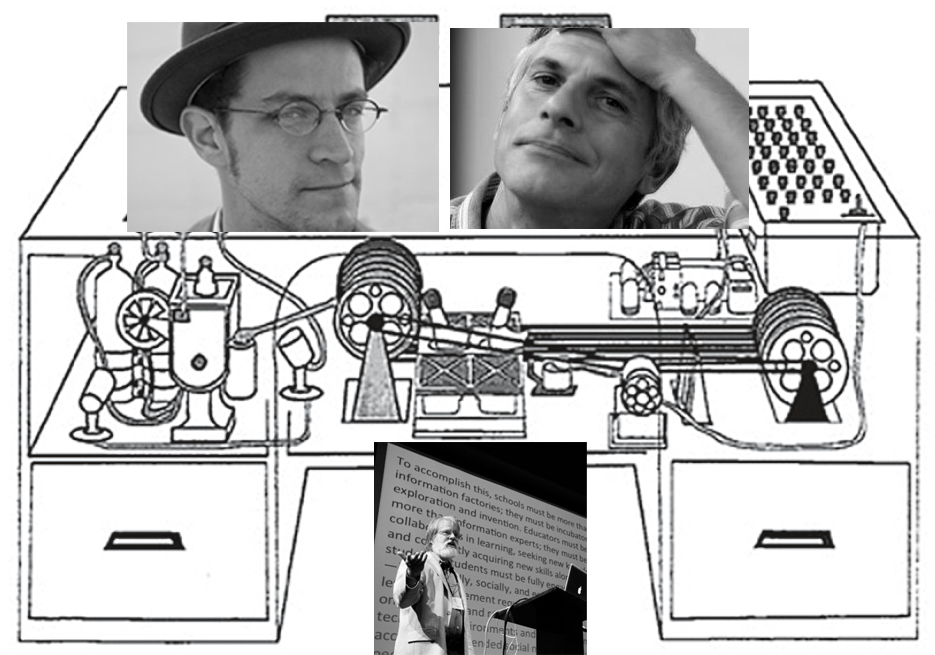
“As We May Think,” Annotation, and Liberal Learning: a conversation with Hypothesi.is’ Jon Udell and Jeremy Dean

Our Faculty Collaboratives Open Learning ’17 cMOOC is in its second week! Today I had the great pleasure of speaking with two leaders at Hypothes.is: Jeremy Dean (Director of Education) and Jon Udell (Director, Integrations). Our topic was Vannevar Bush’s epochal “As We May Think,” especially as seen through the lenses of online annotation and liberal learning. Click on the image below to experience our conversation.


As you’ll hear, Bush’s phrase “associative trails” appropriately wound its way throughout the conversation. I encouraged Jon and Jeremy to reflect on robust resource linking across collaborating minds as well as the more idiosyncratic and sometimes apparently “random” associative trails that are forged within our individual brains. I had probably registered this distinction myself in one of my many earlier passes through this endlessly fascinating essay, but today the distinction became newly vivid for me, and helped me understand areas of connection and disjunction within the essay itself.

Since a classic blog-based distributed conversation brought us together many years ago, I have interacted with Jon on numerous occasions. Some of his own associative trails have grown familiar (and dear, I must say) to me, but he’s always full of surprises, too, and I remain consistently challenged and stimulated by his ongoing work with the Web as a platform for co-constructed knowledge. I have been fortunate to spend more time with Jeremy lately, learning of his literary and musical background, and learning much more about his work with educators who are adopting Hypothes.is in their teaching as a way of helping students learn to scaffold and extend their own learning. It’s fascinating to see two people who are quite distinctive in background and personality nevertheless strongly united in their commitment to building a better world out of deeper, more thoughtful, more educated, and more robust human interaction.

I’m confident you’ll detect my own enduring concerns and commitments here as well. As I reflect on today’s conversation, I can see how my own work, and perhaps my personality as well, are situated almost at the meeting point between Jeremy and Jon. I hope that middle-ness helped to elicit the uniqueness, and the tremendous connections, these two thinkers brought to bear today. My thanks to both of them. I hope we can do this again, and soon.