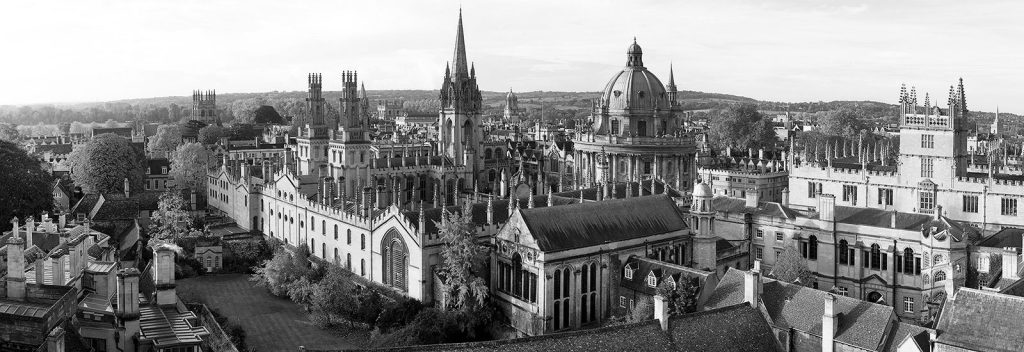
Oxford University
“A university training…aims at raising the intellectual tone of society, at cultivating the public mine, at purifying the national taste, at supplying true principles to popular enthusiasm and fixed aims to popular aspiration…at facilitating the exercise of political power, and refining the intercourse of private life.”
I don’t think this quote from Cardinal John Henry Newman’s 1852 book “The Idea of a University” aligns very well with our contemporary concept of a ‘Liberal Education.’ I’m not sure what a quote from a Catholic priest, from a time before Charles Darwin, Karl Marx or Albert Einstein influenced the academy, has to do with modern education at all. I think we are past the notion of “Universal” ideas and values.
In the mid-Victorian era, very few people were educated and many graduates never had to hold a job. The British Empire, like the American Empire, didn’t require educated men, just well trained, obedient men. With corporations controlling every aspect of our lives, American Universities are now turning out highly trained technocrats (of all gender identities) to run this Neoliberal Empire.
To me, a more appropriate quote would be from a 1959 graduation speech by Leo Strauss, the University of Chicago political philosopher and primary theorist of Neoliberalism;
“Education to perfect gentlemanship, to human excellence, liberal education consists in reminding oneself of human excellence, of human greatness. …we know that there cannot be the simply true substantive view but only a simply true formal view; that formal view consists in the insight that every comprehensive view is relative to a specific perspective, or that all comprehensive views are mutually exclusive and none can be simply true. The facile delusions which conceal from us our true situation all amount to this, that we are, or can be, wiser than the wisest men of the past. We are thus induced to play the part not of attentive and docile listeners but of impresarios or lion-tamers. Yet we must face our awesome situation, created by the necessity that we try to be more than attentive and docile listeners, namely, judges, and yet we are not competent to be judges. As it seems to me, the cause of this situation is that we have lost all simply authoritative traditions in which we could trust, the nomos which gave us authoritative guidance, because our immediate teachers and teachers’ teachers believed in the possibility of a simply rational society. Each of us here is compelled to find his bearings by his own powers however defective they may be.” http://www.ditext.com/strauss/liberal.html
Not to worry, Neoliberal Universities and corporate employers will surely supply you with any traditions they think you need.
I’m retired, don’t need job training and have been watching the creeping fascism of Neoliberalism since Reagan was elected President. I’m also working class and an American-Scot so I look to other educational traditions. After inventing compulsory education with “The Education Act 1496”, whereby the Parliament of Scotland required that landowners send their eldest sons to school, “[t]he Mechanics’ Institute movement began in 1800 when Dr George Birkbeck of the Andersonian Institute in Scotland gave a series of lectures to local mechanics. The nineteenth century term “mechanic” meant artisan or working man. The lectures were free and proved popular. They led to the formation of the Edinburgh School of Arts (1821) and the London Mechanics’ Institute (1823). The movement spread quickly throughout the British Empire.” http://mivic.org.au/history-of-mechanics-institutes.html
I belong to the San Francisco Mechanics Library, which was established in 1854, just four years after California became a state. I attend lectures, classes, book groups and writing groups, in addition to the library and computer lab. One of the reasons I chose Metro State is that I’m not interested in a traditional (or Neoliberal) education. In addition to getting credit for prior learning, my learning strategy is to use an eportfolio, as a Digital Humanities and Open Education project on the internets, to document my lifetime of learning together with all my coursework. This will allow me to reflect on how these learning experiences are connected to the wider world of ideas and for other learners to participate and comment. This is a radical idea for most Universities.
Here’s an example of one workers’ plan, learned at a Mechanic’s Institute, for documenting his learning (while Cardinal Newman was busy setting up a Catholic University in Dublin for the Pope):
“In an essay, remarkable at once for the originality of its views and the practical good sense it contains, John Foster recommends the propriety of every man writing memoirs of himself, not as an exercise of ingenuity — not as a means of drawing the world’s regard — but to fix in a man’s own mind, a sense of the progress he has made in moral and intellectual ideas to mark the change in his sensations which a prolonged experience of life produces and to excite a feeling of gratitude for those many providential interpositions which the most careful observer can scarcely fail to recognize as exercised in his behalf.” Diary for 1858 by Andrew Mcllwraith (Craftsman and former Mechanic’s Institute student) from More of a Man: Diaries of a Scottish Craftsman in Mid-Nineteenth-Century.
In order to get “a sense of progress” I’ll document the educational conferences, online courses and webinars I’ve attended, as well as the research I’ve been doing on Open Education, Networked Knowledge Organization Systems, graph databases, semantic metadata and the philosophy of semiotics.
I also intend to take more writing courses like “Memoirs and Creative Nonfiction” and communication and social research courses to deepen my work with community groups in social justice and the educators I’m working with to develop my local community colleges’ student leadership. I don’t see any Metro courses that teach one how to build a personal information technology infrastructure but perhaps I’ll find some.
I highly recommend the media, computing and learning textbook The Future of Thinking, Learning Institutions in a Digital Age written by students, educators and others interested in Higher Education in collaboration with the Humanities, Arts, Science, and Technology Advanced Collaboratory (HASTC). http://futureofthebook.org/HASTAC/learningreport/about/ or get a polished version for free on Google Play https://play.google.com/store/books/details/Cathy_N_Davidson_The_Future_of_Thinking?id=7B5znR_ki4MC
They (collectively) wrote;
“Over the past two decades, the way we learn has changed dramatically. We have new sources of information and new ways to exchange and to interact with information. But our schools and the way we teach have remained largely the same for years, even centuries. What happens to traditional educational institutions when learning also takes place on a vast range of Internet sites, from Pokemon Web pages to Wikipedia? This report investigates how traditional learning institutions can become as innovative, flexible, robust, and collaborative as the best social networking sites. The authors propose an alternative definition of “institution” as a “mobilizing network”–emphasizing its flexibility, the permeability of its boundaries, its interactive productivity, and its potential as a catalyst for change–and explore the implications for higher education. …In order to create a new field of digital learning, we must bring together research, knowledge, methodologies, and expertise from radically distributed existing fields— from the media and design arts to history, sociology, communications, psychology, philosophy, education, policy studies, political science, the computational sciences, engineering, and all points in between. A field cannot exist without institutional grounding.”
As far as inspiration for my learning, I look to a more contemporary, and pertinent source. Though an academic, twenty years ago Richard Rorty predicted:
“At [some] point, something will crack. The nonsuburban electorate will decide that the system has failed and start looking around for a strongman to vote for — someone willing to assure them that, once he is elected, the smug bureaucrats, tricky lawyers, overpaid bond salesmen, and postmodernist professors will no longer be calling the shots.
And this:
One thing that is very likely to happen is that the gains made in the past forty years by black and brown Americans, and by homosexuals, will be wiped out. Jocular contempt for women will come back into fashion. The words “ni**er” and “ki*e” will once again be heard in the workplace. All the sadism which the academic Left has tried to make unacceptable to its students will come flooding back. All the resentment which badly educated Americans feel about having their manners dictated to them by college graduates will find an outlet.
And, finally, this, the eerie anticipation of our current presidential predicament:
He will be a disaster for the country and the world. People will wonder why there was so little resistance to his inevitable rise. Where, they will ask, was the American Left? Why was it only rightists like Buchanan who spoke to the workers about the consequences of globalization? Why could not the Left channel the mounting rage of the newly dispossessed?” (from Achieving Our Country: Leftist Thought in Twentieth-Century America by Richard Rorty)
In “Philosophy as Poetry, a slim volume that contains the 2004 Page-Barbour Lectures, …he suggests that “the imagination is the principle vehicle of human progress.” It makes for a memorable slogan, especially for those of us who would like to see federal support of the arts and the humanities — along with such basic goods as health care and environmental protection — continue. But I think a sound pedagogy can be made out of it as well, one that highlights the importance of, among other things, social hope. After all, it is up to us to imagine a different future for our democracy.” from Rorty and Social Hope – Los Angeles Review of Books https://lareviewofbooks.org/article/rorty-social-hope/
Richard Rorty had a pragmatic approach to education as well. He recognized the conservative values of tradition and ‘truth’ and suggested these would be best leaned in primary education; what he termed education as socialization. He suggested that higher education was the appropriate place to learn the liberal values of freedom and progress through rational criticism, or education as individualization. Unfortunately, Rorty had no sympathy for radical ideas like Mechanic’s Institutes or Universities Without Walls, so we don’t know what he would think about Metro State.
I hope to learn more about alternative educational models and research their efficacy. As Rick Hendra and Ed Harris note in their paper The University Without Walls Experiment;
“The only UWW unit actively engaged over the years in research and publication efforts appears to be the UWW at the University of Minnesota, (now called First College). [Metro State]…may have developed instruments worthy of examination or replication by other researchers so that good comparative data might be made available.
…We don’t know how the educational outcomes of the UWW approach, centered on mentoring relationships, compare either to traditional undergraduate education or to adult-oriented continuing education programs. We don’t know — and must find out — the principles of good practice established by these programs. What we do know is that the existence of fifty roughly equivalent programs, operating in a wide variety of academic institutions, provides opportunities for comparative studies that are exceedingly rich.
It is an historic irony that such an ambitious experiment was able to generate so little published research. It would be regrettable were that irony allowed to persist: the founding generation of educators may not be available much longer and they are likely the best references we have as to how all these experiments, separate and together, played out. As much as we need to document their individual recollections, we need even more urgently to recapture their vision and their wisdom as higher education enters a new period of turbulence fed by technology and competitive pressures.” http://people.umass.edu/~hendra/Unpublished%20Results.html

My first digital media project 2013
My goal is to develop a (free and open source) digital approach to a liberal arts education, both heutagogy (theory of self-directed learning) and praxis, that will support anyone with access to a computer as they learn how to learn. From savants in the global south to illiterate inmates of America’s prisons, having a way to document, reflect on and share one’s learning should help people collaborate to improve their lives.
As for ‘social hope’, I prefer Antonio Gramsci’s famous quote from his Prison Notebooks, written while a prisoner of Benito Mussolini’s Fascist regime; “I’m a pessimist because of intelligence, but an optimist because of will.”



 I couldn’t make it to the Southwest Popular/American Culture Association conference this year so I made this postcard with last year’s photos of Albuquerque. (and this year’s graphic)
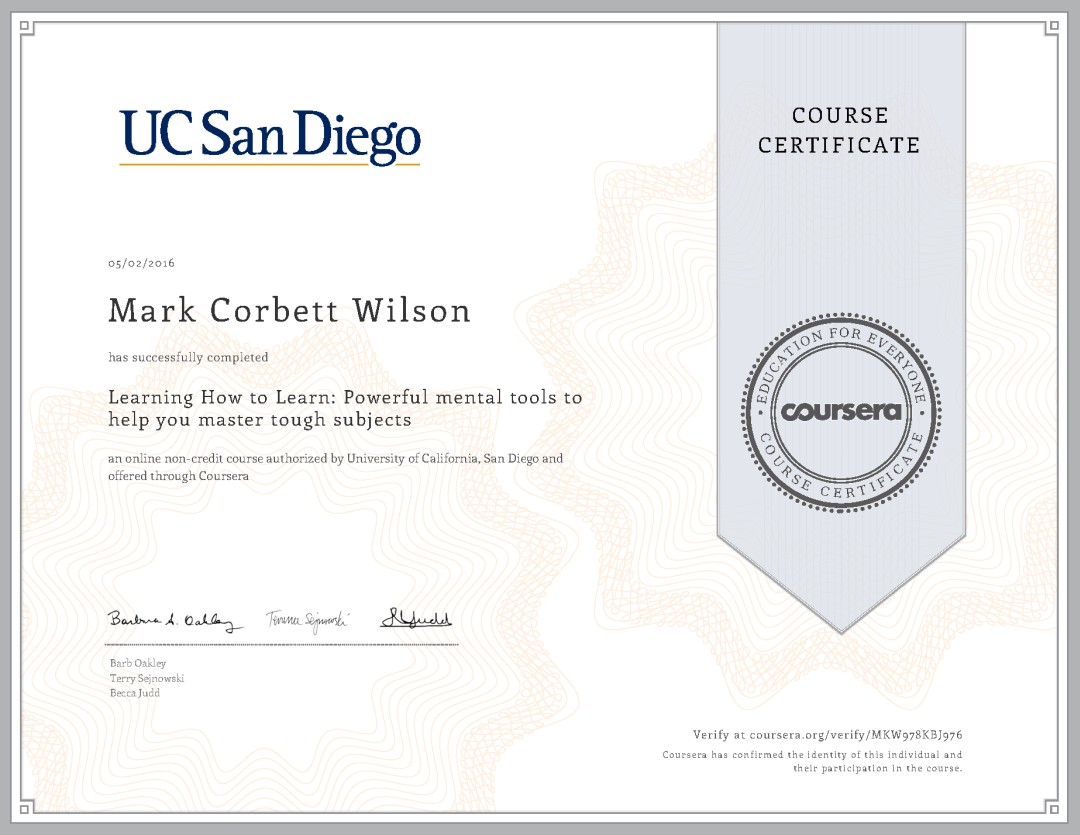
 Learning How to Learn: Powerful mental tools to help you master tough subjects by University of California, San Diego on Coursera. Certificate earned on May 2, 2016. This Certificate can be verified at https://www.coursera.org/account/accomplishments/certificate/MKW978KBJ976