Tag Archives: Text

Mark Corbett Wilson 2018-02-23 22:20:35

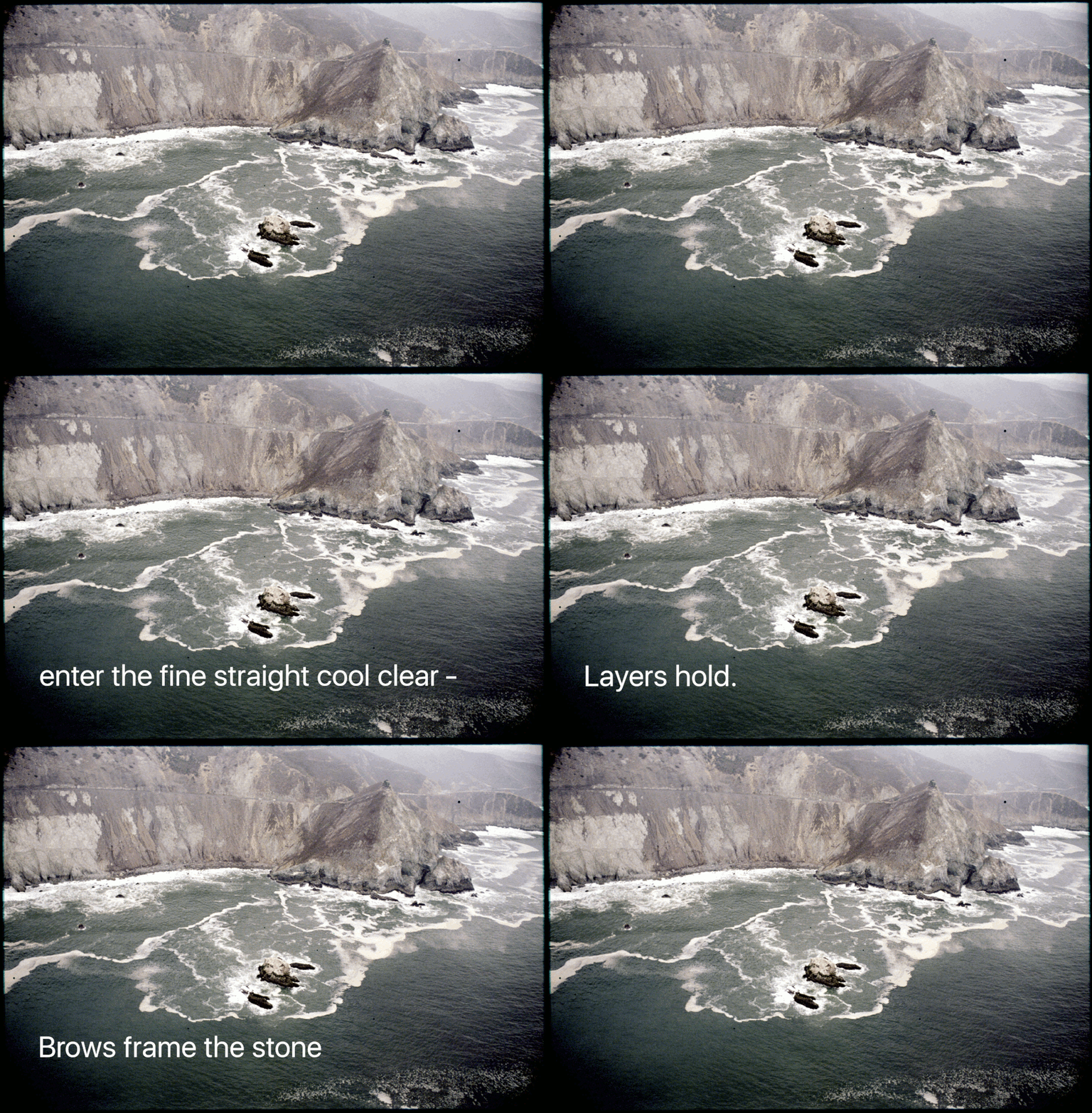
1979 archive photograph of Devil's Slide on former California Hwy 1 used as a background for a gif made with text from Nick Montfort’s dynamic poem generator

I used a 1979 archive photograph of Devil’s Slide on the former California Hwy 1 as a background for a gif made with text from Nick Montfort’s dynamic poem generator to complete today’s Daily Create for Digital Alchemy in the Open Education course Networked Narratives at Kean University in New Jersey.

#dda165 Visualize Taroko Gorge

This Daily DA published February 21st, 2018 is organized under For the Eyes (visual), Incantations

Open Nick Montfort’s dynamic, generative poem….

Let it flow by…

Relax your mind.

Now try to isolate a stanza or two. Try to copy it or save it in a screenshot. Next, connect to a photo (preferably your own). What imagery comes to mind? What gorge do you see?

What comes to mind when you let Taroko Gorge flow by? It need not be so literal as this small Arizona Gorge…

Tweet your response to @netnarr and be sure to include the hashtag #dda165

Here we go again! Taking Year 2 of Networked Narratives for a spin!

What The Heck Kind of Course is This?

At the core this is a bonafide on the ground course in Networked Narratives at Kean University, with registered students who will spend some time each week in a classroom. Last year it was co-taught by Mia Zamora at Kean join via the interwebs by Alan Levine who beamed in from his home Arizona. Several of you participated.

This time around, Alan is the sole teacher, still beaming in, with the assistance of TAs Hailey and Marissa. Mia is this year teaching at the University of Bergen in Norway, and her class there will overlap with ours as well. And for a middle segment of the course we will be connecting with students of Maha Bali at the American University Cairo.

Also, as an open connected course, the experience is open to anyone else on the internet who wants to do all or part of the same activities and assignments. Why? Because that’s what networks allow and enable. – Alan Levine

Everyday there is a prompt to create something digital, a Digital Daily Create (dda), to post online and/or tweet; #dda132 for example.

#dda132 A Spin of the Google Translate Roulette

If you connect your blog, both registered students and “open participants” (like me), your posts appear on the Networked Narratives website. It’s all very interwoven and mysterious and fun!

For my “Spin of the Google Translate Roulette” I chose a “song” that emerged from Ken Kesey’s Acid Tests in the 1960s. A musical improvisation with a nod to free jazz, there are thousands of recordings available and no two are the same. Originally created by the Grateful Dead, “Dark Star” is now performed world wide and a band has taken the title for the name of their “orchestra.” American movie director John Carpenter (Halloween, Escape from New York, They Live) chose “Dark Star’ for the title of his first film. The song lyrics are credited to Writer(s): Robert Hall Weir, Jerome J. Garcia, Philip Lesh, Ronald Charles Mckernan, Michael S. Hart, Robert C. Hunter and William Kreutzmann on AZLyrics.com.

Dark Star is often performed as part of a larger medley and improvisational ‘jams’ can extend the ‘song’ to nearly an hour. These ‘jams’ appealed to 60s concert goers more interested in “an experience” that in just listening to recorded songs performed live. The first version I ever heard was recorded live at the Filmore West and released as a double album titled “Live Dead.” Years later I had the good fortune to work with Bob Thomas, the artist and graphic designer who painted the album cover, at the original “Renaissance Pleasure Faires”, but that’s another story…

I translated “Dark Star” from English to French, from French to Chinese, from Chinese to Hindi, from Hindi to French and from French back into English. To quote an English rock band I never cared for;

“The Song Remains the Same.”


My College Degree as a Digital Humanities Project

Digital Humanities by Craig Bellamy CC BY-NC-SA 2.0


I’
m developing a new model for adult learners so they can avoid the experience I had while trying to improve my skills at a Community College. Combining Self-Directed Learning, Computational Thinking, Digital Pedagogy, Open Education and Open Social Scholarship theories with Open Education Resources (OER), Free and Open Source Software (FOSS) and ePortfolios, I intend to create a free platform for any adult learner to document and reflect on their diverse learning experiences. I think simplifying all these dense and often conflicting learning theories into an approach (Praxis) any adult student can use to design their own self-directed education pathway will be useful. (Heutagogy)

I’ve been working on these ideas for three years, starting with attending a presentation by faculty from Evergreen College in Washington on integrating individual courses’ homework assignments across institutional silos. That led me to eportfolios as a way to collect all types of evidence (digital objects) of learning. Learning about tagging and metadata for discoverability on the internets, I observed the need for a controlled metadata vocabulary to allow searches for emerging patterns. These new ways of looking at one’s learning has the potential to suggest new constructions of learning experiences and new areas of research.

I belong to the Association for Authentic, Experiential and Evidence-Based Learning (AAEEBL) and have attended their conferences, including a session at this year’s 8th Annual Forum on Digital Learning and ePortfolios at the 2017 AAC&U conference in San Francisco. The ePortfolio Forum is jointly sponsored by AAC&U’s project, VALUE: Valid Assessment of Learning in Undergraduate Education; the Association for Authentic, Experiential and Evidence-Based Learning (AAEEBL), the association of ePortfolio professionals; and the International Journal of ePortfolio (IjeP). At this year’s AAEEBL Conference I joined the Technology Special Interest Group and convinced them to take on my idea for an ePortfolio Ontology as their first project. I’ve also joined the Association for Learning Technology, the UK group to “advance education through increasing, exploring and disseminating knowledge in the field of Learning Technology for the benefit of the general public.”

The Hurley Information and Technology Convergence Center at the University of Mary Washington in Fredericksburg, Virginia. Photo by MCW


I
recently realized that my idea of ‘finishing a Bachelor’s degree while using Free and Open Source Software to create a learning eportfolio on my own domain and blogging about it in public’ is a Digital Humanities project. In 2016 I attended the Digital Pedagogy Lab Institute at the University of Mary Washington, VA, home of ds106 and the Domian of One’s Own initiative. I learned about UMW while attending the Digital Humanities Summer Institute at the University of Victoria, BC, where I took Critical Pedagogy and Digital Praxis in the Humanities from Jesse Stommel and Chris Friend. This year I took two courses during DHSI to support my project; ‘Open Access and Open Social Scholarship’ and ‘TEI and Metadata.’ That led me to explore metadata ‘triples’ which led to the concepts of graph databases and ‘faceted’ searches.

Lincoln as a boy reading at night. Library of Congress CollectionNow I want to learn how to integrate a FOSS graph database (Neo4j?) with FOSS curation tools (WP, Omeka, GitHub?) to utilize the power of humanities computing and the semantic web to document and reflect on my learning experiences. And then document my reflections and be able to do faceted searches of everything I’ve created together with everything I’ve curated into my database. I need to learn to appropriately tag all these digital objects with metadata so that they integrate seamlessly with the semantic web. Hopefully this can be automated to a large degree.

My plan is to structure my Metro State University’s College of Individualized Studies Bachelor’s degree as a Digital Humanities project using an eportfolio to document, reflect on and publish my learning. Which tagline do you like: Learning in Public or Learning Out Loud? Or suggest another.


Where I Am From

I was invited to post something on their site by the Young Writers Project through their collaboration with the Networked Narratives open access learning project based at Kean University. I then realized I hadn’t posted this on my site. Now I have!


Artist talking about the collaborative project of painting a mural around a warehouse in West Oakland, California, titled "West Side is the Best\ Side."


Where I Am From by Mark Corbett Wilson

I am from fire,
from Pyro Engineering Inc. and Advanced Radiation Corporation
I am from glittering quartz, a desert washed by Pacific tides.
(Hot and dry, cool and moist,
it smelled of passion and petroleum.)
I am from cactus,
the thorns, flowers and fruit whose
visions and pain I remember
as if they were my own.

I am from Pictland and perseverance,
from Corbett and Duncan and Fraser.
I am from Hollywoodland lesbians
and disgraced Republican Nixonian Quakers,
from ‘early to rise’ and don’t call it Fascism.
I am from the middle way of Mr. Gotama’s Eight Tasks
before dialectic atheism emerged.
Soy un Californiano. Mis comidas
son chiles, frijoles y maíz.
The indentured Highland lad o’ pairts
and America’s First Peoples,
the prettiest girl at Schwabs’ soda counter;
the Slaughter cowboy’s homestead graveyard.

I am from kitchen jam sessions and garage workshops,
table saws and lapidary equipment,
art cars and personal computers
conceived during new moons.
I am from lifetimes disappeared –
the Jurupa Oak contemplating ancient valleys
obscured by smoke.