Tag Archives: Serendipity

Listening to the Spring Rain and Wikipedia

So far in 2018, the second Monday evening of the month is technology night at the Western Institute for Social Research (WISR). In my new (volunteer) position as Learning Technologist, I suggested it to help the faculty and administration improve their digital skills as they transition to an online accredited institution. For our first project, I set up a free Wikiversity course so we can all learn to edit and eventually create Wikipedia pages. “The Wikiversity e-Learning model places emphasis on “learning groups” and “learning by doing”. Wikiversity‘s motto and slogan is “set learning free”… .” With all the work being done around accreditation, a part time faculty and a student body of working adults I hoped this asynchronous exercise would be a low stakes way to invite learning and lead to the creation of a Wikipedia page for future students and other interested parties to learn more about WISR.

The same small group has been attending the meetings, but not really doing any coursework. This is typical of free no credit online courses. Hopefully, as more folks hear about the class, this will improve. We’re also comparing Zoom to GoToMeeting, so there is a lot of technological change going on. And sound issues, always sound issues.

The next morning I received an email notice of a new blog post from my favorite Learning Technologist CogDog. If you haven’t visited his websites, you should. You’ve certainly seen one of his thousands of daily photographs that he posts to Flickr, they are licensed for free use and are all over the internets. Anyway, his latest post is about the class he’s co-teaching in Mexico on “Open as a Question; Wikimedia as Example, Open Pedagogy, Open Technology, and Open Scholarship.” His posts are always filled with links to social media, learning technologies and even code he writes. Near the end of his post he embedded a presentation he prepared, but never used. CogDog doesn’t throw away projects, he shares them. Instead of making slide decks for presentations he creates websites, or as he describes them, SPLOTS (Smallest Possible Online Learning Tools). Of course, he’s posted the modified Word Press theme he uses to create SPLOTS on GitHub, so you can use it too.

I clicked on “The ‘Pedia and Beyond” and wandered through it’s eleven pages of video, photos, instructions and social media links. The last page has a link to “Listen to Wikipedia”, an audio visual representation of Wikipedia events in real time!


http://listen.hatnote.com/


“Bells indicate additions and string plucks indicate subtractions. Pitch changes according to the size of the edit; the larger the edit, the deeper the note. Green circles show edits from unregistered contributors, and purple circles mark edits performed by automated bots. You may see announcements for new users as they join the site, punctuated by a string swell. You can welcome him or her by clicking the blue banner and adding a note on their talk page.”

To me it sounds like a cross between Indonesian Gamelan music and New Age relaxation sounds. I was mesmerized by the floating circles (with their Wikipedia titles) and the various sounds identifying the types of Wikipedia edits happening when SPLAT! A giant gray circle covered nearly the entire screen and inside the circle was “Presidency of Donald Trump.” I clicked on it and was taken to the Wikipedia talk page for this Wikipedia article. There was the major addition to the “Presidency of Donald Trump” article ; the list of Notable Departures from his administration. I imagine this was inspired by the one Rachel Maddow has been scrolling on her nightly cable news show.

List of Departed Trump Administration list on Rachel Maddow Show.I scanned down the Wikipedia list and back to the top: it is chronological and the top entry in Secretary of State Rex Tillerson and today’s date, March 13, 2018. That’s how I found out the US Secretary of State has been fired!

Below his entry is
John McEntee – Personal Aide to President Fired 3/13/2018
James Schawb – Spokesperson for ICE Resigned 3/12/2018
Gary Cohen – Top Economic Advisor Resigned 3/7/2018
and Hope Hicks.

Hope Hicks “Role” was listed as Secretary of State, a copy and paste error no doubt, so I signed into Wikipedia and edited it to read “White House Communications Director.” This entry referenced a Business Insider article which had her correct title. Did you know all Wikipedia entries have to have references? Several people at the Western Institute for Social Research do. They now have Wikipedia accounts and are researching new articles. Why don’t you join us?


https://github.com/cogdog/splotpoint


https://github.com/cogdog/splotpoint

https://en.wikipedia.org/wiki/The_Rachel_Maddow_Show

Here we go again! Taking Year 2 of Networked Narratives for a spin!

What The Heck Kind of Course is This?

At the core this is a bonafide on the ground course in Networked Narratives at Kean University, with registered students who will spend some time each week in a classroom. Last year it was co-taught by Mia Zamora at Kean join via the interwebs by Alan Levine who beamed in from his home Arizona. Several of you participated.

This time around, Alan is the sole teacher, still beaming in, with the assistance of TAs Hailey and Marissa. Mia is this year teaching at the University of Bergen in Norway, and her class there will overlap with ours as well. And for a middle segment of the course we will be connecting with students of Maha Bali at the American University Cairo.

Also, as an open connected course, the experience is open to anyone else on the internet who wants to do all or part of the same activities and assignments. Why? Because that’s what networks allow and enable. – Alan Levine

Everyday there is a prompt to create something digital, a Digital Daily Create (dda), to post online and/or tweet; #dda132 for example.

#dda132 A Spin of the Google Translate Roulette

If you connect your blog, both registered students and “open participants” (like me), your posts appear on the Networked Narratives website. It’s all very interwoven and mysterious and fun!

For my “Spin of the Google Translate Roulette” I chose a “song” that emerged from Ken Kesey’s Acid Tests in the 1960s. A musical improvisation with a nod to free jazz, there are thousands of recordings available and no two are the same. Originally created by the Grateful Dead, “Dark Star” is now performed world wide and a band has taken the title for the name of their “orchestra.” American movie director John Carpenter (Halloween, Escape from New York, They Live) chose “Dark Star’ for the title of his first film. The song lyrics are credited to Writer(s): Robert Hall Weir, Jerome J. Garcia, Philip Lesh, Ronald Charles Mckernan, Michael S. Hart, Robert C. Hunter and William Kreutzmann on AZLyrics.com.

Dark Star is often performed as part of a larger medley and improvisational ‘jams’ can extend the ‘song’ to nearly an hour. These ‘jams’ appealed to 60s concert goers more interested in “an experience” that in just listening to recorded songs performed live. The first version I ever heard was recorded live at the Filmore West and released as a double album titled “Live Dead.” Years later I had the good fortune to work with Bob Thomas, the artist and graphic designer who painted the album cover, at the original “Renaissance Pleasure Faires”, but that’s another story…

I translated “Dark Star” from English to French, from French to Chinese, from Chinese to Hindi, from Hindi to French and from French back into English. To quote an English rock band I never cared for;

“The Song Remains the Same.”


Association for Learning Technology ALT Winter Online Conference

 image from pxhere CC by

I got up early (1 am in Oakland, California!) to participate in this year’s Association for Learning Technology Winter Online Conference.  I could only access one of the day’s Blackboard webinars, confirming what I’ve heard about Blackboard, but got to participate in a tweet chat. I hope tomorrow the technology is up to the task. Otherwise, the irony may become toxic.

California Sociological Association Annual Conference

Network Map of Nugan Hand Ltd private bank and connections by Mark Lombardi.

I was recently in Sacramento, California, at the annual meeting of the California Sociological Association. Two years ago I attended the meeting in Oakland, where I live. I again saw none of my sociology teachers or classmates from any of the four Peralta Community Colleges. I did run onto William Ochoa, a former colleague and Senator in the Associated Students of Laney (Community) College, now working on his Master’s degree in Sociology at Mills College in Oakland, California.

I attended all seven sessions of the two day conference including; the Popular Culture & New Technology panel, the Community College Roundtable, Critical Perspectives in Education, The 2016 Presidential Election Revisited panel, Making Sociology Matter, Social Movements and Sociology: the Big Picture. The panels included many interesting presentations and many I attended were student driven. The highlight for me was an unusual and memorable presentation by Frank Roberts from Mt. San Antonio Community College on his project to unify the major theories of sociology. The last session of the conference, there were only five attendees which allowed a lively and prolonged discussion.

PP slide by Frank Roberts

First Roberts mapped Donald Brown’s Anthropological catalog of 369 “Human Universals” traits to Robert Nisbet’s “Unit Ideas of Sociology” using an Excel spreadsheet. Balancing Nisbet’s conservative, community oriented approach, Roberts added sociological Agency to Community, Sacred, Authority, Status, Alienation units. This accounted for many personal and creative traits. Then Roberts mapped these six unit ideas to the three major sociological theories: Structural-Functionalism, Comfit Theory and Symbolic Internationalism. I imagine the resulting integration of sociological theories can be used to describe and possibly clarify many intersectional positions. This is an idea I will continue to reflect on and try to use in my future sociological studies.

The official theme of the California Sociological Association annual meeting was “A Legacy of Sociology”: the keynote presentation was “Who rules America?” by William Domhoff, Distinguished Professor Emeritus and Research Professor in the Sociology Department at the University of California, Santa Cruz. His latest work is as co-author of Studying the Power Elite: Fifty Years of Who Rules America? (Routledge 2018). Dr. Domhoff summarized his long career in researching America’s elite and focused on the rise of think tanks (and policy discussion groups) in influencing policy and politics. This corresponded with the waning of Marxist theorists’ influence in academia and resulted in a lessening of criticism of corporate influence. Dr. Domhoff didn’t mention Louis Powell’s 1971 memorandum for the American Chamber of Commerce, “Attack on the American Free Enterprise System” but I couldn’t help wondering how Dr. Domhoff would characterize its influence. He’s inspired me to read the book that started this line of inquiry, C. Wright Mill’s 1956 book The Power Elite. Researching the interlocking nature of corporate directors, first with excel spreadsheets and now with powerful computers running social network analysis software, Dr. Domhoff has tracked how corporate power has fragmented from being centered in banks to a more distributed system of endowed academic chairs, corporate funded policy groups and think tanks, foundations and emerging industries. Dr. Domhoff concluded optimistically; there’s a new wave of power structure researchers using larger databases and the final chapter of the story of “America’s Power Elite” has not been written.

Network Map of World Finance by Mark Lombardi

Lifetime’s of Learning

Fire engulfs a home

Whenever I meet another glassblower I ask them “when did you first get in trouble for starting a fire?” They always have a story.

I was about five when my mother called the fire department on me because I liked to play with matches. I can’t remember if this was before or after my friend Marta and I got caught playing doctor in her closet, but I digress. I was in the alley behind our neighbors garage, an old wooden shed, when the fire truck rolled up and several large men in uniforms climbed down. They gently but firmly explained why I shouldn’t play with fire. They made a big impression on me and that day I stopped playing with fire.

Three millenia of glass by Mark Corbett Wilson

“Wherever humans have gone in the world, they have carried with them two things, language and fire. As they traveled through tropical forests they hoarded the precious embers of old fires and sheltered them from downpours. When they settled the barren Arctic, they took with them the memory of fire, and recreated it in stoneware vessels filled with animal fat….A human body at rest devotes roughly one-fifth of its energy to the brain, regardless of whether it is thinking anything useful, or even thinking at all. Thus, the unprecedented increase in brain size that hominids embarked on around 1.8 million years ago had to be paid for with added calories either taken in or diverted from some other function in the body. Many anthropologists think the key breakthrough was adding meat to the diet. But Wrangham and his Harvard colleague Rachel Carmody think that’s only a part of what was going on in evolution at the time. What matters, they say, is not just how many calories you can put into your mouth, but what happens to the food once it gets there. How much useful energy does it provide, after subtracting the calories spent in chewing, swallowing and digesting? The real breakthrough, they argue, was cooking.” (Adler, Jerry)

My most vivid school memory is the afternoon the Principle came into our class, talked to our teacher for a minute and made her cry. He then told us that the President of the United states of America had been shot and killed. The only other strong memory I have, is finishing my class work and taking out a book to read. The teacher came over and told me to put the book away, that I was supposed to be doing my work. I showed her that I was finished and she told me I should just sit quietly until everyone else was finished. From that day to this, I realized most of the rules schools have instituted are not there to support students’ learning.

My father was a rock hound, which made me a pebble pup. He and his friends all cut and polished the rocks we found and made jewelry in their home workshops. My mother was from New Mexico, so we often visited her family and drove and hiked all over the American Southwest collecting rocks. Being a kid, I wasn’t allowed to use the lapidary machinery or torches. My father died suddenly and his friends decided to show me how to use the equipment safely because they knew, as a junior member of the Whittier Gem and Mineral Society, I would try and make jewelry on my own. Because I could identify most American gemstone they also encouraged me to help organize the donations to the Juniors’ fund raising table at the annual Gem and Mineral Show. I appreciated their thoughtfulness in keeping me occupied and engaged as I grieved.

Always an A student, my grades plummeted. There were no grief counselors available to elementary school students back then so the administrators decided to skip me a grade. I have no idea what they were thinking but the week I turned 12 I found myself the youngest kid in Katherine Edwards Junior High School. I had never had to switch classrooms during the school day so the ‘boys’ counselor showed me around my first day and wished me luck. The good news was they had a band, so I could continue to play clarinet. Being ‘husky’, the band director encouraged me to learn the sousaphone. …and I never wrote to thank him.

Polished agate

“Every culture ever studied has been found to make music, and among the oldest artistic objects known are slender flutes carved from mammoth bone some 43,000 years ago — 24,000 years before the cave paintings of Lascaux.…The new paper “takes a very innovative approach and is of great importance,” said Josef Rauschecker, director of the Laboratory of Integrative Neuroscience and Cognition at Georgetown University. “The idea that the brain gives specialized treatment to music recognition, that it regards music as fundamental a category as speech, is very exciting to me.”In fact, Dr. Rauschecker said, music sensitivity may be more fundamental to the human brain than is speech perception. “There are theories that music is older than speech or language,” he said. “Some even argue that speech evolved from music.”” (Angier, Natalie)

After WWII, my mother was working in a bank and renting a house in Hollywood with five other “girls.” My father was a counter man at the local Ford dealership and trading handyman work for music lessons. Evelyn Pennick had been a vaudeville performer and owned a Hollywood music store. She and her female partner were my mother’s landladies; that is how my parents met. Andy and Ev also owned several other properties including a cabin on Big Bear Lake and a cottage and a sailboat in Newport Beach. I always wondered how they acquired all this property.

Hollywood, California, early 20th century

After I was born in Hollywood, my parents moved us to a small Mid-Western Quaker village, just east of East LA. When I was nine, my dad and I started taking music lessons at Ev’s store in Hollywood. He studied Flamenco Guitar and I learned to play the clarinet. I’ll never forget the picture of Evelyn in a cocktail skirt and fishnet stockings playing two clarinets at once. It was an inspiration to me in more ways than one. I didn’t learn what a lesbian was until years later.

I was fourteen when my cousin talked her mom into taking us to see “Hair” at the Aquarius Theater on Sunset Blvd. for her birthday. It was 1969 and the original road company didn’t wear flesh colored tights. Two years later, Elvin Bishop and Big Brother and the Holding Company played at my high school. It was the first time I saw real rock bands. By then, I had played in the high school orchestra, marching band, pep band/jazz combo and the orchestra for the theater department’s annual musical. I also joined a local youth marching band because they had traveled to the Calgary Stampede in Canada and represented Whittier at Richard Nixon’s Inauguration in Washington D.C. The year I joined were selected to march in the 37th Annual Sugar Bowl Parade in New Orleans. I bought my first cocktail, a hurricane, on Bourbon St. in the French Quarter on New Year’s Eve. I was fifteen. I should have sent my junior high school band director a postcard.

I began taking classes at my local community college during my junior year in high school. There were no AP classes and I was bored. After I graduated from high school, I took a jewelry class and a glassblowing class thinking I would use a torch to make little trinkets to add to my jewelry, like I had seen on Olivera St. in Los Angeles. Instead, we all gathered in a utility room next to the ceramics studio, and the teacher told us “as soon as we finish building this furnace and kiln, we’re going to make glass and learn how blow it. He had a degree in chemistry and ceramic design from Alfred University in New York, and a month later we were blowing the glass we had made, from a furnace we had built. We did not know it, but we were the second wave of the American Studio Glass Movement. I was seventeen and had found my life’s’ work, although it took a few more years to realize it.
American Studio Glass Movement

That summer my girlfriend Wendy and I drove a VW bus from LA to Vancouver, British Columbia, and then across the newly completed TransCanada Highway to St Johns, Newfoundland. We explored Boston, New York City and Washington DC. We had one flat tire, and gathered a lifetime of memories.

While driving across Ontario, which is nearly twice the size of Texas, we heard the Grateful Dead were playing in New York, so we decided to take a little detour to see them. We listened to the AM radio news that the roads were being closed, but since we were coming from the north through Buffalo, we drove right to the Watkins Glen Racetrack, parked the van and walked right in. It was the biggest crowd we had ever seen, and we had been to the Rose Bowl Parade. The Dead played all afternoon. It looked like a big storm was headed our way so, at Wendy’s insistence, we left without seeing The Allman Brothers and The Band. That concert turned out to be the largest in US history, 600,000 people, nearly twice the size of Woodstock. Wendy was right: it poured rain for the next couple days.

Fort Amherst and Lighthouse St. Johns, Newfoundland

One morning, from the campground above St Johns, I saw three black wooden ships leaving the harbor. They were very low in the water and had wine colored square sails with black crosses. At lunch in the harbor, I asked about what I had seen. A harbor worker told me it was the Portuguese fishing fleet loaded with cod and headed home. The only sounds I had heard were the sails luffing, and asked if they had motors. I was told that they were the last of the traditional fishermen. This was twenty years before the collapse of the Atlantic northwest cod fishery. They sailed nearly three thousand miles each way without modern technology, the way it had been done for hundreds of years. It made me think of the Nina, the Pinta, and the Santa Maria, nearly 500 years before. At the time, I had never heard of a caravel.

Caravels Nina and Pinta

I tried many different jobs and kept taking night classes during the 70s. I managed a used book store and then managed a head shop that sold herbs and had a counter culture news rack. In response to ads I saw in East/West magazine, I spent the summer of ‘76 studying The Tao of Physics with Fritjof Capra, Tai Chi and Buddhism at Choyam Trungpa Rinpoche’s Naropa Institute in Boulder, Colorado. I then learned stone masonry through the Haystack School of Crafts (in Maine) at Paolo Soleri’s architectural megastructure project, Arcosanti, in central Arizona. In 1978, I spent most of the year working at Arcosanti; managing the cafe, leading a concrete construction crew, giving tours and working in the foundry making sand molds, pouring bronze and finishing the wind bells Soleri sells to finance his architectural projects. During that summer, I collaborated on the design of the food service for the Arcosanti Music Festival. The owners of the Arcosanti Cafe built food booths and I supervised the delivery of the organic food we served to the thousands of concert goers as well as the backstage area for VIPs and the performers. That ‘78 music festival still holds the record for the largest number of cars burned in a parking lot fire; the exact number will never be known, but it is ironic that it happened at an architectural project for a city without cars. That fall I worked in Soleri’s Cosanti bronze foundry in Phoenix. One day I went into the break room and picked up a Time magazine with a metal tub full of purple Kool-Aid on the cover. I read the article about the Jonestown massacre and decided I was done with visionary leaders.

Arcosanti, Arizona

I returned to LA and got a job making the glass equipment used to grow Silicon crystals and manufacture computer chips. With purity being crucial, this glassware is made from Pure Fused Quartz (PFQ) and requires a hydrogen/oxygen flame to reach the 4,000 degrees necessary to work it. This is the same flame that launches the space shuttle and makes quartz work the most dangerous form of glassblowing.

I continued taking art glass lessons from M. Rhys Williams at his Cactus Glassworks. Rhys received the first Master of Arts in Glass from Illinois State University, taught by one of the original American Studio Glass artists Joel Philip Myers. Often my blowing partner was Thurston LeVay, the owner of Glass Instruments, a high-tech glass shop in Pasadena, California. After years of lobbying he hired me and set me on my career path. I built high powered lamps and LASER’s in the daytime and took LASER technology classes at Pasadena City College at night. Rhys and I demonstrated glassblowing for several years at the LA County Fair and after I started working at Glass Instruments I set up a glass distillation column to demonstrate how glass is used in research.

After being laid off during the Reagan Recession, I spent a year studying Manufacturing Engineering at Cal Poly Pomona. For my work study job, I reopened the Cal Poly glass shop and repaired labware for Chemistry professors from Cal Poly and the Claremont Colleges. That was the first time I worked on a large research vacuum system. Unable to afford to continue on financial aid and work study, I moved to northern California to continue working as a scientific glassblower. I also continued making art glass at San Francisco State University and in Berkeley’s many glass studios.

In 1989 I answered a want ad in the San Jose Mercury News:
7052 to Kovar call Glastronics 408 727 8003.
Only an experienced glassblower and LASER maker would have known that 7052 is a Corning glass formula engineered to weld directly to the steel alloy Kovar to make hermetic (vacuum tight) seals for electro-optical devices.

In 1990, I cut two tendons and a nerve in my right (dominate) hand on a piece of glass. I was lucky to have Dr. Robert Markison in San Francisco as my surgeon. In addition to being one of the foremost hand surgeons in the world, Dr. Markison is a professional musician and amateur magician! After months of physical therapy, I returned to work. I mention this because for a year I had to work left handed and eventually became ambidextrous with Dr. Markison’s encouragement. I have always wondered how this experience altered my brain and my thinking.

Map of Howard Gardner’s Multiple Intelligences

I am looking forward to documenting all my learning experiences and getting college credit through Metro State for many of my interests. Realizing the unusual circumstances of my life, I have always focused on my uniquely 20th Century American experience. Between my travels and my self-directed learning, I have explored the history and cultures of nearly every region in North America. I should start a list of every museum I can remember visiting.

For several years I was the Sunday manager at Moon News in Half Moon Bay, the finest bookshop and newsstand I’ve ever seen. I loved putting out all the Sunday papers and chatting with my regulars. And the 40% discount. I was downsized from my fulltime job as the Silicon Valley economic bubble collapsed. I had to sell the Early Modern beach house I had remodeled, overlooking the harbor in Half Moon Bay. I lost all health insurance (including dental, optical and lifetime long term care) and 1/3 of my private pension. I had spent fourteen years making high-intensity short-arc mercury vapor lamps for the production of computer chips.

1935 (William Wurster?) house on the former HWY 1 in El Granada, California

I returned to managing bookstores to make ends meet. Independent bookstores have become an endangered species thanks to Amazon. Moon News closed its doors in 2009. I also worked at the EastWest Bookshop, easily the largest New Age bookshop in California, now that the Bodhi Tree in LA is closed. I helped close the Books Inc. in the Stanford Shopping Center on the Stanford campus in Stanford, California and reopen it in the Town and Country Village in Palo Alto. All these stores hosted author readings and book signings and all the staff wrote short book reviews. I introduced and taped dozens of talks and wrote even more book reviews.

For a decade, I was involved with The Crucible Fire Arts Center in West Oakland. I took jewelry, machining and neon classes, and volunteered at many of their open houses and Fire Arts performances. I served as an intern in mold making department for Billy Heibert and as teacher’s assistant for Nick Diphillipo in the bronze foundry (who I had worked for at the Arcosanti and Cosanti foundries). I also filled in as the glassblowing technician and demonstrator, when Kier Logo injured his hand the week before the 2008 performances of the Fire Ballet Firebird: “L’oiseau de feu”.

A typical Crucible party

I worked a short time as the Senior Glassblower at the Richmond Technology Center, Chevron’s global research headquarters next to the Chevron Refinery in Richmond, California, where hundreds of researchers and their staffs explore energy solutions and support the refinery. Once the premier industrial glassblowing shop on the west coast, after decades of neglect it was the most dangerous and mismanaged place I have ever worked. While it had the most varied, interesting and challenging work I have ever done, I had no experience navigating huge bureaucratic organizations and was terminated for documenting safety violations.

Richmond Technology Center (foreground) and Chevron refinery after explosion

I was looking for a way to utilize my four decades of scientific glass blowing experience when I heard the new President say:

“…in this economy, a high school diploma no longer guarantees a good job. I urge the Senate to follow the House and pass a bill that will revitalize our community colleges, which are a career pathway to the children of so many working families. To make college more affordable, this bill will finally end the unwarranted taxpayer-subsidies that go to banks for student loans. Instead, let’s take that money and give families a $10,000 tax credit for four years of college and increase Pell Grants. And let’s tell another one million students that when they graduate, they will be required to pay only ten percent of their income on student loans, and all of their debt will be forgiven after twenty years – and forgiven after ten years if they choose a career in public service. Because in the United States of America, no one should go broke because they chose to go to college. And it’s time for colleges and universities to get serious about cutting their own costs – because they too have a responsibility to help solve this problem.” – President Barack Obama State of the Union Speech January 2010

My monthly expenses were low, I decided to go to back to school and learn the skills needed to start my own business. At the time, I had a beautiful partner, shared a reasonably priced two bedroom apartment and had my dream motorcycle for transportation. I completed the Free Application for Federal Student Aid (FAFSA) in April 2010 and qualified for the maximum benefits, $5,500 in Pell Grants and Stafford Student Loans up to $9,500. I chose Laney Community College in Oakland because it was one of the few schools in the Bay Area that offered an Entrepreneurship Certificate and, having lived in Oakland when I first moved to the Bay Area, loved the diversity and working class vibe.

I submitted my paperwork to the Laney College Financial Aid Department and was told that I would receive funds in 6 to 12 weeks. I bought hundreds of dollars’ worth of textbooks and started school.

For the previous four years I had been under and unemployed. I started school with no savings and the expectation that I would receive my pre-approved funds in a timely manner. After three months, I ran out of money. I kept hoping to receive my funds and didn’t drop any classes. Returning to the FA office at the end of the semester I was told my FA Specialist was on vacation for a month. I asked who had been assigned his clients and was told ”no one.” I contacted my Congressman’s office, who wrote the US Department of Education on my behalf. The DOE made one phone call to the Peralta Community College District (PCCD) offices and assured my Congressman that everything was fine. My first response from the PCCD Director of Financial Aid was a voice message; “Mr. Wilson, you have bad grades and now have to petition for your financial aid.” No compassion or acknowledgment of their responsibility to support student success.

Although I followed every procedure on time, bureaucratic incompetence repeatedly kept me from receiving my pre-approved Federal Financial Aid. Eventually my partner left me, I was evicted and failed many classes. I repeatedly asked the financial aid office staff to do their job, and spoke directly to the Peralta Community College District (PCCD) Board of Trustees: for many reasons, the institution was unable to provide the support I needed (and had paid for with my taxes).

Saturday on the Sacramento Delta

In the eight semesters I needed financial aid, I received it on time once, even after contacting my second US Representative. Despite all my pleading for help, all my belongings in storage were auctioned to pay my overdue storage fees. I lost my appliances, antique furniture, artwork, lapidary workshop, glassblowing tools, photographs and the family bible. I became just another homeless student on Oakland’s streets with one backpack, one laptop and two pairs of jeans.

In response, I became a student representative in the shared governance of the PCCD. In my two plus years as a student leader I learned to navigate the structure of the PCCD, helped create and run the new District-wide four college Peralta Student Council (PSC) and was elected its first Communications Officer. I chaired the working group that identified what students needed to support campus life, wrote the document describing the job and presented it to the Chancellor who hired four Directors of Campus Life to support student governments and clubs. I also spent a year as the only student on the PeopleSoft Financial Aid Solutions Steering Committee to computerize financial aid. We finally managed to install the software and force the staff to accept the new procedures. It was the third attempt in the seven years the District had owned the software. For my efforts, I was recognized as Student Leader of the Year by my peers on the PSC and by California Assembly member Rob Bonta.

Recognition for my service from California State Assemblyman Bonta

During this time, the PCCD Chancellor tried to destroy our new student organization by de-legitimating the Student Trustees as PSC officers. He claimed it was an accreditation problem but failed. Someone in the PCCD tried to block me from enrolling by illegally reversing my previous semester’s fee waivers which created a $900 debt to be cleared before I could enroll. I prevailed, but even going before the Board of Trustees (again) did not result in any punishment for the offenders. I stepped down from student government and changed colleges to escape the bullying. I have all the documents and emails. The Peralta Student Council has not met in the past two years.

In 2014, I couldn’t understand why I couldn’t register for an HTML class I wanted to take. The online system kept telling me that I had already taken the class, but I was sure that I hadn’t. I finally went through the process of generating an unofficial transcript online to double check before I went started the process of challenging the Registrar. There it was. I had taken the class during the most stressful period of my life and didn’t remember it. Apparently, this is one of the body’s protective mechanisms, to just wipe out the memory. I didn’t have to take the class; I already got an A.

When I was old enough to access my pension, I transferred to Berkeley City College (a sister school in the PCCD), changed my major to sociology and finished two Associate’s degrees with a 4.0 GPA during my final two years. This quote from Cathy Davidson’s new book confirms my lifelong suspicions:

“Apparently, University of Illinois professor of agriculture Herbert Mumford introduced the idea of grades to the American Meatpackers Association soon after Mount Holyoke adopted them. The meatpackers worried, though, that it was difficult to reduce something as complex as the quality of sirloin or chuck to an A, B, C, D, or F. So, from the beginning, they insisted that, along with the grade, the written comments of the meat inspector be tied to each and every piece of meat. What we would now call the “metadata” traveled with each piece of graded meat. Strangely, educators were less skeptical about applying grades to student learning. They were quick to take on a variety of standardized measurements that reduced the complexities of intelligence, aptitude, and achievement to a single alphabetic or numerical score.” (Davidson, Cathy N)

I’ve been documenting the educational conferences, online courses and webinars I’ve attended over the past three years, as well as the research I’ve been doing on eportfolios, Open Education, Networked Knowledge Organization Systems, graph databases, semantic metadata and the philosophy of semiotics. After a conversation during the Digital Humanities Summer Institute at the University of Victoria, BC, this summer: I realized that my ‘finishing a Bachelor’s in public using Free and Open Source Software to create a learning eportfolio on my own domain’ idea is actually a Digital Humanities project itself. I took two courses at UVic to move this forward; ‘Open Access and Open Social Scholarship’ and ‘TEI and Metadata.’ That led me to explore metadata ‘triples’ which led to graph databases and ‘faceted’ searches. Now I want to learn whatever’s needed to integrate a FOSS graph database (Neo4j?) with FOSS curation tools (WP, Omeka, Zotero, GitHub?) to utilize the power of humanities computing and the semantic web to document and reflect on my learning experiences. And then document my reflections and be able to do faceted searches of everything in my database. I need to learn to appropriately tag everything I create with metadata, and also everything I’ve collected, so that it integrates seamlessly with the semantic web as I make it public. Hopefully this can be automated to a large degree.

I also intend to take more writing, communication and social research courses to deepen my work with community groups on social justice. I’m still working with the dedicated educators I’ve met, to develop my local community colleges’ student leadership. My goal is to develop a (free and open source) digital approach to a liberal arts education, both heutagogy (theory of self-directed learning) and praxis, that will support anyone with access to a computer as they learn how to learn. From savants in the global south to illiterate inmates of America’s prisons, having a way to document, reflect on and share one’s learning should help people collaborate to improve their lives. To that end I’ve participated in and/or been certified by:

  • ds106, western106, tdc
  • a Domain of my Own on Reclaim Hosting
  • Digital Humanities Summer Institute at UVic: Digital Pedagogy, Open Access and Open Social Scholarship and TEI and Metadata
  • Audrey Watters Action class in Digital Pedagogy Lab at University of Mary Washington
  • Learning How to Learn: Powerful mental tools to help you master tough subjects University of California, San Diego
  • Mindshift: Break Through Obstacles to Learning and Discover Your Hidden Potential McMaster University both by Drs. Barb Oakley & Terry Sejnowski
  • Research Data Management and Sharing The University of North Carolina at Chapel Hill and The University of Edinburgh
  • Copyright for Educators & Librarians from Duke University all through Coursera
  • Gardner Campbell’s semester long, online Open Learning 2017, an AAC&U Faculty Collaboratives hub
  • Digital Storytelling Workshop, Sound and Story Workshop, Digital Storytelling As A Tool for Education and WeVideo webinars, Digital Storytelling Facilitator’s Training and StoryCenter Writers Group based on “Seven Stages: Story and the Human Experience” by Joe Lambert through StoryCenter in Berkeley
  • Introduction to Canvas Course from Instructure through Peralta Community College District
  • Learning to Learn Online from Athabasca University
  • Principles of Project Management from Polytechnic West through Open Universities Australia
  • Creating Your Research Question by Petra Boynton through Edmodo
  • Networked Narratives open participant – a Kean University class taught by Mia Zamora and Alan Levine
  • Teaching with Moodle 3.3 through LearnMoodle
  • and webinars, lots of webinars.

I have lived in the same place for more than a year for the first time since I was evicted in 2012. I was diagnosed with a stress induced gastrointestinal syndrome at the county hospital despite not having health insurance for years. I have replaced clothes, furniture, housewares and computers. My lifetime collection of housewares, antiques, photos, books, memorabilia and my artwork can never be replaced.

The Aldous Huxley’s survey the wild fire damage in 1961

I now understand the trauma of people that have had their lives destroyed by fire.
Left with nothing but memories of the losses that can never be replaced, you are thankful to be alive.

More than ever before, Thanksgiving is my favorite holiday.

Now I am starting a new educational adventure, finishing my Bachelor’s degree online through Metropolitan State University’s College of Individualized Studies. With my Peralta Community College District experiences, my newfound resilience and the skills to navigate any dysfunctional organization, I will not allow it to become another conflagration.


References

Adler, Jerry. “Why Fire Makes Us Human.” Smithsonian, 2013,http://www.smithsonianmag.com/science-nature/why-fire-makes-us-human-72989884/.

Angier, Natalie. “New Ways Into The Brain’s ‘Music Room’.” New York Times, 2016,https://www.nytimes.com/2016/02/09/science/new-ways-into-the-brains-music-room.html.

Davidson, Cathy N. The New Education: How To Revolutionize The University To Prepare Students For A World In Flux. 1st ed., New York, NY, Basic Books, 2017.

Obama, Barack. “2010 State of The Union Address”, 2010,http://stateoftheunionaddress.org/2010-barack-obama.

Hoagy, Bix, Wolfgang Beethoven Bunkhouse and me

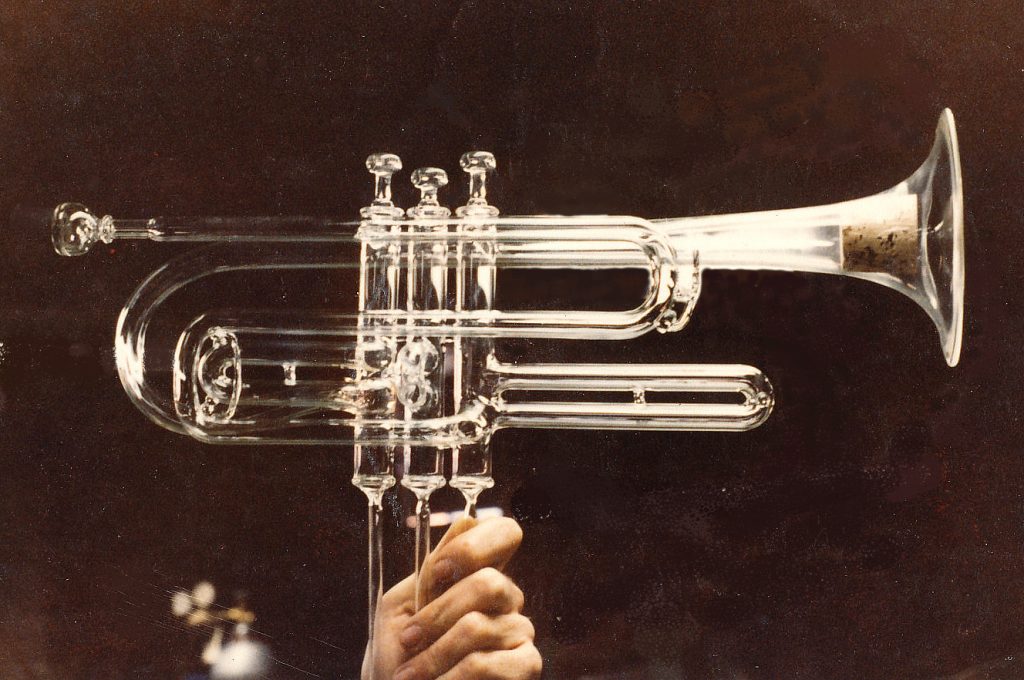
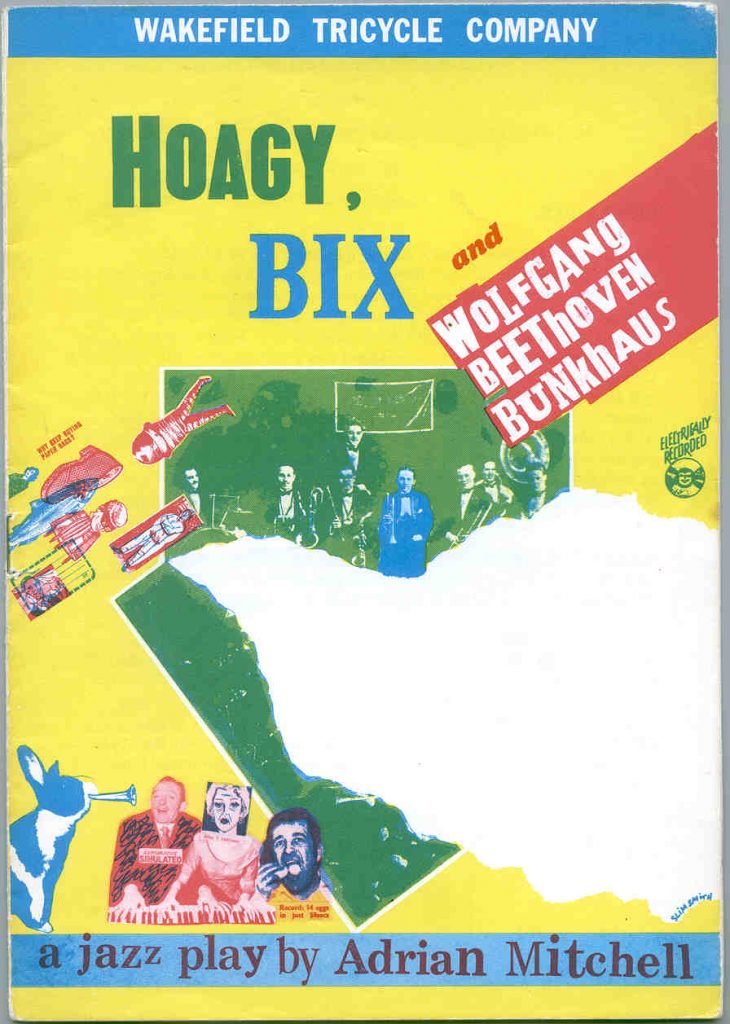
I was coming to the end of my first year as a scientific glassblower. Thurston LeVay, the owner of Glass Instruments, came into the shop and talked with the leadman, John Smith. I saw John shake his head and Thurston went to the second glassblower’s bench and talked with Jimmy Sato. They both looked at me and Thurston walked back and told me there was a guy in his office that wanted a trumpet made from glass. It was for a play about Bix Beiderbecke, a coronet player actually, and he asked if I could make one.

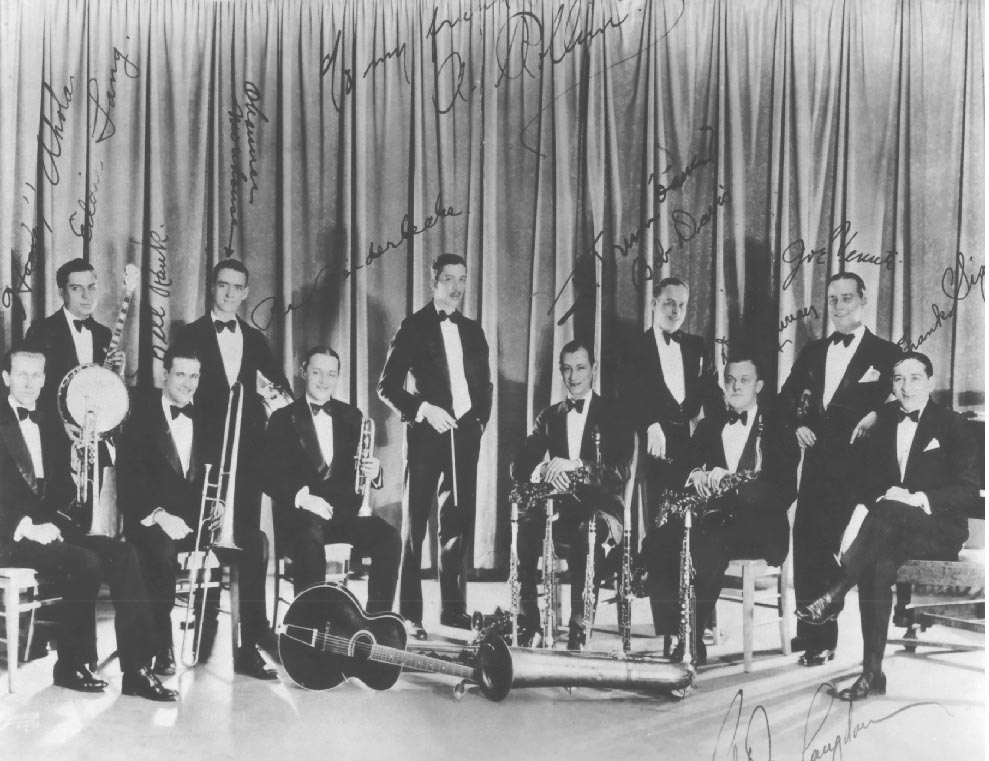
New Yorkers 1927


I had met Thurston five years before, when we were both taking off-hand glassblowing lessons from M. Rhys Williams at his Cactus Glassworks in Claremont, California. Rhys had come to my mom’s workplace looking for fire brick to build a new glassblowing studio in Pitzer College, one of the Claremont Colleges. My mom was the office manager of Pyro Engineering, a small firm that designed and repaired furnaces to make steel (back when we made steel in America), and sold fire resistant brick and mortar and casting materials. I was taking glassblowing classes at Rio Hondo Junior College, so she got a card from Rhys and gave it to me the next time I stopped by to visit.

Traditionally, glassblowing is done in teams. You might have seen it at a fair or on PBS. One person gathers glass from the furnace on a steel blowpipe, while another is adding color or decorating another glass bubble. The gaffer (an affectionate term for grandfather in Italian) typically sits at the bench and finishes the pieces before handing them to the ‘boy’ that takes them off the blowpipe, puts them away in the 900 degree annealing oven, cleans the remaining bits of glass off the pipes and punty rods and returns them to the rack beside the furnace to pre-heat. It is a continuous process; All members of the gaffer’s team are continuously doing their jobs as the finished pieces accumulate in the annealer. They are cooled slowly overnight to relieve the stresses induced by shaping the glass with steel tools and reheating to continue working on a piece.

In 1962, Harvey Littleton gathered a group of ceramic artists at the Toledo Museum of Art in Ohio. He had an idea that they would build a little furnace and blow glass. For fun and as a learning adventure. At that time the only people, worldwide, that had access to molten glass were the workers in glass factories. Whether they were making plate glass for architectural glazing, running machines to make bottles and light bulbs, or making the glassware used in academic and commercial laboratories, only professionals had access to hot glass. Harvey Littleton had a retired glassblower, Harvey Leafgreen stop by and show the workshop participants how to gather the glass, start the bubble and give it some shape. Several of the ceramicists went back to their colleges and studios, built small glass furnaces and started to learn more about glassblowing. That was the start of the American Studio Glass Movement.

American Studio Glass


In glass studios, unlike factories, there is usually just the glass artist (and perhaps an assistant or two) doing all the jobs required to produce a piece. Over the years many unique processes have been created and there has been an explosion of glass art around the world; from the smallest art museums to Las Vegas casinos, people have been enjoying and collecting glass art. Rhys Williams is one of those glass artists. Know for his painterly use of color on the vases and bowls he blows by himself, he has also been teaching at local colleges for over forty years. To help support his private studio in his early days he gave glassblowing lessons and to lower the cost to the student and teach teamwork, two students were scheduled at the same time. That’s how I met Thurston LeVay.

Recognizing that most glass artists were upper middle class was the first time I realized that being working class limited one’s life choices. I didn’t have a trust fund to help me go to art school or start a glass studio (the most expensive art form because of the energy required), so I looked for work in glass shops. I repeatedly asked Thurston for a job, but he told me that they didn’t hire anyone without experience. Catch 22! While managing the local head shop (I think they are called smoke shops today), I met Dick, the owner of the LAPD. Not the Los Angeles Police Department but the LA Pipe Distributor. Through him I met Gene, the owner of the Doobie Incense Company, who distributed incense and made glass pipes and funnels for aficionados of hash oil. This was before drug paraphernalia became illegal in California. I convinced Gene to hire me as a glassblower and soon I was blowing 200 hash oil pipes an hour! I quickly sent up a torch in my kitchen (don’t tell the fire marshall), and at 5 cents apiece I was making ten dollars an hour. It was the ‘70s and I could easily make my monthly rent in a day! When I applied for a job in a factory a couple years later, I could honestly say that I had years of experience with Pyrex glass. Not that it mattered, my next job was making quartzware for the semi-conductor industry. Purity being crucial, this glassware is made from Pure Fused Quartz (PFQ) which requires a hydrogen/oxygen flame to reach the 4,000 degrees necessary to work it. This is the same flame that launches the space shuttle and makes quartz work the most dangerous form of glassblowing. And that’s how I gathered enough experience to get a job at Glass Instruments.

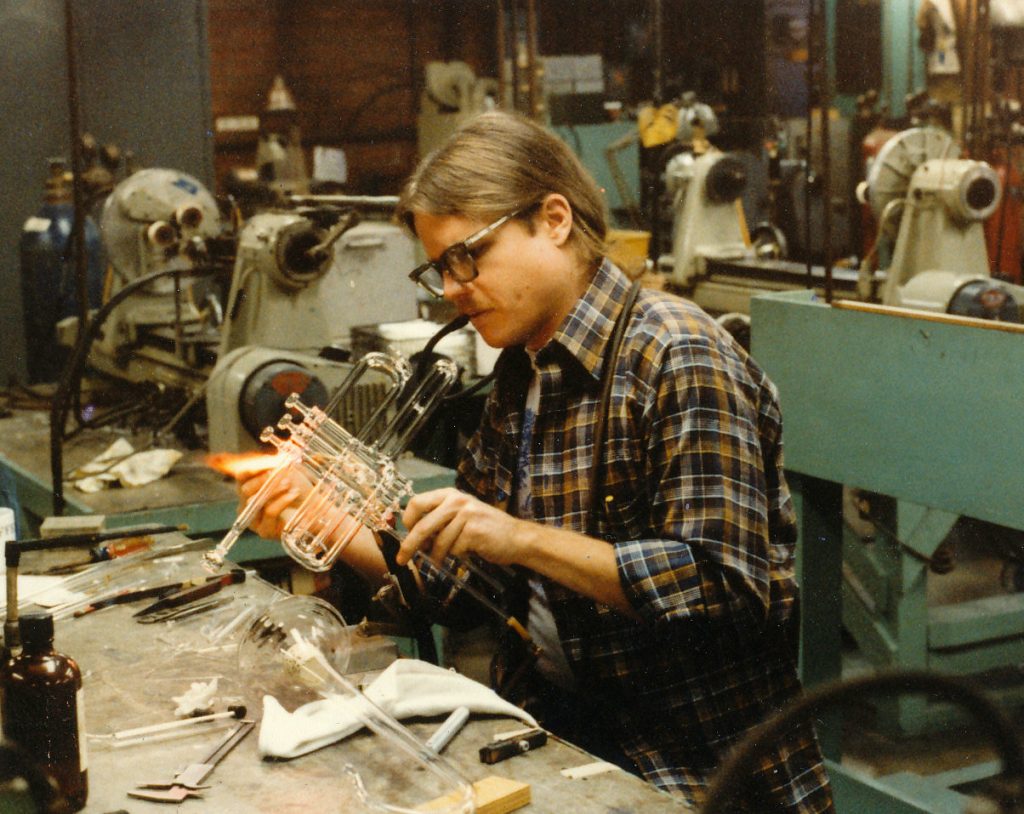
Mark Corbett Wilson assembling Pyrex coronet


I told Thurston I could make the glass coronet and he asked me how long I thought it would take. From my vantage point of being retired, I can see that he was playing with me, but I told him I could make it in a day. Estimating custom work is the hardest part of any small business and I’ve learned to multiply my best guess by two to cover the inevitable unforeseen challenges. Thurston knew that better than anyone, but he let me try to make it. The set designer for the Mark Taper Forum brought a real coronet in as a pattern, I have no idea what Thurston charged him for the glass one. I took some measurements and went to work. The first day went well but I wasn’t finished. Hank, the shop manager, was an engineer and stiff old Yankee that didn’t like longhairs. He started needling me the next morning, reminding me that I had estimated I would only take one day. John, the lead glassblower just smiled but I knew everything was OK when Thurston’s son (the sales manager) came into the shop and started taking pictures. By noon the coronet was finished and put in the annealing oven.

That’s the day I learned I could hold my own in any scientific glass shop.
A few days later the designer picked up his prop and left me two tickets to the show.

I found these on the internet:

The original London program

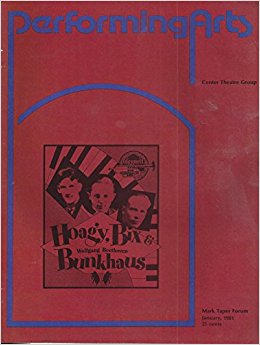
The Los Angeles program

“The following is an almost verbatim transcription of an account kindly provided to me by Richard M. Sudhalter.
The Taper production in Los Angeles came some months later. The stage band was myself on cornet, Dave Frishberg singing and playing piano, Bob Reitmeier on clarinet and alto, Howard Alden (age 22) on banjo and guitar, Putter Smith (younger brother of Carson Smith) on bass, and Dick Berk on drums. The cast included the singer-cabaret artist Amanda McBroom. Mark Robman worked out an interesting idea for staging the musical sequences: every time the Bix character, played by Harry Groener, had to play some cornet, he would stand, horn at mouth, in the spotlight, facing the audience; I would stand, in darkness, back-to-back with him, but costumed identically. Then we would simply revolve, as if on a pedestal, bringing me into the spotlight and him into shadow. I’d play the solo – I remember doing “Singin’ the Blues” and “I’m Comin’ Virginia,” among others – then we’d revolve back, and I’d melt into the darkness off stage while Groener carried on with his lines. The musical side of the show got mostly rave reviews, but Mitchell’s play took a critical pasting. Unfairly, I thought: he’d tried, very imaginatively, to bring off a difficult concept, blending the Weltschmerz of the Bunkhaus humor (even casting some of the episodes as puppet-show plays within the play) with the Beiderbecke tragedy, all against the Carmichael coming-of-age motif. There were things that didn’t work, sure – but I thought then, and still do, that it was a very ambitious undertaking and deserved better treatment than it got.” http://bixography.com/inforrelated.htm#HoagyBix,Bunkhaus.

A few days after my 25th birthday, my girlfriend and I saw Hoagy, Bix and Wolfgang Beethoven Bunkhouse in the Mark Taper Forum at the Los Angeles Music Center. I’d been to dozens of live theater shows, including musicals, but I’d never seen anything like a lead musician standing behind the actor playing a musician and rotating into the spotlight for solos. We waited to see my glass coronet, and when one of the characters said Bix’s tone was as clear as crystal, the musician rotated into the shadows as ‘Bix Beiderbecke’ came into the spotlight playing a ‘crystal’ coronet. That was the moment that I realized that not only could I make anything out of glass, but I could participate in the ‘arts’ without going to an expensive private art college.

“Crystal” coronet for LA production of “Hoagy, Bix and Wolfgang Beethoven Bunkhouse”


I have always wondered where the crystal coronet went after the house went dark. Apparently, there was never another production mounted.

My College Degree as a Digital Humanities Project

Digital Humanities by Craig Bellamy CC BY-NC-SA 2.0


I’
m developing a new model for adult learners so they can avoid the experience I had while trying to improve my skills at a Community College. Combining Self-Directed Learning, Computational Thinking, Digital Pedagogy, Open Education and Open Social Scholarship theories with Open Education Resources (OER), Free and Open Source Software (FOSS) and ePortfolios, I intend to create a free platform for any adult learner to document and reflect on their diverse learning experiences. I think simplifying all these dense and often conflicting learning theories into an approach (Praxis) any adult student can use to design their own self-directed education pathway will be useful. (Heutagogy)

I’ve been working on these ideas for three years, starting with attending a presentation by faculty from Evergreen College in Washington on integrating individual courses’ homework assignments across institutional silos. That led me to eportfolios as a way to collect all types of evidence (digital objects) of learning. Learning about tagging and metadata for discoverability on the internets, I observed the need for a controlled metadata vocabulary to allow searches for emerging patterns. These new ways of looking at one’s learning has the potential to suggest new constructions of learning experiences and new areas of research.

I belong to the Association for Authentic, Experiential and Evidence-Based Learning (AAEEBL) and have attended their conferences, including a session at this year’s 8th Annual Forum on Digital Learning and ePortfolios at the 2017 AAC&U conference in San Francisco. The ePortfolio Forum is jointly sponsored by AAC&U’s project, VALUE: Valid Assessment of Learning in Undergraduate Education; the Association for Authentic, Experiential and Evidence-Based Learning (AAEEBL), the association of ePortfolio professionals; and the International Journal of ePortfolio (IjeP). At this year’s AAEEBL Conference I joined the Technology Special Interest Group and convinced them to take on my idea for an ePortfolio Ontology as their first project. I’ve also joined the Association for Learning Technology, the UK group to “advance education through increasing, exploring and disseminating knowledge in the field of Learning Technology for the benefit of the general public.”

The Hurley Information and Technology Convergence Center at the University of Mary Washington in Fredericksburg, Virginia. Photo by MCW


I
recently realized that my idea of ‘finishing a Bachelor’s degree while using Free and Open Source Software to create a learning eportfolio on my own domain and blogging about it in public’ is a Digital Humanities project. In 2016 I attended the Digital Pedagogy Lab Institute at the University of Mary Washington, VA, home of ds106 and the Domian of One’s Own initiative. I learned about UMW while attending the Digital Humanities Summer Institute at the University of Victoria, BC, where I took Critical Pedagogy and Digital Praxis in the Humanities from Jesse Stommel and Chris Friend. This year I took two courses during DHSI to support my project; ‘Open Access and Open Social Scholarship’ and ‘TEI and Metadata.’ That led me to explore metadata ‘triples’ which led to the concepts of graph databases and ‘faceted’ searches.

Lincoln as a boy reading at night. Library of Congress CollectionNow I want to learn how to integrate a FOSS graph database (Neo4j?) with FOSS curation tools (WP, Omeka, GitHub?) to utilize the power of humanities computing and the semantic web to document and reflect on my learning experiences. And then document my reflections and be able to do faceted searches of everything I’ve created together with everything I’ve curated into my database. I need to learn to appropriately tag all these digital objects with metadata so that they integrate seamlessly with the semantic web. Hopefully this can be automated to a large degree.

My plan is to structure my Metro State University’s College of Individualized Studies Bachelor’s degree as a Digital Humanities project using an eportfolio to document, reflect on and publish my learning. Which tagline do you like: Learning in Public or Learning Out Loud? Or suggest another.


In the Valley of Hearts’ Delight

Bronze bust of DeWissant by Auguste Rodin


I caught a ride to Stanford yesterday to discuss eportfolios with Dr. Helen Chen. We didn’t get a chance to talk at the recent Association for Authentic, Experiential and Evidence-Based Learning (AAEEBL) conference in Portland. My friend had an appointment at Stanford Hospital and being early for my meeting, I walked over to the Cantor Center for Visual Arts at Stanford University. I wandered around the Rodin sculpture garden and then sat on the cafe patio to wait for the museum to open.

Cantor Center for Visual Arts at Stanford University


I signed into the free wifi and checked my phone to see if the orientation hold had been lifted on my account at Metropolitan State University in St. Paul, Minnesota. One morning at the AAEEBL conference Paul Wasko had introduced me to Marcia Anderson, the director of Academic Advising in the College of Individualized Studies at Metro State. She encouraged me to apply that day in order to be enrolled for the fall semester. Metro State was founded in 1971 as a ‘University without Walls’ “serving adult students by recognizing demonstrated learning gained outside the classroom” while working toward their higher educational goals. I applied and during the one day I was home from Portland before leaving for a weekend training in LA, I went online and had my transcripts sent. From all of the eleven colleges I have attended!

Ocean Park No. 94 by Richard Diebenkorn


The email had arrived, inviting me to register for “Educational Philosophy & Planning” the foundation class all Individualized Studies students take to create their personal learning plan. I had been working with Jane Kreuger, my admissions advisor, and Marcia had contacted Dr. Tedder, the Chair of Individualized, Interdisciplinary and Life Long Learning in the College of Individualized Studies, and convinced him to enroll me in his already full class. I went to the website, selected the class (the override worked!), finished enrolling, went to the payment site and paid my fees. I still had five minutes before the museum opened so I called Jane and told her I was sitting on the Cantor Arts Center patio at Stanford and had successfully enrolled using my phone! It was Friday afternoon in Minnesota and classes begin the following Monday.

Glassblowers hand torch


I toured the main exhibit, Creativity on the Line: Design for the Corporate World, 1950–1975, and had lunch on the patio; a Cobb salad and iced tea. (only $20!) I was reminded by the planes overhead, that on Friday afternoons the private jets leave San Jose International Airport every ten or fifteen minutes. I then saw the Modern & Contemporary exhibit and some of the main collection, Object Lessons: Art & Its Histories, before meeting with Helen in her office in Wallenburg Hall.

Hoover Tower and Wallenberg Hall at Stanford University


We discussed my ‘controlled vocabulary (ontology) for eportfolios and the semantic web’ project (the reason I joined AAEEBL and went to the conference in Boston two years ago) and I shared that the AAEEBL Technology Special Interest Group had decided to take on this project. I also shared my newest project: creating a Free and Open Source Software (FOSS) stack for any learner to have the tools to create a lifewide eportfolio, on their own domain, to collect their lifetimes of learning. It all come together after I learned about semantic triples in Beyond TEI: Metadata for Digital Humanities at the University of Victoria, BC, during this years’ Digital Humanities Summer Institute. But that’s another story. Helen asked if this had anything to do with “Linked Data”, so I took out my phone and showed her the picture I had taken earlier that morning.

Recent additions to book pile on my desk


As far as I can tell (I’ll never have a degree in Library and Information Science nor Computer and Information Systems), having an ontology and using semantic triples are the basis for the latest graph databases, being able to discover fellow researchers on the internet and structuring one’s eportfolio to take advantage of ‘faceted’ (semantic) searches. It’s my theory that creating a properly structured database for an eportfolio of one’s lifetime of learning projects and products can lead to perspectives only made possible by computing. These unique clusters of data should help generate the deep reflections that are central to eportfolios function of supporting lifewide learning.

High-intensity short arc mercury vapor lamps used in the production of computer chips


Aint digital technology amazing? I’m glad I spent most of my glassblowing career supporting California’s computer industry. I regret that the term ‘Silicon Valley’ is now being used in place of ‘predatory venture capital.’ What we workers created in Silicon Valley has linked together the entire world (with some areas and peoples yet to be connected). Workers are not responsible for how their products are used, nor who buys the companies we work for. Capitalist predation is a centuries old problem. I look forward to using these new technologies and sharing FOSS platforms with everyone, especially under served adult learners. It was a good day in the (former) Valley of Hearts’ Delight.

Seaweed by Georgia O’Keefe