I am currently two weeks into teaching HISP 470: preservation abroad in Paris. My students have been writing wonderful posts about their experiences, focusing on topics like the rehab of Notre Dame, the variety of churches in the city, dealing with trash and recycling, etc. This post is nothing so serious, though it does discuss […]
Category Archives: Virginia Group
Virginia Faculty Collaborative Group
It’s all fun and games (until you build a city)
I posted semi-recently about the convergence of my nerdery and work interests with the Urban Design Alignment Chart. That was a fun little project, but last fall I joined those two interests more seamlessly. So seamlessly, in fact, that I didn’t even think twice about it until just now. Last semester, I taught HISP471VV: Urban […]
Selling Gen Z on GenEd
Every year, JMU’s more than 80 First Year Advisors have a full day of professional development to prepare for the summer registration of more than 4600 freshmen. This year, I offered some updates about the General Education program followed by these remarks:
I’m often asked by advisors, “How can we talk about the value of JMU’s General Education program in a way that seems persuasive and authentic for this population, Generation Z, at this moment in time?” Yesterday’s IHE featured an op-ed by Roger Ferguson, prez & CEO of TIAA, that got me thinking. Called “Liberal Arts Under Pressure,” it argues for the necessity of a liberal education as part of every single baccalaureate degree.
Ferguson notes the loud, incessant push for more vocationalism in highered, and he acknowledges the practical need to draw clearer connections between college majors and workplace opportunities, but he insists that it’s actually the liberal education portion of a degree that is most useful. “Where does a person learn how to relate to other people? How to communicate a message that’s calibrated for different listeners? How to work collaboratively to solve problems? We learn these things at colleges and universities that offer diverse classes full of diverse people.” His words here are generic—these learning outcomes apply to ALL aspects of life, not just careers.
There’s a tension that applies to first year academic advising: you’re here to help students get started in their chosen major, but you also encourage them to explore, to sample from the banquet of options open to them. Students and parents are very nervous about exploration, however. And they have a right to be nervous: Between 2008-2010 roughly 8.8 million Americans lost their jobs and many jobs didn’t come back after economy rebounded. In my Intro to American Studies class, which attracts freshmen every fall, we discuss the American Dream and how it has changed radically in recent decades. Parents imagine that STEM-y majors will guarantee success, but that’s just not so. Technology is helping to render many jobs obsolete, whether blue collar, white or pink, the kind that once supported a pretty comfortable, middle-class American lifestyle. Here’s some statistics: Out of 10 million new jobs created between May 2012-May 2016, only 5% (541,000) were in computing technology sector. In fact, according to the Bureau of Labor Statistics, the majority of new jobs created were in fields that only indirectly relate to tech fields (what George Anders calls “tech- influenced jobs). If you consult the LinkedIn emerging jobs report for 2018, you’ll see job titles like professional medical representatives, relationship consultants, market analysts, application salespeople, assurance staffers, business support specialists, background investigators, etc.
Books like George Anders’ You Can Do Anything remind us that, despite the prevailing tech mania (Amazon!), the human touch is more crucial than ever. Anders argues that curiosity, creativity, and empathy may be even more valuable than communicating effectively, thinking analytically, and reasoning quantitatively. And it turns out that curiosity, creativity, and empathy—capacities that define the human condition—are just what Gen Z has.
That observation struck me while reading some infographics about Gen Z compiled by Vision Critical, a marketing firm. And yeah, I know it’s a marketing firm, but in important ways we are “marketing” to the first years already, trying to sell them on the value of our program, so why not learn from experts?
Some highlights about Gen Z:
- They use their smartphones more than any other device–more than 15+ hours weekly.
- They especially respond to video storytelling formats; Youtube is their preferred social media platform, where they spend an average of two hours per day. They also prefer Snapchat and Insta over FB and LinkedIn.
- They have an 8 second attention span! So if you want to grab their interest and hold it, be quick.
- They are entrepreneurial-minded, and sincerely expect to be their own bosses after graduation.
- They are very idealistic, very global minded; 60% say they want to change society for better.
These are traits we can address when we talk about the value of liberal education. So here’s my pitch to you to make to them.
- They are global minded. Well, that’s Curiosity. So talk to them about the knowledge of human societies and global cultures that runs throughout the program. Talk to them about the knowledge they need about the physical world we share. (That’s our program’s Cluster two and three, right there.)
- They are entrepreneurial. That’s Creativity. So talk up the intellectual skills and cultural competencies infused in GenEd, the critical and creative thinking, the problem-solving; the verbal and non verbal communication skills of Cluster one. Connect for them the use of the scientific method, the purpose of rigorous experimentation from Cluster three.
- They want to be the change. That’s Empathy. So talk about the dispositions or capacities that GenEd cultivates. Civic engagement, how to be a better citizen, from local communities to global, that’s Cluster four. And inclusivity, well, they especially foster that capacity in Cluster five.
Most of all, emphasize the value of learning in an academic context, guided by faculty who are teacher-scholars, experts in their fields. Sure, they will also take online or distance learning or digital courses. But the human connection is why they come to bricks and mortar university. We can leverage that, too. To repeat Ferguson: “Where does a person learn how to relate to other people? . . . [A]t colleges and universities that offer diverse classes full of diverse people.” We can absolutely reach Gen Z if we understand who they are, what they value. It’s not a hard sell.
Sources:
Christopher Goodman and Steven Mance, “Employment Loss and the 2001-009 Recession.” (April 2011). https://www.bls.gov/opub/mlr/2011/04/art1full.pdf
LinkedIn Emerging Jobs Report, 2018. https://economicgraph.linkedin.com/research/linkedin-2018-emerging-jobs-report#_blank
Ferguson, “Liberal Arts Under Pressure.” Inside Higher Ed. https://www.insidehighered.com/views/2019/05/06/disadvantages-and-dangers-making-cuts-liberal-arts-opinion
https://www.visioncritical.com/blog/generation-z-infographics
Gen Z Looks a Lot Like Millenials …. (Jan. 2019). Pew Research Center. https://www.pewsocialtrends.org/2019/01/17/generation-z-looks-a-lot-like-millennials-on-key-social-and-political-issues/
Notre Dame: Follow-up Thoughts
Since the Notre Dame fire, I’ve had lots of interesting conversations and fielded many pertinent questions. I thought instead of endlessly repeating myself, I should write some of this stuff down. Here goes: What exactly was lost? How do we fix it? The cathedral itself took the brunt of the damage: most of the artwork […]
Reflections on Open Learning ’19

Open Learning ’19 has ended and I’d like to ask everyone to consider writing a blog post as a way to reflect on their experience in the cMOOC over the past few weeks. (Rebecca Clark has already done this, and wonderfully so–check out her post!)
For me, this was my first time serving as Hub Director and that was a pretty daunting task. I’m a pretty good meeting manager and project organizer, but like it’s predecessors, Open Learning ’19 has had many pieces and parts to juggle and is run completely by volunteers. It’s been a challenge to find time to give the cMOOC and the Hub the attention they deserve. But we pulled it off! People came, they learned something, and their networks expanded! At least one person’s education and career may have taken a different path because we were here!
What was new for me this time was taking a lead role in designing the experience. We intentionally pulled in not only established leaders in the field, but the emerging leaders as well. We highlighted new projects and new roles in the realm of open learning. We pared down the experience to what we thought might allow some to make it to the finish line (and some did!). As is common with MOOC experiences, we had folks dropping in and out, but there were some who were there on the first day and are still engaging with the experience in this final week. Any level of participation is valuable and I thank all of you who participated for contributing to the learning experience.
We had fun looking back on the previous iterations of the cMOOC and invited some past participants to rejoin us for interviews, annotations and the reunion Zoom. That was my crazy idea and it turned out to be more fun than even I imagined. Reconnecting in a connected learning experience is a wonderful feeling and I loved hearing about how people took their learning experience from the cMOOC into their work. It lives on through you! I am humbled to know that the Open Learning cMOOC in all its iterations and the Hub have continued to inspire you in the in between times. My hope is that the Hub will continue to do that and I am committed to finding ways to keep it fresh and alive. What struck me about the reflections on past iterations of the cMOOC was the lasting impact that this particular learning experience has had.
One thing you can do to help keep the Hub alive is to continue to use the hashtag #OpenLearningHub when you blog or tweet something that’s relevant to the community we’ve built around all the iterations of the cMOOC. Also consider using #openlearning as well to gain a further reach, but the #OpenLearningHub hashtag will ensure that your voice comes into the Open Learning Hub site for our community to see. This will syndicate your post to the Hub and so it will serve as a way to refresh the content there for all of us. Follow the hashtag to keep up with posts from our community.
I truly look forward to connecting with everyone in the years to come and I’m proud to have played a role in facilitating the Open Learning cMOOC experiences. May the Hub live on through all of us!
And a very special to Gardner Campbell who had the initial idea for the cMOOC and the Hub, encouraged me to move from novice to node to hub director, and hung in there with me through all of this latest iteration. There’s no one I’d rather hang with in my liminal space of learning. Yoda to my Skywalker, you are!
Notre Dame
As I write this, Notre Dame is on fire. I’m not going to show photos of the blaze. It feels like looking at a crime, looking at a corpse. I should be grading right now – sorry students – but I can’t focus on anything except this loss. So I’m going to write, because right […]
Comments on a "networked course"
After viewing the interview between Dr. Rob Blair and Gardner Campbell, I was struck by the appropriateness of using a networked course to teach a class on “democratic erosion.” Involvement of students and educators with different income sources, lifestyles, and political leanings (in terms of regional differences) can only diversify and enrich intellectual discourse.
I was interested to discover what concepts were discussed and in what ways students engaged with them, so I visited the course online. It was just as simple as I had imagined from the interview. While individual instructors design assignments specific to their classes, all students are expected to participate in (if only to attend/observe) political events locally and to blog about their experiences.
The overarching idea that we are all here together, learning and sharing with each other, no matter our differences is central to a democratic system and is key to making open learning work. I loved when Dr. Blair described how he introduced this idea to others. He sent out a few emails to some “friends,” and that turned into emailing larger groups, and those people talked to each other and spread the word, until the Washington Post got wind and published on the project.
If an idea is good, it isn’t likely to stay small. It can become something large and complex and help lots of people. I see open pedagogy as something that is taking shape and becoming a force strong enough to break down old barriers to access to information and education.
Democratic-erosion.com: an Open Pedagogy network
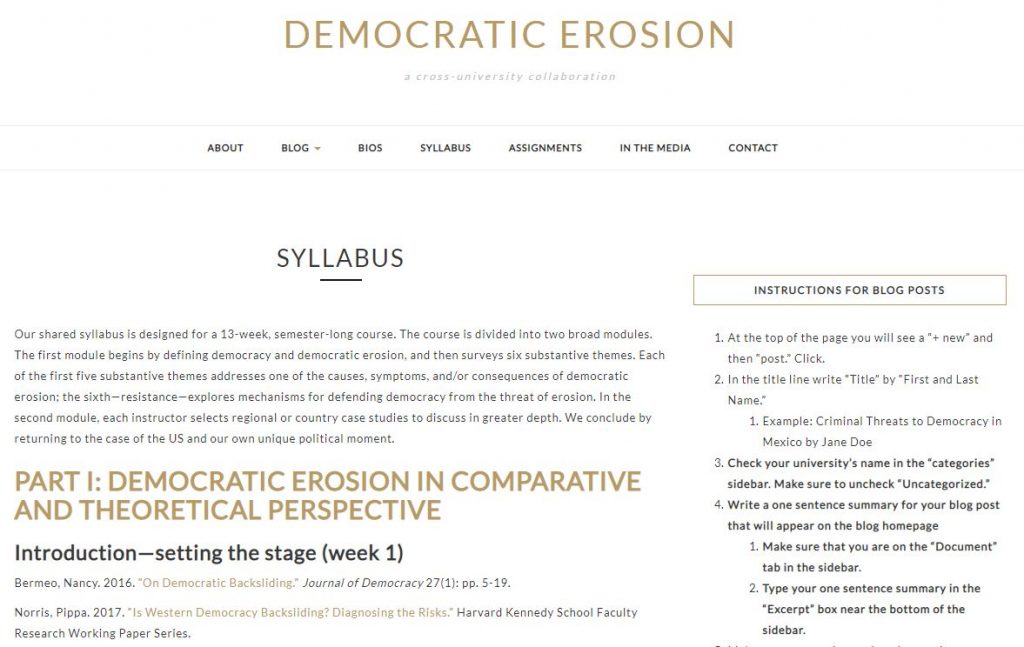
Toward the end of Open Learning ’18, I spotted an article in the Washington Post about a “nationwide college course” about the way democracies decay or erode over time. The Brown University professor who started the course, Rob Blair, began his efforts in the fall of 2017, with three schools in the network. As of this writing, in the spring of 2019, the main course website, democratic-erosion.com, lists thirty-seven schools in the network, three of them outside the United States, as well as one that’s not an institution of higher education, the DC Jail. There’s also an “uncategorized” category, bringing the total categories of participation to thirty-eight. While not all of these participants have contributed to the cross-university blog yet, their presence on the site, and the shared learning resources in the course itself, emphasize the fact that networked learning is at the heart of this ongoing project.
Although the term “open pedagogy” doesn’t appear on the democratic-erosion.com site, I think Dr. Blair’s course and the network built on that foundation certainly deserve to be considered in that light–which is why I immediately contacted him to arrange for an interview.
The interview took place in April, 2018, too late for Open Learning ’18. Nevertheless, while the course network has grown considerably since that time, the course design and the course site are still what they were when I spoke with Rob, so the interview remains relevant (at least in my view). So here, for Open Learning ’19, is our conversation about what I remain convinced is a remarkable example of the value and essential qualities of open pedagogy.
SunLovingLibrarian 2019-03-20 18:58:00
Open Access & OER
The concept of publishing for impact rather than for pay was highlighted in this week’s chapter read on Open Access. Impact is seen as not only beneficial to the larger scholarly world, but to to the author as well, in that they “score career points” (p. 2) and have a better chance of receiving promotions, grants, and the like. So the impact (once measured) is as generous as it might be self-serving.
By chance, I happened to read another article this week, “Widening the Threshold: Using Scholarship as Conversation to Welcome Students to Science,” in which another side to career benefits and publishing was mentioned. In this article, undergraduate students observed that
“lab techs who do much of this kind of work but are rarely credited as authors or invited to participate in larger conversations. This was an opportunity for students to reflect on how people might choose research collaborators, and indeed who counts as a collaborator. It sparked their beginning to think about how authorship credit is impacted by social expectations and biases. This, in turn, can help students see that citation and collaboration are not markers solely of virtue but of social forces.”
This says to me that even articles published as open access are not always beneficial to all creators of the information, or even fair. Previous to this revelation, I had pictured open access material as something morally good. But maybe I should take a different perspective. Maybe morals have little to do with it.
This same article discusses barriers to access and to perceptions of authority based on social structures like gender and race, etc., which further tied in to the discussion on Tuesday among the conference participants in Toronto.
One more related idea that presented itself to me haphazardly to me was during my viewing of a webinar from ACRL titled “Beyond Citation Counting: Metrics and Altmetrics for Demonstrating Scholarly Impact.” The very simple idea was that “the absence of metrics [does not equal] the absence of impact.” I think of this more in terms of OER, where materials can be so remixed that they are almost unrecognizable. Their core purpose may still have a big impact on a large audience, but it can’t necessarily be accurately assessed.
I’m still trying to wrap my head around the interconnectedness of scholarly communication in its many forms. I feel like this blog is all over the place, but that I could map these ideas onto a piece of paper and show myself the big picture. So many factors play into the dissemination of scholarly works, the measurement of impact of those works, and the driving force behind it all: just we humans, engaged in sharing information we find important.
Link to the article above: https://bit.ly/2WakE24
Considering the Internet: Annotation Activity
Though there is that feeling of “vulnerability” in a group annotation activity, it helps to remember that the participants who commented before me offered me insights to mull over before making my own comments. I didn’t judge them negatively; rather I respect their views and appreciate their own public leap. I look forward to sharing more and gaining confidence voicing my thoughts online.