Digital Presence: A Scheduled Chat with Ken Bauer’s Students

Tomorrow, Lee Skallerup and I will be speaking to Ken Bauer’s #iTec Digital Identity course, a five day bootcamp on digital identity for undergraduate students at Tecnológico de Monterrey on…you guessed it – digital identity.  Ken has put together a stunning lineup – Dave Cormier, Bonnie Stewart, Alan Levine, Amy Burvall, and Autumm Caines – and that’s just on the first half of the week.

I’ve heard all of those people speak expertly on digital identity, to the point that I feel a bit superfluous.  However, in the spirit of not giving into imposter syndrome, I’ve devoted a bit of time to thinking about what I can bring to the conversation that is special and uniquely my own.

I started by brainstorming on Twitter with 5 thoughts on my approach to digital identity and when I started that list, it became clear to me fairly quickly that I had a problem with the title of this course.

 I don’t like to talk about digital identity, because it creates an unnatural divide between digital and other forms of identity.  Digital identity is no different than the multiple identities we carry through the day – e.g. our parenting identity, professional identity, peer identities.

Personally, I’ve been working hard over the last five years to consolidate those identities into a balanced, holistic approach to being an authentic human…so to separate out my ‘digital identity’ and talk about it for minutes on end just doesn’t seem to jibe with the rest of my life mission.

I am myself. I am myself in digital spaces.  I am myself in the grocery store, in my living room, in my work cubicle.  Because my digital experience is so completely integrated into my physical activities, I am my digital self at the very same time that I am waiting in the grocery store line, and in my living room, and in my work cubicle. In fact, I workout early in the mornings to exercise videos stored on my google drive. I can be doing one-legged burpees when I see a Twitter notification pop up in the corner of the screen. Therefore, I am my digital self even as I am very much also my physical self. The distinction is meaningless to me.

I prefer to talk about digital presence.

Presence is closely related to but different from identity.  Identity is who you are; presence is how you behave. How you present yourself.  How you engage with the space and others in it.

Digital presence. All of the speakers Ken has lined up are brilliant on digital presence, but I can speak specifically to what it means to behave as a learner in a digital space.

My primary goal as a blogger and tweeter is to learn.  I am a constructionist at heart; Seymour Papert writes that thinking is made sharper – refined – when it is made concrete. Write a thought down and it becomes less abstract while also becoming something that is available for self reflection and social commentary.  I write to make things concrete.  I write in digital public spaces to gain access to social commentary.

I blog and tweet to create a record. We learn by studying our own trails (and the trails of others).  In 1945, Vannevar Bush called these associative trails. Sure, I could  trace my trails through journals and scrapbooks, but I write in digital, public spaces so that I can have access to hyperlinks, tags, filters, multimodal forms of expression.  I write in these spaces to have access to digital affordances. The ability to rearrange posts and create serendipitous juxtapositions is magical, happy learning.

Finally, I blog and tweet to be a part of something larger than myself.  I have written over and over again on personal learning networks (so has Dave Cormier, probably a little more famously) so I’m not going to belabor the point now.  But as I have said before (and so has Howard Rheingold), the key to learning in and on the open web is making oneself useful. There are different ways to make oneself useful. Being a learner is not just about the cognitive stuff; yes, on Twitter I have been known to help people learn their epistemological frameworks and others have helped me learn to code SQL sequences (all true, documentable stories). However, meaningful learning is often emotional.  It feels scary sometimes.  Isolating.  Confusing. Lonely.  I make myself useful by making myself available in digital spaces.  I help people and they help me as best as we all can, because we are human: humans being humans in digital spaces. 

Digital presence as an opportunity to create, record, and share – that’s what I’m going to talk about tomorrow.


The Wedge

A boogie-boarder rides a wave at The Wedge in Newport Beach, California.

The formation of the surfing spot known as the Wedge was a by-product of alterations to the Newport Harbor, which were completed and re-dedicated on May 23, 1936. Before those renovations and extensions of the West Jetty wall, the Newport Harbor was the premier surfing spot on the entire west coast of North America.

Legendary surf music guitarist Dick Dale memorialized the Wedge in an eponymous 1963 instrumental piece, which is included in his Greatest Hits. The Wedge also makes an appearance in Bruce Brown’s The Endless Summer. – Wikipedia

#UDGAgora: Open as in Taco

For the second year iteration of our UDGAgora work with faculty from the University of Guadalajara, the schedule moved to the second day a presentation on openness Brian Lamb and had done in 2015 later in the week.

Since 2003 Brian and I have done enough presentations together that we cannot remember them all, but it’s always something we can do without getting all scripted. But that does not mean it’s not planned. I can remember last year we had not much planned in advance, and the idea in 2015 was jelled with help from Nancy White on the long drive back from a long day. Nancy helped us turn our ideas maybe 180 degrees.

Mainly, she helped us try to step out of the perspective of North American perspectives on openness, and make it more of a question than an answer. Openness was, and is, one of the pillars of this project- all the work participants do in our activities are done in places the world can see, and we hope to have participants experience this in a way that will have them consider doing the same when they do their own project implementations.

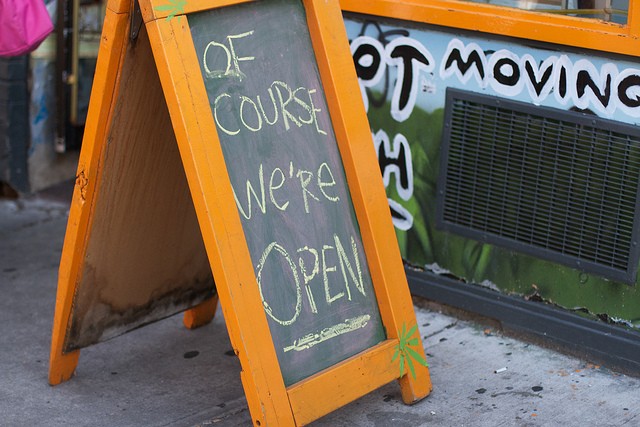
Open Of Course
flickr photo shared by cogdogblog under a Creative Commons ( BY ) license

But that does not mean we want to assume than an assertion than open is good will resonate (a nod to Catherine Cronin). Talking about Openness with a capital O may not mean much. 5 Rs? And what do we know of the culture of sharing, or re-purposing here? We felt we had to go maybe smaller O and relate to the experiences they were just starting to have in our face to face sessions.

The idea we came up with was rather meta, and real. In front of our audience, we would be having this late night conversation of “What can we tell them?” played out. This is one of those techniques Nancy introduced to the group called “Private Conversation in Public”

Last year, in the first week it was called Late One Night in an Obscure Hotel Bar; the following week we thought it better to not promote bar habits, where it was Late One Night in Our Hotel (though in translation it looks like it says “in our hotel bed”!).

This year, because we love our local La Choza Taco stand, and had been there 2 nights before, we made it Late One Night at Tacos La Choza I recorded audio too to go along with the slides.

Like last year, Brian and I were able to assemble the night before the slides in Google Docs. It works well when we are sitting at the same table, each workin on different parts of the slide deck.


The plan was during our talk, if one person said “pass the cilantro” that means “slow down” (we try to watch our fast talking for the same of our Spanish Speaking audience, some of them getting simultaneous translations via headphones) and “I’ll have another taco” means “advance the slides”.

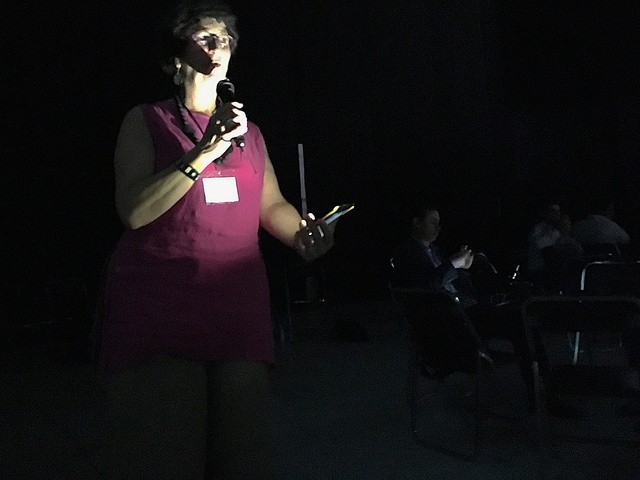
We had them dim the lights, and Nancy introduced us with a spotlight from her phone…

Lights Out for a Session on Openness (?)
flickr photo shared by cogdogblog under a Creative Commons ( BY ) license

More or less what we tried to do was:

  • Start reflecting from our own experiences in openness, mine with True Stories of Open Sharing. But we question ourselves if that kind of story really would mean anything here. Brian then talks about his early experiences with UBC’s Jon Beasley-Murray’s Murder, Mayhem Madness Wikipedia project, conjecturing that being a project about a Latin American author might have resonance.
  • We talk as though we have not convinced each other.
  • So we start talking about the small bits of open sharing we saw in our work here at UDG. Now in 2015, we did this in Thursday after 3 full days, and we had examples. In this version, we had only one day to draw upon, so we also used examples from the previous year.
  • We talk about their early exposure to twitter, and how our hashtag activity is visualized with Martin Hawksey’s Twitter TAGS. And how we managed to see our tag trending that day in Mexico (e.g. showing them there is attention from more than those in the room)
  • Then we go back to the past, to our photo in 2003 when we met in Vancouver, along with D’Arcy Norman, noting there was no twitter then, how our openness was rooted in our blogs. Brian talks about his internship in Barcelona, where he was expected to work on something he had little experience. By writing about this in his blog, he got ideas from other colleagues. Ironically, it was a resource suggestion from Tannis Morgan (who leads this project) that helped Brian run with the project. My example of blogging and external contacts influences, was how my writing on just half an idea for a project got amplified and propelled by a comment from Stephen Downes. The idea here is to demonstrate how if we do not pretend to have answers, but ask questions, that others will assist and influence us.
  • We move towards the project with the ever present feeling among these faculty, who will earn a “diploma” (like a certificate) for this project, is that They Will Be Evaluated. We describe and show how the reports for this project are openly shared in a site we call Comparte (“Share”). We show them examples of open web resources / media created by last year’s participants… with open meaning they are available now as ideas than can be studied, and maybe emulated.
  • Then we close with the photo of the taco shown at the top of this post. Because tacos.

It’s still hard to know how these faculty take these ideas. But this is a long project, they work together intensively for a week, then form small 3 person mutual support groups as well as access an online space. For 8 weeks starting in late August, they will have a an online experience with us where they are starting to build and put into play their project implementation plans.

So we do not expect them to embrace openness because we say its important. We want them to build up a series of small open experiences, incorporate that into their projects, and hopefully then learn about the value of open through their own practice.

The variety, mixing of ingredients, and maybe even the messiness of tacos might be a useful and tasty metaphor after all…

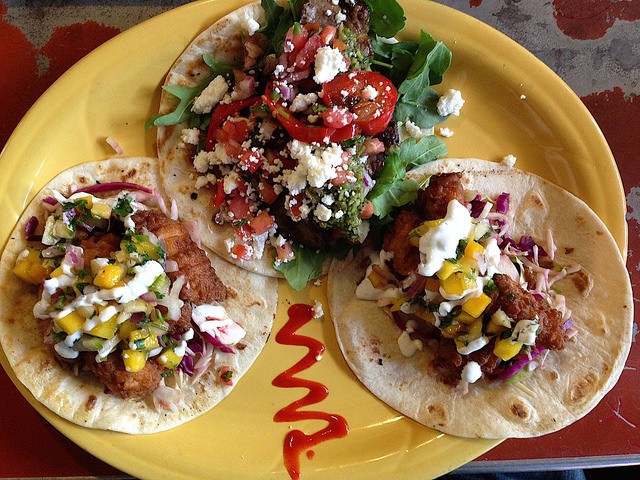
2014/265/155 Maybe The Best Three Tacos Anywhere
flickr photo shared by cogdogblog under a Creative Commons ( BY ) license

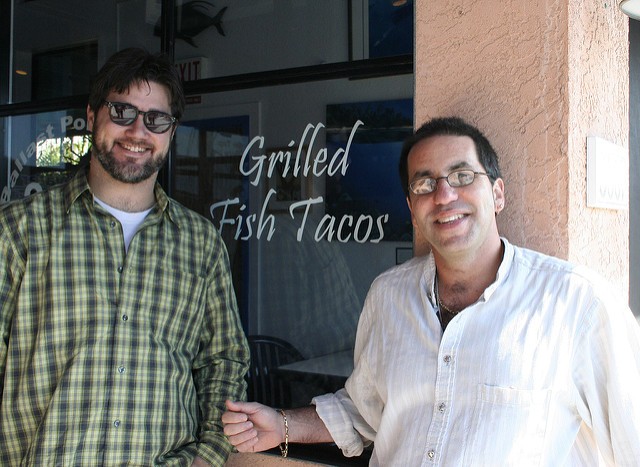
By the way, there is a precedent from a talk we did at the EDUCAUSE ELI Conference back in 2006, also with a taco theme

Yes! This is IT!
flickr photo shared by cogdogblog under a Creative Commons ( BY ) license

Top / Featured Image: an open taco from our favorite stand in Guadalajara (La Choza) sampled maybe the night before this presentation. The photo is my photo of a tuna taco, a flickr photo https://flickr.com/photos/cogdog/27050136383 shared under a Creative Commons (BY) license

The post “#UDGAgora: Open as in Taco” was originally rescued from the bottom of a stangant pond at CogDogBlog (http://cogdogblog.com/2016/06/udgagora-open-as-in-taco/) on June 20, 2016.

The network is the deliverable