Tag Archives: Uncategorized

For-Profit Involvement in OER – Part 5

 Below is a re-posting from http://developingprofessionalstaff-mpls.blogspot.com/2017/01/for-profit-involvement-in-oer-part-5.html

Wednesday, January 25, 2017

For-Profit Involvement in OER – Part 5

This is a continuation of a discussion from Part 4


In a blog post yesterday, David Wiley said:


“The conversation needs to be larger, the sense of urgency needs to be greater, and the vision and imagination of what’s possible needs to be far, far broader.


PDFs aren’t going to get us there. We need more efforts to provide the benefits of publishers’ “adaptive” systems while honoring and enabling the values of the OER community (e.g., the 5Rs and open pedagogy) and more support of these efforts.


The tl;dr (sic) is this: faculty (who make the decision about what resources will be used by students) love these systems, and with good reason – they can make things better for students and faculty alike. If the OER community doesn’t recognize that and start providing and promoting viable alternatives to publishers’ platforms, the best possible future for OER is being locked down inside a Pearson MyLab playing second fiddle to proprietary content. No 5Rs and no open pedagogy.”


Earlier in the post he said: “And don’t even start trying to explain how the LMS is the answer. Just don’t.”


I responded, ignoring his exhortation: “LMSs properly supported, are very good ‘platforms’ for all kinds of assessment and analytics. And, more importantly, control of the LMSs can remain in the hands of the faculty where it should be, if they choose to exercise that authority. Of course, if faculty are only interested in the easiest way to do things, well, then, they can always pay someone or have someone else pay for the difficult parts of teaching and learning.”


David responded to that by saying- “This is demonstrably false. Just taking the first example that comes to mind, LMSs cannot do Computerized Adaptive Testing no matter how they’re supported.”


I’m not sure where to start. Arguing that we shouldn’t consider LMSs for OER because LMSs can’t do CAT is a problem for at least two reasons: First, CAT is usually not OER in practice, today. But, secondly, LMSs can indeed to CAT if you want to use them for that.


David then went on to propose that I read what he’d written about LMSs and CMSs and OLNs back in 2009. I generally agree with what he wrote in 2009. Faculty adoption of all of the interactive, collaborative, student centered features of an LMS is a slow and extremely tedious process. We wrote about that in our book chapter and 2014 HLC Conference Best Paper describing such an initiative. David would do well, I think, to consider the work of one of his colleagues at BYU, Charles Graham, who we reference in our work. Graham, et al. point out that implementing a hybrid or blended system in an institution requires a whole lot more than was considered by David and Mott in their 2009 paper.
David clearly understood that there are a whole host of issues to consider as faculty change the very nature of how they do what they do. David’s approach regarding the task of transforming the way faculty approach how they interact with students in the teaching and learning process was not to show faculty how to do it. Instead, he created a for-profit company where OER is housed in an LMS that is connected to the institution’s LMS via LTI. The advantage to faculty is that they don’t need to learn how to install OER in their LMS courses and learn how to use the new, interactive, collaborative, student centered, wider community connected features of their LMS, or learn how to manage the analytics that are available with all current generation LMSs. The advantage to David is he gets to have a for-profit company that charges the students of those faculty who don’t want to learn how to do all of that difficult ‘platform stuff.’ Sure the students save money compared to what they would pay if they bought the books from proprietary publishers, but the faculty stay ignorant about how to really manage learning using a learning management system. Ignorant faculty are good for profit making.

One for the hippie hub

You better think (think)
Think about what you’re trying to do to me
Think (think, think)
Let your mind go, let yourself be free

Think by Aretha Franklin and Ted White

Our “flower child hub director, Gardner” sent a nice message reminding me to do some OpenLearning17 blogging, so here goes.

When I went back to look at Vannevar Bush’s “As We May Think” a few days ago, I was happy to see a few annotations from some former ds106ers, from when I tried to get them on the annotation train. We also used the article back when we did The Internet Course, and I did a primitive Cmap breakdown of some of my thoughts and reactions to it.

One of the things that struck me about it was Bush’s background. He founded defense contractor behemoth Raytheon, headed the Office of Scientific Research and Development during WWII, and was instrumental in the creation of the National Science Foundation. He was pretty much the embodiment of the military-industrial complex in his day. But as windham notes in annotation, Bush’s “humanitarian optimism” inspired both the essay and the many minds behind the development of the Internet.

He recognized that there is something more important than the money to be made – humanity over profit. I imagine that might have been obvious in the wake of WWII, but it has long since been forgotten in military-industrial complex, and it no longer seems to matter to the powers that be in information technology. The Web was meant to connect people, in Berners-Lee’s view, rather than to disrupt them. A way to let your mind grow and let yourself be free.

People walking around everyday
Playing games, taking score
Trying to make other people lose their minds
Ah, be careful you don’t lose yours, oh

It can be hard to maintain that sense of humanitarian optimism in this age of disruption, creative destruction, and weaponized information. When I looked up the lyrics to Aretha’s song, the third line above stood out to me – the definition of gaslighting. That’s quite the opposite of informing, isn’t it? The tool that Bush envisioned and humankind built is not being used to connect people, or to organize information, or to help us think better, but quite the opposite. This has to do with the social, political, economic and technological environment we have created and the way information is generated and distributed within it.

If we work to understand the hows and whys of information creation and flow, what I would call information literacy, then presumably we will be better able to review our shady present. That would elevate my spirit. Until then, there’s always Aretha:

Are We There Yet?

abstract-air-backdrop-1755967_1280

First off, I’ve had yet another library school connection. I’m not sure which class I read this article in, but somewhere along the line in one of my classes we were assigned this article. At the time I remember being impressed that someone would have such a good sense of the future of information, though a lot of the mechanics ended up being more sophisticated than he thought they’d be what with the Internet and the advances in computing. I’m a science-fiction reader, and I’m often similarly impressed with what older science fiction authors get right about the future. Of course, they often also get it wrong. I don’t know whether to be amused or upset that male science fiction authors of the 50s and 60s could not imagine a future in which women were not housewives (see Fahrenheit 451 and Do Androids Dream of Electric Sheep?).

I named this post “Are We There Yet?” because it seems to be that the seamless access of information and ease of annotation is lagging. As Bush notes, we have gotten very good at storing information and taking less and less space to store it cheaply. However, access and annotation are still regular snags. Search algorithms have a long way to go for research purposes. When I teach students how to use the library, knowing that they will be frustrated by the ever-present clunkiness of databases, I try to get them to see that the purpose of their searching is different. In a Google search, often the first web page or two will do the trick. Who ever scrolls to the bottom of a Google search results page? Who goes on to the next page? More likely you’d rerun the search with different words. The idea is that a web page or two will meet the need for information. Research for scholarly purposes ideally involves a more exhaustive search, and Google doesn’t handle that well. They prioritize precision over recall. A library database prioritizes recall over precision. As of yet having both done well isn’t possible. So, while the information is out there, still in traditional article form for the most part, it’s not simple to retrieve effectively.

Besides access is annotation. The research indicates that students still prefer print books, and the ease of annotating is often cited as a reason for that preference. Digital versions of annotation tools exist, but they are still awkward and limited. They also vary based on which e-reader software/hardware is being used. I feel there is a long way to go toward making annotations and links between data easy to achieve in the digital realm. Ultimately, while students prefer print, libraries generally see students use e-books more than print books. I don’t think this means the students were misleading us when they said they prefer print. I think convenience wins over preference and the student at home that wants to use information from a book for an assignment is going to use the book they can access immediately.

My musings are mainly concrete and concerning the technology we deal with right now. I’m aware that all of this assumes a scholarly communication environment that has perhaps stagnated, and some of the “but this is the way it’s always been done” needs to be challenged. My impression is that the challenges are happening – the movement behind this course is one example – but they haven’t hit a critical mass yet or gained full support from academia. When I reach the end of my career, 40 years from now perhaps, it will be interesting to see what has changed and what has stayed the same.

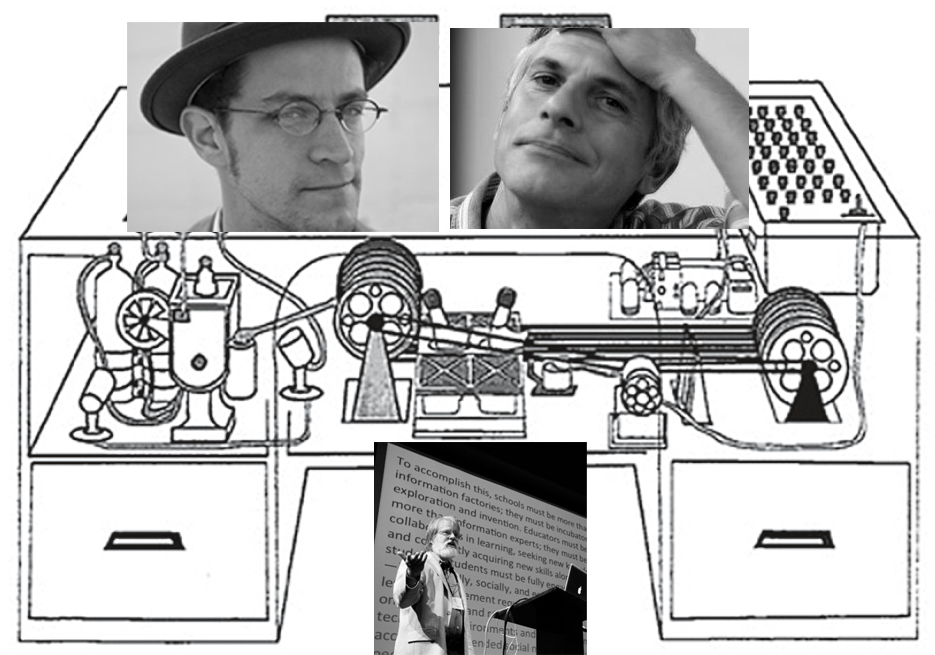
“As We May Think,” Annotation, and Liberal Learning: a conversation with Hypothesi.is’ Jon Udell and Jeremy Dean

Our Faculty Collaboratives Open Learning ’17 cMOOC is in its second week! Today I had the great pleasure of speaking with two leaders at Hypothes.is: Jeremy Dean (Director of Education) and Jon Udell (Director, Integrations). Our topic was Vannevar Bush’s epochal “As We May Think,” especially as seen through the lenses of online annotation and liberal learning. Click on the image below to experience our conversation.


As you’ll hear, Bush’s phrase “associative trails” appropriately wound its way throughout the conversation. I encouraged Jon and Jeremy to reflect on robust resource linking across collaborating minds as well as the more idiosyncratic and sometimes apparently “random” associative trails that are forged within our individual brains. I had probably registered this distinction myself in one of my many earlier passes through this endlessly fascinating essay, but today the distinction became newly vivid for me, and helped me understand areas of connection and disjunction within the essay itself.

Since a classic blog-based distributed conversation brought us together many years ago, I have interacted with Jon on numerous occasions. Some of his own associative trails have grown familiar (and dear, I must say) to me, but he’s always full of surprises, too, and I remain consistently challenged and stimulated by his ongoing work with the Web as a platform for co-constructed knowledge. I have been fortunate to spend more time with Jeremy lately, learning of his literary and musical background, and learning much more about his work with educators who are adopting Hypothes.is in their teaching as a way of helping students learn to scaffold and extend their own learning. It’s fascinating to see two people who are quite distinctive in background and personality nevertheless strongly united in their commitment to building a better world out of deeper, more thoughtful, more educated, and more robust human interaction.

I’m confident you’ll detect my own enduring concerns and commitments here as well. As I reflect on today’s conversation, I can see how my own work, and perhaps my personality as well, are situated almost at the meeting point between Jeremy and Jon. I hope that middle-ness helped to elicit the uniqueness, and the tremendous connections, these two thinkers brought to bear today. My thanks to both of them. I hope we can do this again, and soon.

As We May Write

I live in a fairly rural town at the start of the Northern Neck of Virginia. Some argue that we’re the “Gateway to the Northern Neck,” as our welcome sign proudly states. Regardless of the term we use, geographically we’re situated at a bend in the Potomac River before it feeds into the Chesapeake Bay. I bring this up because the reason I, and around 70% of people I know, live in King George is that it’s home to Dahlgren, a Naval Surface Warfare Base (from what I’m told the bend in the river makes this spot ideal). I’m not qualified to say this but something tells me that if Dahlgren were to cease to exist, King George would just about be finished, too.

While my dad has since changed career paths, my family was moved to KG in the early 90s when my dad got stationed here. After retiring from the Navy, he worked with government contractors outside the base doing basically the same thing he would have been doing inside base. My dad used to joke that he could never wish for world peace because he’d be out of a job. While reading the beginning of the assigned reading for this week, I had this in mind. While my family is not directly dependent on the base anymore (although I’m sure I could find several ways if I let my mind wander), just about all my friends’ parents, the parents of the kids I babysat, and the spouses of most of my teachers growing up depend on the work from the base in one way or another.

I have often asked the same question Bush poses at the beginning of the text, although admittedly not as thoughtfully and clearly: what are the scientists to do next? While I think the need for war-related research isn’t going away anytime soon, it’s cool to know that people were asking this question almost 75 years ago, the same way I’m asking it now (yay progress). I’m fascinated by where Bush’s mind goes with his answer, so I think I’ll just dive right in. My response will be organized via association, rather than an index, as per his suggestion. 😉 .

I love that Bush explains how ineffective a car would have been to make in Ancient Egypt. I think of all the technology that I’ve thought “oh well, that’s more effort than it’s worth” without thinking of the possibilities it could hold. Often times, the first edition of a tool takes longer and is more difficult to use than using no tool at all (in the example of writing vs typing). However, once we get to later editions we cannot imagine our lives without these tools. I think sometimes it’s difficult to think so long term and remember that what we’re working on now, might be of some use down the road. When I was younger and I tied two rakes to the back of my Barbie Jeep to rake the leaves in the driveway (a project that took twice as long to construct as would have taken to just rake the leaves by hand- and worked about half as well) my dad explained how his job as a mathematician was all about spending more time in order to find the easiest way to do something. The first time around, these tools we spend so much time making are often ineffective in terms of time and resources, but they open the door to making the tasks easier in the future. Since I’m only 22, I can hardly remember a life without internet, but I’m assuming when people first started using it, while there was excitement for the future, there was also a question of if it was worth it.

This way of thinking can be directly applied to much of what we do in terms of incorporating technology into higher education. Although the internet is pretty much used across the board, there are other technological tools that I think professors and universities are slow to adopt. It can be difficult and even seem forced when we try incorporating these new tools, but with time, it might be hard to imagine a college education without them. I think this falls in line with accessibility of ideas.

What I really love about Bush’s vision for the future, is the idea of making things permanent. I think that the concept of permanence is partially what compels us to write and to speak. We have an idea and we want people to have access to that idea. While having an idea is great, if we don’t remember or share this idea, it’s not of too much use. If we never act to make the idea a reality, it’s even less useful. Additionally, if we can store an idea but don’t have any way of getting to it, there’s no real reason for it to be stored. We feel the need to share our ideas and give them some permanence.

Whenever I think of the internet, I think of it as both permanent and temporary. Teens are warned to think before posting as “nothing ever really goes away on the internet” but at the same time, if the internet stopped working one day, most information (regardless of importance) would be lost forever. We currently are saving and sharing our ideas when we write and present our research, when we tweet and post our thoughts, and when we comment our opinions. We have shared our thoughts with the world and they are timestamped so that everyone knows when we had them. But is there a way to improve what we’re currently doing now? How do we file away and share the information in a way for others to easily search and find these thoughts? And by that I mean, how do we share our ideas, our knowledge, and our passion in way that’s easily accessible?

I have no clue, that’s why I’m trying to spend more time reading everyone else’s thoughts rather than writing my own, but I don’t think the answer is super simple, just because something as incredible as the internet exists.

While this article was written almost 75 years ago, with a few tweaks it could read like it was written last week. Although we have the internet now, and almost everything he envisioned for the future seems to already exist, the need for a better way to share information is something we can still work on. Now the problem seems not to be the way the information is organized, but how we make it accessible for others.

Lastly, On a practical note, I can’t help but wish for this idea of the memex exactly as Bush described. I have a series of folders on my laptop labeled “screenshots and such” that I’d conservatively estimate have anywhere from two to three thousand screenshots in them. I’ve spent hours upon hours organizing these screenshots into folders (which could still use quite a bit more organization), so the idea of a device in the future that could organize everything for me sounds exciting. Maybe it’s time for me to get started making my next tool.


Openness, Connection, Scholarship, Knowledge Development, Learning

[1152 words]

I’m still pondering the relationship between openness and connection. There are significant ways in which the two concepts align well with each other in the domain of learning, even if they do not overlap semantically. That is, open learning is generally going to be characterized by a relative ease of connection in many forms. Connecting new information or concepts to previous learning. Facility of connecting reflective insights to hard data, or old writing to new writing through easy access to stores of data or to the archive. Connections between learners in different regions or different time zones. Connection and collaboration over great distances.

There are also significant ways in which one can also see some tension or opposition. One of those lies in the disciplinary rules for knowledge development and in the parameters and institutions that have evolved for verification and control of that intellectual work. Let me offer a brief historical sketch. As humanist intellectual traditions emerged from the Renaissance and evolved through the Enlightenment, the development of ideas, the formulation and verification of models was a relatively open process. Anyone who felt qualified and able to do so could contribute to the enterprise, which was constructed around sharing information, theories and arguments through print media, mostly books. Those media were “accessible” more widely than manuscripts and personal letters and notes had been. However, that “openness” was quite relative. Very few persons, almost exclusively men, could afford to make the steep climb toward access to that free exchange of ideas. One had to be literate and one had to have the resources to buy or borrow books, assemble a personal library or be in a position to access someone else’s personal library; additionally, one needed leisure time to read and reflect; finally, one needed a modicum of social-intellectual reputation to publish or the support and influence of an influential patron or a printer. Generally speaking, there was no such profession as “scholar” or “researcher.” One could, however, be an erudite writer, like Voltaire or Samuel Johnson and live by one’s pen and by one’s reputation. In the eighteenth century, writers often survived thanks to patronage, but increasingly over the course of the nineteenth century, writers were able to earn a living directly from their writing. That said, even with growing access in the nineteenth and early twentieth century to literacy, coupled with the power of publishing one’s thoughts, theories or research, only those with a certain education and a certain socio-economic standing had access to books and to the “connected” conversation of the erudite.

In the nineteenth and twentieth centuries, knowledge production, teaching and learning evolved significantly. The influence of religion in education (and as a moral authority) waned somewhat and secular education gained significant in infuence. At the same time, thinkers increasing channeled critical inquiry and publishing into disciplinary channels. Areas of knowledge that that had previously been pursued and developed by amateurs and by men of leisure and intellectual inclination came to be formalized as history, philosophy, mathematics, physics. Openness continued to exist in the form of a relatively accessible channels of publication and distribution, school and public libraries and through increasingly rapid personal communication. To assure the validity and reliability of information and conclusions developed within those increasingly well-defined areas of knowledge, persons (mostly men) who recognized each other as experts inthe domain applied rules and criteria to the relatively open discussion of hypotheses, methods, experiments, reflections and conclusions. Over time, scholars and arbiters of publication further clarified and formalized those rules and criteria. The authority of postsecondary institutions rose and the production of knowledge under their aegis came to be highly regularized. Disciplines and disciplinary academic publications (journals and presses) structured , validated and assured the quality of knowledge production and knowledge dissemination. By the late twentieth century, though, it seems to me that that pendulum had swung a bit far in the direction of verification and control (especially control). Disciplinary structure overshadowed much of learning and it influenced even the relative standing and level of power of sectors within universities.

What is more, discipline-focused publication became an industry unto itself. The very profitability of that enterprise spurred the rise of aggressively for-profit institutions (publishers, disseminators), who took advantage of the publish-or-perish incentives of academia to harness both relatively inexpensive peer-review labor and large streams of unpaid-for content. Institutional dependence on peer-reviewed publication to evaluate scholars and academics’ need to appear in print (or to bolster their h-index or other metrics) as a demonstration of “productivity” undergird that economic model. Organizations like Elsevier (“Empowering Knowledge / Knowledge Uncovered“) depend on essentially free academic labor and content, on the one hand, and, on the other, scholars’ need to consult scholarly publication, some of which is available only in exchange for a costly (in some cases, exorbitant) subscription or per-use fee.

There is a paradox here. On the one hand, intellectual work and the production of knowledge is far more democratic and more widely shared in the twenty-first century than it was in the 1750s. Additionally, modalities of communication have arisen that make the sharing of ideas and communication almost instantaneous. The internet has greatly facilitated connection and shared understandings among scholars. There is greater openness and greater communication. On the other hand, there has been a significant trend moving knowledge production in the direction of closure and restriction. The rise of disciplines and the enforcement of disciplinary standards in academic publishing has, in large measure, discouraged cognitive exchange and erected barriers to communication between disciplines. There are countertrends, of course, but the gist of the evolution has been toward ostensible “rigor” in the the genre and style of writing in peer-reviewed journals and a restrictive monodisciplinary focus of particular journals. Additionally, the economic model that makes access to journals extremely costly restricts functional openness.

Reaction to copyright and DRM restrictions and constraints and high fees led to various openness or open access movements, statements or trends, like the BOAI, Creative Commons and SPARC and various open science initiatives. If there is a liberation in these efforts at openness, it is not only relief from high-cost access to scholarly work, but it is also in the way in which open online scholarship has rekindled connection across disciplinary lines. Digital humanities, for example, often blends over into statistics or information science or data visualization. The work of sociologists and literary theorists may appear in close contact, inviting comparison. Biologists, geologists and anthropologists may offer converging perspectives on issues like climate change in a single scholarly piece. There are ways in which “open” also invites “connection.”

There will always be a tension between the insistence of some on disciplinary rigor and discipline-specific doctrine and the refusal of other scholars and learners to be contained within a single well-defined box. It is this latter, the pulling together of openness and connection in digitally mediated learning that gives me hope and motivation.

#openlearning17

-rrdaniel2


The open question

dark-1836961_1280

When I realized one of the authors of this first article is Jeffrey Pomerantz, I laughed out loud. Dr. Pomerantz was my thesis advisor when I was in the library science program at the University of North Carolina. Thankfully, I have no bad memories of that process, so I have not been traumatized by reading an article co-written by him.

While I recognize that discussions about “what is open?” and “why open?”, etc., etc., are necessary, I am always a little bored. I am not the best abstract thinker. I find it much easier to be concrete and active. Articles like this one feel like academic exercise that will never end. Other academics are free to engage in that discussion. I’ll be over here for when something needs to be done, thanks!

One way in which the concept of “open” and what it means exactly matters for me is as a librarian working with e-resources. Resources provided by the library are not “open” in the sense that they are free to everyone. But they are effectively free to the students and faculty who don’t feel the purchase. They have been available for a very long time, and faculty are typically free to use them to build a non-traditional curriculum.

Overall, I’ve thought that education is an appropriate space for valuing openness. Gaining knowledge, creating knowledge, sharing knowledge. The values of library science especially match up well with these ideas. One of our ideals is that information would be accessible and free to absolutely anyone. Socioeconomic status should never be what determines whether a person can access the information they need to be a good citizen, parent, caretaker, friend, partner, etc.

Openness?

[644 words]

Plunging into the content and the spirit of the cMOOC #openlearning17, I’m thinking at length about “openness” and its many resonances. And, to be quite honest, I’m posing some hard questions during my interior conversation, as I think about the future, the future of education in general and my own life years from now. (N.B. To some degree, there will be some overlap between this MOOC and another that I’m working on, “What Future for Education?” — taught by Clare Brooks and created by the University of London, UCL Institute of Education.) Another “life thread” that interjects itself into whatever I’m weaving here is deep distress about the Zeitgeist (triumphant extremist populism, nationalism, racism, disregard for truthfulness and ethics, factionalism).

Let me start with the last element (concern), then move on from there. For obvious reasons, I’m worried. My country is entering into what promises to be a phase of extreme conflict, dissension, instability, strife and extreme disregard on the part of many poitical leaders and their followers for fellow human beings. While I’m concerned for the well-being of the vulnerable and marginalized in the U.S., while I’m taken aback by gag orders and by blatant lying, and while I despise the way in which leaders in power want to jettison environmental protections, reject climate-change treaties and ignore scientific evidence and muzzle conscientious scientists and public servants, I’m also very selfishly wondering about my own prosperity and my retirement portfolio. Will I be able to retire a bit early? Or will the economy melt down and diminish my retirement savings and force me to continue working for many more years to come? Will I never be able to retire? More importantly, will this horror lead to armed conflict or destruction of the social ecosystem that I know how to navigate?

In this context (one that I recognize is far harsher for folks in other countries or regions), I find it a bit harder to commit to “openness” in the sense of devoting time and talent to the creation of resources for unfettered distribution, with little or no proprietary control or benefit. My fear and anxiety make it harder for me to feel generous. The dire threat of this social-political moment makes me wonder if I need to hold back and preserve the resources of my work and talent, to invest them in my own future good. Should I not seek maximum benefit, eventually, by selling my creations for top dollar? Of course, it is possible that I’m deluding myself about the value of my cognitive powers and my efforts in knowledge-creation, learning management, or the crafting of educational products. Still, I suspect that I may have a few good ideas, strategies and frameworks to offer. I may be able to help improve the quality of learning, both now and for the future.

So, influenced by angst and concern for the social, economic and political future of my country and the world, I ask myself whether or not I should try to shape these potential contributions to a more commercial and self-serving purpose. Should I craft appealing products, market them, sell the heck out of them? (And to heck with openness!) Except that, in the end, that’s not really who I am. Despite it all, I am determined to continue to create high-quality frameworks, concepts and materials in collaboration and in dialogue with colleagues and fellow-travelers.  In some cases, I may make my stuff broadly available as OERs. Still, with my sympathetic nervous system constantly stimulated by what I see and hear daily, it’s hard to remain dilated, relaxed, generous, vulnerable and open — in the best senses of that last word — connecting freely and meshing with a process that draws me out of my self-centeredness. (Hmmm… I can’t help but wonder: Is “openness” functionally opposed to “self-centeredness”?)

Sorry for the excessive length of this post.