When discussing free software and open access I think that personal property rights are and ‘who’s going to pay for that’ are questions that come up frequently.
As Stallman writes, “you should think of ‘free’ as in ‘free speech,’ not as in ‘free beer’.” (Free Software Foundation, 2014).
Wow, this clears it all up for me. We are sharing knowledge, not giving away our beer supply.#Openlearning17.
This blog’s initial reasons for existing are contingent and instrumental. Its purpose will evolve over time, undoubtedly, but for the moment, it is primarily intended as a tool for participating in the Open Learning 17 cMOOC.
Currently on sabbatical, I have spent a great deal of time thinking about teaching, learning, education. I am hopeful that these reflections will help me better support my students’ learning and allow me to empower and equip them — and myself — for living and working in the twenty-first century. Despite cultural and political forces to the contrary, I am hopeful than openness — open exchange, open access, clarity about power relationships, verifiable accuracy in the public record, freedom of connection, freedom of speech, open-mindedness — will provide humanity with the tools it needs to better understand our universe, to help us build more effective, more helpful, more constructive and more sustainable societies across the planet that allow all human beings, indeed, the biosphere as a whole, to survive in diversity and to thrive.
Open learning, connected learning, collaborative learning, critical learning are all part of what I hope will be an emergent paradigm that points toward increasingly collaborative, satisfying, peaceful and sustainable human cultures. It is not an exaggeration to say that I believe that the long-term survival of Homo sapiens sapiens and of all sentient species depends on a radical shift that must include changes in dominant notions of education and learning.
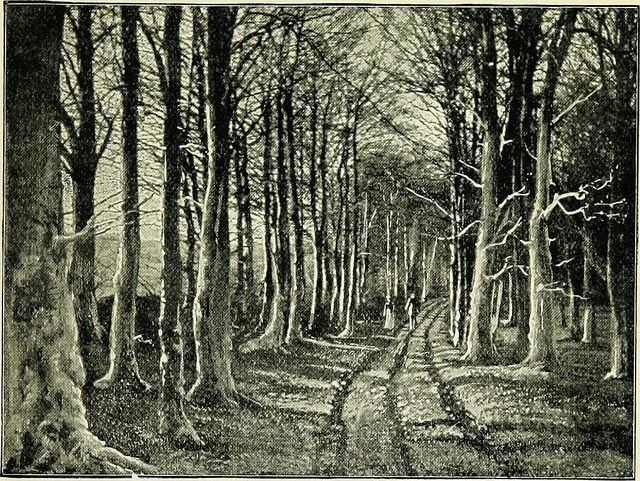
Image from page 30 of “British sanatoria for the open-air treatment of tuberculosis : with numerous illustrations ; [reprinted with additions and alterations from the “West London Medical Journal.”]” (1899)
It’s been a while since I joined a MOOC. Mostly that’s because I recognize that I don’t have the time. #OpenLearning17 is hard to pass up though, because of the format, the great people involved, and the topic, which means a lot to me. Hopefully I will find some openings in my schedule so I can put something in and get something out of it.
I’m thinking about my journey to open education. I’ve always been a heavy library user, and the library represents a form of open education although I never thought of it that way. Fifteen years ago or so I enrolled in a distance ed masters program in digital printing and publishing. It taught me to get out of the printing industry, but I learned some other lessons as well. I noticed that almost all of the tools, readings and materials we used were freely available online. What we were paying for in the program was mainly the selection and organization of the materials, and some occasional feedback and interaction. Thinking there might be more of a payoff in learning about the selection and organization of information, I dropped that program and entered one in library science.
Then, as I was transitioning from a K-12 librarian to academia, I found out about MOOCs. I thought this was a brilliant innovation. Siemens and Downes opened their course to learner input, and at the same time opened it up to the public, sharing the learning experience with the world and seeing what the world could add to it. This became addictive, and eventually I got sucked into ds106 and never escaped. (ds106 is 4life, you know.) So I’ve been thinking about the value of open resources and the potential of open pedagogy and practices, trying to talk the talk and hoping to walk the walk, to get better at it and do it more. OpenLearning17 can be another step on the journey.
Where is our community? This Google map shows the locations of everyone who has registered a blog site at http://openlearninghub.net. The map will update over time, so be sure to check back. [Post by Steve Greenlaw, and lightly edited for the Hub by Gardner Campbell.]
I’m super excited that some of my favorite Virginia educators have gotten together to do a cMOOC! #OpenLearning17 started today and I’m so thrilled to follow along and learn with a great community. The syllabus says this week is for introductions, blogs, and working with a connected learning coach. There is also a great reading all about the meaning of “open” which was enlightening to the history of the word. To this end the article starts with the word “free” as defined by Richard Stallman for the Free Software Definition, distinguishing the difference between “free” as in “free speech” not as in “free beer”. “Free”, in the sense that will eventually grow into “Open”, is focused more on liberation than lack of price. So, besides lacking a price, “free” as defined by Stallman also includes the ability to see and change the program itself – also the ability to redistribute changed versions of the program. It seems to me that in this way the program is used by the person instead of the person being used by the program. It also seems that this encourages community as conversations need to arise around this kind of usage.
I am actually struggling with some “free beer” kind of software (at least I think it is free beer) in my life right now so I thought I’d talk about it as my introduction to the group.
I’ll be the first to admit I’m not the best at email management. Our institution has a size limit on faculty and staff inboxes that is like 20mb or something. I’m always archiving stuff off because I’m getting yelled at for not having enough space in my mailbox. To make more room one of the first things that I do is sort by size and archive off the messages that are the largest. Usually these are messages that have large attachments.
A few months ago it seemed to really start filling up quick. The thing was I would do my little trick of sorting by size and I started finding these messages from one particular professor that I was working with that had no attachment – often they were just a sentence or two of text. I checked to see if perhaps there was an image in the signature line that was taking up a bunch of room but I didn’t see anything like that. I thought it was a fluke, archived the messages, and moved on.
The thing was it kept happening and it was getting worse. The first few times I found these messages they were maybe 500kb but then after a week I was finding that they were 1mb – then 2mb – and always from the same professor. What was going on?
I’d had enough and I knew there was something that I couldn’t see in the background of those emails. I asked our Instructional Designer Jim Kerr what he thought and we started a back and forth of trying to deduct what was going on. Was it only in replies? Was it every email that professor sent me? It did not seem to be happening when the professor sent from his phone… Well eventually we pulled up the source code for the emails and the cause became abundantly clear – there was about 11,000 lines of junk code in each of those emails. I don’t read or write code but one word was sticking out all over the place; Grammarly.
Grammarly is a piece of “free” software that is supposed to help you write better. In real time it corrects spelling and grammar errors in all of your text. You can install it as browser plug-in so that you don’t even have to go to a website – wherever you write text on the web it is there.
Grammarly says it is the “free grammar checker” but I believe this is free as in beer not free as in speech. I’m new to the open/free movement and new to Grammarly so let me know if I got this wrong. I don’t see anywhere that I can get to their code to tweak it or to see what exactly it is doing or why it is ending up in the background of very simple emails and bloating them up. Any talk of community on their site applies to those looking to talk about grammar issues not to talk about the software, how it functions, or how users can change it directly. Grammarly is free but there is a paid tier and the volume licensing also has a cost associated to it. So, I suppose it is like free cheap beer – if you want the stuff that tastes good you have to pay.
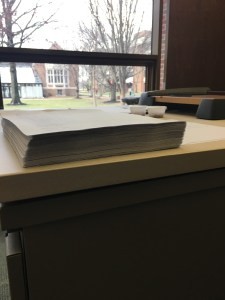
I printed the code that was behind the email just so that I could demonstrate how much was actually going on behind the scenes. Mind you this is double sided.
Printed code behind an email message that was one sentence long. This is double sided.
After going through all of this the professor immediately removed Grammarly from his computer – he said his email box was filling every day and no one could figure out why. But it also got Jim and I thinking about how Grammarly works. It is not entirely on your computer – much of the computing process is in the cloud – it needs the internet to function. So, it seems that it is basically a keylogger. Though it is not covert (I mean you install the thing) it is recording every keystroke and sending it to their servers to check for grammar and spelling issues. It does seem that they are encrypting and such but now we are wondering if there are implications for FERPA in an educational setting. And besides having some program record and send my every keystroke is a little creepy to me. Especially, If I don’t know what is going on in the background.
To be honest, I’m not a coder and even if Grammarly did make their source code available I couldn’t make much of it. I think that there might even be security issues if it were that open. Honestly, a big reason why I’m writing this as a part of my introduction for #OpenLearning17 is because I’m trying to better understand the implications from others that might know better than me. I’m wondering if our concerns about FERPA are warranted and if anyone has any clue how the junk code got into the emails. Any feedback would be great but if not, if this is too far outside the interest of #OpenLearning17, that is okay too. Hoping that this post can still act as a way of saying hi and giving folks some idea of the type of things that I’m thinking about.
Looking forward to working with everyone in #OpenLearning17 and can’t wait to see where this takes us.
Watched a video interview with the ‘connectedness coach’ or something like that for the course.
Truth be told, if I hadn’t had 15 hits on my little equity post, I’d have forgotten about #openlearning. The semester has started so my job is actually serving students. (Yesterday was a day I wished I had a way to keep track of what I did all day. I was regaling it to my friend and kept having to say “Wait! Wait! There’s more!”) There’s also the stuff of death and taxes that has eaten much of my focus.
Still, the “first week” of that cMOOC (‘connectivist’ so “learn from each other” rather than ‘here’s some lectures from MIT guys, aren’t you lucky?’) doesn’t start ’til tomorrow — I suppose there are things in their LMS that will “open” then because right now it just claims (falsely) that each week listed on the syllabus will link to its details.
So far (right, xious… it hasn’t even **started** yet ~ ) it still feels like a whole lot of academic talk about the academic world and ‘openness.’
We are having some of those issues out on the front lines. Friday’s anecdote #7 was a kiddo not being able to find courses to enroll in (starting at midterm since it’s too late for Spring)… I told him about our new online independent skill-building options and he said that well, he needed a course. He knew that he just didn’t get things done independently.
(OTOH, anecdote #3 was the Brazilian who listened to a chunk of Modumath and said, “It’s perfect! He talks slowly and explains things!” — and we’re trying to make that more open)
Lots of us on the edge of open — we’re the ones who *do.* So … it’s easy for us to project that onto the rest of the world… a world of people who benefit from a lot more structure. I actually remembered to ask people coming in for that independent stuff (it can be done on the internet anywhere but — guess what!! — they want to *go to school.*) about making a folder and logging time and progress. (I have qualms. I cannot remember things like folders. So far, though, *they have.* All of ’em…. I really should get that other guy a folder…)
Why does that belong in this #openlearning blog post? Because “open” should be better than “okay! open for swimming!” on the open seas.
We don’t have a “course” because … then we’d need students to be “in the system.” They’d need the right kind of email address. Even if it’s open to everybody, they have to do a mess of paperwork and … some of the folks in some of hte groups who’d use it are undocumented. I’d like to see us set up “houses” like Hogwarts and … you can pick your character. (Didn’t Second Life do something like that?)
Then *if you so choose* you can find ways to connect with your identity and get credentials.
If “open” is open to people with the right tech equipment, the right tech skills, and even then there are hoops to navigate… per the section in Fifty Shades of Open about “open means use,” that’s not really open.
How to provide the structure so many people need for good learning … without that structure turning into insurmountable hurdles? Let’s explore…
I work as an instructional designer and faculty professional development manager. I have been an advocate and champion for OER since the beginnings, and I look forward to learning more during this course. My background include developing courses with backwards design alignments to purely OER content. I also have developed hybrid OER options and interactive OER games and formats for students using coding.
This is my first foray in putting myself out there, my words, my thoughts, no doubt my ramblings… I will be using this blog initially to share thoughts about the Open Learning Hub: http://openlearninghub.net/
This is my first foray in putting myself out there, my words, my thoughts, no doubt my ramblings… I will be using this blog initially to share thoughts about the Open Learning Hub: http://openlearninghub.net/

 ree beer’.” (Free Software Foundation, 2014).









 I work as an instructional designer and faculty professional development manager. I have been an advocate and champion for OER since the beginnings, and I look forward to learning more during this course. My background include developing courses with backwards design alignments to purely OER content. I also have developed hybrid OER options and interactive OER games and formats for students using coding.