How will your experience in #OpenLearning affect your teaching practice or scholarship? Why? #OpenLearning17 has provided lots of inspiration for making my teaching practices more open and accessible. The course has also helped me better understand some of the choices I’ve made about the learning environment I want to create with my students. I have …
Category Archives: Virginia Group
Virginia Faculty Collaborative Group
Using Hypothes.is to Help Students Read Scholarly Papers
One of the things I’ve learned from #OpenLearning17 has been the ability to use Hypothes.is to collaboratively read something online. Hypothes.is is free software that allows one to annotate any webpage as one is reading. The annotations are a layer “on top of” the webpage. They do not modify the page itself. While the annotations are reason enough to find Hypothes.is interesting, the software allows one to share the annotations with anyone else using Hypothes.is. But wait–there’s more! A group of people can read the same webpage and annotate it in parallel, each seeing each others’ comments. This raises some interesting possibilities.
In my upper level courses, it’s not unusual for me to assign students to read scholarly journal articles. This is not trivial. Economics journal articles are a particular type of technical writing. It takes practice to figure out the format of journal articles, but more importantly, the argument contained in them. This is especially true when the argument is mathematical, or when the argument includes statistical analysis, as are often the case. I imagine professional writing in other disciplines is similarly challenging. I assign these readings and hope for the best. When I discuss the articles in class, I ask if there are any questions, and I ask students what they made of the articles. A few students ask questions or express opinions. Most are silent, perhaps because they found the task too difficult. They can’t even say what they didn’t understand.
What if I told students we were going to read the article together as a group? What if I left signposts in the form of annotations to guide the reading? What if I asked students to identify things they didn’t understand and asked others to respond if they could? I suspect it would be a different experience than my previous practice. It’s possible that students would get more out of it. At a minimum, it would harder for students to pretend to do the work when they’ve left few or no comments. I think this is worth trying.
I wonder what other possibilities there are for using Hypothes.is in one’s teaching?
The Waste Books, Teaching, and Learning
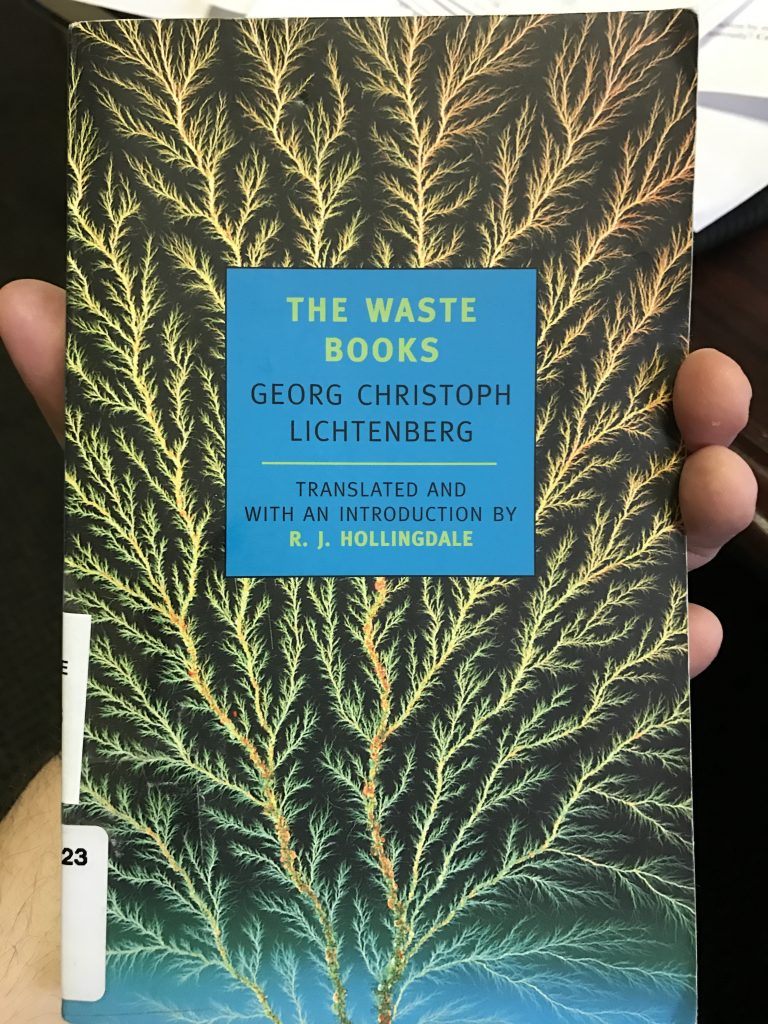
Gjertrud Schnackenberg’s extraordinary and heartbreaking Heavenly Questions, in particular the section called “Sublimaze,” has led me to a new author–new to me, anyway: Georg Christoph Lichtenberg. Much more to say about Lichtenberg, and the associative trail I followed when he appeared (not rhizomatic, and not predictable either), but no time to say it just now. Yet I do want to copy, and share, a Lichtenberg observation I read just last night in that lovely space just before sleep. It has made quite an impression on me. Perhaps you will find it illuminating, too.
From Notebook C, entry 26, in The Waste Books, translated and with an Introduction by R. J. Hollingdale (Penguin, 1990, rpt. New York Review Books, 2000), pp. 36-37:
Herrr Capitaine-Lieutenant von Hammerstein was much in favor of instruction with apparatus. The principal argument he always put forward was that it could only be a good thing to achieve one’s objective as quickly as possible. That was virtually the only argument he had. But since the investigation of a subject, the effort involved in understanding it, is calculated to teach us to know it better from several sides and to attach it most readily to our system of thought, for people who have the ability a drawing is certainly to be preferred to a model. An increase in knowledge acquired too quickly and with too little participation on one’s own part is not very fruitful: erudition can produce foliage without bearing fruit. There are a great many shallow heads who are astonishingly knowledgeable. What we have to discover for ourselves leaves behind in our mind a pathway that can also be used on another occasion.
OpenLearning17–an end and a beginning
We are in the last week of OpenLearning17. It’s been a marathon of learning and connecting, and the experience has reminded that I’m not built for marathons. The only sport I was ever remotely skilled in was fencing–short bouts where it’s not about endurance, but rather strategy, sizing up your opponent quickly and leveraging your individual strengths (being left-handed is nearly always an asset). I have made it to the final week. It’s been sporadic bouts for me, but I’m still in the game. I’m still learning and connecting and I want it to continue.
How will we sustain the learning and connecting after the course? Certainly many of us have new connections on Twitter and through our blogs, but how can we use the http://openlearninghub.net to continue the conversation? What it will look like after the cMOOC is finished? Where will the conversations go? What needs will emerge that the hub could support?
I think we’ve only scratched the surface of possibilities. The participants in the cMOOC have been so thoughtful and insightful. It’s been wonderful to see the sparks of individual epiphanies and the connections between and among participants. We have built a community of learners here and I am eager to see where we take it.
It seems to me that much of what we have discussed involves experimentation with learning environments, whether they are online or face to face. How could the hub support that experimentation in a sustainable way? I want to continue to hear more about what others are doing as they try new things with open learning. If I get brave enough to experiment, I want a place to share that experience and get feedback.
I would also like for us to explore how we could incorporate student experiences into the hub, not just second hand reports from instructors, but actual student voices. We’ve had some links to student blogs, but that’s linking out to students, not bringing them in, right? We’ve included students in panel discussions, but that brings them in for just a moment in time. Are there ways we could incorporate the open learning experiences of students in an ongoing way? Is the life of a student too transient to make this possible? If open learning is student-driven, how can we bring students into our discussions about open learning? What are the risks?
Liberal Education and the Digital Opportunity, pt 2
Here’s the second live Hangout conversation with Randy Bass and Bret Eynon, authors of Open and Integrative: Designing Liberal Education for the New Digital Ecosystem. This week we dive even further into the core elements and purposes of a liberal education, as well as the questions of vendors, platforms, and ready-made ecosystems that might be obstacles to the “rebundling” Bass and Eynon advocate in their book.
To view this conversation, click on the image below.
Laying Out My Pieces
A quick thought on an Easter morning – When did we stop asking questions? Or did we ever start?
I was in the doctor’s office the other day for a routine check-up. The nurse, who was going through the standard screening questions, said: “And you don’t smoke or drink alcohol.” I responded, “Well, I don’t smoke but I do drink alcohol.” And she said: “Ok, occasional alcohol,” and went on with her screening…statements?
Why didn’t she stop to say, “Can you tell me about your drinking?” What if I were a heavy drinker…maybe even worried about it? She gave me absolutely no space to share any of that with her.
Similar problem with a colleague. We have only known each other for four months, but she assumes she knows me, when in reality she knows far less than anyone who follows my blog or Twitter activity. She doesn’t know the story behind why I believe in collaborative learning. She doesn’t know that I already have really vivid experiences with self-reflection, the fluidity of identity, and the impact of institutional structures and processes on self-expression and -advocacy. Rather, she assumes that she needs to teach me these things because I am “new.” I’m not new; I’m an adult, therefore I am not new. I have a history which needs to be reconciled with her experience and our shared space. However, that can only be done if I am allowed to speak about my past experiences. I need the space to lay out my pieces if I am going to make this integration happen.
Therein lies the importance of asking questions/giving space.
The obvious response is that I should speak up and tell people what I need. However, the nuanced response is that power hierarchies are real, self-advocacy is not always clear-cut, and thoughtful approaches are needed to identify and then get precisely what you need.
In medical contexts, screening questions are meant to screen. Really there is no excuse for the nurse’s actions. The patient does not necessarily know that they have a problem (hence the need to screen), and shouldn’t be expected to feel comfortable bringing them up especially when a medical professional has already chosen the “correct” answer on their behalf. I’m still kicking myself for not providing feedback. I had a lot of reasons (none of them really good enough, I guess) for not wanting to be an ass about it, especially since I don’t actually have a drinking problem (I screen myself).
In terms of work, people higher in the organizational chart need to ask more questions, they need to give more space to the people below them on the org chart. I will learn how to insert myself even where there are no spaces for me to do so. When I figure out how to do this, I will let you know. But for now, a gentle reminder for everyone with power:
Stop. Think. Ask questions. Make space. It’s not only your job, it’s the right thing to do. It’s also really smart.
Featured Image by: Glen Carrie, http://www.unsplash.com


Mapping My Place in the Open Landscape
Maybe it’s all the cultural geography I’ve read, but I find the idea of mapping my place in the landscape of open learning very intriguing. Am I digital visitor or a resident? In my forthcoming book, I explore (among other things) the way cognitive mapping works to help people navigate their place in the cultural landscape of a community; I’m especially interested in the way that our attachments to physical places serve as mnemonics for experiences or events (both positive and negative) crucial to identity formation, especially civic and racial identities. Among other things, I consider the way parades function—a group of people processing deliberately by iconic buildings and monuments serves to inscribe shared values on the landscape but also works to unite the marchers and the watchers as members of an imagined community. (People can also be excluded from participating and have traumatic memories of events and places.) I wonder if a similar kind of attachment and identity can be formed in online spaces. Seems plausible, right? If I consider the web a place and participate in certain online communities, then I’m having experiences and making relationships that shape my identity as a member of those communities. The piece I’m puzzling out concerns the mnemonic structures. What takes the role of the physical marker, the iconic building or monument or sign? Is it the architecture of a web domain? The WordPress page, the Twitter profile, the Facebook page?
To explore these ideas further, I decided to delve into visitor and resident mapping exercises. Through the Open Learning17 cMOOC, I had already read Laura Gogia’s post on V&R mapping, and she led me to read Donna Lanclos’s keynote on Teaching, Learning, and Vulnerability, which included more on mapping exercises, as well as a Periscope of Bonnie Stewart’s recent presentation at Keene State (slidedeck here) and David White’s various posts and videos at JISC. (These folks all know each other and work together in various ways and so if you follow my trail, you’ll quickly see the interconnectedness of these sources.)

My Visitor/Resident map, April 2017
A mapping exercise is a great way to visualize one’s own practices online and reflect on them. Here’s what mine looks like. It wasn’t difficult to do—the hard part was finding the colored markers (fortunately I have a daughter who’s a tween). It corroborates my approach, which has been to keep most of my personal stuff, well, personal. Note I have almost nothing in the upper-left corner. I don’t do Facebook or Instagram, but I am considering Tumblr as a way to share certain photos and curate digital images and such. I could do more with Twitter: the map shows my personal activity: I also manage two other Twitter accounts, one for an organization and one for a group on campus, but those don’t count because I’m not ‘me’ when I’m tweeting under those handles. Could I do more with LinkedIN? Should I? I am hopeful that my blog will become more ‘residential’ in the future.
Why Twitter? I joined in 2012 and I consciously chose it because I wanted (ok, needed) to connect to other scholars who were working on public history, collective memory, race, and place. It also connected me to a group of administrators in public higher ed who share my concerns about defunding, attacks on liberal education, adjunctification, student debt, inclusivity, and myriad other challenges. Sometimes, the two communities even intersect, as they have in recent conversations about memorials to slaveholders and white supremacy on campuses. And that topic brings me back to physical markers that serve as mnemonics for individual and group identity formation.

Facebook flyer posted on a glass door. Image from Flickr, CC license.
Obviously, there are no physical markers on the Web. But there are visual markers that tell us, whether we are visitors or residents, where we are. There are signposts and trails everywhere. And the current fascination with personal branding, even in the hallowed halls of Academe, reflects the recognition that our digital identities are tied to, derive from, and are shaped by the markers evident in the myriad digital spaces we enter. Having a consistent brand (same color or font, photo, logo) is imperative, it seems, as we travel around the internet. My undergraduate students understand the way visual markers work to create digital identities, but at this stage of their lives they seem more interested in promoting multiple selves than in crafting a coherent persona.

My current Twitter header etc.
My identity on Twitter, the place I reside most, is still evolving. I chose a photo that depicts me talking and gesturing with my hand because I happen to be a talker and gesturer. My profile includes words that chiefly convey my professional identity yet there is a nod to my private self in the references to my coffee addiction. Coffee isn’t unique to me, but it is actually a significant part of who I am and how I spend my time. The photo of the coffee cup I took on a visit to Charleton’s Coffee House in Colonial Williamsburg, so it also serves as a mnemonic for me of that trip and a physical place (Williamsburg) that is crucial to my professional identity since I went to W&M and worked at CW.
When I go to my Twitter site, I see signs of who I am IRL and I assume others see them, too. But I’m not aggressive in promoting my self this way and perhaps other residents will see me as merely a visitor as a result. In her Keene State talk, Bonnie Stewart noted that open citizenship occurs in “quantified” spaces. The number of followers you have, the number of comments posted, these quantities influence how others see you and whether they will interact with you or not. So those numbers serve as visual markers of your identity, except they are created by others.
Something happens when you move out from your own Twitter timeline and enter a communal space like the one defined by #openlearning17. There, I see familiar “faces,” meaning the digital identities of other members of this online community, and I remember who is who by virtue of their profiles and handles. The people in that digital space are different each time, but the place is always the same—the white Twitter boxes, the blue Twitter bar, the navigation buttons, the bird. I see the same thing when I check in over at #twitterstorians or #AACU17 or even #JMU. It’s a corporate space, designed FOR users, not BY users. I can’t get lost in the Twitterverse, not really. The markers always tell me where I am and who.
Musings on Chp. 1
In Chapter 1 of Open & Integrative, Bass and Eynon note that many students are entering higher education with “uneven academic preparation,” with some of the students coming from “dysfunctional school systems” or other challenging circumstances. They go on to discuss the boon liberal education would be to those students with its emphasis on “critical thinking, problem solving, historical perspective, integrative learning.” As I reflected on passages from Chapter 1, I wondered–are higher education institutions really prepared to do this work?
So often, students from the backgrounds that Bass and Eynon describe are left to feel rudderless in a swiftly moving academic stream–and reminded over and over how their backgrounds or life challenges will make things more difficult for them or haven’t prepared them in any way. However, many of these students have already used critical thinking, problem solving, and the like before entering higher education institutions (sometimes before entering secondary institutions). Where are the spaces that help these students understand that they already possess some of the very skills that help people to be successful not only in college, but in life? Where are the appreciative approaches to educating students? Are the integrative approaches institutions use integrative across the experiences they will have (are having) in college, or do they also include integrating some of the very useful skills these students developed prior to attending the higher education institution? With technology, for example, were these students already using technology in integrative, open ways prior to their higher education experience? If so, how will institutions gather this information?

