Category Archives: Virginia Group

Virginia Faculty Collaborative Group

Faculty and New Media Literacies

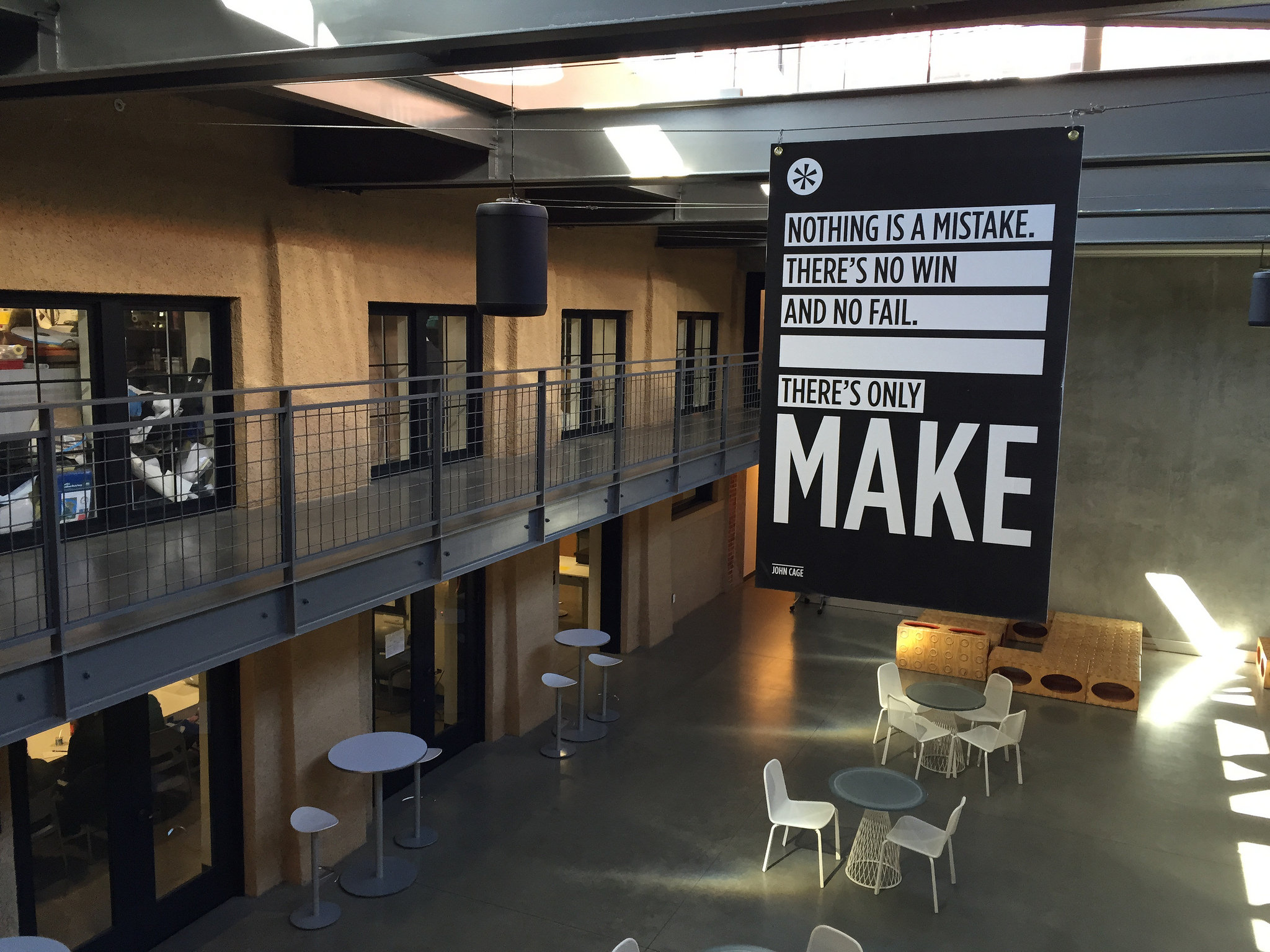
Lindellhallen, Humlab, Umea University, Sweden, Second Life

Photo by Gardner Campbell

Last week in Open Learning ’17 we began our work with Randy Bass and Bret Eynon’s book Open and Integrative: Designing Liberal Education for the New Digital Ecosystem, published in 2016 by the AAC&U. As with other things we’ve read in our openly networked course of study, we’ve been busy annotating the book with Hypothes.is. And as I was reading along and making my annotations, I found that my colleague Amy Nelson (also on the Open Learning ’17 Steering Committee) had very succinctly annotated a passage that had given me pause as well.

First, the passage from Open and Integrative:

Connected learning previews the new ecosystem where learners move easily between formal and informal contexts, connect knowledge and lived experience, and deepen learning through engagement with others. (19)

Then, Amy’s note:

Would like to see faculty incorporated into this ecosystem more explicitly. They also need to be more nimble and able to negotiate across these domains.

Exactly. The more I thought about it, the more it seemed to me that Week 10 (topic: participatory cultures) and Weeks 11-13 (topic: liberal learning and the new digital ecosystem) of Open Learning ’17 needed to be introduced to one other, so to speak. Perhaps the juxtaposition already suggested this idea to me, but it really was Amy’s comment that helped me connect the dots.

When Bass and Eynon write about digital ecosystems, they sometimes mean the open Web and various affordances on the Web. Most of the time, however, they lean more toward “learning technologies” like eportfolios, analytics, simulations, etc. that schools build for learners, a very different kind of ecosystem that the one made possible by the Web itself. (One could also argue that ecosystems our students live in when not in school are not about the open Web either, an argument that deserves its own post, and one I will address obliquely below.) Why does this difference matter? Obviously, the word “ecosystem” implies something more than the dominance of one or two species. The word suggests something holistic, comprehensive, a system that includes of many interdependent parts in a larger network.

I’d argue that the turning point for civilization was not so much digital computing as networked digital computing. I had a small habitrail on my individual computer back in the 1980s, but it wasn’t an ecosystem. It was more along the lines of a “productivity suite.” Suites on the Mac were more interesting and truly interconnected than they were on the PC, but we’re still talking about the walled garden of an individual computer. Exciting, you bet, but not an ecosystem.

An ecosystem is complexly connected. An ecosystem supports emergent phenomena. An ecosystem is “deeply intertwingled,” to borrow Ted Nelson’s plangent phrase.

An ecosystem gives and gathers life
To and from all its members.

An ecosystem is genuinely and thoroughly participatory.

No one is only a creator.
No one is only a consumer.

So as I thought some more about Amy’s comment, I began to understand that one of my ongoing nodes of discontent with the status quo has to do with how, all too often, faculty do not themselves have the knowledge, skills, or dispositions to be members of the participatory cultures supported by the open Web. (They may also lack the knowledge, skills, or dispositions to be members of the participatory cultures supported by the contemporary university, given that the contemporary university is more likely a “multiversity,” as Clark Kerr observed half a century ago–but that’s also another post.) During a very stimulating and lovely conversation with Randy and Bret about their book, I could nevetheless hear the conversation drifting toward the opportunities and skills we would help students to enjoy and acquire. At one point toward the end of the conversation, I asked Randy Bass about the relationship between the digital ecosystems inside and outside the university. While stressing the need for “porous boundaries” between those two ecosystems, Randy articulated a laudable goal for schools trying to think about such boundaries. Randy asked schools

to think about how you’re empowering people inside a university by helping them learn how to connect outside the university, how to build networks, how to negotiate networks, how to protect themselves, how to leverage resources that they don’t yet control, how to make use of intellectual tools in combination with what might their own … facility in these digital environments for the kind of, what we could call in the Jesuit tradition, the kind of “interior freedom” that we’re trying to help students achieve…..

And as I listened to Randy and agreed with him, I couldn’t help wondering whether faculty might be a bit complacent about their own abilities in this regard. Do our faculty know how to connect outside the university, especially in the kinds of participatory cultures Jenkins describes? Do faculty know how to build and negotiate effective, mind-expanding online networks that cross institutional boundaries–or that aren’t defined by institutional boundaries at all? Do faculty know how to leverage resources they don’t control? Do faculty know how to use intellectual tools in digital environments that have little or nothing to do with school? For that matter, do faculty have the kind of  “interior freedom” Randy advocates, within these new digital ecosystems?

And a little voice in my head spoke again: why do we assume we can maintain our professional lives free of these new literacies and at the same time convey wisdom to students about their lives and literacies?

In his 2006 white paper “Confronting the Challenges of Participatory Culture: Media Education for the 21st Century,” Henry Jenkins sounds an urgent call to action:

The social production of meaning is more than individual interpretation multiplied; it represents a qualitative difference in the ways we make sense of cultural experience, and in that sense, it represents a profound change in how we understand literacy. In such a world, youth need skills for working within social networks, for pooling knowledge within a collective intelligence, for negotiating across cultural differences that shape the governing assumptions in different communities, and for reconciling conflicting bits of data to form a coherent picture of the world around them.

We must integrate these new knowledge cultures into our schools, not only through group work but also through long-distance collaborations across different learning communities.Students should discover what it is like to contribute their own expertise to a process that involves many intelligences, a process they encounter readily in their participation in fan discussion lists or blogging. Indeed, this disparate collaboration may be the most radical element of new literacies: they enable collaboration and knowledge-sharing with large-scale communities that may never personally interact. Schools are currently still training autonomous problem-solvers, whereas as students enter the workplace, they are increasingly being asked to work in teams, drawing on different sets of expertise, and collaborating to solve problems.

Youth need those skills, now more than ever. The question then becomes whether faculty themselves have these skills in ways that can be modeled and thus meaningfully incorporated in their own pedagogies (and in their own scholarly networks as well–why not?).

These skills are not just ‘information” skills, narrowly considered. They are new media literacies.

I’ve copied Jenkins’ 2006 skill taxonomy below, with some comments. With the caveat that I do not think knowledge, skills, and dispositions can be divided, my question remains: to what extent do you have and model these skills for your students? To what extent do your colleagues have and model these skills for their students? As we consider Jenkins’ list, we may well agree that there’s a profound gap between what we say students should know and what we ourselves can, or are willing, to do as we participate in this new digital ecosystem.

As I argued in “My Computer Romance“:

We live in 2007. Faculty complaints are real and serious. In lives full of teaching, advising, reading, marking papers, writing, presenting at conferences, publishing—more demands each year—faculty do not have the time to learn these new literacies. Based on their past experience, faculty fear that whatever they do learn will likely be obsolete within a few years. If faculty are successful in learning these new forms of reading and writing and in working within them, their achievements are often not valued in the tenure and promotion process. And if faculty incorporate these new literacies into their teaching, they still may not understand how to evaluate student work within these literacies. I hear these complaints from my faculty colleagues, faculty at other U.S. colleges and universities (from liberal arts to research institutions), and faculty around the world. These are valid complaints. They must be addressed, especially by administrators who can align institutional resources to bring relief and opportunities to those faculty ready to engage with these tools. All faculty who are ready deserve a place where they too can enjoy a computer romance.

Yet faculty must move forward before the professional infrastructure is completely hospitable. Faculty can no longer afford to wait. We faculty live in 2007, and we all must be ready. These technologies are not going away. Their promise is enormous and only beginning to be realized. They are essential components of every aspect of our lives, and we owe it to ourselves and our students not only to understand them but to delight in them, to learn within them, and to share those delighted experiences of learning with our students. Only when our students see our own learning blossoming within a computer romance will they listen to us when we tell them to use these tools more wisely themselves.

Lives of curiosity, creativity, and discovery within this new digital realm await us all if we are prepared to calm our fears, share our ideas (whether or not they’re “half-baked”), and remember the excitement that called us to this place, this vocation. The computers are us. The world is our wiki.

Yes, it’s now seven years later. There may have been some incremental progress in some areas, but I fear there have been many more steps back than forward. Perhaps it is not too late to turn that around. I hope not.

And with that, here’s Jenkins’ list, with my comments in italics.

Play
— the capacity to experiment with one’s surroundings as a form of problem-solving
This specific form of new-media play is likely foreign to many faculty, even in their private lives. Will a generational transition address this gap, or will faculty culture continue to penalize play in favor of other, more aggressively career-focused kinds of professional activity?

Performance
— the ability to adopt alternative identities for the purpose of improvisation and discovery
I suspect many faculty would be baffled as to why this skill might be desirable or important.

Simulation
— the ability to interpret and construct dynamic models of real-world processes
Perhaps less of a skill gap here, though these models are usually contained within specific course or institutional boundaries.

Appropriation
— the ability to meaningfully sample and remix media content
The word “appropriation” probably isn’t the best word for this skill anymore, but the ability is still relevant and important. To take one very small example: how many faculty do you know who’ve created an animated gif, or experimented with an image macro?

Multitasking
— the ability to scan one’s environment and shift focus as needed to salient details.
I’d say this ability badly needs another name, as much research suggests human beings are fooling themselves if they imagine they’re good multitaskers. That said, there is what I’d call a “gestalt” or “gist” or “sizing-up” ability–that ‘scanning one’s environment’ Jenkins describes–that is important, especially in networked cultures.

Distributed Cognition
— the ability to interact meaningfully with tools that expand mental capacities
This ability is perhaps the most vital of all, especially in new-media online participatory cultures. Any mind-expanding or intellect-augmenting technology vastly broadens one’s intellectual and personal horizons. School itself should be such a tool. Books certainly have been, for centuries. To what extent do faculty experience online participatory cultures and new-media literacies as mind-expanding?

Collective Intelligence
— the ability to pool knowledge and compare notes with others toward a common goal
This is certainly the goal of a scholarly community, though it’s not always clear what goals are truly held in common, and I wonder to what extent academia is a genuinely participatory culture in the contemporary “multiversity.”

Judgment
— the ability to evaluate the reliability and credibility of different information sources
This ability is probably the most familiar and putatively widespread among faculty in the contemporary university, though the Sokal Hoax does give one pause in this regard.

Transmedia Navigation
— the ability to follow the flow of stories and information across multiple modalities
I think most faculty wouldn’t know where to start with this ability, though they might plead that they’re not film scholars, art history scholars, writing teachers, musicians, etc. Yet not being able to follow the flow of stories and information across multiple modalities does seem to be missing a considerable opportunity in the new digital ecosystem.

Networking
— the ability to search for, synthesize, and disseminate information
Faculty can do this in older ways, but it’s not clear to me to what extent the new media landscape has altered more conventional practices or abilities. In particulate, I wonder if faculty routinely disseminate scholarly information outside peer circles.

Negotiation
— the ability to travel across diverse communities, discerning and respecting multiple perspectives, and grasping and following alternative norms.
Faculty are often skeptical about faculty in other disciplines, a very short hop across communities with fairly limited intellectual diversity. Are faculty willing to take on the diverse communities and alternative norms of Twitter? of Wikipedia? of Reddit? 
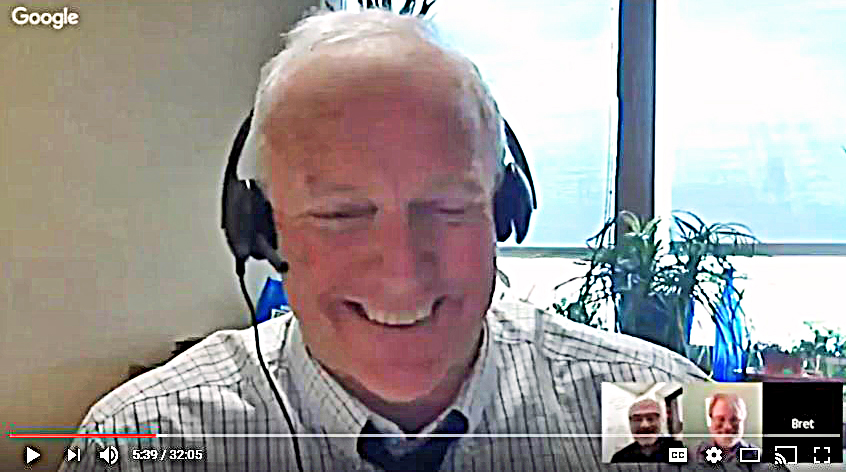
Randy Bass and Bret Eynon on Open and Integrative-Pt 1

What does liberal education look like at Georgetown University vs. LaGuardia Community College? What unites liberal learning advocates and digital ecosystem aficionados, and what separates them?  How do the digital ecosystems our students bring to school connect with the digital ecosystems built for schools? What do the authors mean by “open and integrative”? These and other questions emerged from the conversation with Randy Bass and Bret Eynon in support of Open Learning ’17 and our first week considering their book Open and Integrative: Designing Liberal Learning for the New Digital Ecosystem. The conversation also sparked some lively discussion on Twitter, and was informed by annotations of their ebook by means of Hypothes.is.

Rather than summarize the conversation further, I invite you to watch it for yourself. It’s a half-hour well spent. Click on the image below to view the video.

Bret Eynon talking about Open and Integrative

For  our second week with Open and Integrative, we’ll be focusing on chapters four and five of the book, which emphasize faculty development and assessment. As with our first week, you’re encouraged to purchase the book and annotate it via Hypothes.is. (Note that to permit shared annotation, the book must be purchased, downloaded, and loaded into a browser with the Hypothes.is extension on and local file annotation enabled. Instructions here: Unfortunately, because the book is not freely available on the open Web, the annotations cannot be shared via Twitter or other social media.)

On Wednesday, April 12 from 4-5 pm EDT, we’ll have another live-streamed conversation with Bret and Randy to dive into topics related to faculty development and assessment. You can watch the Hangout here:

Finally, I encourage everyone to consider writing a short (or medium, or long) blog post reflecting on some part of Open and Integrative. I know Randy and Bret find this feedback and conversation very helpful, as do I and (I hope) everyone in the Open Learning ’17 network.

And as always, keep those #openlearning17 tweets coming.

Post written and interview conducted by hub director Gardner Campbell

Week 11: Open and Integrative: Challenge, Context, Strategies

Bass-Eynon book: Open and Integrative

This week we begin our work with Open and Integrative: Designing Liberal Education for the New Digital Ecosystem, the 2016 AAC&U publication by Randy Bass (Georgetown) and Bret Eynon (LaGuardia Community College). This book will be our text for the next three weeks. Each week, we will begin by annotating and discussion a portion of the book in Hypothes.is. Each week will feature a Twitter chat on the week’s emphasis, as well as a live videoconference with Randy and Bret as they speak to your thoughts and your questions.

To get started, you’ll need to purchase and download a PDF copy of Open and Integrative. You can do that here: https://secure.aacu.org/store/detail.aspx?id=E-GMSDIG . The price for AAC&U members is listed as 15.00, but hub director Gardner Campbell reports he was charged only 12.00. We recognize that this is the first non-OER we have used in Open Learning ’17, but we believe the investment is worth it, and we hope it will not prove a hardship for you. If you have concerns, please don’t hesitate to contact hub director Gardner Campbell directly at gardner.campbell AT gmail.com (substitute @ for AT, of course).

WEEK 11:
For our first week on Open and Integrative, we’ll focus on the first thirty-nine pages of the book, the chapters titled “Challenge,” “Context,” and “Strategies.”

Monday-Tuesday, April 3-4
Using Hypothesi.is, read and annotate chapters 1-3 of Open and Integrative. Please feel free to continue reading and annotating throughout the week.

Wednesday, April 5, at noon, EDT
Twitter chat on first three chapters of Open and Integrative.

Date and time TBA—probably Friday, but watch this space
Toward the end of the week, we will have a live videoconference with Randy and Bret, with an opportunity for them to address thoughts and questions you’ve shared on Hypothes.is and via Twitter.

A look ahead:

Week 12 will focus on faculty development and outcomes assessment

Week 13 will focus on “rebundling” and next steps, with an opportunity for you to envision how Open and Integative and the AAC&U’s LEAP initiatives might foster change on your campus.

Week 14 is Open Learning ‘17’s grand finale—details forthcoming!

Post written by hub director Gardner Campbell

End of another era

Approximately seven years ago, I left a rapidly growing medical practice for an uncertain future. I didn’t have a plan.  Come to find out, I didn’t have much of an idea about my core identity either, because what I had was so integrated with my profession. The year(s) after I left medicine was (were) very dark, but they provided me with all the opportunities to hit rock bottom, to make mistakes, to ask for help, and to be brave in a Paul Simon, Cool, Cool River  kind of way.

How many times have I blogged about how difficult it is when someone asks me about leaving medicine?  I can think of three separate post and a handful of tweets, but there have probably been more. I haven’t liked it very much. The comments about my questionable work ethic,  my presumed student debt and the disappointment to my family, the rumors that I must be addicted to drugs or alcohol or guilty of extreme malpractice — I’ve heard them all.  All of those things would flash through my head – along with a healthy dose of self-hatred (for not being able to stick with it, to prevent burnout, to advocate for myself better) – every time some stranger would casually ask me why I left medicine…and then walk away after a minute or two leaving me to re-play my answer in my head over and over and over again.  I never answered well.

Things changed last week during my MBTI certification.  In one day five different clusters of people walked up to me and asked me why I had left medicine (it’s a long story on why they knew I was a physician in the first place – even when I don’t include it in my intro, it invariably comes up. It’s such a large part of my perspective on life that it always does).  I have no idea what made this day different. Maybe it was the intensity of the experience, the fact that they were all genuinely curious. Maybe I truly am done with feeling victimized by others’ assumptions.  I don’t know.  But I finally got my answer in place in a way that doesn’t leave me torn up after I’m done giving it.

Today hasn’t been the greatest day.  It wasn’t the worst, but I’ve moved on to my next hangup, -the next professional hurdle I need to move past.  I’ll save that for another day, but I want to take a moment to celebrate this victory for what it is. I deserve this.

So.  My two minutes on why I am no longer a physician.

Why I Am No Longer A Physician

By Laura Gogia

Three reasons.

  1.  A lack of resources.  I went to work in an underserved, isolated region straight out of residency training. I was the only gynecologist, the only female surgeon, the only surgeon who was also the mother of tiny babies.  I worked in a hospital culture rife with sexism, sexual harassment, bullies, mediocrity, and general dysfunction.  I had no mentors, no peers, no backup, no help, no call coverage, no vacations, no strategies for dealing with desperately poor, uneducated, holistically unhealthy populations. I was all in, but I was unprepared.
  2. A lack of opportunity. A lack of peers means a lack of professional development. Medicine is easy enough to keep up on via conferences and reading; surgical skills require practice and interdisciplinary training.  I refused to place my patients at risk for the sake of my learning curve.  My surgical skills were out of date in three years and that was unacceptable to me.
  3. I wanted something different.  I love people and their stories but I am not built to engage with so many people in intensely important (sacred, even) one-on-one scenarios everyday, nor am I built to work the same, limited number of diagnostic algorithms day in and day out. To be happy, I need more freedom, more quiet time, and more creativity than the proper practice of medicine allows.

There.  That’s the whole story.  It’s actually quite simple and logical. It’s also entirely forgivable…maybe even brave and very smart.  And I can say it without wanting to cry or throw up after I’m done.

On to the next challenge.

Featured Image by Chad Madden, http://www.unsplash.com

A New Model for OER: Anthologies Instead of Textbooks?

I have heard that sometimes adjunct faculty are assigned to teach a class at the last minute, often with the textbook already chosen and sometimes with a syllabus to follow. No one should argue that this is an ideal situation. But I also wonder how often instructors teach their courses to meet the align with the textbook they are using, rather than teaching the way that works best according to their context (e.g. students and their understanding of the subject)? I know I did it this way when I was a new faculty member. One of the claims regarding open source textbooks is that they lead faculty to think more deeply about their pedagogy and their contexts. This is what popped into my head when I read Cathy Saunder’s wonderful thought-provoking post: “How Good Can a Course that Follows a Standard Textbook Be?”

For some years, I’ve wondered why there tend not to be open textbooks in English Literature or Composition. OER publishers have told me that they prefer to publish open textbooks that have a large market. English faculty have told me they don’t typically use textbooks, but rather anthologies with commentary. Cathy made two points in her post that caught my interest:

“The class is, however, a huge one, with over 100 22-student sections taught each semester, and the instructor community is correspondingly large (even with many of us teaching 3 or 4 sections a semester).”

“Because 300-level composition courses with similar learning goals are rare, we don’t really fit into an existing market (though this doesn’t, of course, keep textbook reps from trying to convince us that they’ve got the perfect book for our class).”

These points made me think that there is indeed a large market for suitable English OER, and that we might be able to expand Cathy’s model of creating and sharing resources as follows. An OER publisher connects a group of interested instructors, who work together to develop not a textbook, nor an anthology, but a collection of readings, annotations, commentaries, and other resources. The OER publisher creates a platform that would allow instructors to easily create their own anthology, by picking and choosing from the collection of resources, which the platform would then turn into a finished book.  The book could be made available in a variety of digital or print formats for free or modest prices. One could imagine asking students to contribute to the collection as well in the form of renewable assignments that David Wiley has discussed and Robin DeRosa has experimented with. The platform would also keep the master copy of all finished books created, for use by those adjuncts who are hired at the last minute or anyone else who didn’t wish to create their own customized anthology.  What say you @OpenStax & @LumenLearning?

Week Ten: Participatory Culture

Stanford D-School motto
Photo CC BY-NC-SA Gardner Campbell

What is participatory culture? How does it differ from consumer culture?

Our anchor reading this week is Henry Jenkins, et al., “Confronting the Challenges of Participatory Culture: Media Education for the 21st Century” (2006). You can download this white paper at http://www.newmedialiteracies.org/wp-content/uploads/pdfs/NMLWhitePaper.pdf 

MONDAY 3/27: Participatory Culture and Participatory Literacies
Read the Executive Summary (pp. 3-11) of “Confronting the Challenges of Participatory Culture: Media Education for the 21st Century.” Today and tomorrow, we’ll use Hypothes.is to annotate these pages. (Of course, feel free to annotate any other part of the document that you want, too.) Gold star for tweeting out annotations with #openlearning17 hashtag. TWO gold stars for mentioning Jenkins when you do: @henryjenkins.

Instructions for annotating PDFs offline via Hypothes.is: https://hypothes.is/blog/synchronizing-annotations-between-local-and-remote-pdfs/

More context: Jenkins’ blog post announcing the white paper: http://henryjenkins.org/2006/10/confronting_the_challenges_of.html

TUESDAY 3/28: Participatory Culture Skills
Look again at Jenkins’ 2006 list of media literacy skills (page four of the white paper at http://www.newmedialiteracies.org/wp-content/uploads/pdfs/NMLWhitePaper.pdf :

  • Play — the capacity to experiment with one’s surroundings as a form of problem-solving
  • Performance — the ability to adopt alternative identities for the purpose of improvisation and discovery
  • Simulation — the ability to interpret and construct dynamic models of real-world processes
  • Appropriation — the ability to meaningfully sample and remix media content
  • Multitasking — the ability to scan one’s environment and shift focus as needed to salient details.
  • Distributed Cognition — the ability to interact meaningfully with tools that expand mental capacities
  • Collective Intelligence — the ability to pool knowledge and compare notes with others toward a common goal
  • Judgment — the ability to evaluate the reliability and credibility of different information sources
  • Transmedia Navigation — the ability to follow the flow of stories and information across multiple modalities
  • Networking — the ability to search for, synthesize,and disseminate information
  • Negotiation — the ability to travel across diverse communities, discerning and respecting multiple perspectives, and grasping and following alternative norms

Again using Hypothes.is, annotate the above list by considering these questions (these are a guide, not an exhaustive set):

How does this list of skills look a decade later? Are some less relevant, or not relevant at all? Are some more relevant? Are some skills missing from the list? How would you characterize your own skills in these areas? How would you characterize the presence of these skills in a typical college course today in your discipline? In the general education curriculum at your school?

Gold stars again for tweeting out thoughts and mentioning @henryjenkins. Platinum stars for blogging your thoughts.

WEDNESDAY 3/29: These Are A Few Of Our Favorite (Participatory Culture) Things: Confessions of a Junior Aca-Fan.

Go on a field trip with Gardner Campbell as he explores some of his favorite participatory culture sites online. He’ll explore the 2002 and 2004 discoveries that kickstarted him into the world of Web 2.0, and from there move onto sites including Wikipedia, Flickr, YouTube, Tumblr, Reddit, An Archive of One’s Own, podcasts, and others. Link to video TBA.
TWITTER CHAT at NOON EDT: Using the #openlearning17 hashtag, ask questions, share thoughts, and tweet out your own “favorite (participatory culture) things” with a thought about why you enjoy the site, what you learn from it, or anything else you’d like to share.

THURSDAY 3/30: Everything you always wanted to know about Kids These Days (but were afraid to ask)

Twitter: tweet out questions you’d like to ask our panelists tomorrow. If they don’t answer the questions, maybe someone else will. (Twitter is participatory culture, too.)

Read to prep for tomorrow: Seymour Papert, “Some Poetic and Social Criteria for Education Design.” Gold star for annotating this short essay using Hypothes.is.

FRIDAY 3/31: Student Panel Webcast, 9:30 – 10:30 a.m. EDT

Meet Ambrose Humphrey and Gabby Leporati (undergraduates), Jamison Miller (graduate student), and Addy Tolliver (newly-minted Ed.D). They’ve agreed to share their own participatory culture experiences, fandoms, obsessions, and the like on a special YouTube Live webcast. Gardner Campbell will moderate the discussion and take your questions via Twitter. Webcast link TBA.

Concluding Participatory Culture TWITTER CHAT: Noon EDT.

Page and post written by hub director and week ten director Gardner Campbell

I am officially MBTI certified

A couple of weeks ago, I met my former advisor at a campus coffee shop.  It had been a while since we had caught up and the conversation went as these things usually do. He updated me on his research plans and I told him all about my new job.  Things were going well and with minimal angst until I brought up the upcoming MBTI training:

Me: They’re sending me to learn how to give the Myers Briggs.

Him: Really?

Me: I need your reassurance that i’m not going to get dumber by getting certified in MBTI testing.

Him: You’re the one with the doctorate in research and evaluation. 

Me: What if they brainwash me?

(Anxious silence)

Him: You’ll probably be okay.

(Anxious silence)

Him: Just don’t get brainwashed.

My transition from institutional research to leadership development has not been gentle.I had to hit the ground running, reading everything from Forbes to Harvard Business Review while also developing reading lists, proposing conferences, and creating sessions. Three months in, and I’m still trying to make sense of the field of leadership development. I’m not a fan of what I interpret as a organizational development, adult education, and social/developmental psychology melange interpreted through a cloudy and unchallenged business lens and served up with a side of fluff.

For me the struggle against business-lite is real, and I don’t think that I am alone.  For as many business executives and executive coaches swarming around glossy and well-marketed personal assessments, there are as many academic researchers who challenge their efficacy and use.

As I wrote in a previous blog post, I have not had the best consumer experience with the MBTI.  However, it is a fairly non-negotiable part of my job. I was not asked to get certified; I was told.  Therefore, I needed to be okay with this experience.  I focused on the fact that my experience with the MBTI had been as an uneducated consumer.  I recognized that I really didn’t know anything about the MBTI.  Finally, I shut up, opened my mind, and drove up to a Courtyard Marriot in Northern Virginia to figure out what I was missing.

I’m only going to say this once, so listen up.

I was not wrong about my previous experiences. Furthermore, given that many people experience the MBTI similarly to the ways I did, the concerns I listed in my previous post are valid.  However, I was wrong about the MBTI.

I have taken the MBTI several times, usually in a classroom setting, without initial coaching (e.g. how to take the test), contextualization (e.g. specific purpose of the test), or follow-up counseling (e.g. how to interpret and use the results).   In other words, it was given to me inappropriately. In fact, the Myers Briggs Foundation would say it was given to me unethically.  While anyone with a master’s degree in counseling or similar can order and distribute tests and reports, relatively few people are certified or have received specific training in how to interpret and use the tests.  In other words, lots of people give these tests and plenty of them are doing it wrong.

I am certified in MBTI coaching and facilitation and I have a few things to say.

MBTI has a theoretical framework. MBTI is based on Carl Jung‘s theory of personality type.  Jung wrote that individuals are born with innate preferences for how they focus their energy (introversion or extroversion); take in information (sensing or intuition); and make decisions (thinking or feeling). How individuals express these preferences will be shaped over time through culture, parental expectations, life experiences, etc.

After Jung published his work in the 1920s his American contemporary, Katherine Cook Briggs began to adapt it into an inventory of questions that could be used to help people identify their preferences. Among other things, she and her daughter, Isabel Briggs Myers, added an additional axis to Jung’s theory related to how individuals choose to orient themselves to the world (judging or perceiving).

MBTI has changed over the years. The questions are constantly tested and refined. If you took an MBTI in the early 1990s and found it to be gendered, you are not wrong.  It was revised in 1998. Recent evidence suggests it is there is no longer a gender bias present.

MBTI has some advantages over other personal assessments. Results given through Myers Briggs are positively framed.  There are no wrong answers.  Every type has its own special strengths and weaknesses. The inventory provides insight into healthy normal human behavior – not pathology.  The positive nature of the Myers Briggs works for marriage counseling.  It works for team building. It works for personal growth.  As an academic, I like the Big Five, which is more commonly used in academic research than the MBTI. Go ahead and call me an introverted, curious, antagonistic (but conscientious) neurotic, because I can take it. However, imagine sitting with your work group and being told you are an antagonistic neurotic.  Like I said, it works for me, but it doesn’t work for most…even other antagonistic neurotics.  The positive nature of the MBTI works in practitioner-based scenarios.

MBTI appears to be reliable and valid. Trained skeptic that I am, I looked at sample sizes, populations, reliability, validity.  The number of types in any population (e.g. introverts and extroverts) is relatively stable over gender, race, ethnicity, country, language, age, employment status, marital status, socioeconomic status, etc.  The Myers Briggs foundation (and independent evaluators) routinely implement reliability (split test and test-retest) testing.  They routinely check validity through reliability and correlational studies (other tests, career choices, factor analysis, etc.).  There is a ridiculous amount of data. I am comfortable saying that MBTI appears to be reliable and valid FOR THE TYPE OF ASSESSMENT THAT IT IS.

So, let’s get to that.

MBTI is a type tool, not a trait tool.  It indicates that you have a preference for introversion or extroversion; concrete versus abstract thinking; logical/systemic vs instance-centric decisions; early-bird versus just-in-time organization. It does not measure “how much” of something you have. It does not measure how good you are at something.  It doesn’t even measure what you usually do in the world. It is about your innate preference. When your assessment returns with something like “you have a very clear preference for introversion” it means just that: You are clear on your preference. You know that you prefer introversion.  It does not mean you are a “strong introvert.”

MBTI is a self-report inventory. Mindset is critical. In my previous post, I mentioned how I used to change my answers to suit whatever person I wanted to be the day I took the test. Yes. A high school student can game the test, which is why it is essential to provide appropriate instructions when you facilitate a Myers Briggs assessment.  You are supposed to take it as if you were in a perfect world and could always do things the way you want to do them. When you look at a word pair, choose the one that seems easiest, more natural. The idea is to cast off your roles and others’ expectations. When you don’t do that, you aren’t really getting to your innate preferences. If you don’t want to get to your innate preferences, you won’t.  The individual taking the test has to be fully cooperative, have full buy-in, have some knowledge of themselves or this thing won’t work.

Appropriate post-assessment counseling is essential. Which brings me to my point: sometimes it is hard to cast off cultural, community, familial, or even personal expectations. Sometimes we don’t know the difference between them and our innate preferences.  Conflicts such as these (between innate preferences and cultural expectations) will often show up in Myers Briggs results. Someone who knows how to interpret the results can see the conflict.  What a wonderful opportunity for self discovery.

So let’s talk about post-assessment counseling.

This is a facilitated self assessment. The client decides their type.  The test does not label you. The Myers Briggs Foundation is clear on this. When facilitating the MBTI, a certified coach must go through the following steps, in this order:

  • Have the client take the test but not see the score.
  • Describe the dichotomies (I vs. E; S vs. N; T vs. F; J vs. P) to the client and have them hypothesize their type.  This is an interactive activity, lots of questions and counseling (First hypothesis)
  • Review the assessment results with the client (Second hypothesis)
  • If the client took Form Q (includes information on personality facets), review these results with the client(third hypothesis).
  • Given all these data points, the client decides their own type.

Facilitation can be oriented in different ways.  The type of things your coach does with these results will depend on the context in which the inventory was given.  There are dozens of contexts; I’ll discuss three.

Team building.  Sometimes teams will take the MBTI together and a coach will be hired to facilitate team building around the results.  In these cases, the focus may be on the team personality type rather than personal types.  Discussions and facilitated activities might focus on how the team tends to process information or make decisions; how other teams or supervisors might perceive them; how certain members might dominate or be dominated through in certain group norms or behaviors; how to appreciate or communicate with other team members.

Relationship dynamics. Some of the therapists I know will ask couples to take the MBTI so that they might begin to develop a language for talking to each other and understanding their differences.  I completely get this now, but I’ll need to go into a little more detail to prove it.  When you receive your four letter type (mine is ‘INTJ,’ you can google it if you like), you also receive a dominant, auxiliary, tertiary, and infantile traits. Dominant is exactly what it sounds like.  Auxiliary supports the dominant. Tertiary and infantile are much less well developed, although in times of extreme stress the infant will often jump into the driver seat.  You know those times when you say “I have no idea what happened to me – that was so uncharacteristic…it’s like I went crazy”?  Your infant was in the driver seat.  I can explain it to anyone who wants the detail, but suffice to say, there is a formula. When my husband and I reviewed each other’s Myers Briggs identified stress reactions, there was such a huge A-HA! moment. We can now identify each other’s craziness as a stress reaction rather than straight up craziness.  This can only be good for our relationship.

Personal growth. As I said in my last post, Myers Briggs is a starting point, not an end point. The questions that emerged for me as I studied these traits were deep and uncomfortable.  I questioned the source of my empathy and emotional intelligence.  I questioned my choice in practicing and then leaving medicine.  I questioned my relationship with my parents, my husband, my friends. I sweated through every shirt I took with me to Northern Virginia.  I had a tension headache every day by 12 noon.  I worked hard this week.  However, it was worth it. I came away with a better understanding of what has happened up to this point in my life.  I forgave my parents, my partners, and even myself a little.  I let some things go and I celebrated others. I got some closure and some confidence. I am and will always be more than my MBTI, but this silly little facilitated self assessment challenged me – it asked the hard questions and I worked just as hard to answer them. It was good. Really really good.

Bottom line: Maybe I’m brainwashed, but I’m also stronger and smarter than I was a week ago. I highly recommend taking the Myers Briggs, but only if you are going to do it right.  Get a purpose. Get a coach.  Get ready to do the work.

Featured Image is my own.


How Good Can a Course that Follows a Standard Textbook Be?

[Note: this post marks my attempt to rejoin the Open Learning ’17 conversation, from which I’ve been absent for several weeks. We’ll see how it goes; fitting even one more thing into any semester is a challenge, and I’m juggling several “extras” this semester.]

The post title is deliberately a bit provocative (and, of course, riffs off of Steve Greenlaw’s  “How Good Can a Free, Open Source Book Really Be?”, one of the readings for this week’s discussion of Open Educational Resources (OER)).  But it’s also an honest question, one which I hope can shift the perspective of our conversation about OER and quality a bit.

In reading Steve’s three posts chronicling his adventures in writing a free, open economics textbook for OpenStax, and the questions raised by the endeavor, I was reminded (and not for the first time during the past year of exploring OER and the conversations surrounding them) just how much pedagogy, and pedagogical assumptions about how courses do or should work, differ from discipline to discipline.

At least at the five fairly-varied institutions where I’ve taught, English classes, whether in literature (my original field of study) or composition (my primary pedagogical field) are rarely structured around following a textbook from beginning to end.  Sure, we may choose readings from an anthology, perhaps one with some contextual material or discussion of subjects like genre or symbolic language, or perhaps assign a handbook covering grammar, citation, and/or research techniques, but it’s not common, at least in my experience, to structure a class around working our way through a textbook, chapter by chapter. Even when English teachers do adopt a textbook, we tend to mix and match textbook material with outside material, skip around, and pick and choose.  Assignments and activities are more often created by the instructor than taken from a textbook.

This doesn’t, of course, keep publishers from creating composition textbooks, complete with ever-increasing amounts of the “ancillary material” Steve mentions in his second post, and urging us to require our students to buy those textbooks (first-year composition is a huge market, even bigger than the one made up of introductory economics students).  But textbooks just don’t structure or define the introductory composition course in the same way that it sounds like they do in other disciplines, including economics.

This is even more true of the course that has formed the backbone of my teaching load for the past 17 years: English 302, Advanced Composition, a required discipline-aware writing class that students ideally take around the beginning of their junior year.  Because 300-level composition courses with similar learning goals are rare, we don’t really fit into an existing market (though this doesn’t, of course, keep textbook reps from trying to convince us that they’ve got the perfect book for our class).

The class is, however, a huge one, with over 100 22-student sections taught each semester, and the instructor community is correspondingly large (even with many of us teaching 3 or 4 sections a semester).  A few of us do assign and use textbooks, but we’re even more likely than English 101 teachers to pick, choose, and adapt the pre-existing materials we use, commercial or not (as a group of us discovered last summer, there aren’t really free, open textbooks that fit the class exactly, either; given our experience with commercial textbooks, this wasn’t a surprise).

Mostly, especially when it comes to assignments and activities, and often when it comes to instructional/informational material as well, we create our own curricular materials. We also share materials with each other, and adapt each others’ materials to our own particular approaches to teaching the class (which has common course goals, and some common kinds of assignments, but allows individual instructors considerable freedom within those parameters).

We’ve begun to formalize this ongoing process of collaboration with the project we began last summer: the English 302 OER collection (currently housed on a Blackboard organization site, so I can’t link to it, but we plan to move our materials to a public platform soon; for the moment, here’s a copy of the proposal we wrote for a GMU 4-VA grant to support some of our work last summer).  We’ve found that the philosophies behind OER specifically, open education more generally, and creative commons licensing in particular fit very well with the community of collaboration we’ve already built, and even help to solve some minor problems with the existing culture of sharing (for instance, it’s useful, come salary/promotion review time, to have a way of identifying, via a licensing statement, who originally wrote an assignment, who adapted it for a different disciplinary “flavor” of the class, who created a slightly different version that works well with a different assignment sequence, and so on).

At the same time, we’ve begun to articulate a standard of quality which the collection and the course represent, and which we have to some extent taken for granted: our students’ learning is guided and facilitated by materials that are selected, adapted, and/or created, and are regularly revised, by the same people who interact directly with the students who use the materials, and the work those students produce.

When you think about it, that’s a very different scenario, and a very different standard of quality, from a class in which students use curricular materials created, and perhaps even selected, by someone whom they will never meet, and who will never meet them, or see the work they produce, or hear the questions they ask, in response to those materials, and inw which instructors have no power to change materials that are not working well.    Of course standard textbooks are revised, and presumably there’s some form of feedback mechanism that informs that process, whether it involves instructor surveys, or review by selected instructors of chapters under composition/revision, or application of knowledge gained through the scholarship of teaching and learning.

But we’re still talking about a mass-produced product, necessarily designed to work for the majority of students (but not necessarily adapted for any particular local population), and fully revised comparatively infrequently, with limited information about how well it works in the classes in which it’s assigned.  In food terms, commercial textbooks are Big Macs, or Budweiser in a can, produced in factories far from the end user, and shaped by customer surveys and maybe focus groups, not gourmet burgers or craft brews created onsite by the same people who interact regularly with the customers.

So why do commercial textbooks exist at all, given their fairly obvious deficiencies in comparison to locally-produced materials?  I can think of a few good reasons (in addition to explanations such as custom, inertia, and the various structural factors that tend to perpetuate a lucrative market once it exists).  Textbooks, and the process of creating and selecting them, help to define the current consensus within a discipline about what students, especially introductory students, need to know, what vocabulary they should be using, etc. That’s useful when those students eventually encounter people who took courses in the same major at other schools, or even took other sections of the introductory class at the same school.   Some standardization is useful.  Textbooks also relieve individual instructors of the need to reinvent the wheel; it wouldn’t be very efficient for each instructor to spend time writing his or her own textbook from scratch (and English department chairs and writing program administrators are regularly reminded just how inefficient nonstandardized classes taught in many small sections are, from the perspective of the university budget).

In  many ways, OER offer the best of both worlds: instructors don’t need to reinvent content that already exists, but they’re free to adapt, revise, and remix to meet the needs of their local student population, on a schedule that works for them and that population (and as Steve points out, even standard textbooks from OpenStax are revised more regularly, with more direct input from users, than printed commercial textbooks ).  As Steve also points out, OER are also affordable (free, or at-cost if students want a hard copy), so the students actually obtain and use them (that’s another major reason composition instructors are moving away from the commercial textbooks and handbooks we did use; even though English and comp textbooks are much cheaper than, say, the average science textbook, many students have decided textbooks are just too expensive, period, and no longer even consider buying, or budgeting for, them.  In many ways, commercial textbook publishers have destroyed their own market, and it seems unlikely that they’ll be able to reconstitute it).

But an open textbook, even one which an instructor has adapted to local needs, is still to a considerable degree a generic, mass-produced product (perhaps a hamburger-helper dinner with some extra vegetables and a favorite spice or two added by the home cook?)   If we were looking for the ideal, truly the highest standard of quality, wouldn’t we be producing all our own curricular materials in-house, adapting them for our particular student populations  (or even for particular students — a goal which Nelson articulated in Computer Lib/Dream Machines, and which some forms of computer-aided-instruction, perhaps somewhat paradoxically, attempt to meet)?  Do the reasons we don’t create materials locally derive primarily from concerns about quality?  If we didn’t start from the assumption that a course should be structured around a preexisting textbook, whether commercial or open, how would our conversation about what makes a course “good” change?


Welcome to OER Week of OpenLearning’17

Open Educational Resources metaphorOER, which is an acronym for Open Educational Resources, seems like a no-brainer to me. In my 30+ year career teaching Principles of Economics, I have used a variety of books, including traditional commercial textbooks, books written on economic subjects for lay audiences (in lieu of a standard textbook), and no text book at all. I’ve concluded that most intro books are pretty much the same, and that any experienced instructor can teach effectively using pretty much any intro text. Why then should we ask our students to use commercial textbooks that cost $75, $175 or $375, when there are free or very inexpensive alternatives available? Yes it takes some time and effort to adopt and transition to using a new text. I don’t discount this, but as professionals don’t we have an obligation to do that if we think it would be better for our students?

Over the last few years, I’ve adopted OER for my intro courses. Before we go further, let’s get a few myths out of the way. When I talk about OER this week, I’m not referring to class materials, bits of content, what used to be called learning objects. I mean open source, complete printed or digital texts edited and published by organizations with solid reputations. These are not self-published books.

For faculty who don’t have experience with OER, there are five key questions we will explore this week:

1. What is OER?
2. How good are open source textbooks?
3. What do instructors and students who use OER think of them?
4. How do we find OER in our discipline?
5. What comes after adoption of OER?

Monday: What is OER?

Open educational resources are much more than simply free resources. In addition, OER give students and teachers the following five rights:

  1. Retain – the right to make, own, and control copies of the content (e.g., download, duplicate, store, and manage)
  2. Reuse – the right to use the content in a wide range of ways (e.g., in a class, in a study group, on a website, in a video)
  3. Revise – the right to adapt, adjust, modify, or alter the content itself (e.g., translate the content into another language)
  4. Remix – the right to combine the original or revised content with other material to create something new (e.g., incorporate the content into a mashup)

While you may not yet fully understand the “5 Rs,” as David Wiley calls them, but understand this: they dramatical change the role of a textbook in a course (or at least they offer the potential for that).

And/or

And


  • Join in – Open Dialog Session: The Open Textbook Library
    Are you concerned about higher education access and affordability? Open textbooks can help ease the burden of textbook costs for students and provide faculty with high quality, customizable course content. Join us for a discussion of textbook costs and student success.

4pm EDT; Tune in via Zoom & submit questions via Twitter.

Tuesday: How good are open source textbooks?

How can we be sure that the quality is equal to that of traditional commercial textbooks? Are open source textbooks peer reviewed? Do they go through a comparable quality control process?

And


  • Join in – Conversation with John Hilton III about the research on OER efficacy. http://OpenEdGroup.org
    12 noon via Zoom conference

Wednesday: What do instructors and students who use OER think of them?

  • Faculty panel on OER usage (recorded video)
  • Student panel on OER usage (recorded video)


  • Join in – Twitter chat 2:00-3:00 pm

Thursday: How do we find OER in our discipline?

  • Interview with Open Textbook author, Caitie Findleyson (recorded video) Twitter


  • Join in: Q & A with Caitie Findleyson, TIME: tbd

Friday: What comes after adoption of OER?

Some have called open source textbooks the gateway drug to something more bigger. As the week comes to an end, we can pursue two possible threads

1. Perhaps the best attribute of OER is not that it’s free, but that it makes instructors think profoundly about how they teach the course.

2. Digital Courseware as a textbook alternative

And/or

And/or

Join in – Twitter conversation 2pm – 3pm