Category Archives: Virginia Group

Virginia Faculty Collaborative Group

The conclusions to a struggle with personal assessments, specifically the MBTI

For most of the upcoming week I will be holed up in a mid-priced suburban extended stay hotel becoming certified in Myers-Briggs Personality (MBTI) testing and – as is typical of everything I do – I am feeling quite conflicted about this.

When I heard that I would be engaging in MBTI coaching as part of my work, my knee jerk reaction was something similar to what was written in this Huffington Post article. Like the author, I am highly skeptical of the MBTI. My high school administered these assessments almost yearly and I overhauled my personality assessment to suit whatever vulnerabilities were secretly ruling my day. Did I need to feel pretty and feminine? I’d dress myself up as a feeling extrovert.  Giving in to my sarcastic side? Judging introvert. Pretending to be a creative free spirit? Intuitive perceiver.  I’ve officially been them all.

Furthermore, like the author of this Harvard Business Review article, I am concerned about the harm – potential and realized – of the MBTI box. When I take the test as honestly as I can, I am a very strong INTJ.  It’s the rarest type for women and in my more vulnerable moments, this knowledge only reinforces (or somehow excuses in a very illogical complicated sort of way) how awkward I feel in gendered social spaces like bridal showers or “ladies nights.”   I know from personal experience that boxes can be very limiting when you apply them to yourself or others because I do it.  I do it just like everyone else does it all the time.

Finally, despite the fact that I seem to put a lot of stock in the power of categories and labels (I am a “J” after all), I would like to think I am more than my MBTI label. I have functioned successfully in dozens of diverse contexts that require me to learn how to act against any sort of type. The Myers Briggs folk like to equate their assessment results to handedness. Yeah, well, when necessary I can be ambidextrous.  Surgical instruments are right-handed. I was hit on the wrist with the back of a scalpel until I could cut suture, clamp vessels, and tie knots as quickly and accurately as the right handed residents. In life our preferences don’t necessarily mean anything; we learn what we have to learn.

That being said, refusing to engage with MBTI or writing it off as idiotic is not a viable option for me. Therefore, I need to find a way to come to terms with it.

I started by reaching out to my network.  I know therapists.  The therapists I know have mixed feelings on the MBTI.  Some discount it entirely for reasons similar to the ones I’ve listed above.  However, others talk about how it offers a vocabulary to those who have none for talking about their preferences or behavior.  The MBTI gives them a place to start in understanding themselves and their relationships with others. Furthermore, this place is positively framed. According to one therapist with whom I spoke, many people blame themselves for what they see as personality shortcomings.  MBTI takes away some of the perceptions of pathology, negativity, or less-ness so that the real work and understanding can begin.

Then I put on my researcher hat.  While observing a MBTI group coaching session, I put aside my own objections and observed what was happening around the room.  I saw some evidence of participants feeling validated.  Many expressed delight, stating that they felt heard and understood, some “for the first time.” I heard participants describing their workflows to each other, picking up terms and phrases from the MBTI assessment manual to communicate with one another more effectively.  I saw people with completely different workflow preferences working to negotiate an action plan that suited both of them (a negotiation mediated through words they had learned from the MBTI). I heard people say “Hey! I wonder if that’s why so-and-so does that…” as if light bulbs had just gone off in their head. I heard the beginnings of curiosity, that if properly coaxed, could lead to something a lot more interesting than MBTI.

Finally, I reached inside. Recently I took the conflict dynamics profile (CDP) as an observer of another leadership development program.  If you aren’t familiar, it’s probably exactly what you think it is. The assessment offers a series of statements regarding how you might act or interact in times of conflict and you provide a score for how frequently you think you engage in that specific behavior. The scores add up and provide you with a profile that tells you how often you use active-constructive responses (e.g. creating solutions, reaching out to resolve conflict, expressing your emotions honestly, taking the perspectives of others); passive-constructive responses (e.g. reflective thinking, delay responding when triggered, adapting to reality); active-destructive responses (e.g. demeaning others, retaliating, winning at all costs, displaying anger); and passive-destructive responses (e.g. avoiding, yielding, hiding emotions, self-criticism).

Overall, my results were good.  I am nothing if not active in any conflict. After years in and out of cognitive behavioral therapy (I keep going back because it works for me), I’ve got my active-constructive responses nailed firmly in place. However, I need to work on the passive-constructive responses, particularly delaying my response when triggered and adapting to reality when things don’t go my way.

This weekend, I had to drive my kids and my mother-in-law up to Pittsburgh for a bridal shower.  I’ve already mentioned that bridal showers aren’t really my scene; I have a lot of internal stuff going on as well as all the normal stuff that happens with in-laws, weddings, and really long drives. Things happened.  I got triggered.  And you know what happened after that?  Without even thinking about it, I grabbed on tight to my conflict dynamics profile.  Even as I was boiling away in some crazy blend of self-loathing and resentment, a part of me was excited by a perceived growth opportunity.  I forced myself to try walking away and I taking my time, because nothing with the other parties is going to change in minutes or even hours (delaying response).  I forced myself to stop focusing on what happened and start focusing on how to negotiate happiness with the current reality (adapting).  I came up with a plan, made it happen, and ultimately ended up in a better place than I would have if things had gone as originally planned.  It wasn’t pretty, nor was it automatic, but it was still perfect.  And I got it done because the stupid conflict dynamics profile gave me some vocabulary and a framework for a personal growth plan…something simple enough that I could grab onto it in the moment, without a therapist or coach present, under pressure, and in Pittsburgh, Pennsylvania.

My conclusion:

  1. Personal assessments are a starting place, not an end point, for self awareness and reflective practice.  I have a pretty solid foundation of skills and strategies for self awareness and reflective practice. The MBTI is not for me, because I don’t need  a starting place for understanding myself and my relationships with others. I’m more of an intermediate player. Obvious statement: Not everyone has been as lucky or privileged as I have been. Not everyone has had my past experiences. Quite a few adults can actually use a MBTI. The key is to make sure that people understand them as a starting place and then carry through with developing the curiosity about others that MBTIs trigger.
  2. Some personal assessments will be more useful to an individual than others. An obvious point of course, but a useful reminder to leadership coaches who pass these things out like they are cotton candy.  Maybe there is a place for personalization. Maybe there is a place for sitting down with participants first, finding out where they are in their personal development and goals, and making a tailored plan. Maybe that will make those personal assessments even more effective.
  3. Personal assessments without proper pre- and post-assessment counseling can be a waste of time (at the least) or harmful (at worst). I stand by this statement as I stand by all my knee jerk reactions I listed at the beginning of this post.  I was not all the way wrong.
  4. The best way for me to push forward my own agenda of points 1 through 3 is to get started. Damn it, Laura, stop dragging your feet, take the training, and use it to help you build some kick ass sessions.

Time to pack.

Featured Image: Andy Beales, unsplash.com

Openly Dedicated

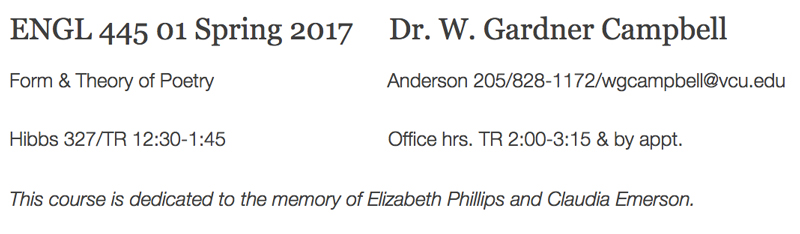
Poetry class dedication

When I got to college, I discovered there was a thing called intellectual history. Part of intellectual history, I also learned, was intellectual lineage: not just idea leading to idea, but thinker leading to thinker. Groups of writers interacting synchronously and asynchronously. Influences, meetings, letters, fallings-out, all of it.

This semester, it occurred to me that I might at least signal to my students that I come from someplace too, intellectually speaking. More precisely, I come from someones. I feel a great cloud of witnesses around me as I teach and as I learn. Those witnesses are intellectual parents, intellectual siblings, and in some cases, even intellectual heirs. These are the people whose work has shaped me, and who have shaped my work. In the most intimate cases, these are people with whom I’ve broken bread. People with whom I’ve fought, and cried. People who’ve believed in me when I didn’t believe in myself, people who’ve encouraged me, people who’ve intervened at key moments. People who are with me as I think and write and teach and learn.

I have always felt that the courses I design and lead, at their best, do not deliver content so much as they mingle souls, as John Donne said letters do. My students sometimes hear a few of my stories, but somehow I wanted to communicate something in a more ceremonial way. So I came up with the idea of putting a dedication on my syllabi. My wish is that students will see how precious our time together may be, and how one day we may find we have changed each other’s lives. I want them to see that courses of study are books, but not just books; assignments, but not just assignments; credit hours, but not just credit hours. I want them to understand that a course of study is more relational than transactional. I want them to understand some of the gratitude I feel.

And I’ll confess it: I want to send a letter of sorts, a communication, perhaps even an eldritch communication in some cases, to the teachers and mentors and colleagues who have sustained me and honored me with their faith and hope and love.

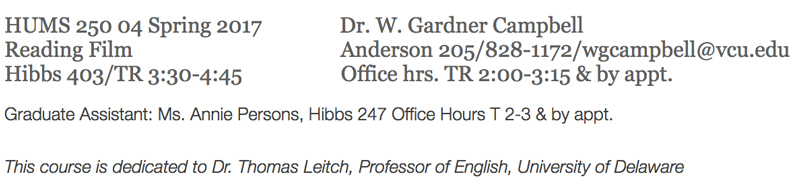
So this semester, my poetry course and my film course both have dedications. The words are small and may well be overlooked, even though I did explain them on the first day of class. In the end, the words may mean little to anyone but me. But I have written them, even as those I honor have helped to write and teach and love me into being. And I am content.

Reading Film course dedication

Open Pedagogy Praxis

This week’s focus for OpenLearning17 has been Open Pedagogy. Co-directors Amy Nelson and Shelli Fowler have provided an engaging array of readings and activities that have inspired some great dialogue (don’t miss today’s Twitter chat at #OpenLearning17). Inspired by all that I’ve been reading this week, I talked with a colleague here in my library about our “Roadmap to Research” course (a face-to-face, 2-credit class) and how we might be able to fold in some open pedagogy praxis. We also need to be thinking about how to move this course into an online environment and the whole OpenLearning17 cMOOC experience is helping me think about what that could look like.

I have been especially inspired by Robin DeRosa’s Extreme Makeover: Pedagogy Edition and am thinking about how we might have students collaboratively create the learning outcomes for the course. I am excited about the possibilities and wish that I were the one teaching it next, but perhaps I can focus on what the course could look like in an online environment while others are teaching the F2F class.

As I said in Wednesday’s Twitter chat, I was never trained to teach (many MLIS programs have “user education” courses, but those are often not required), so I am a clean slate, with no formal training to undo. This lack of training has always seemed a hindrance to me, but after reading Amy’s interview with Shelli about Contemporary Pedagogy at Virginia Tech, I now realize that it might be a gift. I have only habits to break (that’s easy right?).

So Amy and Shelli, thank you for an inspiring week! See you in the Twitter chat.


It’s a Real Thing: Open Pedagogy

About three years ago, I recreated my own domain. I had had a fairly extensive website back in the late 1990s, when Web 1.0 ruled the universe, but when I came to JMU in 2005, I found that faculty overwhelmingly used Blackboard and hid their syllabi and assorted pedagogical aids away from public sight. It has been interesting to watch the shift toward open ed occurring here in the last decade. As more and more faculty, generally the younger ones, experimented more and more with WordPress and Omeka and similar tools, I did, too. And as I added blogging assignments, digital exhibits, and web-based portfolios to my classes, I realized that it was high time to put my own self out there again. How could I ask my students to create their own domains and post their own work under their own names if I was not willing to do the same thing myself?

I admit that I’m still anxious about the kinds of privacy and surveillance issues that Audrey Watters raises in her recent keynote, Ed-tech in a Time of Trump, but that anxiety is now part of my approach to open pedagogy, which I understand to be a real thing, after all:

I love that you’re like ‘I didn’t know there was a name for it.’ There is a name for it, as soon as I pretend there’s a name for it. Open Ped is kind of in a phase where it’s becoming a thing, but it may or may not actually be a thing. I don’t know when you get to say something is a thing. Robin DeRosa

In my Introduction to Public History, students create their own web domains as their semester-long project. I have an undergraduate working with me, Edel Rimando, who is serving this semester as a fellow in the Digital Communication (DigiComm) Center. It’s a sweet deal: she is an effective peer mentor, since she is one of them, and she holds her own consultation hours in addition to leading three (three!) hands’ on workshops in class. The first time I assigned students to create websites I required them to use WordPress, which is my preferred platform, however, I was not comfortable enough with the myriad options to be an effective guide. The second time, I allowed them to choose between WordPress and Wix and Weebly, the drag-and-drop options that DigiComm recommends to first-timers. All of the students in that class chose Wix or Weebly, so this semester, that is what we (Edel and I) went with. I don’t use them and I don’t like them for all the reasons DeRosa notes in her interview, but they are user-friendly, efficient, and get the job done.

20160324_170516753_iOS

Last semester’s Intro to Public History class working on their domain projects.

The students have freedom to design their domains as they want. We discussed professional designs, branding, and so forth. We also discussed some basic ways to protect privacy. Each person has to have a simple resume and a biographical statement that explains what the site’s function will be. Is it merely to fulfill this class’s requirement or will he or she use it to curate excellent work from multiple classes? Many of my students are public history concentrators, so they have required internships for which they have to create a blog, which they can link to their domain. Other students are in the teaching licensure program and create links to lesson plans they have made, while others still are in graphic design and use their domains to showcase their commercial work. I have been amazed at the range of talents and projects that my students showcase on their domains–from photography to music videos to traditional research papers.

To meet the outcomes for public history the students must include two projects specific to this class’s content. The first is an analysis of a city block in downtown Harrisonburg; each student is assigned a section of an historic fire insurance map that documents how a block appeared ca 1960 and then she has to physically walk the block today paying attention to and interpreting changes in the cultural landscape from then to now. Although the students initially produce traditional written essays, they are actually generating content for their individual domains. Transforming that essay, with its written text and digital maps and photographs, into a webpage poses an interesting and instructive challenge that fits the open pedagogy model in the way it employs a learner-driven process and connects to the wider public. The assignment asks them to consider writing for a public audience instead of me, their professor, and to play with design and navigability among other things. By putting their work online they are clearly doing a kind of public history, although they understand that they are not doing digital public history in the sense of inviting the public to participate in the project or comment on their work. The project does not, in other words, involve the community itself, and I can only say “next time” to that criticism.

084

Rear view of Montpelier showing location of historic slave quarter, which is under reconstruction.

A second project that they must complete offers a different challenge. It involves a field trip to Montpelier, the home of James and Dolley Madision, which serves as a case study for many of the different branches of public history we study: historic preservation, historic house museums, exhibit design, virtual tourism,, archaeology. In effect, they choose a particular aspect of public history that appeals to them and they use their visit as an opportunity to explore how that aspect works at an actual historic site. Of course, they must then figure out to present their analyses on their domains. Although they have examples and a rubric, I try not to direct them too much. They need to feel ownership and have agency for the assignment to succeed.

As they build their sites they work with their fellow classmates, not just me and Edel. I requested and got approval to teach in one of JMU’s EPIC classrooms, which has six tables or pods seating six students each. During the regular class meetings, students plug their laptops into the various outlets and take turns projecting their screens to a wall-mounted monitor. As they work through in-class digital exercises and discuss readings, they have been building a sense of community that will serve them in good stead when they present their domains in the final weeks of class. These days have been scheduled well in advance and serve as design charettes. Each student’s URL will be added to a common Google doc so that the entire audience can navigate along with the presenter and provide feedback to be used prior to final submission for grading.

This assignment, well, this entire class isn’t nearly as open as it could be or I’d like it to be. In other classes I have experimented with different open pedagogical practices, baby-stepping my way toward something more radical. I appreciated reading about Robin DeRosa’s extreme makeover: pedagogy edition and seeing her candid acknowledgement of the time it takes to build your network of outsiders who are willing to participate in the students’ open learning experience. I also found it helpful to think about the tension between content transfer and skill development in many courses, especially upper-level ones in the major, as mine is. Content transfer has definitely taken a back seat to community building and students’ self-efficacy. My role is that of facilitator, and despite my worries about the risks (privacy, surveillance, trolls) associated with open learning, I find the whole open pedagogy thing energizing.


Contemporary Pedagogy at VT: A Conversation with Shelli Fowler

Working with the Open Learning cMOOC  (#OpenLearning17) has given me the opportunity to re-connect with one of the most inspirational and talented educators I know. During her long tenure at Virginia Tech Dr. Shelli Fowler developed and taught a graduate course  called “Pedagogical Practices in Contemporary Contexts.”  A jewel in the crown of certificate programs in Transformative Graduate Education and Training the Future Professoriate, Contemporary Pedagogy brings together graduate students from across the university in a seminar devoted to developing a distinct teaching praxis. Shelli designed the course, which is known across campus as “GEDI” (the Graduate Education Development Institute) to help graduate students acquire the diverse and flexible skill sets they need to succeed and lead as teacher/scholar/professionals in the changing landscape of higher education. It works at multiple levels — as a professional development forum for early-career teachers, as an interdisciplinary discussion of the challenges and commonalities of engaging undergraduates at a Research I university, and as a site of critical engagement over the connections between the philosophical underpinnings and practical application of pedagogy (praxis).

When Shelli moved to VCU in the fall of 2015, she asked me to continue offering the class for the graduate school. I was delighted to help, because the course, its creator, and its constituency had terrific reputations. I also welcome any and all opportunities to work with students outside my main area of expertise.  As I’ve learned to teach GEDI over the last few terms I have been inspired by the passion students bring to the linked endeavors of professional development, interdisciplinary dialogue, and critical engagement with pedagogy. I have been invigorated by their talent and willingness to grow and learn from each other.  And above all, I have been mightily impressed with the form and substance of Shelli’s curriculum.  I have tweaked the corners of the reading list, updating a few things here and there. But the only major change I made to was to shift more of the interaction and content creation into the open and into connected spaces. The arc and substance remain Shelli’s.

Busy as she is in her position as interim Dean of University College at Virginia Commonwealth University, Shelli generously agreed to help facilitate this week, and to answer a few questions about the history and design of GEDI.*

*Pronounced like “Jedi” – as in “GEDI’s use the Force to Cultivate Curiosity.” The current course website is here: http://amynelson.net/gedis17/ Find us on Twitter @GEDIVT and #gediVT.

AN: Tell me about the Genesis of GEDI: Where (and when) did you start, and how did you move from concept to implementation? What was your main goal for the course?

SF: GEDI began in the spring of 2003 as a pilot graduate seminar with around 18 students.  I was a new addition to the Learning Technologies division (new TLOS) at Virginia Tech.  The VP of my unit, Dr. Anne Moore met with the new Dean of the Graduate School, Dr. Karen DePauw, to explore how her unit might collaborate with and support the new Dean’s Transformative Graduate Education (TGE) initiative.  The idea of a professional development experience focused on teaching and learning for the 21st century, one that supplemented and moved beyond mentoring at the departmental and college levels, was born.  Because of my work in faculty development and critical pedagogy, I was tapped to create GEDI.  The first couple of semesters it was a small graduate seminar and I worked with the graduate student participants to discover what they knew about teaching and learning, what they wanted to know, and how we could co-create a semester-long seminar experience that provided opportunities to move beyond the still over-utilized ‘stand and deliver’ content-delivery approach that informed their disciplines, both in the experiences as learners and, for those who had done some teaching, in the ways they were expected to teach.  The main goal for GEDI was to create a dynamic, active co-learning environment that continually challenges us to reexamine traditional teaching strategies and explore active, connected, critically engaged co-learning across the disciplines and in a wide range of learning environments–small and large, face-to-face, blended, fully digital.  As such, I really intended from the very beginning to ‘gently disrupt’–a favorite descriptive phrase of mine, the status quo of teaching and learning practices that students suggested were based on ‘we’ve always done it this’ or ‘it’s efficient and easy to assess,’ or ‘just follow the teaching tips on the handout provided.’ Interestingly, the emphasis on (and some might argue epidemic overvaluing of) assessment as the driver for curricular and pedagogical praxis very often leads to over-simplified student learning outcomes and an attempt to standardize assessment in ways that indicate the teaching (and coverage) of material occurred but that fails to gauge student agency and engagement with, or ability to apply and build upon, curricular knowledge.  What was unexpected was how quickly the course grew.  By the third semester, the course had gone through the university-wide approval process and became a three-credit, graded, semester-long graduate seminar, GRAD 5114, and a core requirement of the “Preparing the Future Professoriate” nine-credit graduate certificate.  This is not a GTA workshop or a college teaching: tips and tricks one-credit course that are common at many institutions.  GEDI is a dynamic graduate seminar taught each semester.  Until I left Virginia Tech in May 2015, I worked with approximately 90-100 graduate students each year in the course.  Doing paradigm-busting with GEDI Knights (as they began to call themselves) has been a great experience for me as both a teacher and a learner.  While I love the challenges and opportunities of my new gig at VCU, I miss–and will always miss–the unique TGE program at VT, all of the remarkable GEDIs and the opportunity to work with and learn from our future faculty in that arena.

AN: The syllabus presents a lovely balance between the practical and the theoretical.  We start by talking about the mechanics of connecting online via the website, which makes for an easy segue into the concepts of connected learning and active co-learning, which makes it easy to problematize and interrogate some pretty important and often unexamined assumptions about the significance of what we as faculty “do” in our classes, what traditional assessment modalities do (and don’t do), and even what we mean by “learning.” These meta-level issues become concrete in discussions about authentic and sideways learning, and by examining how different teaching modalities work on the ground. Then students have the opportunity to integrate all of this into a learner-centered syllabus. How did this particular configuration of topics come into being and how did you determine how best to integrate the theoretical and applied components of the course?

SF:  The exploration and development of one’s own teaching praxis is a central focus of GEDI.  A critically engaged Freirean approach requires us to embrace the ways in which our theory must inform our praxis, but also reminds us that our teaching experiences in different contexts must also inform our the theoretical approaches.  The specific sequencing of topics on the GEDI syllabus evolved with input from the graduate students.  The focus on disrupting unexamined status quo practice is a constant current, no matter what activities and co-created deliverables. That requires reflection, of course.  A critically self-reflexive awareness of who one is as a teacher, of how one’s ‘teaching self’ is read and misread, and empowered and/or disempowered, is an important part of the process, too.  That work begins in week one of the seminar and informs the work we do together in the readings and the creation of curricular materials that students do relevant to their current or future teaching.

AN: I’m also struck by how the intensity of the course builds through the first seven weeks (and the syllabus project). The topics from these weeks lay the foundation for heart of the matter —  Inclusive Pedagogy and Paulo Freire’s Critical Pedagogy.  Why are these two topics so important and how do they inform your own teaching praxis?

SF:  While an inclusive praxis informs all we do in GEDI, I discovered from the GEDIs that the most honest, deep-dive, open and vulnerable engagement with the topic of diversity, social justice, equity, inclusive excellence occurred after the community of co-learners had been challenging themselves and each other of less fraught topics.  We become better listeners, more attentive to the cultural differences among us, when we’ve been doing some collective ‘paradigm-busting’ as a learning community.  Rather than begin week one right out of the gate with Freire and inclusive pedagogy–a focus that might unintentionally be (mis)perceived as a prescriptive methodology when a Freirean praxis is intentionally non-prescriptive and essentially an anti-methods pedagogy–GEDIs begin by exploring the broader category of teaching and learning in contemporary U.S. higher education (or K-16 +).  They begin to reflect and interact and support and challenge as they discover or articulate what they think and why in their blogging and as they begin to challenge unexamined assumptions about what teaching should be or what constitutes learning.  In my work, adapting a Freirean pedagogical praxis is essential, regardless of disciplinary field(s) or course content.  The very difficult work for all of us is to invent and (re)invent our praxis so that it is dynamic, rather than static, and stays attentive to equity and access and social justice, domestically and globally.  In the GEDI seminar, we begin that process and intend for it to shift and evolve not just throughout the remainder of our seminar but over the span of our teaching.

AN: After the heavy-hitting weeks devoted to inclusivity and Freire, the momentum again shifts in more practical directions. Once again the “deliverables” (a teaching philosophy statement and Problem-Based-Learning / Case study assignment) find powerful undergirding from meta-level framing at the same time they are shaped by very practical “how to” thought-pieces and flowcharts. How did you develop this part of the course in ways that speak to future faculty in all fields — the engineers and other STEM specialists as well as those of us working in the humanities and social sciences?

SF: One of the things that occurs with the move back to what the GEDIs affectionately refer to as ‘tangibles,’ (items such as those you name above that they will use as they construct, or reenvision, their teaching praxis), is a rethinking of the ways their assignments reify traditional power structures in our learning environments.  In GEDI, the meta-level framing encourages participants to foster collaborative and inclusive learning environments not just via their syllabus redesign, but in their PBL/case study assignments, for example, with the integration of ethical dilemmas that require students to navigate the complexities of systemic inequities as they learn and apply content to become problem-solvers and problem-posers, including in the STEM fields.  I have found that GEDIs in engineering, the sciences, and vet med to be some of the most think-outside-the-box innovators when provided the opportunity to do PBL/case study/ethics curricular design.

AN: The last thing I want to comment on and commend is the way the final module (on ethics in the 21st-Century academy) bring the student back to the notion that we are all in this together. As faculty we face the same challenges and imperatives as our students. We need to commit to learning from and with each other, and to identifying the best ways to make our educational system more humane, ethically oriented, and responsive to a rapidly changing world. Would you like to speak to this?

SF: We are facing similar challenges and imperatives, you’re right.  The final curricular segment in GEDI uses a Parker Palmer article, “A New Professional: The Aims of Education Revisited,” to spark awareness that we as faculty need to foster learning environments that encourage learners’ sense of agency and their understanding that their actions as (future) professionals always have ethical repercussions to which they should attend.  And that is the same for those of us in academe, too.  It is increasingly important in this current moment–how do we best leverage the power of networked co-learners to build and to shape more humane, ethical, equitable, and responsive educational opportunities and non-institution-like institutions of higher ed?  One of my takeaways from working with GEDIs is that it is possible to do this if we value working with and learning from our students.


Open Learning, Digital Citizenship, & Political Citizenship

NOTE: For week three of the #OpenLearning17 cMOOC, I was supposed to read Doug Engelbart, Augmenting Human Intellect: A Conceptual Framework (excerpts online). But I got sidetracked, as I often do, by other readings. Imagine my surprise, however, to find Englebart everywhere I looked.

I’ve been recently thinking about the relationship between open learning, digital citizenship, and political citizenship. At JMU, I’ve been leading efforts to advance the civic engagement of our undergraduates and I’ve been involved in digital humanities work in the College of Arts and Letters. These interests grow out of my training in American Studies and public history, both of which are interdisciplinary endeavors that seek to involve ordinary Americans in shaping a more accurate, more sophisticated understanding of our shared past. In case it isn’t evident, American Studies scholars and public historians alike have been actively engaged online, whether digitizing collections, hosting MOOCs, or blogging about their work. In fact, I was motivated to join the #openlearninghub in part because I wanted to learn from academics doing digital work in other fields. How, I wonder, can we leverage the positive human relationships that many people build online to foster effective participation in the traditional modes of politics that undergird our representative democracy?

swagjimmy

icitizen swag surrounds my James Madison bobblehead. It’s a real-time, digital polling tool that facilitates open communication and collaboration between citizens and their elected leaders to shape the policies that affect their lives. https://icitizen.com/

The specific prompt was Autumm Caines’ blog post on digital citizenship (#digciz), which led me to her website and course syllabus. She argues that higher ed offers an important opportunity to help young people develop a better sense of their rights and responsibilities in digital environments. Her work put me in mind of another essay I was reading at the time, Joseph Kahne, Ellen Middaugh, and Danielle Allen, “Youth, New Media, and the Rise of Participatory Politics,” in From Voice to Influence (2015). All the evidence points to the growing power of digital networks for political organizing. Groups around the world are using new media, mobilizing applications like Twitter and Facebook to create protests as they did so effectively during the Arab Spring and the Women’s Marches. Evidence also indicates that young people are the ones most effectively using their digital networks for more than mere social interaction. They forward weblinks from Huffington Post, create and circulate political memes, like each others’ Instagram images, contribute to polls at icitizen, and sign online petitions at Move.org. Unfortunately, young people are also the most disengaged from traditional political life, even as they constitute the largest single demographic.

To better understand youth activity online (and my own geezer brand of activity, lol), I have turned to the work of Howard Rheingold, the man who seems to have coined the term virtual communities. In particular, his adaptation of the concept of the panopticon to the digital world affirmed my own concerns about corporate surveillance, but his argument for greater mindfulness in Net Smart is even more intriguing. For Rheingold, online networks are not only essential to our private success (and personal empowerment), but the public good. He says, “I believe that learning to live mindfully in cyberculture is as important to us as a civilization as it is vital to you and me as individuals.” (NetSmart, p1)

For me, the common thread for these writers is connected learning. I wasn’t at all surprised to see that Rheingold cited Doug Engelbart, for example, or to find Henry Jenkins’ work on participatory culture in both Rheingold and Allen et al. Caines, similarly, teaches Rheingold in her #digciz course and is co-director of VConnecting, a global initiative that hosts informal virtual meetings between people attending academic conferences and those who can not attend. I confess I’m still trying to figure out how all these individuals and their ideas and their activities intersect, but so far they have inspired me to put together a draft syllabus for a course called Citizenship in the Digital Age. I’ll put details in a future post. For now, though, here are some of the salient bits:

Potential Readings

Foundational documents like the Declaration of Independence, the Constitution, the Bill of Rights, Federalist 10; as well as court cases

American Studies texts like: Crevecoeur, What is an American?; Emerson, The American Scholar;  DuBois

Essays by Danielle Allen, Howard Rheingold

Robert Putnam, Bowling Alone

For several  years now, I’ve had students posting to a common course blog and/or creating their own web domains (Shout out to my fellow Virginians over at University of Mary Washington and the Domain of One’s Own project). So this course also will include social media and new tools associated with “civictech,” such as icitizen and Ballotready and Turbovote.

If you have good ideas for other readings and assignments, please let me know.

Some Keywords: Access, Redlining and Divides

Today is March 8 – International Women’s Day, which is being marked in the US by the #Daywithoutawoman campaign. I’ve struggled to get clarity on my own stance here — I’m especially sensitive to the point that striking is a privilege not everyone enjoys and have settled for the following demonstrations of solidarity: I’m wearing red (glasses), only spending money at my favorite local businesses owned by women, (mostly) staying off social media, reminding the world that we still / will always deserve equal pay and paid family leave, and holding off until tomorrow to post this.

I should also point out that this holiday has deep connections to the Russian Revolution, that women protesting bread shortages in St. Petersburg helped bring on the crisis that toppled the tsar in 1917  (the Bolsheviks implemented calendar reform along with so much else, so the “February Revolution” is now commemorated in March), and that seventy years of Soviet power were not enough to overcome the tyranny of housework, the hegemony of the short-handled broom, or the cultural norms that still tether women to both.

short handled brooms
By Vladimer Shioshvili – it’s all about cleanliness, CC BY-SA 2.0, Link

Moving on to thoughts about yesterday’s Hangout for #Openlearning17:

Maha Bali and Sue Erickson coordinated a rich and diverse discussion of Open Access, which Maha has already written about. (You can also find updates on this and on the week as a whole on the cMOOC hub.) What follows are some not entirely random but far from coherent responses to the hangout:

  1.  On Chris Friend’s overview of the editorial process at Hybrid Pedagogy: I find the (emerging) model of “double open” peer review (using a googledoc) really attractive.  I’m also really encouraged that a journal like Hybrid Pedagogy has managed to do (at least) three really important things in a short time: 1) serve as the incubator and main publishing venue for a new interdisciplinary field; 2) become one of the most prestigious publications in the field; and 3) develop an innovative editorial policy that embodies the main tenets of that field, thus amplifying, fortifying and disseminating them. It’s pretty impressive.
  2. The devil is in the details of Open Access. The premises that contour the details are inflected differently for different audiences (scholars and students) and stakeholders (which include institutions and publishers as well as scholars, students and the public). I keep thinking that discussions of viability and transformation in scholarly publishing have some things in common with discussions of healthcare reform but if I go there now this will not get done today.
    So….
  3. I learned a lot listening to Peter Suber and Frances Bell, and we’ve been annotating Peter’s book this week in hypothes.is. Teaching (mostly) in the open makes it easy to direct students to high value materials on the open web, but mine still need access to proprietary databases.
    My specific frame of reference here is Soviet History, for which there are many openly accessible, legal-to-use, on-line materials. But for students who don’t speak Russian (so, 90+ percent of my undergrads), translations of primary materials are essential and less abundant. Fortunately we have the “Current Digest of the Russian Press,”  Founded by the ACLS and SSRC in 1947, the Current Digest (published weekly)  makes an overview of the news available to the Soviet (now Russian) public accessible to English-speaking audiences. During the Cold War it was a mainstay of information about life in the Soviet Union, and it remains a valuable source.
    The good news is that our library, which had subscribed (intermittently ) to the print edition of the digest acquired a digital subscription a few years ago (Thank you, Newman Library!). The digital version is much easier to use than the print version (because searching), but also quite expensive. There was a significant upfront fee for the “archive” (which is what my students mainly use), plus there’s an annual fee of a couple thousand dollars to keep our subscription current. My students use and cite articles from the Current Digest on their blogs, but of course they are behind a paywall. You have to be logged into the university’s network to access the database. This is the less good news.
  4. Having read and loved Chris Gilliard and Hugh Culik’s article on Digital Red Lining, I wonder if access to materials like the Current Digest might present another inflection of that issue. Chris notes that students become aware of “the line” when they bump up against a paywall as they search for materials.  In my case the students wouldn’t even know the materials were there unless I showed them how to find the database and use it. (The Current Digest is aggregated with other databases we get from the same vendor, so I have to show  students how to navigate the interface so they are search in the right place.) I help them cross the line (pointing out that the library’s subscription to this database makes that possible), but the line then becomes visible in their posts, because they cite articles that readers can’t access unless they also have a subscription.  I don’t know that I think about this. Part of my role as a prof is to filter forward the materials I think will best facilitate learning and spark curiosity. Leaving aside any thoughts I might have about the ethics of the pricing structure for things like the Current Digest, I want my students to know that these things exist and learn how to use them. In their working and intellectual lives going forward, they will be using a range of resources. And they will want to have access to different kinds of information sources. I want them to see the value in paying for a newspaper or magazine subscription, for example. I also want them to be able to afford a newspaper subscription. But at the same time, I want to minimize the obstacles that keep them from reading those things. Especially paywalls. Especially in education.
  5. The kind of red lining Chris addresses speaks to an even greater challenge, and one that we really have to work on if we’re going to transform higher ed in ways that enlighten and democratize rather than creating (more) elites and blurring the boundaries of privilege that protect them.  All libraries are not created equal. As Chris points out, the community college JSTOR is not the same as the JSTOR of the R-1 University.  And students of color and students from economically disadvantaged groups are more likely to be at a community college than at an R-1 University. So it’s hard to make any kind of claim about equal access to library resources – Open Access or otherwise. (And no, I don’t think good, even great Inter-Library loan is sufficient.)
    I tweeted about this during the hangout, but will just note again here, that I was really struck by the resonances between the way digital red-lining works and the historical effects of red-lining that Dale Winling and others have charted in their Mapping Inequality project.
  6. I want to push back against the idea that open access for students means open access textbooks and that it means something different for their teachers. In my field (history, the humanities more broadly), I mainly want us to think about what we mean by “textbooks” (open or otherwise), why we use one (or not), and what the adoption of a “textbook” says about how we think learning happens (or not).
  7. Keywords are multivalent. That’s one of the qualities that makes them keywords.  We started talking about “Fifty Shades of Open” and have already seen how complex the connotations of Open can be even within a particular dimension of Open such as Open Access. So I’m intrigued by the way the ancillary fields are claim and define their Keywords. Two collaboratively authored books are doing this right now:
    The MLA’s curated collection Digital Pedagogy in the Humanities is organized around Keywords, the first one of which is Access. The definition focuses mainly making content accessible and usable to different and diversely-abled audiences. The kinds of ideology and legal underpinnings of what we’ve been talking about this week vis-a-vis Open Access are taken up in the Open section, and elaborated on in the entry on Public.  Meanwhile, Digital Keywords  explicitly invokes Raymond Williams’ classic text to frame a collection of twenty-five salient terms in digital media studies, but neither “open” nor “access” made the cut.* In fact the overlap between the two volumes is pretty limited. The only keywords to appear in both are: archive, community, gaming, hacker/hacking, information, and prototype.
    Strange.
    *Both are, however, in the expanded (200+) keyword index at the back of the book.