Make an Alchemy Propaganda Poster
Tap into the motif of old time poster art; modify an existing one to change it’s meaning.
Make an Alchemy Propaganda Poster
Tap into the motif of old time poster art; modify an existing one to change it’s meaning.
 I couldn’t make it to the Southwest Popular/American Culture Association conference this year so I made this postcard with last year’s photos of Albuquerque. (and this year’s graphic)
Trail Mixes in Vending Machine flickr photo by Pat Guiney shared under a Creative Commons (BY) license
OK, I’m pretty late with this. My day job – workshops to give, roundtables to facilitate, assignments to grade etc. etc. – is running my agenda these days. I am kinda following the readings and listen to all of your blogposts on my one-hour commute, read by … I think the computer voice’s
The powers of the President to protect our country are very substantial and will not be questioned.
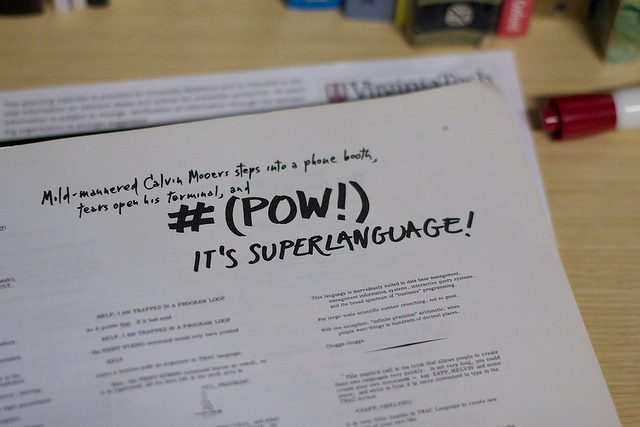
Repost of For the Wholiness of the Human Spirit (2015)
Re-watching Ted Nelson’s eulogy for Doug Engelbart last week reminded me of one of the many (many) reasons Nelson’s thinking about computers and society resonates so powerfully with me. Mourning the loss of one of the most pivotal stars of the new media revolution by indicting his colleagues and making them laugh (nervously), invoking the tropes of classical funeral orations and quotes from Shaw and Shakespeare, and recounting the highlights and tragedies of Engelbart’s career, Nelson’s eulogy is a tour de force in terms of form (technique) and content. He insists, as passionately as he had in 1974, that computers should support our dreams, indeed that technology is an expression of those dreams. And dreams, of course, are as much about the emotions as they are about reason and calculation.
Movies and books, music and even architecture have for all of us been part of important emotional moments. The same is going to happen with the new media. To work at a highly responsive computer display screen, for instance, can be deeply exciting, like flying an airplane through a canyon, or talking to somebody brilliant. This is as it should be…..
In the design of our future media and systems, we should not shrink from this emotional aspect as a legitimate part of our fantic (see p. 317) design. The substratum of technicalities and the mind-bending, gut-slamming effects they produce, are two sides of the same coin; and to understand the one is not necessarily to be alienated from the other.
Thus it is for the Wholiness of the human spirit, that we must design. (NMR, p. 307)
The democratizing, radically-reimagining agenda laid out in Computer Lib / Dream Machines is as relevant today as it was in 1974. In the early seventies, computing was about inscrutable calculations, fiendishly massive quantification, and the expertise of, yep, experts. Nelson summoned every woman to “understand computers,” to engage with them, and to create with them. He insisted (rightly) that we are creatures of culture and of interaction as much (perhaps even more so) as we are creatures of reason and calculation. And he wanted us to use computers to develop a “fantic space” (inspired by Eisenstein’s and Pudovkin’s concept of filmic space) to help us communicate emotionally as well as cognitively:
RESPONSIVE COMPUTER DISPLAY SYSTEMS CAN, SHOULD AND WILL RESTRUCTURE AND LIGHT UP THE MENTAL LIFE OF MANKIND. (NMR, p. 317)
Forty years later, the landscape has changed, but the challenge remains. We carry computers with us all day long, communicate with people downstairs and around the world in the blink of an eye, and can summon nearly all the world’s texts and many of its numbers to our screens with a few key strokes and a good internet connection. I do feel that my mental life has been illuminated and transformed by the innovations Nelson envisioned. But do we understand computers and the networked world in the way that Nelson thought we needed to? Has the Computer Priesthood” been ousted? Or just changed clothes? And what about “Computer Aided Instruction” (CAI, as Nelson calls it)? I look at computerized testing, video taped lectures, the march of MOOCs, the “Learning Management System” industry, and the relentless pressure to scale, standardize, measure and homogenize an experience that should be so much more….and I think we still need to focus instead on using this technology to provide students (and ourselves) with a real education:
Instead of devising elaborate systems permitting the computer or its instructional contents to control the situation, why not permit the student to control the system, show him how to do so intelligently, and make it easy for him to find his way? Discard the sequences, items and conversation, and allow the student to move freely through materials which he may control. Never mind optimizing reinforcement or validating teaching sequence. Motivate the user and let him loose in a wonderful place” (NMR, p. 313).
I want to keep my beacon set on that wonderful place.


For Week Four, Open Learning ’17 features Dr. Ted Nelson, author of Computer Lib/Dream Machines. Click on the image below to watch excerpts from the interview I did with Ted in 2014.
Ted spoke with me as part of the Thought Vectors in Concept Space connectivist MOOC VCU ran in that summer long ago (feels that way, anyhow). That interview ran nearly two hours and is still up on YouTube. For Open Learning ’17, I’ve created this abridged version that runs a more manageable 30 minutes.
Ted’s call for learners to aspire to an “oceanic mind” that draws on multicontextual knowledge aligns well with the goals of liberal learning generally, as well as with the Essential Learning Outcomes of the AAC&U’s LEAP initiative and the Faculty Collaboratives project that Open Learning ’17 is proud to participate in. For best results, I encourage everyone to read the following bits from Computer Lib/Dream Machines as a rich context for understanding Ted’s ideas in the interview.
Counting pages in the downloadable pdf excerpt available at the New Media Reader site, including the introduction:
1-10, 17-19, 26 (explains “fantics”), 30 (“Thinkertoys”)
Throughout his life, Ted Nelson has been provocative, even irascible, but he also burns with the hard, gem-like flame Walter Pater aspired to. Enjoy the tempo presto of his words and ideas as they tumble forth. Remember that Heraclitus is his philosophical guide. Ted’s care for the arts of expression, juxtaposed with Doug Engelbart’s care for the arts of collaboration, continues to inspire readers, writers, and educators worldwide.
This afternoon, the steering committee for #openlearning17, a AACU Faculty Collaboratives Experience, met to discuss what has gone well with the experience thus far and what we can do to improve. Several of us mentioned how thought-provoking and mind-binding the Twitter discussions have been, but others have made a request: specifically, those who have been attending Twitter discussions regularly want a little time to get to know each other.
To that end, let’s carve out a little time.
One of the more interesting things about connecting with people in virtual spaces is the knowledge that they could be doing all sorts of physical things in all sorts of physical places while they are holding that conversation with you. While I take pride in the fact that my online personality is very much the same as my face-to-face personality (maybe a little more confident, but I’m working on that), I’ve hosted Twitter chats from airplanes, airports, the attic, a Lincoln Town Car, a hotel bar (while ducking to avoid a bar brawl), taxis, offices (mine and others), my car, on my phone, in my doctor’s office, at the Hair Cuttery, and on four different continents.
What I’ve come to appreciate over the years is that physical context matters to our online interactions, as much as anything that is going on in our head while we are chatting. And knowing the physical environment of those with whom we chat helps us get to know them. It makes them more real. It makes us more comfortable. Therefore, I propose the following:

That’s my office desk, by the way. I bring my lunch because I prefer simple lunches and don’t like to waste valuable time going out. I buy a large cup of coffee (a splash of milk) as a personal incentive to leave the seat warmer in my car every morning. I love seat warmers. I have to take off my glasses when I read because I’m months away from needing bifocals, and I’m trying to keep a dish garden alive, because one would think that an adult old enough to consider bifocals might be able to maintain a plant. Also, I am building a database and working hard to develop coding schema that make sense and are entirely sustainable (all those papers). I’ve been on the job for a month. It’s not like I’m applying any pressure on myself at all.
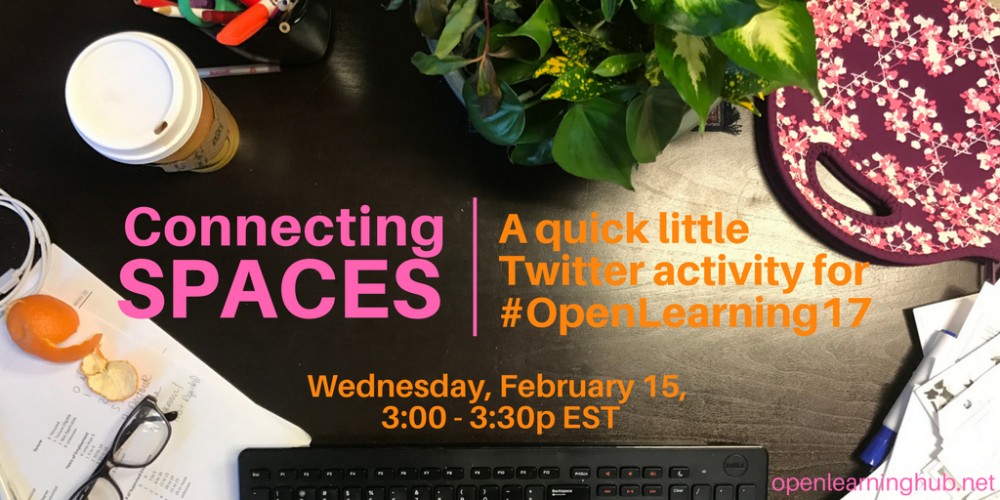
On Wednesday, February 15, 2017 at 3:00pm EST, I will be hosting a quick little Twitter activity called Connecting Spaces. Come. Chat however feels comfortable, but it might be interesting if we share a little about our physical spaces. Where are you? Why are you there? Why or why not do you like to engage in Twitter chats in this space?
Taking a picture of your space, or better yet, a quick video would be a great way to introduce yourself.
Regardless, I hope to see you there.


On Wed of this week, I am running the first of my three series workshop designed to introduced colleagues to the idea of teaching in a digital age. I am looking to make this a co-constructed experience (although, I have a back-up plan in reserve.) I have about 10 people signed up– this is part of … Continue reading Teaching in A Digital Age: A conversation of sorts